

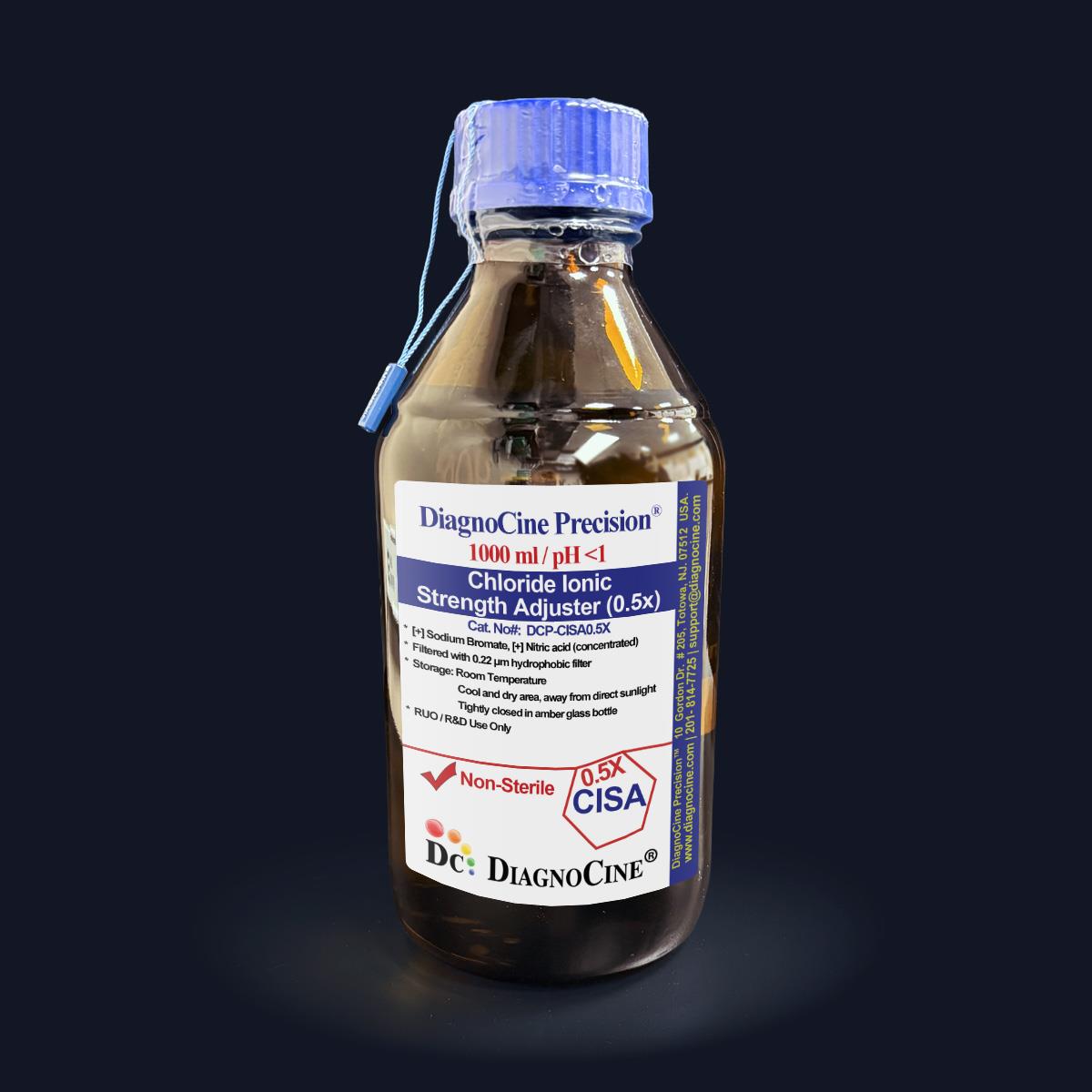
Chloride Ionic Strength Adjuster [0.5X]
Also referenced as Chloride ISAB (Ionic Strength Adjustment Buffer), Chloride ISA, or Chloride Background Electrolyte Solution
A ready-to-use potentiometric reagent engineered to equalize the ionic background of aqueous samples and calibration standards during chloride ion-selective electrode (Cl- ISE) measurements. This 0.5X working-strength formulation requires dilution prior to use. In addition to helping standardize ionic strength, the formulation may help reduce interference from certain anionic species in chloride ISE workflows, depending on R&D sample matrix and method conditions.
- Filtered with a 0.22 µm hydrophobic filter for a clean, low-blank potentiometric reagent.
- 0.5X strength.
- Supports EPA SW-846 Method 9212 and SMEWW 4500-Cl-.
- Sodium bromate / concentrated nitric acid chemistry for AgCl/Ag2S solid-state electrodes.
- CatalogDCP-CISA0.5X
- Size1000 mL
- SterilityNon-Sterile · 0.22 µm hydrophobic
- pH< 1
- StorageCool, dry, dark · amber glass
- Shelf Life18 months (unopened)
- ShippingRoom Temperature
- GradeR&D Use Only
Filtered with a 0.22 µm Hydrophobic Filter
Every lot of Chloride Ionic Strength Adjuster [0.5X] is filtered through a 0.22 µm hydrophobic membrane, delivering a particulate-reduced, low-blank reagent that minimizes extraneous background chloride and supports stable, reproducible electrode response. The product is supplied non-sterile in an amber glass bottle.
Why an Ionic Strength Adjuster Is Required
Chloride ISEs do not measure free ion concentration directly — they respond to thermodynamic ion activity, which is governed by the total ionic composition of the solution. In real-world samples, ionic strength can vary significantly from sample to sample. These differences can shift the activity coefficient of chloride between samples and calibration standards, introducing systematic bias that is not fully addressed by electrode recalibration alone.
Adding a high-concentration ionic strength adjuster to all standards and samples saturates the total ionic background to a uniformly high level, making activity coefficients essentially identical across the entire sample set. This helps create a more consistent ionic background across the measurement set and supports accurate, reproducible chloride potentiometry in chloride ISE workflows, including EPA SW-846 Method 9212 and related laboratory methods.
Formulation & Ingredient Roles
| Ingredient | Role |
|---|---|
| Sodium bromate (NaBrO3) | Strong oxidant used to help suppress iodide, bromide, sulfide, and cyanide interference. |
| Nitric acid (HNO3), concentrated | Acidifies the matrix and helps maintain a stable measurement environment; may also help reduce hydroxide and carbonate effects. |
| Ultrapure Water | Low-background solvent used to minimize extraneous chloride contamination. |
Standard ISA Addition & Measurement
Apply to all solutions uniformly — including the blank, calibration standards (serial decade series: e.g., 1, 10, 100, 1,000 ppm Cl-), and unknown samples. Stir all solutions at a consistent, moderate rate during measurement to maintain a stable liquid junction potential and reproducible electrode response.
Compatible ISE Measurement Workflows
Direct Measurement (Calibration Curve)
Standard approach for routine sample batches with consistent matrix.
Standard Addition
Preferred for complex or variable-matrix samples; minimizes matrix-effect bias.
Analyte Addition (AA) / Sample Addition
Useful when sample volume is limited or electrode behavior is slightly non-Nernstian in the sample matrix.
Uniform Treatment
Treat blank, standards, and samples identically for the most reproducible activity coefficients.
Research Applications
- Stormwater runoff chloride monitoring — road salt (NaCl, CaCl2) contamination studies for R&D.
- Soil extract chloride analysis for agricultural salinity profiling and remediation research.
- Industrial process water and other complex aqueous matrices used in research studies.
- Cell culture media and buffer verification — chloride ion concentration QC for physiological buffer formulation (PBS, HBSS, Ringer's solution, DMEM).
- Tissue extract chloride measurement (animal, plant, fish tissue) following wet-ashing or acid digestion.
- Fermentation and process stream chloride monitoring in research settings.
- Chloride analysis in food and beverage research and formulation studies.
- Cheese, bread dough, fermentation brine, and cured product chloride profiling.
- Establishing linear dynamic range, electrode slope verification, detection limit, and precision/reproducibility for new chloride ISE methods.
- ISE electrode conditioning and stabilization of new or regenerated AgCl/Ag2S sensors prior to analytical runs.
- Proficiency testing and inter-laboratory comparison sample preparation.
- Corrosion science: precise chloride threshold determination for pitting corrosion initiation studies in materials research.
Chloride ISE Methodology & Applications
The peer-reviewed references below (indexed in PubMed) describe the analytical methodology, ionic strength adjustment principles, and sample-preparation context underlying chloride ion-selective electrode measurements. They are provided as background on the technique and its applications and do not report on this specific product.
- Sekerka I, Lechner JF. Ion selective electrode for determination of chloride ion in biological materials, food products, soils and waste water. J Assoc Off Anal Chem. 1978 Nov;61(6):1493–1495. PMID: 730656
- Cerklewski FL, Ridlington JW. Chloride determination in foods with ion-selective electrode after isolation as hydrogen chloride. J Assoc Off Anal Chem. 1987 Sep-Oct;70(5):924–926. PMID: 3680135
- Lindner E, Pendley BD. A tutorial on the application of ion-selective electrode potentiometry: an analytical method with unique qualities, unexplored opportunities and potential pitfalls. Anal Chim Acta. 2013 Jan 31;762:1–13. doi: 10.1016/j.aca.2012.11.022. PMID: 23327940
- Pietrzak K, Morawska K, Malinowski S, Wardak C. Chloride ion-selective electrode with solid-contact based on polyaniline nanofibers and multiwalled carbon nanotubes nanocomposite. Membranes (Basel). 2022 Nov 16;12(11):1150. doi: 10.3390/membranes12111150. PMID: 36422143
Laboratory Personnel Precautions
- Contains concentrated nitric acid and sodium bromate — classified as a corrosive, strongly oxidizing acid solution (UN 1826 / UN 1494 analogue, Oxidizer Class 5.1).
- Handle exclusively in a chemical fume hood; risk of bromine vapor (Br2) generation during dispensing.
- Wear chemical-resistant gloves (nitrile or neoprene), splash-rated safety goggles, and an acid-resistant lab coat.
- Do not use with cyanide-containing samples unless a formal risk assessment and appropriate safety controls are in place.
- Do not store with reducing agents, organic solvents, or flammables.
- Neutralize waste with sodium bicarbonate before disposal per institutional EHS hazardous waste protocols for oxidizing acids.
- Store sealed in the original amber glass bottle; do not freeze; avoid temperatures above 30°C.
Common Questions
Quality & Origin
ISO 13485 & CE
Manufactured under ISO 13485-certified and CE-approved facilities (Suppliers of Diagnocine Precision).
QA & Final Testing
All final packaging, quality assurance, and testing performed at the Diagnocine R&D and Quality Testing Center.
Assembled in the USA
Customization and assembly completed at Diagnocine Precision in Totowa, New Jersey, USA.
For Research and Development (R&D) Use Only. Not intended for diagnostic, clinical, human therapeutic, or veterinary use. This product is manufactured under ISO 13485-certified and CE-approved facilities (Suppliers of Diagnocine Precision). All final packaging, quality assurance, and testing are done at the Diagnocine R&D and Quality Testing Center. All specific customization requests and assembly were accomplished at Diagnocine Precision in Totowa, New Jersey, USA.