Balanced Salt Solutions - Category Selection Guide
Four formulations, one page. Pick the salt solution your workflow needs and go straight to its product page — the composition tables, selection logic, and handling guidance follow below.
| Balanced Salt Solution | Buffering & Cations | Best For | Product Page |
|---|---|---|---|
| Hank's Balanced Salt Solutions | Ambient air · HCO3- low (~4 mM) · Ca2+/Mg2+ with or without | Open-bench rinses, resuspension, transport, dissociation prep (CMF form) | Viewarrow_forward |
| Earle's Balanced Salt Solution | 5% CO2 incubator · HCO3- high (~26 mM) · Ca2+/Mg2+ present | CO2-environment handling, metabolic assays, media base | Viewarrow_forward |
| Tyrode's Balanced Salt Solution | Ambient air · HCO3- moderate · Ca2+/Mg2+ present | Organ/tissue perfusion, GI and cardiac prep, platelet aggregometry | Viewarrow_forward |
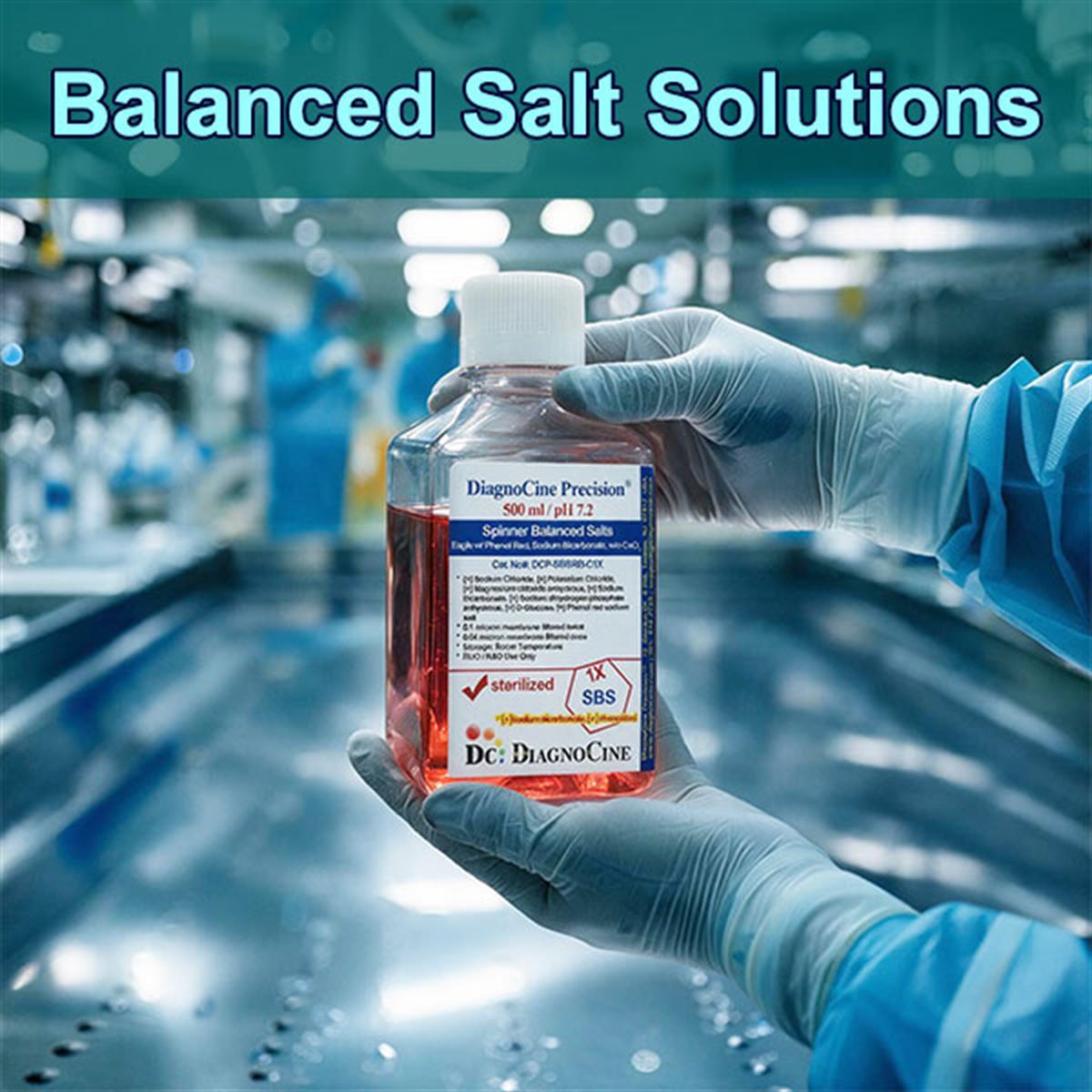
| Spinner Balanced Salts, Eagle w/ Phenol red and Sodium bicarbonate w/o Calcium chloride 1X (Liquid) | 5% CO2 incubator · HCO3- high · Ca2+ omitted | Suspension and spinner-flask culture (prevents clumping) | Viewarrow_forward |
Not sure which one? Compare the selection table and compositions · See applications by solution · Read the FAQ
What a balanced salt solution is — and what it is not
A balanced salt solution (BSS) is a buffered, isotonic salt solution that holds cells and tissues at physiological pH, osmolality, and ionic balance during handling. It is not a growth medium. It carries no amino acids, vitamins, or serum, so it is used for washing, dissociation prep, dilution, transport, dissection, and assay setup, not for proliferation in the incubator.
The parameters that decide which formulation fits a protocol — and the ones a single product name will not tell you.
- Four formulations stocked: Hank's (HBSS), Earle's (EBSS), Tyrode's, and Spinner Balanced Salts (Eagle, Ca2+-free).
- Gas phase drives the EBSS vs HBSS split: EBSS is buffered for 5% CO2; HBSS is buffered for ambient air. Match the solution to the gas phase of the work, not to the cell line.
- Bicarbonate content is the mechanism: EBSS carries high bicarbonate (~26 mM), HBSS low (~4 mM), Tyrode's moderate.
- Divalent cations act as an adhesion switch: Ca2+ and Mg2+ maintain cadherin (cell–cell) and integrin (cell–substrate) adhesion.
- Calcium/magnesium-free (CMF) forms prime cultures for enzymatic dissociation, usually with trypsin and EDTA.
- Spinner salts omit Ca2+ specifically to prevent aggregation in suspension.
- Every formulation carries D-glucose at 1000 mg/L, and all are isotonic and pH-buffered — but none contains amino acids, vitamins, or serum.
- Phenol red is not inert: it has weak estrogenic activity and overlaps common fluorescence channels.
- EBSS bicarbonate2200 mg/L (~26 mM)
- HBSS bicarbonate350 mg/L (~4 mM)
- Tyrode's bicarbonate1000 mg/L (moderate)
- D-Glucose (EBSS / HBSS / Tyrode's)1000 / 1000 / 1000
- NaCl (EBSS / HBSS / Tyrode's)6800 / 8000 / 8000
- KCl (EBSS / HBSS / Tyrode's)400 / 400 / 200
- CaCl2 anhyd. (EBSS / HBSS / Tyrode's)200 / 140 / 200
- MgSO4 anhyd. (EBSS / HBSS)98 / 98
- MgCl2 anhyd. (HBSS / Tyrode's)48 / 100
- HEPES supplement range10 to 25 mM
Two decisions determine your choice
Gas phase and divalent cations. Get either one wrong and the solution works against the protocol — drifting pH in one direction, or holding cells together when you need them apart.
Gas phase drives the EBSS vs HBSS split
EBSS is buffered for 5% CO2; on the open bench it outgasses CO2 within minutes and drifts alkaline. HBSS is buffered for ambient air; in a CO2 incubator it over-acidifies. Match the solution to the gas phase of the work, not to the cell line.
CO2-independent buffering on the bench
Need CO2-independent buffering on the bench? Add HEPES at 10 to 25 mM — but note it can be phototoxic under light and cytotoxic at higher concentrations.
Divalent cations act as an adhesion switch
Ca2+ and Mg2+ maintain cadherin (cell–cell) and integrin (cell–substrate) adhesion. Keep them when adhesion, spreading, or junction integrity must be preserved.
Remove them to dissociate
Remove Ca2+ and Mg2+ (calcium/magnesium-free, CMF) to prime cultures for enzymatic dissociation, usually with trypsin and EDTA. Rule of thumb: cells staying attached, keep Ca2+/Mg2+; cells being detached, remove both.
Suspension work omits calcium
Spinner salts omit Ca2+ specifically to prevent aggregation in suspension, which is why the Eagle spinner formulation is supplied without calcium chloride for suspension and spinner-flask culture.
Phenol red is not inert
It has weak estrogenic activity[1] and overlaps common fluorescence channels. Use phenol-red-free BSS for imaging, flow, and hormone-response assays.
The mistake that costs a plate
Choosing the solution by cell line instead of by gas phase. The two workhorses differ roughly six-fold in bicarbonate: EBSS is built for the 5% CO2 incubator, HBSS for the open bench. Used in the wrong atmosphere, EBSS drifts alkaline within minutes of leaving the incubator and HBSS over-acidifies inside it.
How the named salt solutions became standard
Each formulation on this page carries the name of the laboratory that published it, and each reference below explains a parameter you still specify when ordering. This chronology is built from the source's own reference list.
-
1
1943 Earle — the CO2-buffered salt base
Earle WR, Production of malignancy in vitro. IV. The mouse fibroblast cultures and changes seen in the living cells. J Natl Cancer Inst 4:165–212. The salt solution described in this line of work is the one still supplied as Earle's Balanced Salt Solution (EBSS), buffered with high bicarbonate for a 5% CO2 environment.
-
2
1949 Hanks & Wallace — the ambient-air salt base
Hanks JH, Wallace RE, Relation of oxygen and temperature in the preservation of tissues by refrigeration. Proc Soc Exp Biol Med 71:196–200. The low-bicarbonate solution from this work is supplied today as Hanks' Balanced Salt Solution (HBSS), buffered for work on the open bench.
-
3
1970 Waymouth — osmolality becomes a specification
Waymouth C, Osmolality of mammalian blood and of media for culture of mammalian cells. In Vitro 6:109–127. Isotonicity stopped being an assumption and became a measured, matched parameter — one of the three things a BSS is required to hold, alongside physiological pH and ionic balance.
-
4
1986 Berthois et al. — phenol red is not inert
Berthois Y, Katzenellenbogen JA, Katzenellenbogen BS, Phenol red in tissue culture media is a weak estrogen. PNAS 83:2496–2500. The pH indicator itself turned out to be biologically active, which is why phenol-red-free formats exist for imaging, flow, and hormone-response work.
-
5
2015 Freshney — consolidated bench practice
Freshney RI, Culture of Animal Cells, 7th ed., Wiley-Blackwell. The selection logic on this page — gas phase, divalent cations, warming, pH confirmation — is the practice codified in the standard manual.
Selecting a BSS, and what is actually in it
The first table is the selection matrix; the second gives representative composition in mg/L. Use them together — buffering decides where the solution can be used, composition decides what it will do to the cells.
| Solution | Buffered for | Bicarbonate | Ca2+ / Mg2+ | Glucose | Best for |
|---|---|---|---|---|---|
| Earle's (EBSS) | 5% CO2 incubator | High (~26 mM) | Present | Yes | CO2-environment handling, metabolic assays, media base |
| Hanks' (HBSS) | Ambient air | Low (~4 mM) | With or without | Yes | Open-bench rinses, resuspension, transport, dissociation prep (CMF form) |
| Tyrode's | Ambient air | Moderate | Present | Yes | Organ/tissue perfusion, GI and cardiac prep, platelet aggregometry |
| Spinner salts (Eagle) | 5% CO2 incubator | High | Ca2+ omitted | Yes | Suspension and spinner-flask culture (prevents clumping) |
| Dulbecco's PBS (DPBS)* | Ambient air | None (phosphate) | With or without | Optional | General washing and rinsing; CMF form for dissociation |
*DPBS is phosphate-buffered rather than a true bicarbonate BSS, but it is used interchangeably for many wash steps.
| Component | EBSS | HBSS | Tyrode's |
|---|---|---|---|
| NaCl | 6800 | 8000 | 8000 |
| KCl | 400 | 400 | 200 |
| CaCl2 (anhyd.) | 200 | 140 | 200 |
| MgSO4 (anhyd.) | 98 | 98 | — |
| MgCl2 (anhyd.) | — | 48 | 100 |
| NaHCO3 | 2200 | 350 | 1000 |
| Na phosphate (mono/dibasic) | 122 | 48 + 60 | 50 |
| D-Glucose | 1000 | 1000 | 1000 |
| Phenol red | 10 | 11 | — |
Which solution for which bench workflow
Select a formulation to see the workflows it is intended to support.
- Open-bench rinses
- Resuspension
- Transport
- Dissociation prep (CMF form)
- Rinsing serum before trypsinization (CMF HBSS — serum inhibits trypsin, so clear it first)
- Priming cells for dissociation (CMF HBSS + EDTA)
- Flow cytometry / live-cell imaging buffer base (phenol-red-free HBSS)
- CO2-environment handling
- Metabolic assays
- Media base
- Washing cells inside a CO2 workflow
- Organ/tissue perfusion
- GI and cardiac prep
- Platelet aggregometry
- Suspension and spinner-flask culture (prevents clumping)
- Suspension / spinner scale-up
- General washing and rinsing
- CMF form for dissociation
- Rinsing serum before trypsinization (CMF DPBS)
- Priming cells for dissociation (CMF DPBS + EDTA)
- Flow cytometry / live-cell imaging buffer base (phenol-red-free DPBS)
Quick reference: the task decides the solution
The bench-level version of the two decisions above — read from the task you are performing.
| Task | Recommended BSS |
|---|---|
| Rinse serum before trypsinization | CMF HBSS or CMF DPBS (serum inhibits trypsin, so clear it first) |
| Wash cells inside a CO2 workflow | EBSS |
| Open-bench rinse or resuspension | HBSS |
| Prime cells for dissociation | CMF HBSS or CMF DPBS + EDTA |
| Suspension/spinner scale-up | Eagle spinner salts (Ca2+-free) |
| Organ perfusion, platelet work | Tyrode's |
| Flow cytometry / live-cell imaging buffer base | Phenol-red-free HBSS or DPBS |
| Drug, hormone, or dye dilution carrier | Any isotonic BSS matched to gas phase |
Frequently asked questions
The questions that come up most often when a purchasing spec meets a bench protocol.
Supporting literature
The published sources behind the selection logic, the compositions, and the handling notes above.
- Berthois Y, Katzenellenbogen JA, Katzenellenbogen BS (1986). Phenol red in tissue culture media is a weak estrogen. PNAS 83:2496–2500.
- Earle WR (1943). Production of malignancy in vitro. IV. The mouse fibroblast cultures and changes seen in the living cells. J Natl Cancer Inst 4:165–212.
- Hanks JH, Wallace RE (1949). Relation of oxygen and temperature in the preservation of tissues by refrigeration. Proc Soc Exp Biol Med 71:196–200.
- Waymouth C (1970). Osmolality of mammalian blood and of media for culture of mammalian cells. In Vitro 6:109–127.
- Freshney RI (2015). Culture of Animal Cells, 7th ed. Wiley-Blackwell.