

- Home
- Spinner Balanced Salts, Eagle w/ Phenol red and Sodium bicarbonate w/o Calcium chloride 1X (Liquid)

Spinner Balanced Salts, Eagle w/ Phenol red and Sodium bicarbonate w/o Calcium chloride 1X (Liquid)
FluxMPS™ Spinner Balanced Salts, Eagle w/ Phenol red and Sodium bicarbonate w/o Calcium chloride 1X (Liquid)
An MPS-grade, calcium-free balanced salt buffer engineered for suspension and spinner-flask cell culture. Formulated without calcium chloride (CaCl2) to prevent cell clumping and adhesion, it delivers a precise, stable pH of 7.2 for hybridoma, HeLa-derivative, and other suspension-adapted lines. Manufactured with Ultrapure Type 1 water and finished through a quadruple-stage 0.1 µm and 0.04 µm membrane process for microchannel-safe, ultra-low particulate purity.
- Quadruple-stage filtration: 0.1 µm membrane filtration twice and 0.04 µm membrane filtration twice
- Endotoxin controlled to NMT 1 EU/mL
- Buffered to pH 7.2 with sodium bicarbonate and sodium dihydrogen phosphate
- Manufactured with Ultrapure Type 1 water (18.2 MΩ·cm)
- Formulated without calcium chloride (CaCl2) for suspension-adapted cell lines
- Microchannel-safe for organ-on-a-chip and microfluidic perfusion workflows
- Customizable pH, molarity, and additive content available on request
- pH7.2
- Osmolality270.00 - 310.00 mOsm/kg H2O
- EndotoxinNMT 1 EU/mL
- SterilityNo growth after 14 days (USP)
- Filtration0.1 µm x2 + 0.04 µm x2
- AppearanceRed colored, clear solution
- Format1X Liquid
- Storage15-30°C, protect from light
- Shelf Life24 months
- Size500 mL
Engineered where standard buffers fail
Conventional 0.22 µm-filtered buffers can carry subvisible particulates that accumulate in microchannels, drift in pH and ionic composition, and introduce assay background. FluxMPS™ buffers are built to remove those failure modes at the source.
Microchannel-safe purity
Sequential 0.1 µm and 0.04 µm membrane filtration, each applied twice, minimizes particulate load for narrow microfluidic channels and sensitive perfusion systems.
Precise, stable pH
Buffered to pH 7.2 using sodium bicarbonate and sodium dihydrogen phosphate for consistent, reproducible pH across lots.
Ultrapure-grade water
Manufactured with Ultrapure Type 1 water (18.2 MΩ·cm) meeting USP <85> expectations for reagent water quality.
Low background for imaging & assays
A defined, reproducible ionic composition supports consistent optical and colorimetric readouts, including phenol red-based pH monitoring.
Defined, traceable composition
Every component is CAS-traceable and lot-released, with controlled ionic strength appropriate for suspension culture.
Customization on demand
pH, molarity, salt composition, and additive content can be modified to match your protocol — contact support@diagnocine.com.
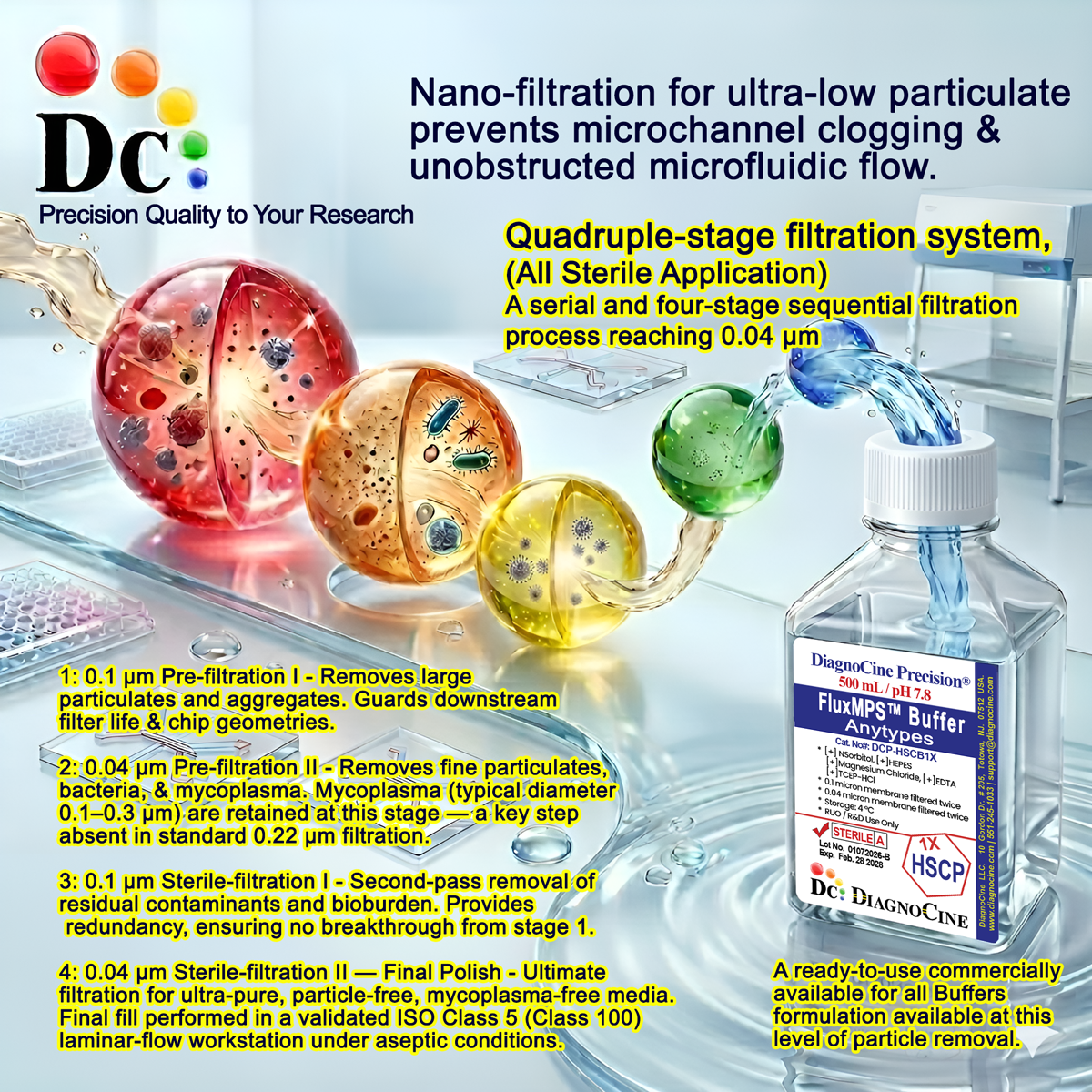
Quadruple-stage filtration system
This buffer is filtered through 0.1 µm membrane filtration twice and 0.04 µm membrane filtration twice, a four-stage sequence designed to remove particulates and bioburden ahead of aseptic fill.
-
1
0.1 µm Pre-filtration I
First pass through a 0.1 µm membrane removes large particulates and aggregates, extending downstream filter life.
-
2
0.04 µm Pre-filtration II
First pass through a 0.04 µm membrane retains fine particulates and bioburden, including organisms in the mycoplasma size range (approximately 0.2 µm).
-
3
0.1 µm Sterile-filtration I
Second 0.1 µm pass provides redundant particulate reduction ahead of final polish.
-
4
0.04 µm Sterile-filtration II — Final Polish
Second 0.04 µm pass delivers the final polish under ISO Class 5 (Class 100) aseptic fill conditions.
Performance vs. conventional buffer
Sequential 0.1 µm and 0.04 µm filtration, each applied twice, removes finer particulates than a single 0.22 µm pass, which supports microchannel-safe use in organ-on-a-chip and microfluidic systems.
© Diagnocine® — DCP-SBSRB-C1X
Where this buffer performs
Formulated without calcium chloride to prevent cell clumping and adhesion, this balanced salt solution is built for suspension-adapted culture, spinner-flask workflows, and downstream microfluidic and organ-on-a-chip use.
Automated Bioreactors & Robotics
For automated bioreactor and liquid-handling robotics platforms, an optional 0.01 µm (10 nm) ultra-filtered variant of this buffer is available to further protect sensitive valves, sensors, and tubing.
- Total Particulate Exclusion for sub-micron sensitive flow paths
- Valve & Sensor Protection in automated perfusion systems
- Extended Perfusion Stability across long-duration runs
Inquiry Required: the 0.01 µm (10 nm) ultra-filtered grade is produced to order — contact support@diagnocine.com to discuss your platform requirements.
Micro Physiological System (MPS) & Chip
Compatible with microfluidic perfusion loops and chip-based culture platforms.
Wash, Dilution & Reconstitution
Defined ionic strength suited to rinse, dilution, and reconstitution steps.
iPSC-Derived Model Handling
Suitable for balanced-salt handling steps in iPSC-derived model workflows.
Endothelial & Primary Cell Perfusion
Calcium-free formulation supports perfusion protocols requiring reduced calcium background.
ELISA, Blotting & Blocking
Low-particulate formulation supports clean assay backgrounds.
Microscopy & Optical Sensing
Phenol red-based visual pH monitoring supports routine culture inspection alongside optical assays.
Specification summary
Values below reflect this product as manufactured and quality-released by DiagnoCine Precision.
| Parameter | Specification |
|---|---|
| Formulation / Composition | Balanced salt solution with sodium bicarbonate, without calcium chloride (CaCl2) |
| Appearance | Red colored, clear solution |
| pH (USP <791>)USP | 7.2 |
| Osmolality (USP <785>)USP | 270.00 - 310.00 mOsm/kg H2O |
| Parameter | Specification |
|---|---|
| Endotoxin (USP <85> BET)USP | NMT 1 EU/mL |
| Sterility (USP <71>)USP | No bacterial or fungal growth after 14 days of incubation |
| Toxicity Test | Passes |
| Water Purity | Ultrapure Type 1 water (18.2 MΩ·cm) |
| Manufacturing StandardISO | ISO 13485-certified, CE-approved facilities |
| Fill EnvironmentISO | ISO Class 5 (Class 100) |
| Parameter | Specification |
|---|---|
| Storage Temperature | 15-30°C, away from bright light |
| Shelf Life | 24 months |
| Expiry | Use before expiry date on product label |
| Parameter | Specification |
|---|---|
| Component Traceability | CAS-numbered, lot-released components |
| Manufacturing QMSISO | ISO 13485:2016 |
| Regulatory Alignment | CE-approved manufacturing facilities |
| Production & Customization Site | DiagnoCine Precision, Totowa, New Jersey, USA |
| Intended Use | For Research Use Only (RUO) |
Full composition (mg/L)
Every component below is lot-released and quality-controlled; category groupings are preserved exactly as provided by the manufacturer.
| Component | CAS Number | Concentration |
|---|---|---|
| Magnesium sulfate anhydrous | 7487-88-9 | 100.00 mg/L |
| Potassium chloride | 7447-40-7 | 400.000 mg/L |
| Sodium bicarbonate | 144-55-8 | 2200.000 mg/L |
| Sodium chloride | 7647-14-5 | 6800.000 mg/L |
| Sodium dihydrogen phosphate anhydrous | 7558-80-7 | 1220.000 mg/L |
| Component | CAS Number | Concentration |
|---|---|---|
| D-Glucose | 50-99-7 | 1000.000 mg/L |
| Phenol red sodium salt | 34487-61-1 | 11.000 mg/L |
Manufacturing & compliance
Produced under a controlled quality system with traceable release testing at every stage.
ISO 13485:2016 QMS
Manufactured under an ISO 13485-certified, CE-approved quality management system.
Ultrapure Type 1 Water
Formulated with 18.2 MΩ·cm Type 1 water.
ISO Class 5 Fill & Finish
Final fill performed under ISO Class 5 (Class 100) conditions.
Micro-Batch Precision
All final packaging, quality assurance, and testing are completed at the DiagnoCine R&D and Quality Testing Center.
Endotoxin — USP <85> BET
Controlled to NMT 1 EU/mL.
Particulate — USP <788> Method 2
Release testing follows USP <788> Method 2 protocols.
Osmolality — USP <785>
270.00 - 310.00 mOsm/kg H2O.
Documentation / CoA
Lot-specific Certificate of Analysis available on request.
How DCP-SBSRB-C1X compares
A side-by-side view against conventional buffer preparations.
| Parameter | DCP-SBSRB-C1X (FluxMPS™) | Conventional Buffer (0.22 µm filtered) | Standard Alternative (0.22 µm filtered) |
|---|---|---|---|
| Calcium-free suspension formulation | check_circle | cancel | cancel |
| Final filtration pore size | 0.04 µm | 0.22 µm | 0.22 µm |
| Number of filtration stages | 4 | 1 | 1 |
| Endotoxin specification | NMT 1 EU/mL | cancel | cancel |
| USP particulate compliance | check_circle | cancel | cancel |
| Ultrapure Type 1 water | check_circle | cancel | cancel |
| ISO 13485-certified manufacturing | check_circle | cancel | cancel |
| Microfluidic channel compatibility | check_circle | cancel | cancel |
| Custom formulation on request | check_circle | cancel | cancel |
Frequently asked questions
Answers to common questions about DCP-SBSRB-C1X.
Supporting literature
Curated literature relevant to balanced salt buffers, suspension culture, and microfluidic applications.
- Ingber DE. Reverse engineering human pathophysiology with organs-on-chips. Cell. 2016. doi:10.1016/j.cell.2016.05.048
- Huh D, et al. Reconstituting organ-level lung functions on a chip. Science. 2010. doi:10.1126/science.1188302
- Bhatia SN, Ingber DE. Microfluidic organs-on-chips. Nat Biotechnol. 2014. doi:10.1038/nbt.2989
- Whitesides GM. The origins and the future of microfluidics. Nature. 2006. doi:10.1038/nature05058
- Croughan MS, Hamel JF, Wang DI. Hydrodynamic effects on animal cells grown in microcarrier cultures. Biotechnol Bioeng. 1987. doi:10.1002/bit.260331211
- Sart S, Errachid A, Schneider YJ, Agathos SN. Engineering stem cell fate with biochemical and biomechanical properties of microcarriers. Biotechnol Prog. 2013. doi:10.1002/btpr.1710
- Uphoff CC, Drexler HG. Detection of mycoplasma contamination in cell cultures. Methods Mol Biol. 2011. doi:10.1007/978-1-61779-108-6_1
- van Meer BJ, et al. Small molecule absorption by PDMS in the context of drug response bioassays. Biochem Biophys Res Commun. 2017. doi:10.1016/j.bbrc.2016.11.062
- Merten OW. Advances in cell culture: anchorage dependence. Philos Trans R Soc Lond B Biol Sci. 2015. doi:10.1098/rstb.2014.0040
- Kim JY, Kim YG, Lee GM. CHO cells in biopharmaceutical production. Appl Microbiol Biotechnol. 2012. doi:10.1007/s00253-011-3758-5