Anti-Rpn12 (S.cerevisiae) antibody, affinity purified
Anti-Rpn12 (S.cerevisiae) antibody, affinity purified
DiagnoCine offers excellent RPN (5, 7, 9, 12) | Affinity Purified Antibodies from S.cerevisiae to researchers studying Ubiquitination, Proteosome, DNA repair, Signal transduction, Apoptosis, Metabolic Regulation, Damaged & Misfolded Proteins, and Cell Cycle Regulation.
Human diseases include Neurodegenerative Diseases, Cardiovascular Diseases, Inflammatory Responses, Autoimmune Diseases, Systemic DNA Damage responses leading to Alzheimer's Disease, Parkinson's Disease, Pick's Disease, Amyotrophic Lateral Sclerosis (ALS), Huntington's Disease, Creutzfeldt–Jakob Disease, Muscular Dystrophies, and Several Rare forms of Neurodegenerative Diseases associated with Dementia.
RPN antibodies have excellent quality and this highly pure antibody can be adapted for Western blotting, Immunoprecipitation, and other methods after optimization.
General Information
| Cat. No. | :FNK-62-209 |
| Size | :50µl |
| Host Animal | :Rabbit |
| Reactivity | :S.cerevisiae Rpn12, not tested with other species |
| Label | :Unlabeled |
| Product | :Rabbit polyclonal antibody affinity purified |
| Immunogen | :Recombinant yeast Rpn12 expressed in E. coli |
| Application |
|
| Storage | :Sent at 4℃ or -20℃ and upon arrival, centrifuge down Briefly and store at -20℃ |
| Form | :Affinity purified IgG in PBS, 1 mg/ml BSA, 0.09 % sodium azide, 50% glycerol |
| Data Link | :SGD RPN12/YFR052W |
Description
The 26 S proteasome is a protein complex with a molecular mass of 2,000 kDa. It is essential not only for eliminating damaged or misfolded proteins but also for degrading short-lived regulatory proteins involved in cell cycle regulation, DNA repair, signal transduction, apoptosis, and metabolic regulation (ref.1). The 26S proteasome is composed of the 20S core particle (CP) and the 19S regulatory particle (RP). The RP is further subdivided into lid and base sub-complexes. Rpn12 is one of the non-ATPase subunits of the lid. Rpn12 interacts with an ATPase subunit, Rpt1, of the base. Rpn12, Rpt1 double mutant becomes lethal, suggesting a strong interaction between Rpn12 and Rpt1. In the double mutant cells, the function of the 26S proteasome is completely eliminated.
 |
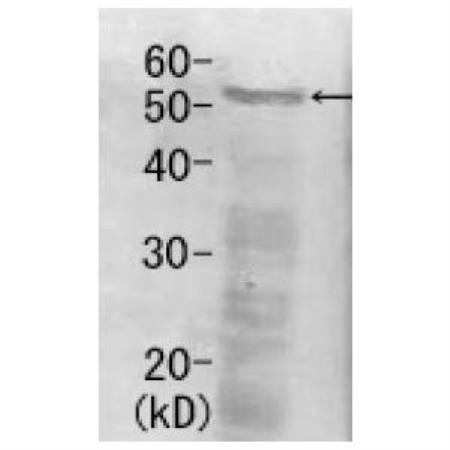
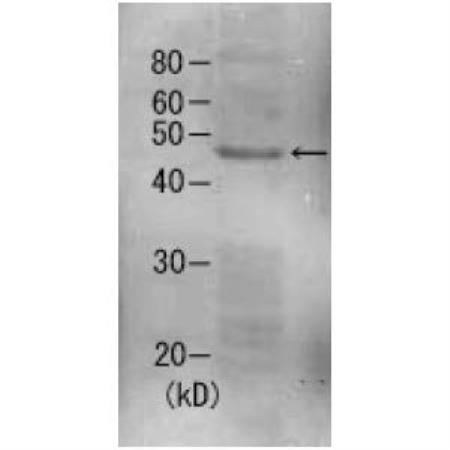
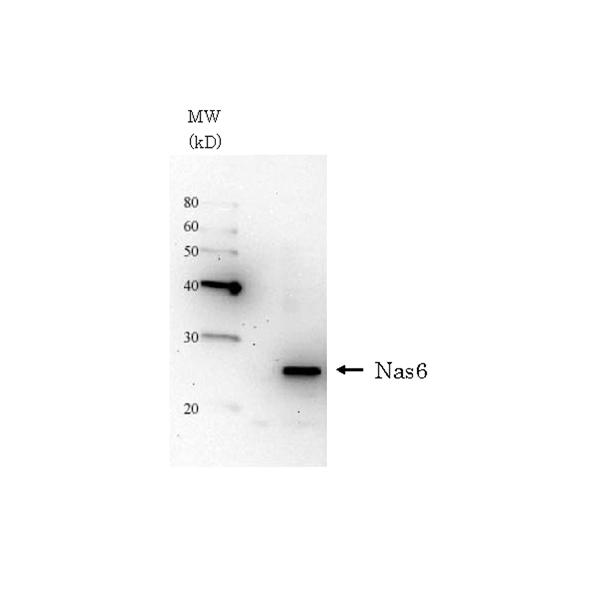
Fig.1 Detection of Rpn12 (32kD) in the crude extract of S.cerevisiae by Western blotting using this antibody. |
References
- Hershko A and Ciechanover A “THE UBIQUITIN SYSTEM.” Annu. Rev. Biochem. 67, 425-479 (1998) PMID: 9759494
- Takeuchi J and Toh-e A “Genetic evidence for interaction between components of the yeast 26S proteasome: combination of a mutation in RPN12 (a lid component gene) with mutations in RPT1 (an ATPase gene) causes synthetic lethality.” Mol Gen Genet 262:145-153 (1999) PMID: 10503546
- Tone Y et al “Nob1p, a new essential protein, associates with the 26S proteasome of growing saccharomyces cerevisiae cells.” Gene 243: 37-45 (2000) PMID: 10675611
Aliases for NOB1 Gene
- NIN1 (RPN12) Binding Protein 1 Homolog 2 3 5
- NOB1P 2 3 4
- Phosphorylation Regulatory Protein HP-10 3 4
- NIN1/PSMD8 Binding Protein 1 Homolog 2 3
- RNA-Binding Protein NOB1 3 4
- Nin One Binding Protein 2 3
- PSMD8 Binding Protein 1 2 3
- Protein ART-4 3 4
- PSMD8BP1 3 4
- MST158 2 3
- ART-4 2 3
- NIN1/RPN12 Binding Protein 1 Homolog (S. Cerevisiae) 2
- Adenocarcinoma Antigen Recognized By T Lymphocytes 4 3
- EC 3.1.-.- 4
- MSTP158 3
- NOB1 5
- ART4 4