


ALP-labelled MAD Reagent
Product#: FNK-BCL-MP-001
$1,415.98
Availability:
Ships in 1-2 Weeks
ALP-labelled MAD Reagent
Cat. No.: FNK-BCL-MP-001
Size: 100μg
Storage: -20℃
Introduction:
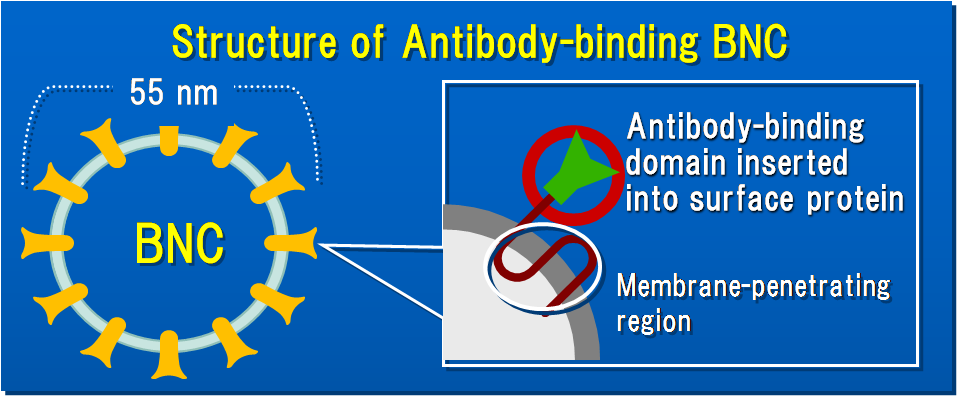
The BNC is a nano-sized (55 nm) particle consisted of about 100 proteins displaying antibody binding sites. The particle labelled with molecules for signal generation (such as HRP and Fluorescent dyes) is referred to as the MAD (Multi Antibody Detection) reagent. The representative of the MAD reagent is HRP-labelled at about 100 HRP molecules per particle. The MAD reagent binds to antibodies at high affinity, and can be used for various immunoassys as high sensitivity.
Principle:
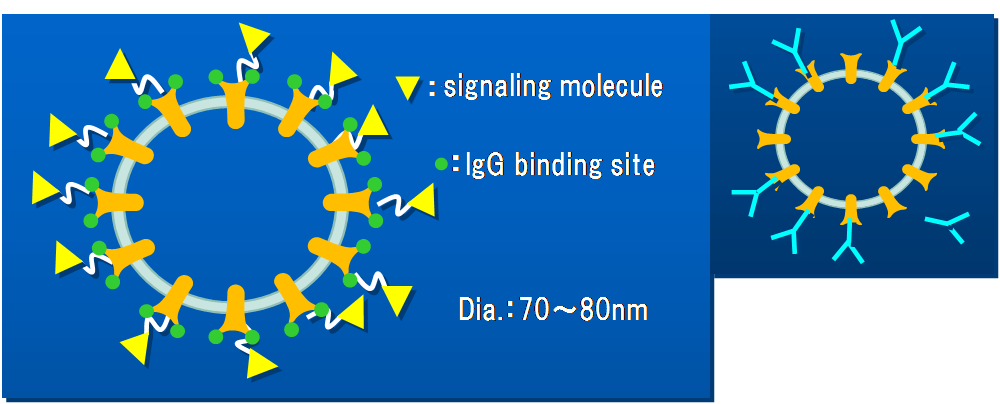
Antibody-binding BNC has 200 to 400 antibody-binding sites per particle depending on the type. The antibody binding site originates from the biding domain of antibody-binding protein, protein A and/or protein G. Because antibodies bind to these binding sites through their Fc region, the antigen binding ability of them is little affected by the binding. When BNC and IgG are mixed, they form a complex which displays many Fab domains outside as shown in the right figure. The MAD reagent is antibody-binding BNC labeled with molecules for signal generation, such as HRP and fluorescent dye. For example, HRP-labelled MAD reagent is composed of antibody-binding BNC which is labeled about 100 HRP molecules per particle, providing highly sensitive antibody detection.
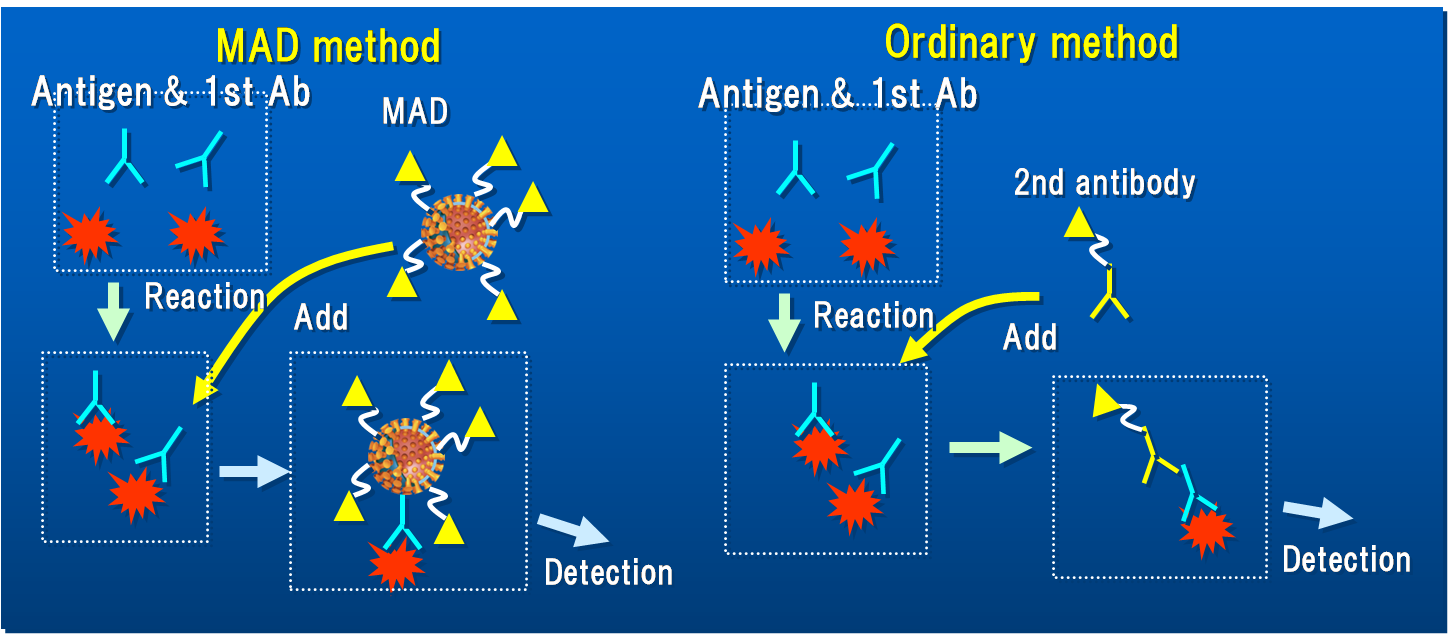
As seen in the below figures, in ordinary method, antibodies bound to antigen is detected by 2nd antibody, such as HRP-labelled antibody. In the MAD method, the antibodies are detected by the MAD reagent. Because the MAD reagent has much more antibody-binding sites (more than 100-fold) and is labelled with much more HRP (at least 50-fold more) than the 2nd antibody, the MAD reagent works as a more sensitive antibody sensor than 2nd antibodies. Furthermore, the MAD reagent provides a one-step antigen detector by using the MAD-antibody complex.
The product is BNC-ZZ labeled with 20 ALP (alkaline phosphatase) molecules per particle. It can be used as the substitute of 2nd antibody in Western blot, antibody-detecting ELISA , and antigen-detecting ELISA using direct method.
Uses
| Western blot | Sensitivity increase (further increased by simultaneous use with 2nd antibody) |
| Simple reprobing | |
| Simultaneous detection of multi proteins | |
| Rapid detection using one-step method | |
| Antibody detecting ELISA | Sensitivity increase (much increase by simultaneous use with 2nd antibody) |
| Simultaneous detection of multi antigens | |
| Rapid detection using one-step method |