

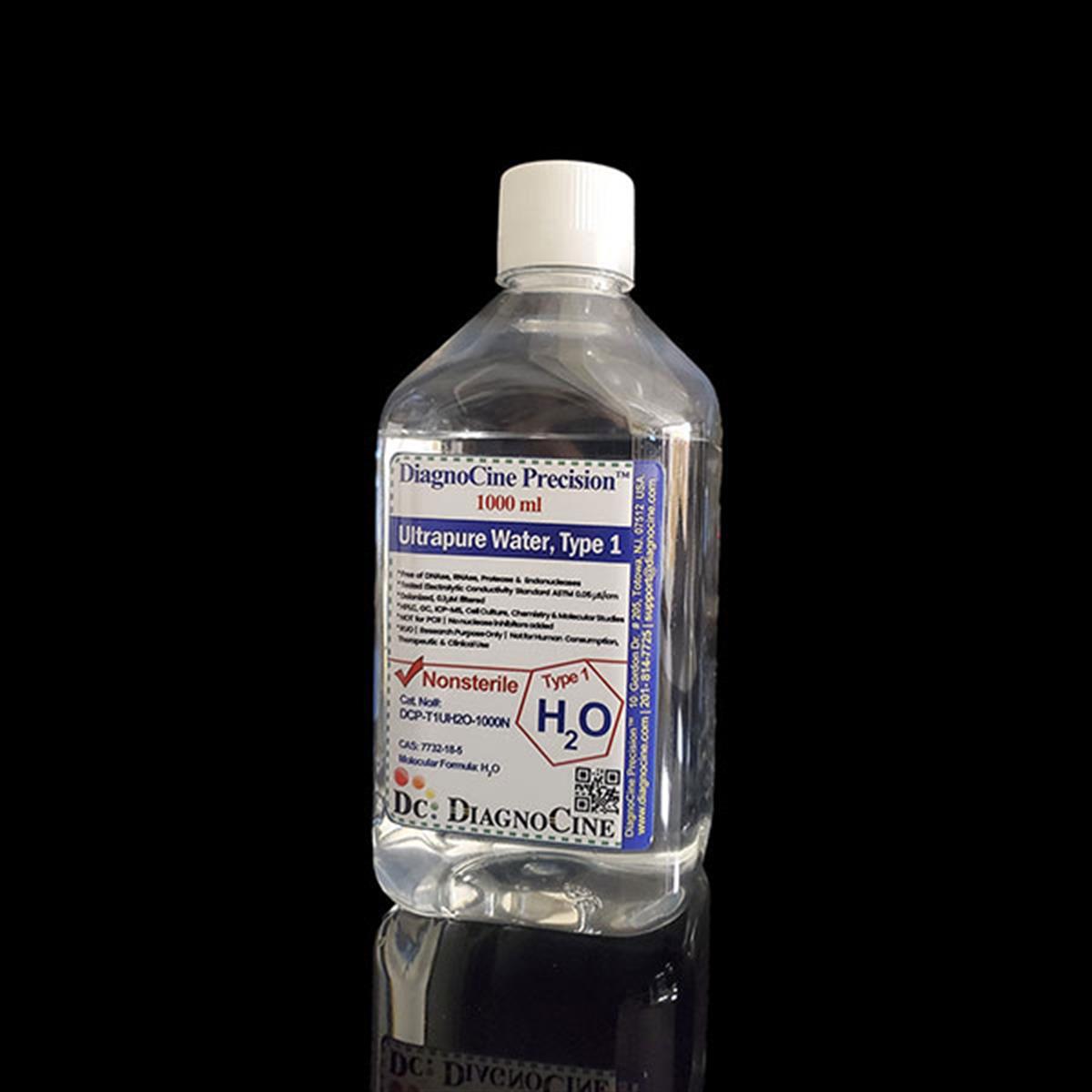

Ultrapure Water, Type 1, 1000ml, Non-Sterile
FluxMPS™ Ultrapure Water, Type 1, 1000 mL, Non-Sterile
FluxMPS™ Ultrapure Water, Type 1 is a quadruple-stage filtered, deionized, single-component aqueous reagent (H2O, CAS 7732-18-5) manufactured for microfluidic, organ-on-a-chip (OoC), and molecular biology workflows that demand ultra-low particulate, nuclease-free water. Supplied non-sterile in a 1000 mL format, it is available non-pH-adjusted (pH 4.5–5) or NaOH pH-adjusted (pH 7.4) to match your protocol.
- Quadruple-stage filtration: 0.1 µm membrane filtered twice and 0.04 µm membrane filtered twice
- Deionized and 0.1 µm filtered for HPLC, GC, ICP-MS, cell culture, chemistry, and molecular studies
- Tested electrolytic conductivity per ASTM standard: 0.05 µS/cm
- Free of DNase, RNase, Protease & Endonucleases
- Available non-pH-adjusted (pH 4.5–5) or NaOH pH-adjusted (pH 7.4)
- Ultrapure Type 1 water classification (18.2 MΩ·cm)
- Non-Sterile — For Research Use Only (RUO)
- pH (Non-Adjusted)4.5–5
- pH (Adjusted, NaOH)7.4
- Conductivity (ASTM)0.05 µS/cm
- CAS Number7732-18-5
- Molecular FormulaH2O
- Filtration0.1 µm x2 + 0.04 µm x2
- SterilityNon-Sterile
- Nuclease/ProteaseDNase/RNase/Protease-Free
- Water GradeType 1 (18.2 MΩ·cm)
- Size1000 mL
Engineered where standard ultrapure water falls short
Conventional single-pass filtered water can carry subvisible particulates, nucleases, and unstable pH readings into sensitive microfluidic channels and molecular assays. FluxMPS™ Ultrapure Water, Type 1 is built to remove those failure points.
Microchannel-safe purity
Quadruple-stage 0.1 µm and 0.04 µm membrane filtration removes particulates before they can foul narrow microfluidic and OoC channels.
Defined pH options
Choose non-pH-adjusted (pH 4.5–5) as supplied, or NaOH pH-adjusted (pH 7.4) for protocols requiring a physiological pH final mix.
Ultrapure-grade water
Type 1 water classification (18.2 MΩ·cm) deionized and 0.1 µm filtered for demanding analytical and molecular biology use.
Low background for sensitive assays
Free of DNase, RNase, Protease & Endonucleases, reducing background risk in molecular biology and general PCR workflows.
Defined, traceable composition
Single-component reagent (H2O, CAS 7732-18-5) tested to an electrolytic conductivity standard of 0.05 µS/cm (ASTM).
pH options on demand
Non-pH-adjusted and NaOH pH-adjusted (pH 7.4) variants available — contact support@diagnocine.com for custom requests.
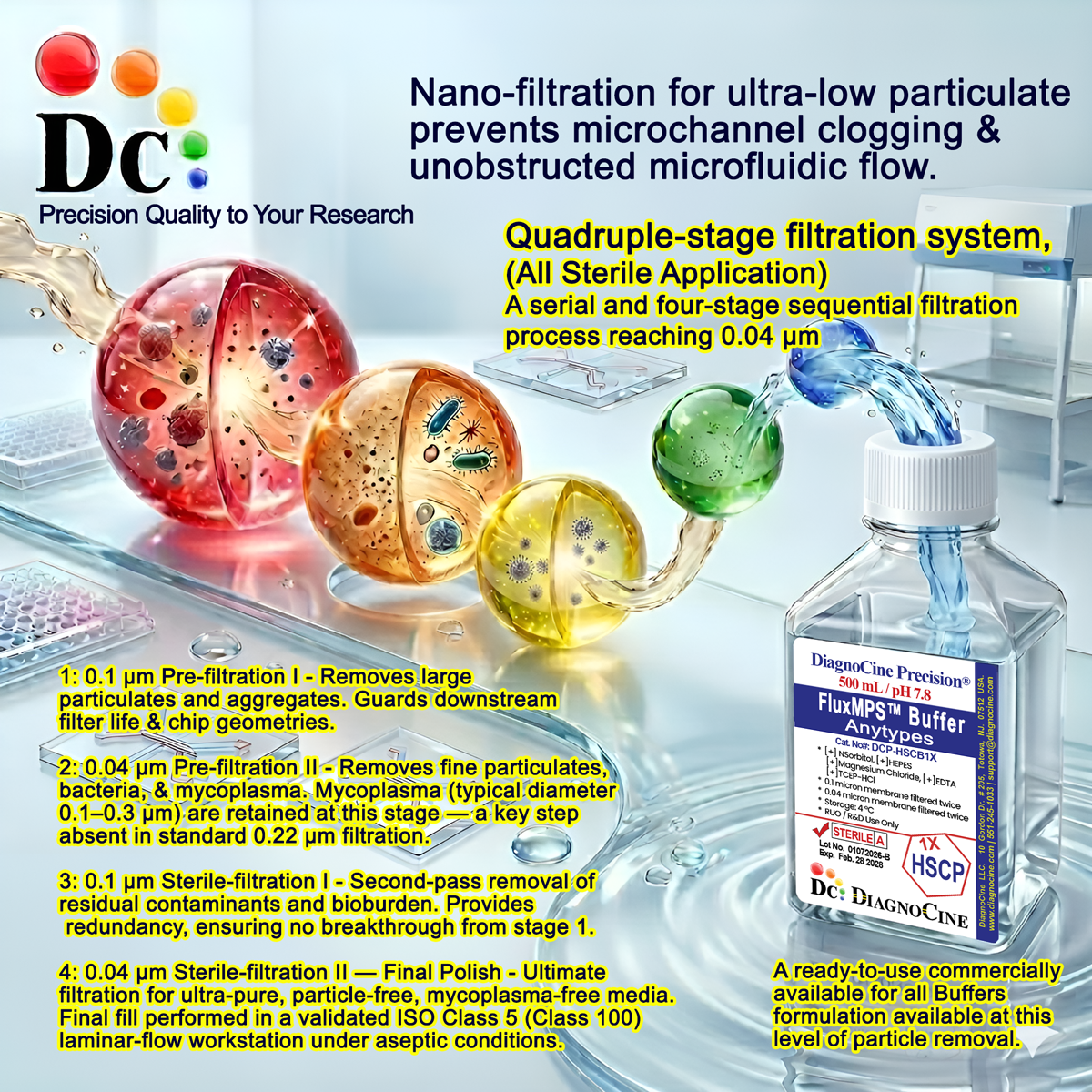
Quadruple-stage filtration system
FluxMPS™ Ultrapure Water, Type 1 is produced through sequential 0.1 µm and 0.04 µm membrane filtration — filtered 0.1-micron membrane twice and 0.04-micron membrane twice — followed by deionization, removing finer particulates than a single-pass filtration step.
-
1
0.1 µm Pre-filtration I
Removes large particulates and aggregates, extending the life of downstream filtration membranes.
-
2
0.04 µm Pre-filtration II
Retains fine particulates ahead of final polishing and deionization.
-
3
0.1 µm Sterile-filtration I
Second-pass 0.1 µm redundancy for consistent particulate control.
-
4
0.04 µm Sterile-filtration II — Final Polish
Final 0.04 µm polish combined with deionization for HPLC-, GC-, ICP-MS-, and molecular-biology-grade purity.
Performance vs. conventional water
Sequential 0.1 µm and 0.04 µm filtration removes finer particulates than a single conventional filtration pass, while deionization and nuclease/protease screening support demanding analytical and molecular biology workflows.
© Diagnocine® — DCP-T1UH2O-1000N
Where FluxMPS™ Ultrapure Water, Type 1 is used
Suited for HPLC, GC, ICP-MS, cell culture, chemistry, and molecular studies, as well as microfluidic and organ-on-a-chip (OoC) systems requiring ultra-low-particulate, nuclease-free Type 1 water.
Automated Bioreactors & Robotics
An optional 0.01 µm (10 nm) ultra-filtered variant is available for automated bioreactor and robotic liquid-handling platforms where sub-0.04 µm particulate exclusion is required.
- Total Particulate Exclusion
- Valve & Sensor Protection
- Extended Perfusion Stability
Inquiry Required: Contact support@diagnocine.com to request the 0.01 µm ultra-filtered grade for your platform.
Micro Physiological System (MPS) & Chip
Ultra-low-particulate water for priming and perfusing microfluidic channels.
Wash, Dilution & Reconstitution
Nuclease-free base water for lysis, dilution, and reagent reconstitution.
iPSC-Derived Model Handling
Low-background water for reagent preparation in iPSC-derived model workflows.
Endothelial & Primary Cell Perfusion
Ultrapure water for buffer and media preparation supporting perfusion protocols.
ELISA, Blotting & Blocking
Reagent-grade water for wash and dilution steps in immunoassay workflows.
Microscopy & Optical Sensing
Low-particulate, low-background water supporting optical and sensor-based assays.
Specifications at a glance
Key physical, purity, handling, and traceability parameters for FluxMPS™ Ultrapure Water, Type 1.
| Parameter | Specification |
|---|---|
| Formulation / Composition | Ultrapure Water (H2O) |
| CAS Number | 7732-18-5 |
| pH, Non-Adjusted Grade | 4.5–5 |
| pH, NaOH-Adjusted Grade | 7.4 |
| Conductivity ASTM | 0.05 µS/cm |
| Parameter | Specification |
|---|---|
| Sterility | Non-Sterile |
| Nuclease / Protease Content | Free of DNase, RNase, Protease & Endonucleases |
| Water Purity Classification | Ultrapure Type 1 water (18.2 MΩ·cm) |
| Filtration System | 0.1 µm membrane filtered twice, 0.04 µm membrane filtered twice |
| Deionization | Deionized, 0.1 µm filtered |
| Parameter | Specification |
|---|---|
| Packaging Size | 1000 mL |
| Air-Exposure Behavior | pH can fall toward 4.5 upon atmospheric CO2 absorption; this does not indicate contamination |
| pH Meter Compatibility | Standard pH meters may show instability due to low conductance; a meter designed for ultra-pure water is recommended |
| Parameter | Specification |
|---|---|
| Molecular Formula | H2O |
| Applications | HPLC, GC, ICP-MS, Cell Culture, Chemistry & Molecular Studies |
| PCR Suitability | General PCR use only (DNA-based, gDNA, abundant RNA source); not for delicate PCR (endpoint or qPCR) |
| Manufacturing QMS ISO | ISO 13485:2016 |
| Intended Use | Research Use Only (RUO); not for human consumption, therapeutic, or clinical use |
Full composition
FluxMPS™ Ultrapure Water, Type 1 is a single-component aqueous reagent.
| Component | CAS Number | Concentration |
|---|---|---|
| Ultrapure Water (H2O) | 7732-18-5 | Not specified |
Manufacturing & compliance
FluxMPS™ Ultrapure Water, Type 1 is produced under Diagnocine Precision's quality systems.
ISO 13485:2016 QMS
Manufactured under an ISO 13485:2016-aligned quality management system.
Ultrapure Type 1 Water
Deionized and 0.1 µm filtered Type 1 water (18.2 MΩ·cm) as the base reagent.
ISO Class 5 Fill & Finish
Fill operations conducted within controlled ISO Class 5 (Class 100) environments.
Micro-Batch Precision
Lot-controlled production supporting consistent quality across batches.
Nuclease & Protease Screening
Confirmed free of DNase, RNase, Protease & Endonucleases.
Particulate Control
Quadruple-stage 0.1 µm and 0.04 µm membrane filtration.
Electrolytic Conductivity
Tested to ASTM standard: 0.05 µS/cm.
Documentation / CoA
Certificate of Analysis available on request.
How DCP-T1UH2O-1000N compares
A look at FluxMPS™ Ultrapure Water, Type 1 against conventional filtered and distilled water grades.
| Parameter | DCP-T1UH2O-1000N (FluxMPS™) | Conventional 0.22 µm-Filtered Water | Standard Distilled / Deionized Water |
|---|---|---|---|
| Final filtration pore size | 0.04 µm | 0.22 µm | Not filtered / variable |
| Number of filtration stages | 4 | 1 | 0 |
| Conductivity tested to ASTM standard | check_circle | cancel | cancel |
| Nuclease / protease-free | check_circle | cancel | cancel |
| Water classification | Type 1 (18.2 MΩ·cm) | Type 2/3 typical | Distilled (variable) |
| pH options available | Non-adjusted (4.5–5) & pH 7.4 adjusted | Single, non-adjusted only | Not controlled |
| Manufacturing QMS | ISO 13485:2016 | Unspecified | Unspecified |
| Microfluidic / OoC channel compatibility | check_circle | cancel | cancel |
| Custom pH formulation available | check_circle | cancel | cancel |
Frequently asked questions
Common questions about FluxMPS™ Ultrapure Water, Type 1.
Supporting literature
Curated literature relevant to ultrapure water quality, filtration, and microfluidic / organ-on-a-chip applications.
- Bhatia SN, Ingber DE. Microfluidic organs-on-chips. Nat Biotechnol. 2014. doi:10.1038/nbt.2989
- Halpern M, Frenkel Y, Sowden R. Behavior of pH measurement in low ionic strength ultrapure water. Anal Chem Insights. 2007. doi:10.1177/117739010700200003
- Light TS, Licht S, Bevilacqua AC, Morash KR. The fundamental conductivity and resistivity of water. Electrochem Solid-State Lett. 2005. doi:10.1149/1.1836121
- Huh D, Hamilton GA, Ingber DE. From 3D cell culture to organs-on-chips. Trends Cell Biol. 2011. doi:10.1016/j.tcb.2011.09.005
- Rios A, Zougagh M. Sample preparation for micro total analytical systems (µTAS). Anal Bioanal Chem. 2015. doi:10.1007/s00216-015-8547-4
- Zhao Q, et al. Nuclease contamination control in molecular biology reagent water. Anal Biochem. 2012. doi:10.1016/j.ab.2012.02.005
- Kim JJ, et al. Endotoxin and particulate control in laboratory water purification systems. J Lab Autom. 2013. doi:10.1177/2211068212460237
- Bruus H. Theoretical Microfluidics. Oxford University Press. 2008. doi:10.1093/oso/9780199235094.001.0001
- Whitesides GM. The origins and the future of microfluidics. Nature. 2006. doi:10.1038/nature05058
- Green MR, Sambrook J. Preparation of reagents and buffers used in molecular cloning. Cold Spring Harb Protoc. 2020. doi:10.1101/pdb.top100438