

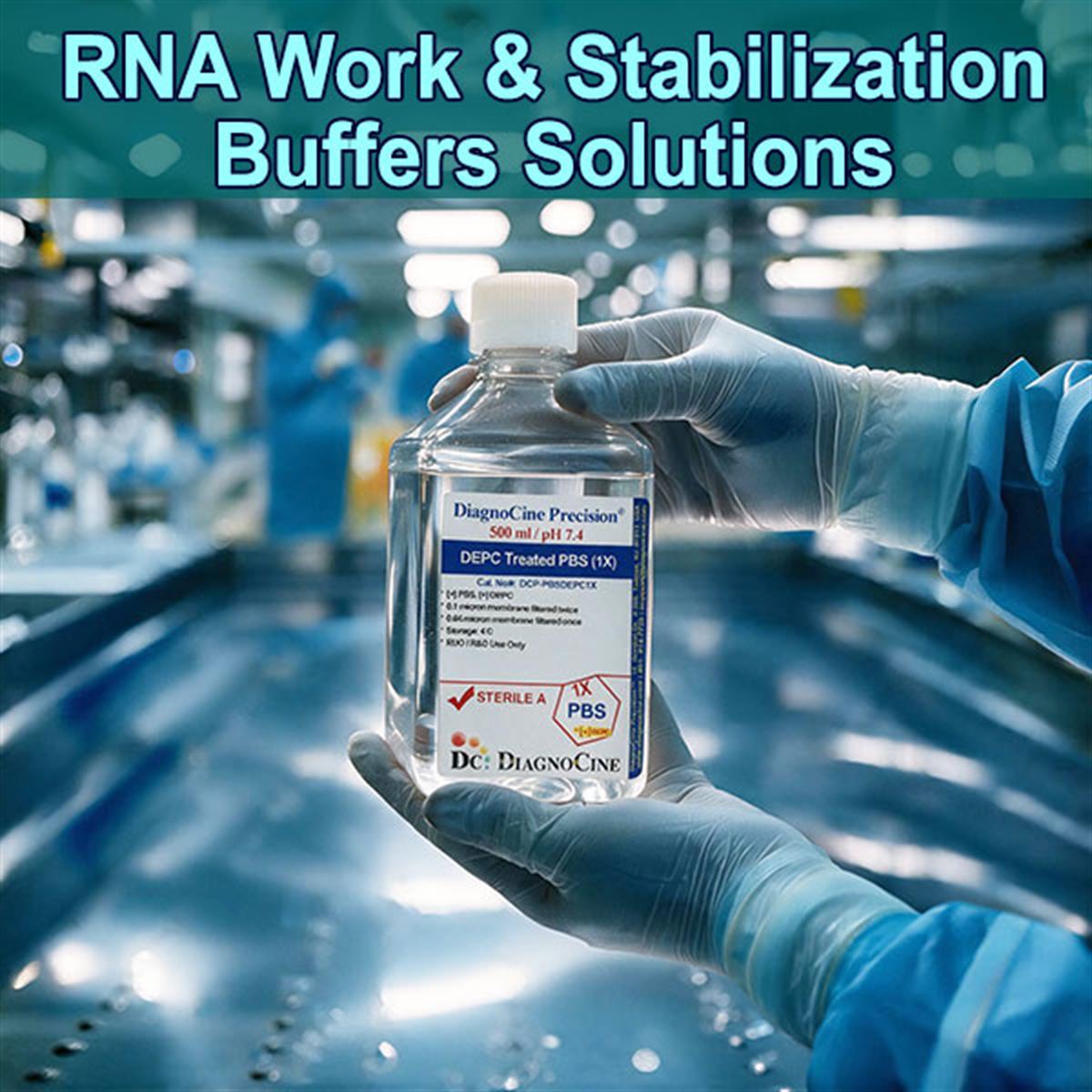
RNA Work & Stabilization Buffers - Category Selection Guide
Four products, four different routes to the same goal. Pick the one that matches where your RNA is at risk — the chemistry, the history, and the workflow guidance follow below.
| Product | Core Basis | Primary Role | Product Page |
|---|---|---|---|
| UltraClean DEPC-Treated Buffers | Chemically inactivated, nuclease-free | Universal transcriptomics baseline — dissolving RNA pellets, preparing gel matrices, diluting enzymatic master mixes | Viewarrow_forward |
| UltraClean PVSA Buffers | Polyvinylsulfonic acid–integrated | Non-toxic RNase inhibition — for workflows sensitive to residual chemistry | Viewarrow_forward |
| UltraClean GuardRNA Lysis | High-density chaotropic/stabilizer cocktail | Instant transcriptome freezing — protects fragile, low-abundance transcripts at the moment of collection | Viewarrow_forward |
| 5% Hydrogen Peroxide Solution (H2O2) | Oxidative decontamination agent | Equipment decontamination — glass plates, combs, and gel boxes before RNA formaldehyde gels | Viewarrow_forward |
Not sure which one? Match the threat to the chemistry · See applications by workflow · Read the FAQ
What this category does, in one paragraph
DNA is robust — double-stranded and stable enough to survive for millennia under the right conditions. RNA is the opposite: single-stranded, transient, and exceptionally prone to rapid degradation. RNA work and stabilization buffers are formulated to protect RNA from enzymatic degradation, preserve its structure, and maintain reliable transcriptomic results.
The attributes that decide which of the four products belongs in your protocol.
- Two degradation routes, not one: enzymatic attack by RNases, and spontaneous self-cleavage driven by RNA’s own reactive 2′-hydroxyl group.
- Protease inhibitors do not help. Standard protein-protease inhibitors don’t stop RNases; these buffers use covalent chemical modification (DEPC) or strong chaotropic denaturants (guanidinium) to dismantle the enzymes outright.
- RNases are the hard problem, not RNA fragility alone. They need no cofactors, can refold after heating, and are shed constantly from skin, bacteria, and tissue — ordinary precautions don’t remove them.
- DEPC-Treated Buffers are the universal transcriptomics baseline: DEPC destroys trace RNase contamination, and the treatment remains the classic route to RNase-free water.
- PVSA Buffers take a different route — polyvinylsulfonic acid mimics the negatively charged nucleic-acid backbone, binding RNase active sites without volatile chemicals like DEPC.
- GuardRNA Lysis ruptures membranes while simultaneously denaturing active cellular RNases in one step, freezing the transcriptome at the moment of collection.
- 5% Hydrogen Peroxide is hardware chemistry, not sample chemistry: it oxidatively inactivates resilient RNases on glass plates, combs, and gel boxes without leaving residues that alter subsequent runs.
- pH control is part of the formulation, because RNA is prone to alkaline hydrolysis in basic conditions.
- Catalog items in this category4
- Distinct protection routes4 (DEPC, PVSA, chaotropic, oxidative)
- DEPC-Treated Buffers — core basisChemically inactivated, nuclease-free
- PVSA Buffers — core basisPolyvinylsulfonic acid–integrated
- GuardRNA Lysis — core basisHigh-density chaotropic/stabilizer cocktail
- Hydrogen peroxide concentration5%
- Degradation routes controlledEnzymatic (RNase) and spontaneous 2′-OH hydrolysis
- DEPC adopted for RNase inactivationLate 1970s
- Guanidinium chaotropic extraction established1979–1987
- Named workflow applications5
RNA work demands a stringency other biomolecules don’t
Each card below is one reason a general-purpose buffer is the wrong tool for an RNA experiment — and each maps to a specific chemistry in the catalog above.
RNA is single-stranded and transient
DNA is double-stranded and stable enough to survive for millennia under the right conditions. RNA is the opposite — single-stranded, transient, and exceptionally prone to rapid degradation. That difference is why RNA gets its own reagent category rather than sharing the DNA bench stock.
RNases are extraordinarily rugged
Work on bovine pancreatic RNase A — a model enzyme in Christian Anfinsen’s protein-folding studies — revealed why RNA work kept failing: RNases need no cofactors and can refold after heating. Heat alone does not retire them.
Contamination is ambient, not occasional
RNases are shed constantly from skin, bacteria, and tissue. Researchers isolating RNA with standard DNA buffers kept getting degraded smears, which established that RNase contamination — not RNA fragility alone — is the central obstacle, and that ordinary precautions don’t remove it.
RNase inactivation
Standard protein-protease inhibitors don’t stop RNases. These buffers use covalent chemical modification (DEPC) or strong chaotropic denaturants (guanidinium) to dismantle the enzymes outright rather than merely slowing them down.
Hydrolysis prevention
RNA’s ribose carries a reactive 2′-hydroxyl group that makes it prone to spontaneous self-cleavage — alkaline hydrolysis — in basic conditions. RNA buffers tightly maintain pH to prevent this auto-degradation, which no nuclease control can address.
Competitive RNase blocking
Some stabilizing polymers act as structural decoys, mimicking the negatively charged nucleic-acid backbone so they bind and sequester free RNases before those enzymes reach real transcripts. This is the mechanism behind the PVSA line.
Two independent failure modes need two independent countermeasures. Enzymatic degradation is stopped by inactivating or sequestering RNases; spontaneous self-cleavage is stopped only by holding pH. A reagent that does one and not the other still loses the sample — which is why this category pairs nuclease chemistry with buffered formulation rather than treating them as alternatives.
How RNA protection moved from precaution to formulation
Each step in this chronology explains a reagent still on the shelf — why DEPC exists, why guanidinium lysis replaced washing, and why stabilization moved to polymers.
-
1
1960s–1970s The obstacle is correctly identified
Researchers isolating RNA with standard DNA buffers kept getting degraded smears. Work on bovine pancreatic RNase A — a model enzyme in Christian Anfinsen’s protein-folding studies — revealed why: RNases are extraordinarily rugged, need no cofactors, can refold after heating, and are shed constantly from skin, bacteria, and tissue. This established that RNase contamination, not RNA fragility alone, is the central obstacle in RNA work, and that ordinary precautions don’t remove it.
-
2
Late 1970s DEPC gives the field a chemical route
DEPC (diethyl pyrocarbonate) was adopted to covalently inactivate RNases in water and salt solutions. This gave the field its first reliable chemical route to “RNase-free” reagents, and it is still the classic treatment for RNase-free water.
-
3
1979–1987 Chaotropic extraction replaces inhibition
Guanidinium-based chaotropic extraction (Chirgwin et al. 1979; Chomczynski & Sacchi 1987) denatures RNases instantly during lysis rather than merely inhibiting them. This made single-step isolation of intact total RNA routine — the basis for modern lysis-stabilization reagents.
-
4
21st century Polymer stabilization for collection and shipping
As transcriptomics moved to single-cell resolution and clinical diagnostics, protection shifted from chemical washes to polymer-based, high-salt stabilization systems that freeze expression profiles upon contact with tissue. This enabled reliable RNA preservation for collection, shipping, and storage of clinical and low-input samples.
Match the threat to the chemistry
Four ways an RNA experiment loses its sample, and the countermeasure this category supplies for each. Where the source attributes a countermeasure to no specific catalog item, that is stated rather than inferred.
| Threat to the RNA | Why an ordinary buffer fails | Countermeasure in this category | Where it lives in the catalog |
|---|---|---|---|
| Enzymatic degradation by RNases | Standard protein-protease inhibitors don’t stop RNases, and RNases need no cofactors and can refold after heating | Covalent chemical modification (DEPC) or strong chaotropic denaturants (guanidinium) to dismantle the enzymes outright | DEPC-Treated Buffers; GuardRNA Lysis |
| Spontaneous self-cleavage (alkaline hydrolysis) | RNA’s ribose carries a reactive 2′-hydroxyl group that makes it prone to self-cleavage in basic conditions — a chemical, not enzymatic, route | Tightly maintained pH to prevent auto-degradation | Stated as a property of RNA buffers generally; the source assigns it to no single catalog item |
| Free RNases reaching real transcripts | Inactivation chemistry may be unwanted where residual reagent would interfere downstream | Stabilizing polymers act as structural decoys, mimicking the negatively charged nucleic-acid backbone to bind and sequester free RNases first | PVSA Buffers |
| RNase-contaminated hardware | Glassware, plasticware, and fluid lines carry resilient RNases that no in-tube additive can reach | Oxidative inactivation that leaves no residue altering subsequent runs | 5% Hydrogen Peroxide Solution |
Which product for which bench workflow
Select a workflow to see what the source states about it and which product it points to.
- RNA extraction and isolation — disrupting cells and tissue while protecting fragile total RNA from endogenous nucleases.
- GuardRNA Lysis ruptures membranes while simultaneously denaturing active cellular RNases in one step.
- This is the modern form of the guanidinium chaotropic approach, which denatures RNases instantly during lysis rather than merely inhibiting them.
- RT-qPCR and RNA-Seq prep — ultra-pure, nuclease-free diluents for sensitive reverse-transcription reactions.
- DEPC-Treated Buffers are the trusted standard for dissolving RNA pellets and for diluting enzymatic master mixes.
- Where residual chemistry would be a problem, PVSA Buffers deliver RNase inhibition without volatile chemicals like DEPC.
- Nuclease elimination — treating glassware, plasticware, and fluid lines to establish an RNase-free zone.
- 5% Hydrogen Peroxide treats glass plates, combs, and gel boxes before RNA formaldehyde gels, oxidatively inactivating resilient RNases without leaving residues that alter subsequent runs.
- DEPC remains the classic treatment for RNase-free water and salt solutions.
- Clinical sample collection — preserving viral or cellular RNA in biofluids during shipping and storage.
- GuardRNA Lysis protects fragile, low-abundance transcripts at the moment of collection.
- This reflects the 21st-century shift from chemical washes to polymer-based, high-salt stabilization systems that freeze expression profiles upon contact with tissue.
- Northern blotting and in situ hybridization — keeping RNA intact through denaturing gel and probe workflows.
- DEPC-Treated Buffers are the trusted standard for preparing gel matrices.
- Treat glass plates, combs, and gel boxes with 5% hydrogen peroxide before running RNA formaldehyde gels.
The four products side by side
The source’s own comparison table, reproduced row-for-row with its product names as published.
| Product | Core Basis | Best Use |
|---|---|---|
| DEPC-Treated Buffers | Chemically inactivated, nuclease-free | Universal transcriptomics baseline — DEPC destroys trace RNase contamination; the trusted standard for dissolving RNA pellets, preparing gel matrices, and diluting enzymatic master mixes |
| PVSA Buffers | Polyvinylsulfonic acid–integrated | Non-toxic RNase inhibition — PVSA mimics the negatively charged nucleic-acid backbone, binding RNase active sites without volatile chemicals like DEPC; ideal for workflows sensitive to residual chemistry |
| GuardRNA Lysis | High-density chaotropic/stabilizer cocktail | Instant transcriptome freezing — ruptures membranes while simultaneously denaturing active cellular RNases in one step; protects fragile, low-abundance transcripts at the moment of collection |
| 5% Hydrogen Peroxide (H2O2) Solution | Oxidative decontamination agent | Equipment decontamination — treats glass plates, combs, and gel boxes before RNA formaldehyde gels; oxidatively inactivates resilient RNases without leaving residues that alter subsequent runs |
Frequently asked questions
The questions that come up most often when an RNA protocol meets a purchasing decision.
The primary literature behind RNase control
The method papers and operational guides behind the chemistry described above.
- Chomczynski, P., & Sacchi, N. (1987). Single-step method of RNA isolation by acid guanidinium thiocyanate-phenol-chloroform extraction. Analytical Biochemistry, 162(1), 156–159. — The single most-cited RNA method paper; the AGPC principle behind modern lysis-stabilization systems that denature nucleases while isolating intact RNA. doi:10.1016/0003-2697(87)90021-2
- Blumberg, D. D. (1987). Creating a ribonuclease-free environment. Methods in Enzymology, 152, 20–24. — The operational guide establishing standards for DEPC-treated solutions and RNase-free hardware handling. doi:10.1016/0076-6879(87)52005-5
- Favaloro, J., Treisman, R., & Kamen, R. (1980). Transcription maps of polyoma virus-specific RNA: analysis by two-dimensional nuclease S1 gel mapping. Methods in Enzymology, 65, 718–749. — A foundational RNA-analysis method (S1 nuclease mapping) illustrating the careful handling required to preserve intact transcripts for downstream mapping. doi:10.1016/S0076-6879(80)65070-8