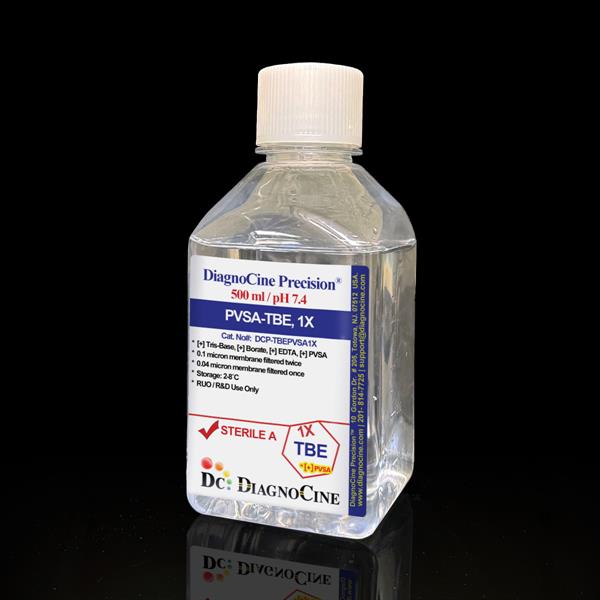
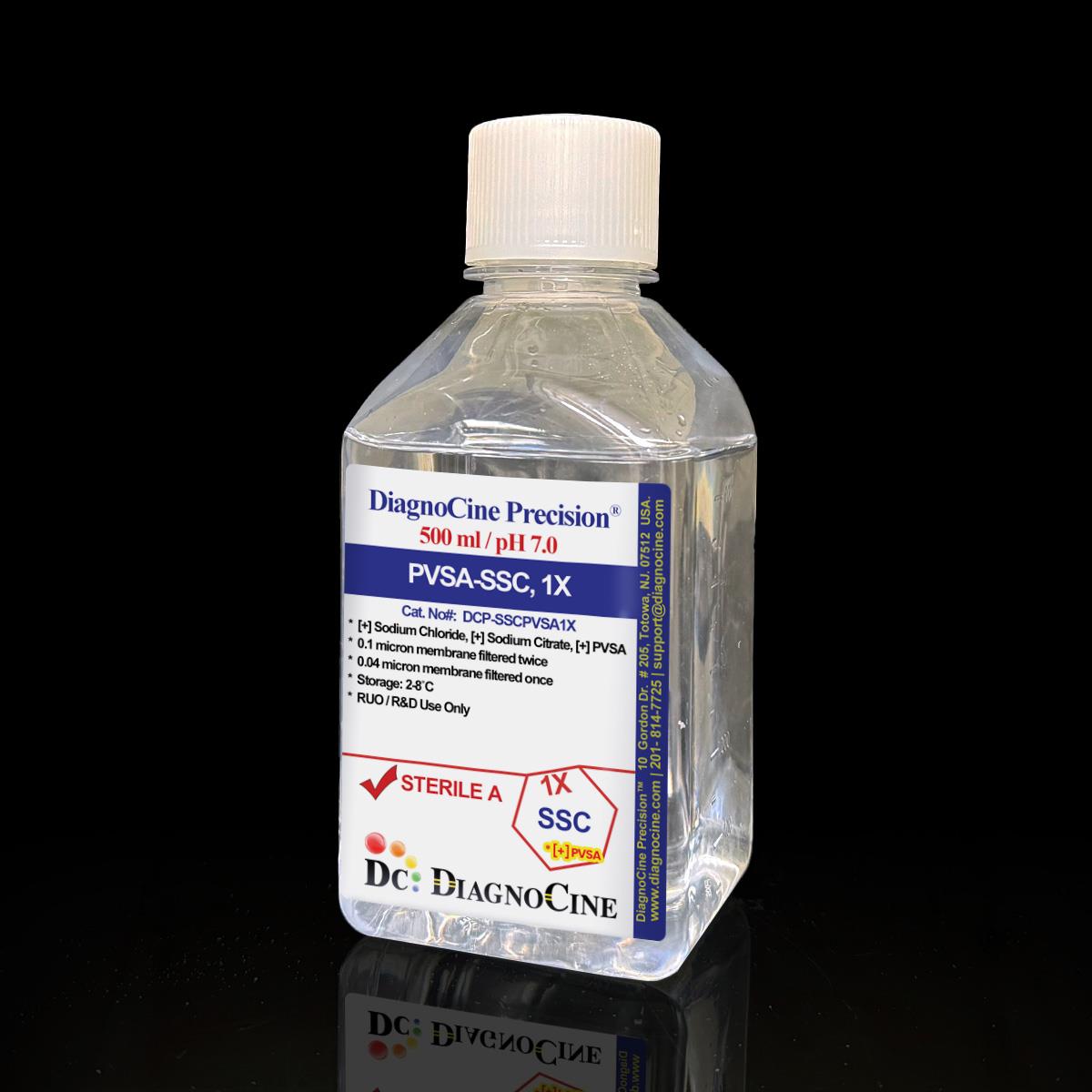
UltraClean PVSA‑SSC, 1X
FluxMPS™ UltraClean PVSA-SSC, 1X
An MPS-grade, RNase-safe 1X Saline Sodium Citrate (SSC) buffer supplemented with polyvinylsulfonic acid (PVSA), a potent polymeric RNase inhibitor. Manufactured with a quadruple-stage filtration process — 0.1 µm membrane filtration twice and 0.04 µm membrane filtration twice — for ultra-clean, nuclease-controlled handling of RNA-containing samples in hybridization, blotting, and microfluidic sample-preparation workflows.
- Sterile, ultrapure buffer filtered through a 0.1 µm membrane twice and a 0.04 µm membrane twice for quadruple-stage purity
- RNase-safe formulation supplemented with PVSA (polyvinylsulfonic acid), a potent polymeric RNase inhibitor
- Standard 1X SSC ionic strength (150 mM sodium chloride, 15 mM sodium citrate) for hybridization and stringency washes
- Formulated with ultrapure, nuclease-free water
- Ready-to-use 1X solution — no dilution or mixing required
- Manufactured under ISO 13485-certified, CE-approved facilities with final QA at the DiagnoCine R&D and Quality Testing Center
- Concentration, pH, and additive customization available on request
- pH7.0
- Sodium Chloride150 mM
- Sodium Citrate15 mM
- PVSA (RNase Inhibitor)1 g/L
- Ionic Strength1X SSC
- Filtration0.1 µm x2 + 0.04 µm x2
- SterilitySterile, filter-sterilized
- FormatReady-to-use 1X solution
- Storage2-8°C, do not freeze
- Shelf Life12 months
Engineered where standard SSC buffers fail
Conventional 0.22 µm-filtered SSC buffers can carry residual particulates, adventitious nucleases, and microbial bioburden into RNA hybridization, blotting, and sample-handling workflows. FluxMPS™ UltraClean PVSA-SSC, 1X is built to remove these failure points at the source.
Microchannel-safe purity
Quadruple-stage filtration (0.1 µm x2, 0.04 µm x2) reduces particulates that can foul microfluidic channels, membranes, and blot supports.
Precise, stable pH
Formulated at pH 7.0 with defined 1X SSC ionic strength (150 mM sodium chloride, 15 mM sodium citrate) for consistent hybridization and stringency-wash behavior.
Ultrapure-grade water
Formulated with ultrapure, nuclease-free water to minimize adventitious RNase and DNase carry-over.
Low background for hybridization & imaging
RNase-safe, particulate-controlled formulation helps limit background signal in probe-based hybridization and blotting assays.
Defined, traceable composition
Sodium chloride, sodium citrate, and PVSA are formulated to stated concentrations and QC-released for appearance and pH.
Customization on demand
Alternate concentrations, pH, and additional chemicals, compounds, proteins, or supplements are available on request.
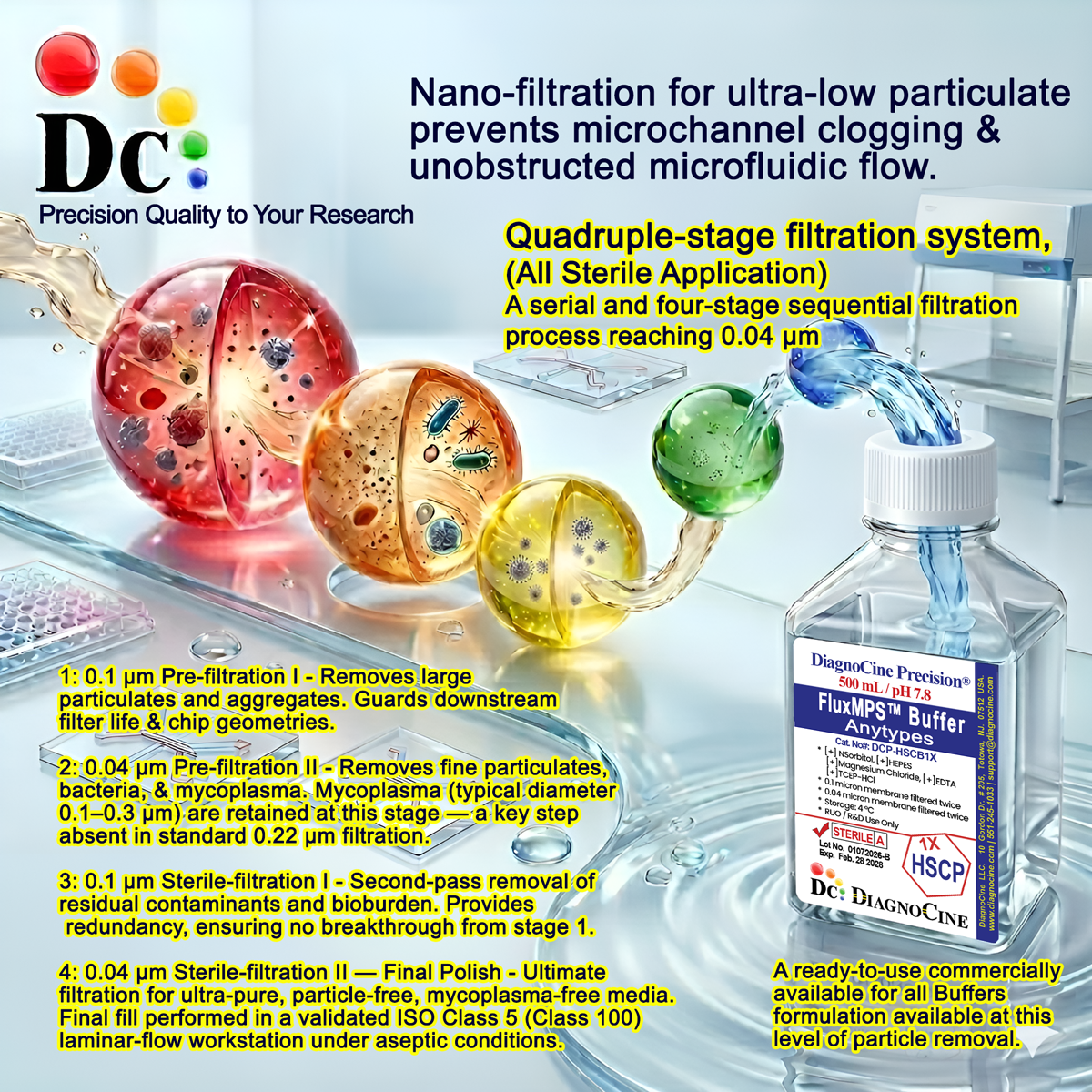
Quadruple-stage filtration system
UltraClean PVSA-SSC, 1X is filtered through a 0.1 µm membrane twice and a 0.04 µm membrane twice, targeting fine particulates, microbial bioburden, and adventitious nucleases before final fill.
-
1
0.1 µm Pre-filtration I
First 0.1 µm membrane pass removes large particulates and aggregates, extending the life of downstream filters.
-
2
0.04 µm Pre-filtration II
First 0.04 µm membrane pass retains fine particulates and reduces bioburden ahead of sterile filtration.
-
3
0.1 µm Sterile-filtration I
Second 0.1 µm membrane pass provides redundant particulate and microbial control.
-
4
0.04 µm Sterile-filtration II — Final Polish
Second 0.04 µm membrane pass delivers the final polish prior to aseptic fill.
Performance vs. conventional buffer
Sequential 0.1 µm and 0.04 µm filtration, each applied twice, targets particulates and adventitious nucleases beyond what a single 0.22 µm pass typically captures, supporting RNase-safe handling of RNA-containing samples.
© Diagnocine® — DCP-SSCPVSA1X
Where UltraClean PVSA-SSC, 1X is used
A ready-to-use, RNase-safe 1X SSC buffer for RNA hybridization, blotting, and general molecular biology workflows requiring defined ionic strength and nuclease control.
Automated Bioreactors & Robotics
For automated liquid-handling, perfusion, and robotic bioreactor platforms that are especially sensitive to particulate accumulation, an optional 0.01 µm (10 nm) ultra-filtered variant of this buffer is available on request.
- Total Particulate Exclusion: Sub-10 nm filtration for the most particulate-sensitive automated workflows
- Valve & Sensor Protection: Reduces particulate load reaching microvalves, flow sensors, and optical windows
- Extended Perfusion Stability: Supports longer-duration automated perfusion and dispensing runs
Inquiry Required: The 0.01 µm (10 nm) ultra-filtered grade is produced to order — contact support@diagnocine.com to request this configuration.
RNA Hybridization & Wash
Hybridization and wash buffer for Northern blotting, in situ hybridization, and RNA probe-based assays where RNase control is critical.
Blotting & Microarrays
Wash and incubation buffer for Southern and Northern blots and DNA/RNA microarrays performed under SSC conditions.
RNA Handling & Short-Term Storage
Washing, resuspension, and temporary storage of RNA-containing samples, cells, or tissues in high-salt buffer with added RNase protection.
Probe-Based Assays & RNA Capture
Dilution of RNA probes, oligos, and conjugates, and washing of solid supports in workflows requiring strict nuclease control in SSC buffer.
General Molecular Biology Workflows
Any procedure requiring 1X SSC with enhanced RNA protection, including high-salt washes and handling steps for RNA-sensitive samples.
RNA-Sensitive Microfluidic Workflows
Quadruple-stage-filtered, RNase-safe SSC buffer for RNA sample-preparation steps within microfluidic and organ-on-a-chip (OoC) workflows.
Detailed specifications
Physical, chemical, purity, storage, and traceability parameters for UltraClean PVSA-SSC, 1X.
| Parameter | Specification |
|---|---|
| Formulation | SSC buffer supplemented with PVSA RNase inhibitor |
| Appearance | Colorless, clear solution; free of visible particulates |
| pH | 7.0 |
| Sodium Chloride Concentration | 150 mM |
| Sodium Citrate Concentration | 15 mM |
| PVSA Concentration | 1 g/L |
| Parameter | Specification |
|---|---|
| Sterility | Sterile, filter-sterilized |
| Filtration System USP <788> | 0.1 µm membrane filtered twice and 0.04 µm membrane filtered twice |
| Water Quality | Ultrapure, nuclease-free water |
| Mycoplasma Control | Prevented via dual-pass 0.1 µm and 0.04 µm filtration |
| Manufacturing Standard ISO 13485 | ISO 13485-certified, CE-approved facilities |
| Parameter | Specification |
|---|---|
| Storage Temperature | 2-8°C |
| Freeze-Thaw | Do not freeze |
| Shelf Life | 12 months |
| Parameter | Specification |
|---|---|
| Raw Material Grade | Molecular biology-grade components |
| Manufacturing QMS ISO 13485 | ISO 13485-certified facilities |
| Regulatory Alignment | CE-approved facilities |
| Production Site | Final packaging, QA, and testing at the DiagnoCine R&D and Quality Testing Center; customization at DiagnoCine Precision, Totowa, New Jersey, USA |
| Intended Use | Research Use Only (RUO) |
Full composition
UltraClean PVSA-SSC, 1X is a standard 1X SSC buffer supplemented with polyvinylsulfonic acid (PVSA) for RNase protection.
| Component | CAS Number | Concentration |
|---|---|---|
| Sodium Chloride | 7647-14-5 | 150 mM |
| Sodium Citrate | 68-04-2 | 15 mM |
| PVSA (Polyvinylsulfonic Acid) | 27070-58-6 | 1 g/L |
| Water (Ultrapure, nuclease-free) | 7732-18-5 | To volume |
Manufacturing & compliance
UltraClean PVSA-SSC, 1X is manufactured, filled, and released under a controlled quality system.
ISO 13485:2016 QMS
Manufactured under ISO 13485-certified and CE-approved facilities (suppliers of DiagnoCine Precision).
Ultrapure Water Base
Formulated with ultrapure, nuclease-free water to volume.
Molecular Biology-Grade Components
Manufactured from molecular biology-grade components and subjected to multiple fine-pore filtration steps to minimize particulates, microbes, and adventitious nucleases.
Traceable Final Release
Final packaging, quality assurance, and testing are performed at the DiagnoCine R&D and Quality Testing Center.
Sterility
Sterile, filter-sterilized formulation.
Filtration Validation
0.1 µm membrane filtration twice and 0.04 µm membrane filtration twice, preventing mycoplasma contamination.
Appearance & pH Release
Colorless, clear solution, free of visible particulates; pH 7.0.
Custom Assembly
Specific customization requests and assembly are accomplished at DiagnoCine Precision in Totowa, New Jersey, USA.
How DCP-SSCPVSA1X compares
UltraClean PVSA-SSC, 1X against conventional single-stage-filtered SSC buffer.
| Parameter | DCP-SSCPVSA1X (FluxMPS™) | Conventional 1X SSC (0.22 µm filtered) | Standard Alternative (0.22 µm filtered) |
|---|---|---|---|
| RNase Protection (PVSA-supplemented) | check_circle | cancel | cancel |
| Final Filtration Pore Size | 0.04 µm (quadruple-stage) | 0.22 µm (single-stage) | 0.22 µm (single-stage) |
| Number of Filtration Stages | 4 | 1 | 1 |
| Sterility | check_circle | check_circle | check_circle |
| Defined 1X SSC Ionic Strength | check_circle | check_circle | cancel |
| Ultrapure, Nuclease-Free Water Base | check_circle | cancel | cancel |
| Manufacturing QMS (ISO 13485) | check_circle | cancel | cancel |
| Microfluidic / OoC Compatibility | check_circle | cancel | cancel |
| Custom Formulation Available | check_circle | cancel | cancel |
| Ready-to-Use Format | check_circle | cancel | cancel |
Frequently asked questions
Common questions about UltraClean PVSA-SSC, 1X (DCP-SSCPVSA1X).
Supporting literature
Curated literature on SSC buffer chemistry, RNase inhibition, nucleic acid blotting, and microfluidic/organ-on-a-chip applications relevant to this buffer.
- Southern EM. Detection of specific sequences among DNA fragments separated by gel electrophoresis. J Mol Biol. 1975. doi:10.1016/S0022-2836(75)80083-0
- Alwine JC, Kemp DJ, Stark GR. Method for detection of specific RNAs in agarose gels by transfer to diazobenzyloxymethyl-paper and hybridization with DNA probes. Proc Natl Acad Sci USA. 1977. doi:10.1073/pnas.74.12.5350
- Chomczynski P, Sacchi N. Single-step method of RNA isolation by acid guanidinium thiocyanate-phenol-chloroform extraction. Anal Biochem. 1987. doi:10.1016/0003-2697(87)90021-2
- Good NE, Winget GD, Winter W, Connolly TN, Izawa S, Singh RM. Hydrogen ion buffers for biological research. Biochemistry. 1966. doi:10.1021/bi00866a011
- Uphoff CC, Drexler HG. Detection of mycoplasma contamination in cell cultures. Curr Protoc Mol Biol. 2014. doi:10.1002/0471142727.mb2804s106
- Huh D, Matthews BD, Mammoto A, Montoya-Zavala M, Hsin HY, Ingber DE. Reconstituting organ-level lung functions on a chip. Science. 2010. doi:10.1126/science.1188302
- Bhatia SN, Ingber DE. Microfluidic organs-on-chips. Nat Biotechnol. 2014. doi:10.1038/nbt.2989
- Ingber DE. Reverse engineering human pathophysiology with organs-on-chips. Cell. 2016. doi:10.1016/j.cell.2016.06.026