

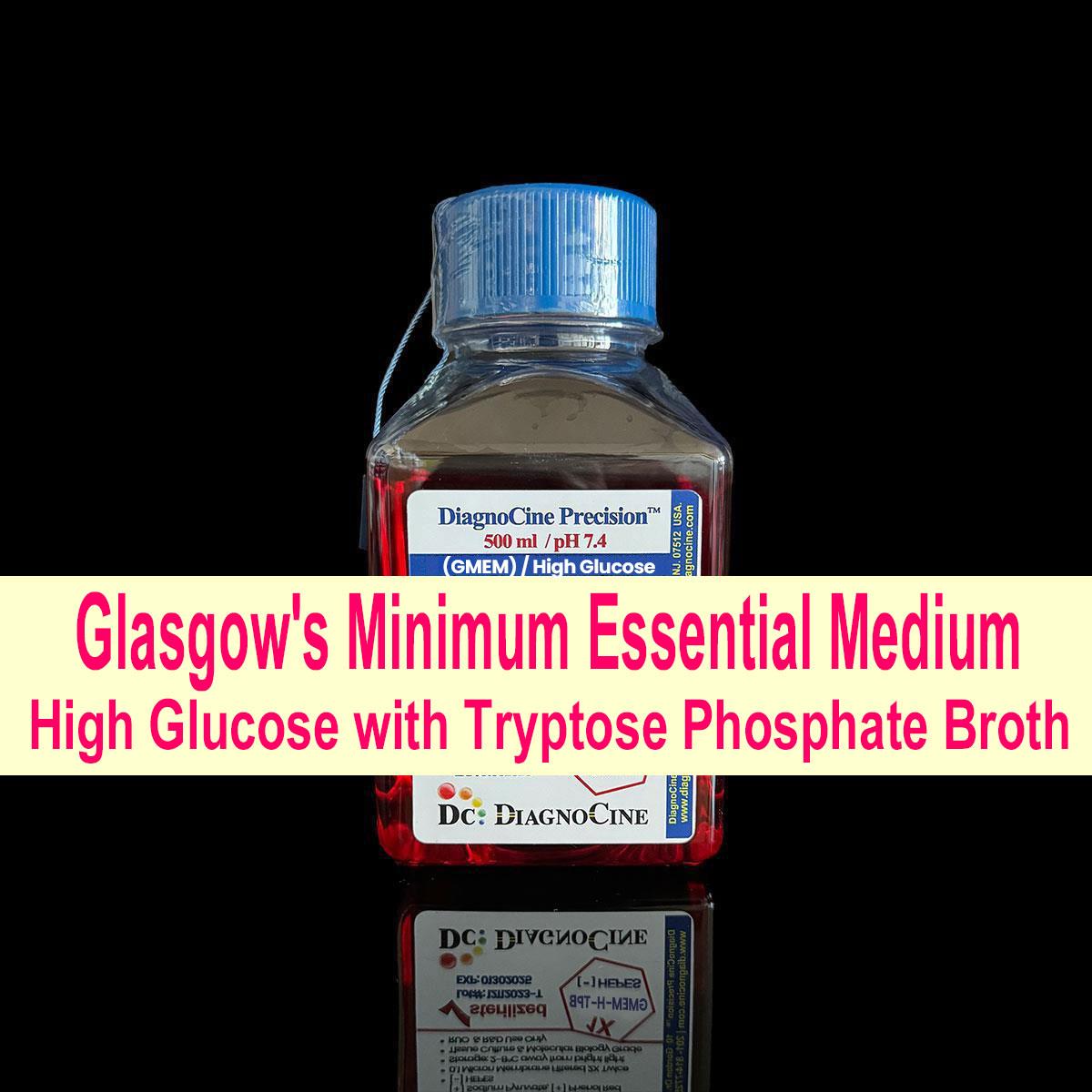
Glasgow's Minimum Essential Medium (GMEM), High Glucose with Tryptose Phosphate Broth
Select See the table below
- See the table below
FluxMPS™ Glasgow's Minimum Essential Medium (GMEM), High Glucose with Tryptose Phosphate Broth
Glasgow's Minimum Essential Medium (GMEM) is a modified version of Eagle's Minimal Essential Medium, originally developed by Ian McPherson and Michael Stoker. It is designed for use with adherent cell lines and was initially formulated for culturing BHK-21 cells. GMEM differs from standard MEM formulations by containing twice the normal concentration of amino acids and vitamins, making it a nutrient-rich medium. This family is supplied with Tryptose Phosphate Broth (TPB) included as standard, enhancing nutritional content and supporting optimal cell growth; TPB can improve cell attachment, proliferation, and overall culture performance, and is especially useful when working with low serum concentrations or in serum-free conditions, helping compensate for reduced nutrient availability. The standard supplementation is typically 10% TPB, complementing GMEM's already higher concentration of amino acids and vitamins compared to standard MEM formulations. High glucose levels can serve as an abundant energy source for cells, supporting increased metabolic demands and enabling extended culture periods without frequent media changes. Every FluxMPS™ variant is purified through quadruple-stage 0.04 micron filtration, engineered for organ-on-chip (OoC), tissue-on-chip (ToC), and lab-on-chip (LoC) microfluidic culture systems.
- 4 variants across Sodium Bicarbonate and HEPES inclusion/exclusion (L-Glutamine, Phenol Red, and Tryptose Phosphate Broth included in every variant)
- Twice the normal MEM concentration of amino acids and vitamins relative to BME baseline
- Tryptose Phosphate Broth (TPB) standard at 10% — improves cell attachment, proliferation, and overall culture performance, especially in low-serum or serum-free conditions
- High glucose formulation: 4.5 g/L (25 mM), suiting rapid proliferation and high glycolytic demand
- The medium of record for BHK-21 cells and foot-and-mouth disease (FMD) and rabies vaccine production worldwide
- Sodium bicarbonate buffering system requiring a humidified 5-10% CO2 atmosphere at 37°C
- FluxMPS™ quadruple-stage 0.04 micron filtration — finer than any ready-to-use cell culture media currently available
- Available in 500 mL and 1000 mL sizes; 2-8°C storage away from bright light; fully customizable on request
- Concentration1X
- Glucose4.5 g/L (25 mM), High Glucose
- L-GlutamineIncluded (all variants)
- Tryptose Phosphate BrothIncluded (all variants), 10% standard
- Sodium Bicarbonate / HEPESConfigurable (+/- ; HEPES 25 mM)
- Phenol RedIncluded (all variants)
- Sizes500 mL / 1000 mL
- Storage2-8 C, away from light
Select Your GMEM, High Glucose with TPB Configuration
Please select the supplement(s) of interest, then click Search. Check the supplement(s) you need below and press Search to instantly highlight every matching variant. Each row links straight through to its product page via the catalog number or the View button.
| Name | Cat No. | L-Glutamine | Bicarbonate | HEPES | Phenol Red | Product Page |
|---|---|---|---|---|---|---|
| GMEM | DCP-GMEM-N1X | check | check | remove | check | Viewarrow_forward |
| GMEM w/o Bicarbonate | DCP-GMEM-BN1X | check | remove | remove | check | Viewarrow_forward |
| GMEM + HEPES | DCP-GMEMH-N1X | check | check | check | check | Viewarrow_forward |
| GMEM + HEPES w/o Bicarbonate | DCP-GMEMH-BN1X | check | remove | check | check | Viewarrow_forward |
About Glasgow's Minimum Essential Medium (GMEM)
Glasgow's Minimum Essential Medium (GMEM) is a modification of Eagle's Basal Medium Eagle (BME), developed in 1962 by Ian A. Macpherson and Michael G.P. Stoker at the University of Glasgow as the culture medium for their studies on polyoma virus transformation of baby hamster kidney cells. It differs from BME in two principal ways: the addition of tryptose phosphate broth (TPB) as an undefined growth supplement, and doubling of both the amino acid and vitamin concentrations relative to the BME baseline. GMEM uses a high-glucose formulation (4.5 g/L) and a sodium bicarbonate buffering system; standard formulations also include ferric nitrate as a trace iron source, with bicarbonate buffering inherited from the Eagle/BME lineage and ferric nitrate from the DMEM lineage. It remains a standard medium for Baby Hamster Kidney 21 (BHK-21) cells and the cell substrate used globally for the production of foot-and-mouth disease (FMD) and rabies vaccines.
Origins and Development: The BHK-21 Cell Line and the Glasgow Laboratory
The BHK-21 cell line and the medium used to establish it share the same laboratory origin. The cells were derived in March 1961 by Ian A. Macpherson and Michael G.P. Stoker from the kidneys of five unsexed, 1-day-old Syrian golden hamsters (Mesocricetus auratus). After 84 days of continuous cultivation interrupted by an 8-day cryopreservation, clone 13 was isolated by single-cell plating to yield BHK-21/C13, the subclone universally used thereafter. The clones and medium were first used in the founding polyoma-transformation publication: Macpherson, I. & Stoker, M. (1962). "Polyoma transformation of hamster cell clones — an investigation of genetic factors affecting cell competence." Virology, 16: 147-151. PMID: 14468055.
The detailed cell-line derivation (the 84 days / 8-day freeze / clone) is the description carried by ATCC and traces to the formal line characterization, Stoker, M.G.P. & Macpherson, I.A. (1964), "Syrian hamster fibroblast cell line BHK21 and its derivatives," Nature 203: 1355-1357. The 1962 paper examined how genetic background influenced susceptibility to polyoma neoplastic transformation across four BHK-21 clones, and the medium — a BME modification with tryptose phosphate broth and doubled amino acid and vitamin concentrations — was disclosed within this virological context, much as DMEM had been communicated three years earlier via a Dulbecco footnote. The medium was named "Glasgow's Minimum Essential Medium" (GMEM) in recognition of its institutional origin.
Modifications from BME
GMEM is classified as a BME modification. (Some vendors describe it loosely as a modified Eagle's MEM, but the quantitative "twice the concentration" is consistently stated relative to BME.) The specific changes were:
- Amino acid concentrations doubled relative to BME — the 13 Eagle essential amino acids at 2x the BME level. (Commercial "GMEM + NEAA" variants additionally supply seven non-essential amino acids: glycine, L-alanine, L-asparagine, L-aspartic acid, L-glutamic acid, L-proline, L-serine — yielding 20 amino acids; the base/original GMEM contains the 13 essential amino acids only.)
- Vitamin concentrations doubled relative to BME, retaining the 8-vitamin MEM-type panel (biotin, present in BME, is not included) at 2x concentration.
- Tryptose phosphate broth (TPB) added at 10% v/v (approximately 2.95 g/L reconstituted from powder) — an undefined protein hydrolysate of pancreatic digest of casein (tryptone), peptone, yeast extract, dextrose, sodium chloride, and disodium hydrogen phosphate.
- High glucose (4.5 g/L); in contrast to BME's 1.0 g/L.
- Ferric nitrate included as the trace-iron source — a DMEM-lineage feature, not inherited from BME (BME contains no iron salt).
Composition
Per-lot Certificate of Analysis (CoA) requests can be directed to support@diagnocine.com.
Inorganic Salts
| Salt | mg/L |
|---|---|
| Calcium chloride dihydrate (CaCl2 * 2H2O) | 265.000 |
| Ferric nitrate nonahydrate [Fe(NO3)3 * 9H2O] | 0.100 |
| Magnesium sulfate anhydrous (MgSO4) | 97.677 |
| Potassium chloride (KCl) | 400.000 |
| Sodium bicarbonate (NaHCO3) | 2750.000 |
| Sodium chloride (NaCl) | 6400.000 |
| Sodium dihydrogen phosphate (NaH2PO4) | 107.8 |
Sodium phosphate: Contrary to the "phosphate-absent" framing sometimes seen, the standard GMEM formulation (Sigma G5154) contains NaH2PO4 at approximately 107.8 mg/L.
Ferric nitrate [Fe(NO3)3 * 9H2O] at 0.100 mg/L: This trace-iron source is shared with DMEM and is absent from BME; it is an inheritance from the DMEM lineage, distinguishing GMEM from CMRL 1066 (no added iron salt).
NaHCO3 at 2750 mg/L: GMEM's bicarbonate (2.75 g/L) lies between DMEM (3.7 g/L) and RPMI 1640 (2.0 g/L) / CMRL 1066 (2.2 g/L), requiring a humidified 5-10% CO2 atmosphere at 37°C.
NaCl at 6400 mg/L: Lower than DMEM and CMRL 1066 (both 6800), with osmolality partly compensated by the higher amino acid and glucose load.
Amino Acids
The base/original GMEM contains the 13 essential amino acids of the Eagle set at 2x BME concentration; the values below include the seven non-essential amino acids present in the AL058 "+NEAA" variant. L-glutamine is added separately.
| Amino Acid | mg/L |
|---|---|
| Glycine (NEAA variant) | 7.500 |
| L-Alanine (NEAA variant) | 8.900 |
| L-Arginine hydrochloride | 42.000 |
| L-Asparagine monohydrate (NEAA variant) | 15.000 |
| L-Aspartic acid (NEAA variant) | 13.000 |
| L-Cystine (as dihydrochloride) | 31.29 |
| L-Glutamic acid (NEAA variant) | 14.700 |
| L-Histidine hydrochloride monohydrate | 21.000 |
| L-Isoleucine | 52.400 |
| L-Leucine | 52.400 |
| L-Lysine hydrochloride | 73.100 |
| L-Methionine | 15.000 |
| L-Phenylalanine | 33.000 |
| L-Proline (NEAA variant) | 11.500 |
| L-Serine (NEAA variant) | 10.500 |
| L-Threonine | 47.600 |
| L-Tryptophan | 8.000 |
| L-Tyrosine disodium salt | 52.000 |
| L-Valine | 46.800 |
| L-Glutamine (added separately) | 292 mg/L (2 mM) |
Vitamins
| Vitamin | mg/L |
|---|---|
| Choline chloride | 2.000 |
| D-Calcium pantothenate | 2.000 |
| Folic acid | 2.000 |
| Nicotinamide | 2.000 |
| Pyridoxal hydrochloride | 2.000 |
| Riboflavin | 0.200 |
| Thiamine hydrochloride | 2.000 |
| myo-Inositol | 3.600 |
Other Components
| Component | mg/L |
|---|---|
| D-Glucose | 4500.000 |
| Phenol red sodium salt | 15.000 |
High-glucose formulation (4.5 g/L = 25 mM): equivalent to high-glucose DMEM — a design choice suiting BHK-21's rapid proliferation and high glycolytic demand. Contrasts with CMRL 1066 (1.0 g/L) and Click's EHAA (1.0 g/L). Sodium pyruvate: absent from the AL058 base formulation, but variant-dependent. No HEPES: GMEM relies on bicarbonate buffering; HEPES is not part of the base formulation, though 25 mM HEPES is offered as a standard customization concentration.
Complete Composition Summary
| Category | Details |
|---|---|
| Parent medium | Eagle's BME (modified) |
| Salt system | Earle's-type (MgSO4; NaCl); ferric nitrate trace-iron source; NaH2PO4 present in standard GMEM (approximately 107.8 mg/L) |
| Amino acids | 13 essential at 2x BME in base/original; +7 non-essential (= 20) in "+NEAA" variants; L-glutamine added separately |
| Vitamins | 8 vitamins at 2x BME; pyridoxal HCl as B6; no biotin, no B12 |
| Glucose | 4500 mg/L (25 mM) — high glucose |
| Sodium pyruvate | Absent from base AL058; present (110 mg/L) in some variants |
| NaHCO3 | 2750 mg/L; requires 5-10% CO2 |
| pH | 7.00-7.60 |
| Osmolality | 275-315 mOsm/kg H2O |
| L-Glutamine | Not in base; add 10 mL of 200 mM stock per liter (= 2 mM final) |
| Tryptose phosphate broth | Not in base; add 2.95 g/L powder or 100 mL/L of 10x liquid broth |
| Serum supplement | 5-10% FBS or hamster serum; hamster (species-specific) serum can improve BHK-21 growth and virus yields |
Media Lineage Comparison
| Feature | GMEM | BME | DMEM |
|---|---|---|---|
| Parent medium | BME (modified) | — | BME (modified) |
| Developer & year | Macpherson & Stoker, 1962 | Eagle, 1955 | Dulbecco & Freeman, 1959 |
| Essential amino acids | 13 at 2x BME | 13 at 1x (baseline) | 13 at approximately 4x BME |
| Non-essential amino acids | 7 (in +NEAA variants) | None | 2 (glycine + serine) |
| Total AA in base | 13 (standard) / 20 (+NEAA) | 13 | 15 |
| Vitamin level | 2x BME; 8 vitamins | 1x (baseline); 9 vitamins | approximately 4x BME; 8 vitamins |
| Vitamin B6 form | Pyridoxal HCl | Pyridoxal HCl | Pyridoxine HCl |
| Biotin | Absent | Present | Absent |
| Glucose | 4500 mg/L (25 mM) | 1000 mg/L | 4500 (high) or 1000 (low) |
| Ferric nitrate | Yes, 0.100 mg/L (DMEM-lineage) | No | Yes |
| Sodium phosphate (base) | Present (approximately 107.8) in standard; omitted in AL058 | Absent | Present (NaH2PO4) |
| Sodium pyruvate | Variant-dependent (0 or 110) | Absent | Present (optional; 110 mg/L) |
| Undefined supplement | TPB (add separately) | None | None |
| NaHCO3 | 2750 mg/L | approximately 2200 mg/L | 3700 mg/L |
| Osmolality | 275-315 mOsm/kg | approximately 270-290 mOsm/kg | 320-355 mOsm/kg |
| Primary application | BHK-21; FMD & rabies vaccine production | General adherent; HeLa, L cells | General adherent; HEK293, fibroblasts |
Validated Cell Types and Applications
Founding Application: BHK-21 Polyoma Transformation Studies
GMEM was developed expressly for the culture of BHK-21/C13 fibroblast clones to investigate polyoma virus neoplastic transformation. The 1962 founding paper used GMEM + TPB to maintain four independent BHK-21 clones through polyoma exposure, quantifying transformation frequencies to examine genetic background effects on cell competence, thereby establishing GMEM as the medium of record for 1960s BHK-21/polyoma virology.
Routine BHK-21 Cell Maintenance
BHK-21 cells are maintained in GMEM supplemented with 2 mM L-glutamine, 10% FBS (or 5-10% hamster serum), and TPB at 2.95 g/L, at 37°C in 5% CO2. Seed stocks for vaccine production are traditionally established in monolayer GMEM + 10% FBS before suspension adaptation.
Foot-and-Mouth Disease (FMD) Vaccine Production
Suspension BHK-21 cells in GMEM-based systems are the internationally established substrate for inactivated FMDV vaccines, among the most economically significant veterinary vaccines worldwide. Large-scale processes use suspension-adapted BHK-21 in stirred-tank bioreactors, with serum-free/protein-free media increasingly replacing GMEM + serum for GMP manufacturing.
Rabies Vaccine Production
BHK-21/C13 cells in GMEM-based culture are a validated substrate for inactivated rabies vaccine (veterinary and human). Industrial-scale processes (e.g., 1000 L stirred-tank cultures with the LEP Flury strain) using BHK-21 suspension cells have met WHO potency requirements; WHO recognizes BHK-21 as an acceptable cell substrate for human rabies vaccine production.
Alphavirus, Bunyavirus & Flavivirus Production
GMEM-grown BHK-21 cells are a permissive host for a range of RNA viruses, including alphaviruses (Sindbis and Semliki Forest viruses), bunyaviruses, and flaviviruses, yielding high titers owing to their permissiveness and rapid proliferation.
Herpes Simplex Virus Research
GMEM-grown BHK-21 cells have served as a permissive host for HSV studies, including viral replication, heat-sensitive DNase activities, and neoplastic reversion work.
Why FluxMPS™ GMEM, High Glucose with TPB
Quadruple-Stage 0.04 Micron Filtration
Purified to 0.04 microns — finer than any ready-to-use cell culture media currently available — removing the microscopic particulates and protein aggregates that silently block micro-channels.
Built for OoC / ToC / LoC Platforms
Engineered from the ground up for Organ-on-Chip, Tissue-on-Chip, and Lab-on-Chip platforms, where the medium itself is part of the instrument and cannot be an afterthought.
Particulate & Aggregate Removal
Eliminates particulates and protein aggregates that disrupt laminar flow and generate false biological signals before the media ever reaches the chip.
Optical Clarity
Supports real-time imaging and integrated biosensing on Organ-on-Chip platforms, where optical clarity of the medium is essential to data quality.
FDA-Recognized Physiological Modeling Standards
Formulated to support FDA-recognized physiological modeling standards, providing a validated, reproducible media foundation for regulatory-facing studies.
Drug Discovery, Toxicology & Translational Research
A validated foundation for drug discovery, toxicology screening, and translational research, where downstream data must stand up to regulatory scrutiny.
Quadruple-Stage Filtration System
Every FluxMPS™ GMEM, High Glucose with TPB variant passes through the same four-stage architecture before reaching your chip.
-
01
Pre-Filtration Stage 1 0.1 µm
Initial coarse particulate removal.
-
02
Pre-Filtration Stage 2 0.1 µm
Secondary particulate and aggregate reduction.
-
03
Sterile Filtration Stage 1 0.04 µm
Fine sterile filtration below standard 0.22 micron practice.
-
04
Sterile Filtration Stage 2 0.04 µm
Final polish for microfluidic-grade clarity.
Engineered for Flow, Not Just Growth
Every component is optimized for consistent, laminar flow performance across complex micro-channel geometries, capillary-bed and vascular simulations, and long-term automated perfusion studies running continuously for weeks.

Frequently Asked Questions
Verified Bibliography
- Macpherson, I. & Stoker, M. (1962). Polyoma transformation of hamster cell clones — an investigation of genetic factors affecting cell competence. Virology, 16: 147-151. PMID: 14468055. DOI: 10.1016/0042-6822(62)90290-8
- Stoker, M.G.P. & Macpherson, I.A. (1964). Syrian hamster fibroblast cell line BHK21 and its derivatives. Nature, 203: 1355-1357.
- Eagle, H. (1955). Nutrition Needs of Mammalian Cells in Tissue Culture. Science, 122(3168): 501-504. PMID: 13255879
- Stoker, M.G.P. & Macpherson, I.A. (1961). Studies on transformation of hamster cells by polyoma virus in vitro. Virology, 14: 359-370.
- Tektoff, J., et al. Production of rabies vaccine by an industrial scale BHK 21 suspension cell culture process. Develop. Biol. Standard. PMID: 3899780
- Yao, T. & Asayama, Y. (2017). Animal-cell culture media: History, characteristics, and current issues. Reproductive Medicine and Biology, 16(2): 99-117. PMC5661806
FluxMPS™ — Precision Cell Culture Media for Microphysiological Systems
Built for the architecture of the future. Not the flask of the past.
Traditional cell culture media were formulated for static well plates and flasks — environments that tolerate impurities, precipitates, and particle loads that would immediately compromise a microfluidic system. FluxMPS™ was designed from the ground up for Organ-on-Chip (OoC), Tissue-on-Chip (ToC), and Lab-on-Chip (LoC) platforms, where the medium itself is part of the instrument.
Purity That Protects Your Platform
FluxMPS™ is purified to 0.04 microns — finer than any ready-to-use cell culture media currently available. At this level, the microscopic particulates and protein aggregates that silently block micro-channels, disrupt laminar flow, and generate false biological signals are eliminated before the media ever reaches your chip.
The result: your platform stays operational, your data stays clean, and your biology drives the result — not your media.
Engineered for Flow, Not Just Growth
The name FluxMPS™ reflects its core design principle. Every component is optimized for consistent, laminar flow performance across:
- Complex micro-channel geometries
- Capillary-bed and vascular simulations
- Long-term automated perfusion studies running continuously for weeks
Zero-clogging performance is not a feature — it is the baseline specification.
Applications & Performance
| Application | What FluxMPS™ Delivers |
|---|---|
| Microfluidics | Stable shear stress; no channel blockage |
| Metabolic Tracing | Ultra-pure matrix with no contaminant interference |
| Long-term Perfusion | Consistent formulation stability over weeks of continuous flow |
| Organ-on-Chip | Optical clarity for real-time imaging and integrated biosensing |
Regulatory Foundation
FluxMPS™ is formulated to support FDA-recognized physiological modeling standards, providing a validated, reproducible media foundation for drug discovery, toxicology screening, and translational research. When your downstream data needs to stand up to regulatory scrutiny, your upstream media cannot be an afterthought.
The Bottom Line
Microfluidic platforms are precision instruments. They require precision inputs.
FluxMPS™ is the only ready-to-use cell culture medium engineered specifically to meet that standard — protecting your chip, your cells, and your science.