


Formalin-Ethanol Solution
FluxMPS™ Formalin-Ethanol Solution
FluxMPS™ Formalin-Ethanol Solution (DCP-FEA1X) is an MPS-grade, ultra-filtered dual-fixative combining 10% formalin (37–40% formaldehyde, CH2O) with 90% ethanol (80% v/v, C2H5OH) for rapid, biomolecule-preserving tissue fixation. Quadruple-stage 0.1-micron membrane (twice) and 0.04-micron membrane (twice) filtration delivers sterile, DNase- and RNase-free reagent quality suited to histopathology, molecular pathology, and organ-chip endpoint tissue analysis.
- Filtered 0.1-micron membrane twice and 0.04-micron membrane twice for sterile, ultra-clean fixative chemistry
- World’s cleanest reagents for cell and molecular biology experiments
- No detectable DNase or RNase activity after 18-hour room-temperature challenge
- Standardized 10% formalin (37–40% formaldehyde) / 90% ethanol (80% v/v) ratio balances cross-linking and coagulative fixation
- Reduced protein cross-linking versus neutral buffered formalin improves downstream antigen retrieval for IHC
- 12-month shelf life; store at room temperature in amber packaging away from bright light
- Manufactured under ISO 13485-certified, CE-approved facilities; final packaging and QA at the DiagnoCine R&D and Quality Testing Center
- Custom concentrations, additives, pH, and formulation modifications available on request
- Formulation10% Formalin (37–40% formaldehyde) / 90% Ethanol (80% v/v)
- AppearanceClear solution
- Filtration0.1 µm membrane x2 + 0.04 µm membrane x2
- SterilitySterile
- DNase ActivityNone detected
- RNase ActivityNone detected
- StorageRoom temperature, amber, protected from light
- Shelf Life12 months
- Manufacturing StandardISO 13485:2016, CE-approved
- Intended UseResearch Use Only (RUO)
Engineered where standard fixatives fall short
Conventional 0.22 µm-filtered fixatives can carry subvisible particulates, inconsistent bioburden control, and background contaminants into sensitive histology, molecular pathology, and organ-chip endpoint workflows. FluxMPS™ Formalin-Ethanol Solution is built to remove those failure modes at the source.
Microchannel-safe purity
Final 0.04 µm membrane pass minimizes particulate carryover into fine tissue architecture and downstream molecular workflows.
Precise fixation chemistry
A standardized 10% formalin (37–40% formaldehyde) / 90% ethanol (80% v/v) ratio balances cross-linking fixation with coagulative dehydration.
Ultrapure-grade water
Formulated with Ultrapure Type 1 water (18.2 MΩ·cm), per USP <85> water-quality practice.
Low background for IHC & imaging
Reduced protein cross-linking relative to neutral buffered formalin enhances antigen retrieval for immunohistochemistry and immunofluorescence.
Defined, traceable composition
Fixed-ratio formalin and ethanol components are lot-released and documented for reproducible histopathology and molecular-pathology results.
Customization on demand
Alternate concentrations, additional chemicals, compounds, proteins, supplements, or a different pH can be produced on request.
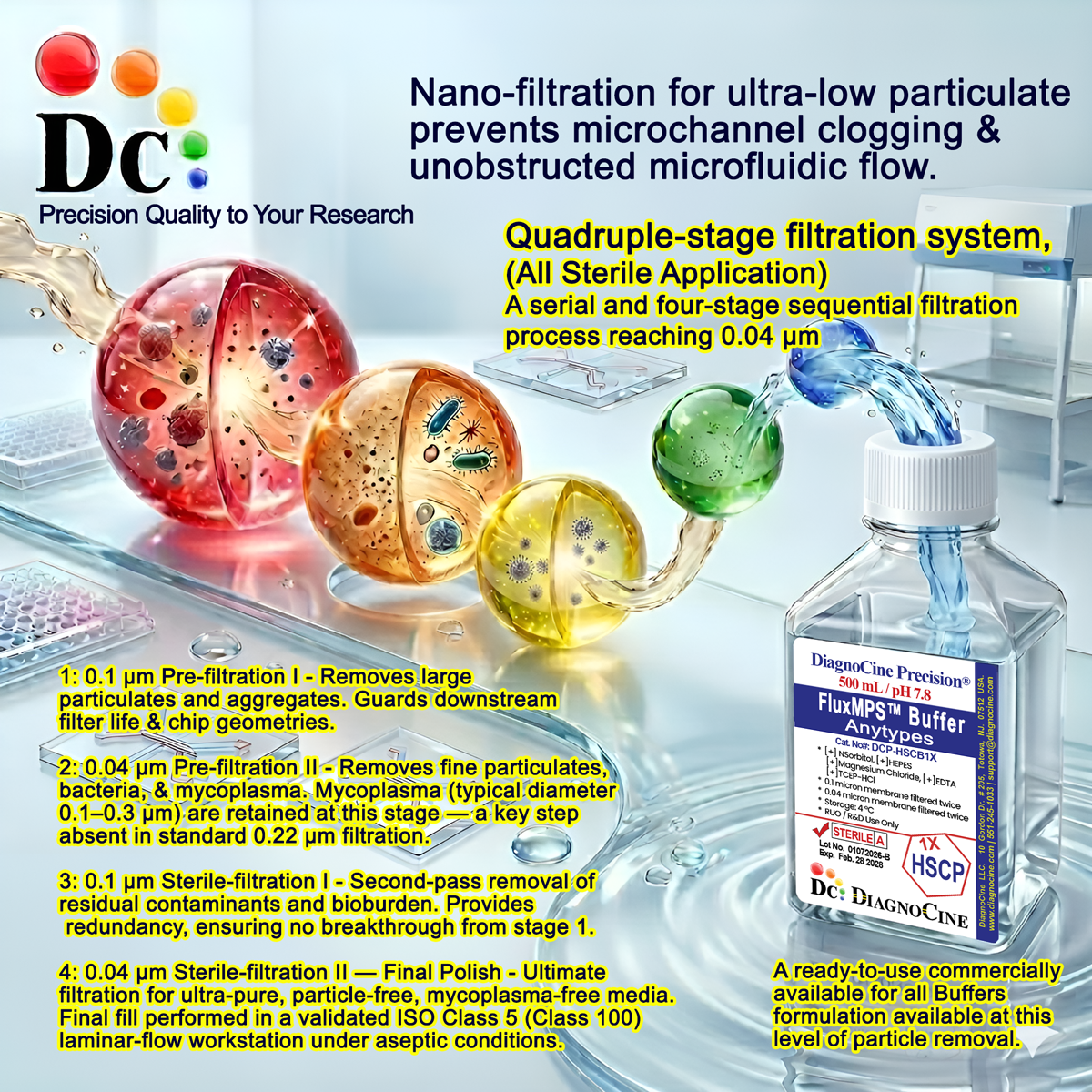
Quadruple-stage filtration system
DCP-FEA1X is filtered through a 0.1-micron membrane twice and a 0.04-micron membrane twice, delivering a sterile, ultra-clean fixative solution suited to histopathology, molecular pathology, and organ-chip endpoint tissue analysis.
-
1
0.1 µm Pre-filtration I
First 0.1-micron membrane pass removes large particulates and aggregates, extending the working life of downstream filters.
-
2
0.04 µm Pre-filtration II
First 0.04-micron membrane pass retains fine particulates and reduces bioburden ahead of final sterile filtration.
-
3
0.1 µm Sterile-filtration I
Second 0.1-micron membrane pass provides redundant particulate and bioburden control.
-
4
0.04 µm Sterile-filtration II — Final Polish
Second 0.04-micron membrane pass provides the final polish. Because the smallest mycoplasma type is about 0.2 microns, this pore size functions as a mycoplasma barrier, preventing mycoplasma contamination.
Performance vs. conventional fixative
Sequential 0.1-micron and 0.04-micron membrane filtration removes finer particulates than a single 0.22-micron pass and blocks organisms at the mycoplasma size range, supporting sterile, low-background histology and molecular pathology results.
© Diagnocine® — DCP-FEA1X
Where DCP-FEA1X performs
Combining formalin cross-linking with ethanol coagulative dehydration, DCP-FEA1X supports histopathology, molecular pathology, immunohistochemistry, and archival tissue workflows.
Automated Bioreactors & Robotics
For automated tissue processors and robotic slide-staining or embedding systems, an optional further-filtered variant of this fixative chemistry can be produced on request to help protect valve and sensor components in automated fluid paths.
- Total Particulate Exclusion: additional membrane polishing available on request
- Valve & Sensor Protection: reduces particulate load reaching automated fluid-handling components
- Extended Perfusion Stability: supports consistent performance in automated processing lines
Inquiry Required: contact support@diagnocine.com to request a further-filtered variant for automated systems.
Routine & Surgical Histology
Preserves fine cytological detail in biopsies, surgical specimens, and autopsy tissue.
Nucleic Acid Preservation
Maintains RNA/DNA integrity for downstream PCR, sequencing, and hybridization assays.
Long-Term Tissue Archival
Provides stable tissue preservation for retrospective studies and tissue repositories.
Immunohistochemistry (IHC) Workflows
Reduced protein cross-linking compared to neutral buffered formalin enhances antigen retrieval.
Organ-Chip & MPS Endpoint Fixation
Fixes organ-on-a-chip and MPS-derived tissue models for downstream histological and molecular analysis.
Cold-Chain & Transport Preservation
Dehydrating properties reduce ice-crystal formation, supporting transport of specimens in cold environments.
Specification summary
Values below reflect only the parameters stated for DCP-FEA1X.
| Parameter | Specification |
|---|---|
| Formulation / Composition | 10% Formalin (37–40% formaldehyde) / 90% Ethanol (80% v/v) |
| Appearance | Clear solution |
| Parameter | Specification |
|---|---|
| Sterility USP <71> | Sterile |
| DNase Activity | None detected (18 hr, room temperature, plasmid DNA) |
| RNase Activity | None detected (18 hr, room temperature, ribosomal RNA) |
| Water Quality | Ultrapure Type 1 water (18.2 MΩ·cm) |
| Filtration System | 0.1 µm membrane x2 + 0.04 µm membrane x2 |
| Parameter | Specification |
|---|---|
| Storage Temperature | Room temperature, protected from light (amber packaging) |
| Shelf Life | 12 months |
| Parameter | Specification |
|---|---|
| Manufacturing QMS ISO 13485 | ISO 13485:2016 certified facilities |
| Regulatory Alignment | CE-approved |
| Production Method | Final packaging, QA, and testing at the DiagnoCine R&D and Quality Testing Center; customization and assembly at DiagnoCine Precision, Totowa, New Jersey, USA |
| Intended Use | Research Use Only (RUO) |
Full composition
Fixed-ratio formalin and ethanol components, lot-released for reproducible fixation performance.
| Component | CAS Number | Concentration |
|---|---|---|
| Formalin (37–40% formaldehyde, CH2O) | 50-00-0 | 10% |
| Ethanol (80% v/v, C2H5OH) | 64-17-5 | 90% |
Manufacturing & compliance
DCP-FEA1X is produced and released under a documented quality system with product-specific nuclease and sterility testing.
ISO 13485:2016 QMS
Manufactured under ISO 13485-certified and CE-approved facilities (Suppliers of DiagnoCine Precision).
Ultrapure Type 1 Water
Formulated with Ultrapure Type 1 water (18.2 MΩ·cm).
ISO Class 5 Fill & Finish
Final packaging and quality assurance completed at the DiagnoCine R&D and Quality Testing Center.
Micro-Batch Precision
Custom concentration, additive, and pH requests are assembled at DiagnoCine Precision, Totowa, New Jersey, USA.
DNase Activity
None detected after 18-hour room-temperature incubation with plasmid DNA.
RNase Activity
None detected after 18-hour room-temperature incubation with ribosomal RNA.
Sterility & Filtration Assurance
Filter-sterilized with 0.1-micron membrane twice and 0.04-micron membrane twice.
Documentation / CoA
Certificate of Analysis available on request.
How DCP-FEA1X compares
Comparison against conventional 0.22-micron-filtered fixatives, including standard neutral buffered formalin (NBF).
| Parameter | DCP-FEA1X (FluxMPS™) | Conventional NBF (0.22 µm filtered) | Standard Alternative (0.22 µm filtered) |
|---|---|---|---|
| Final filtration pore size | 0.04 µm | 0.22 µm | 0.22 µm |
| Number of filtration stages | 4 | 1 | 1 |
| Sterility | check_circle Sterile | cancel | cancel |
| DNase / RNase tested | check_circle None detected | cancel | cancel |
| Genomic DNA/RNA recovery vs. NBF | 15–20% higher | Baseline | Baseline |
| Manufacturing QMS | ISO 13485:2016, CE-approved | Not specified | Not specified |
| Custom formulation | check_circle | cancel | cancel |
Frequently asked questions
Common questions about DCP-FEA1X Formalin-Ethanol Solution.
Supporting literature
Curated literature on formalin-ethanol fixation, nucleic acid preservation, and tissue chip histology.
- Fox CH, Johnson FB, Whiting J, Roller PP. Formaldehyde fixation. J Histochem Cytochem. 1985;33(8):845-853. doi:10.1177/33.8.3894502
- Srinivasan M, Sedmak D, Jewell S. Effect of fixatives and tissue processing on the content and integrity of nucleic acids. Am J Pathol. 2002;161(6):1961-1971. doi:10.1016/S0002-9440(10)64472-0
- Vincek V, Nassiri M, Nadji M, Morales AR. A tissue fixative that protects macromolecules (DNA, RNA, and protein) and histomorphology in clinical samples. Lab Invest. 2003;83(10):1427-1435. doi:10.1097/01.LAB.0000090154.55436.D1
- Hewitt SM, Lewis FA, Cao Y, et al. Tissue handling and specimen preparation in surgical pathology: issues concerning the recovery of nucleic acids from formalin-fixed, paraffin-embedded tissue. Arch Pathol Lab Med. 2008;132(12):1929-1935. doi:10.5858/132.12.1929
- Ingram M, Techy GB, Saroufeem R, et al. Preservation of RNA in fixed tissue for molecular pathology applications. Biotechniques. 2006;41(3):315-320. doi:10.2144/000112224
- Uphoff CC, Drexler HG. Detection of mycoplasma contaminations. Methods Mol Biol. 2005;290:13-23. doi:10.1385/1-59259-838-2:013
- Bhatia SN, Ingber DE. Microfluidic organs-on-chips. Nat Biotechnol. 2014;32(8):760-772. doi:10.1038/nbt.2989
- Ramaiahgari SC, den Braver MW, Herpers B, et al. A 3D in vitro model of differentiated HepG2 cell spheroids for histopathology-relevant hepatotoxicity endpoints. Arch Toxicol. 2014;88(5):1083-1095. doi:10.1007/s00204-014-1215-9
- Taylor CR, Levenson RM. Quantification of immunohistochemistry--issues concerning methods, utility and semiquantitative assessment II. Histopathology. 2006;49(4):411-424. doi:10.1111/j.1365-2559.2006.02513.x