

Flamma® 594NA NHS ester
Size of product (mg)
-
1 mg

-
5 mg

-
25 mg

Flamma® 594NA NHS ester
Cat. No. List below
Description
The NHS ester reactive group of Flamma 594NA readily forms stable amide bonds with primary amines, such as the ε-amino groups of lysine residues in proteins or the amine terminus of modified nucleotides. This property makes it ideal for labeling various biomolecules and for incorporation into oligonucleotide synthesis as a fluorescent label.
Key Features:
1. Bright yellow fluorescent dye with Ex/Em maxima at 583/603 nm
2. NHS ester reactive group for efficient conjugation to primary amines
3. Extinction coefficient of ≥ 92,000 cm?¹M?¹
4.Molecular weight of 817.95 g/mol
5. Soluble in DMF and DMSO
6. Purple solid appearance
Applications:
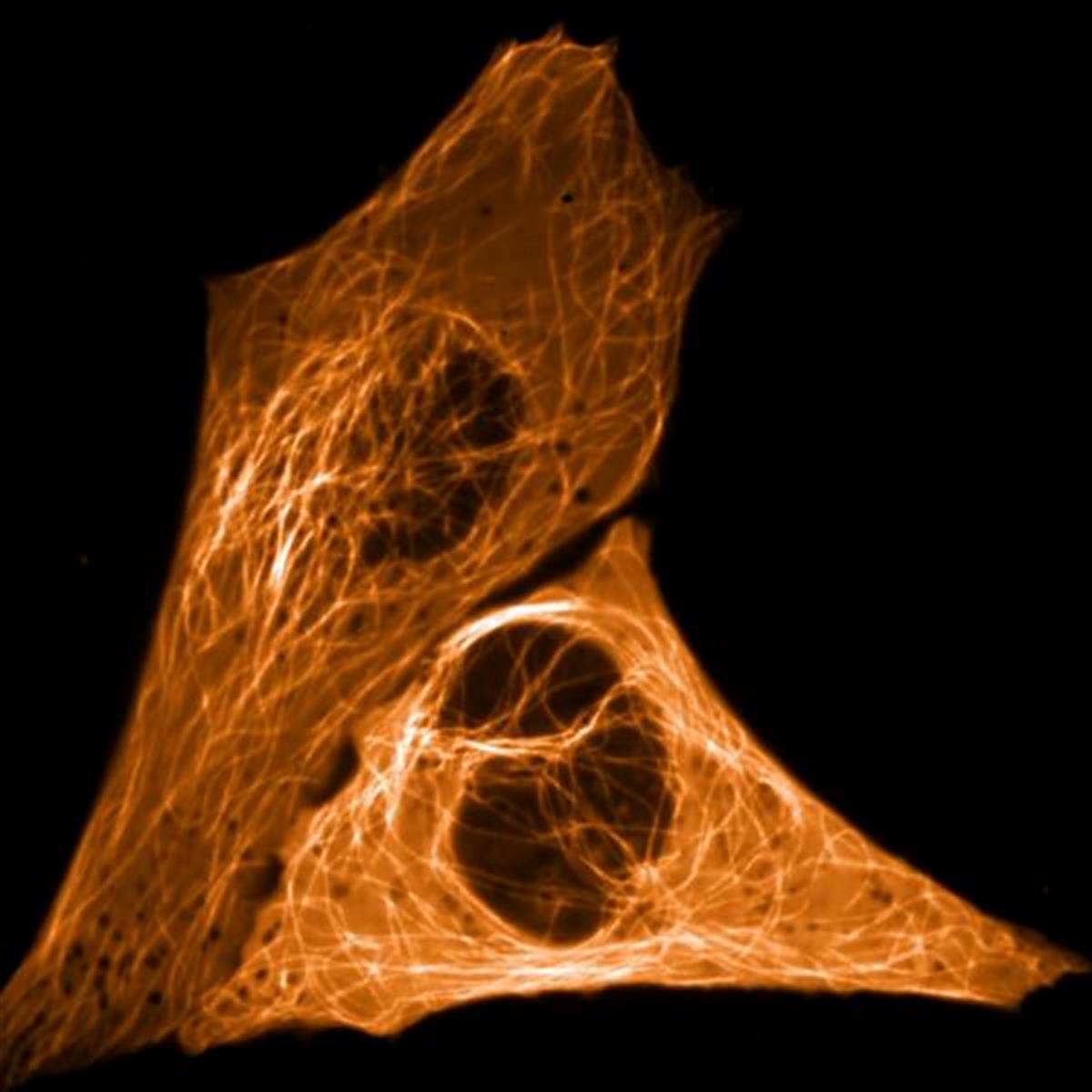
1. Bioimaging and fluorescence microscopy
2. Labeling of proteins, antibodies, and peptides
3. Incorporation into solid-phase oligonucleotide synthesis
4. Detection of low-abundance biomolecules
5. Replacement for Texas Red in existing protocols
Advantages:
1. Spectral similarity to widely used fluorophores, allowing easy integration into existing imaging setups
2. Stable fluorescence signal for reliable imaging results
3. Versatile excitation options with multiple laser lines
4. Efficient conjugation to various biomolecules through NHS ester chemistry
5. Suitable for sensitive detection of low-abundance targets
6. Higher extinction coefficient compared to the provided specifications, offering improved brightness
For optimal performance, Flamma Fluors 594NA NHS ester should be stored at -20°C and protected from light1. Its molecular formula is C₃?H₄?N₃O₁₃S₃.The dye is available in various package sizes, including 1 mg, 5 mg, and 25 mg.
- Fluorophore: Flamma Fluors 594NA
- Reactive group: NHS ester
- Excitation/Emission Max.(nm): 583/603
- Spectrally similar dyes: Alexa 594, DyLight 594, Texas Red-X
- Extinction coefficient: ≥ 92,000 cm-1M-1
- Appearance: Purple Solid
- Molecular Weight: 817.95 g/mol
- Molecular Formula: C38H47N3O13S3
- Solubility: DMF, DMSO
- Storage conditions: -20 ℃, protect from light
| Quick link (Cat.#) | Series | EXmax (nm) | EMmax (nm) | Spectrally similar dyes |
| PNS1122 | Flamma® 552NA NHS ester | 553 | 570 | Alexa 555, DyLight 549, Cy 3, ATTO 550 |
| PNS1415 | Flamma® 581NA NHS ester | 590 | 608 | Alexa 594, DyLight 594, Cy 3.5 |
| KNS1001 | Flamma® 594NA NHS ester | 583 | 603 | Alexa594, DyLight594, Texas Red-X |
| PNS1215 | Flamma® 648NA NHS ester | 646 | 665 | Alexa647, DyLight650, Cy5 |
| PNS1515 | Flamma® 675NA NHS ester | 689 | 709 | Alexa680, DyLight680, Cy5.5, IRDye680LT, CF 680 |
| COS1030 | HEX NA NHS ester | |||
| COS1022 | TET NA NHS ESTER |
Background
Fluorescent Dyes for Oligonucleotide Synthesis
Fluorescent oligonucleotide probes are developed for the detection and the quantification of target DNA or RNA sequence with the high sensitivity and specificity along with low toxicity. They have been used in a wide range of applications including, FISH, in situ hybridization, sequencing and genotyping. Fluorescent dye and quencher paired molecular beacon probes are widely used in the field of real–time nucleic acid detection and PCR quantification, SNP detection, and clinical diagnostic assays.
There are two major strategies for chemical incorporation of fluorescent dyes into an oligonucleotides: direct fluorescence labeling during chemical synthesis and post synthetic fluorescence labeling. The direct oligonucleotide labeling during solid phase synthesis can be achieved via the standard phosphoramidite chemistry containing various spacer arm lengths. Direct labeling during solid phase chemical synthesis might afford high yield but also increases the risk of damaging fluorescence tag from acidic deprotection step. Thus certain fluorescent dyes are not compatible with solid phase chemical synthesis, thus their labeling must be conducted post–synthetically through various labeling methodologies.
Post synthetic labeling of a fluorescent dye to an oligonucleotide can be achieved by labeling various activated dyes to modified oligomers having functional groups such as primary amine, thiol, aldehyde, azide, alkyne, or carboxylic acids. Depending on binding target, the fluorophore might be selectively introduced at either the 5′ or 3′ ends of the oligonucleotide as well as randomly incorporated throughout the sequence. BioActs offers fluorescent dye phosphoramidites and fluorescent nucleotide phosphoramidites for direct fluorescence labeling and Flamma NA series dyes for post synthetic fluorescence labeling method.
Citation & Reference
1. Xu, Peisheng. Zwitterionic chitosan derivatives for pH-sensitive stealth coating. Biomacromolecules 11.9 (2010): 2352-2358.
2. Ibrahim, Basma M. A strategy to deliver genes to cystic fibrosis lungs: a battle with environment. Journal of controlled release 155.2 (2011): 289-295.
3. Oh, Keun Sang. Accurate sequential detection of primary tumor and metastatic lymphatics using a temperature-induced phase transition nanoparticulate system. International journal of nanomedicine 9 (2014): 2955.
4. Yhee, Ji Young. Tumor-targeting transferrin nanoparticles for systemic polymerized siRNA delivery in tumor-bearing mice. Bioconjugate chemistry 24.11 (2013): 1850-1860.
5. Yoon, Hong Yeol. Glycol chitosan nanoparticles as specialized cancer therapeutic vehicles: Sequential delivery of doxorubicin and Bcl-2 siRNA. Scientific reports 4 (2014).
6. Ryu, Ju Hee. Early diagnosis of arthritis in mice with collagen?induced arthritis, using a fluorogenic matrix metalloproteinase 3–specific polymeric probe. Arthritis & Rheumatism 63.12 (2011): 3824-3832.
7. Hollis, Christin P. In vivo investigation of hybrid paclitaxel nanocrystals with dual fluorescent probes for cancer theranostics. Pharmaceutical research 31.6 (2014): 1450-1459.
8. Koo, Heebeom. The movement of self-assembled amphiphilic polymeric nanoparticles in the vitreous and retina after intravitreal injection. Biomaterials 33.12 (2012): 3485-3493.
9. Zhu, Lei. Real-time monitoring of caspase cascade activation in living cells. Journal of controlled release 163.1 (2012): 55-62.
10. Yoon, Hong Yeol. Bioreducible hyaluronic acid conjugates as siRNA carrier for tumor targeting. Journal of Controlled Release 172.3 (2013): 653-661.
11. Yhee, Ji Young. Cancer-targeted MDR-1 siRNA delivery using self-cross-linked glycol chitosan nanoparticles to overcome drug resistance. Journal of Controlled Release 198 (2015): 1-9.
12. Park, Jin Woo. Wide-Ranged Fluorescent Molecular Weight Size Markers for Electrophoresis. Bulletin of the Korean Chemical Society 34.1 (2013): 29-30.
13. Huang, Xinglu. Multiplex Imaging of an Intracellular Proteolytic Cascade by using a Broad?Spectrum Nanoquencher. Angewandte Chemie International Edition 51.7 (2012): 1625-1630.
