

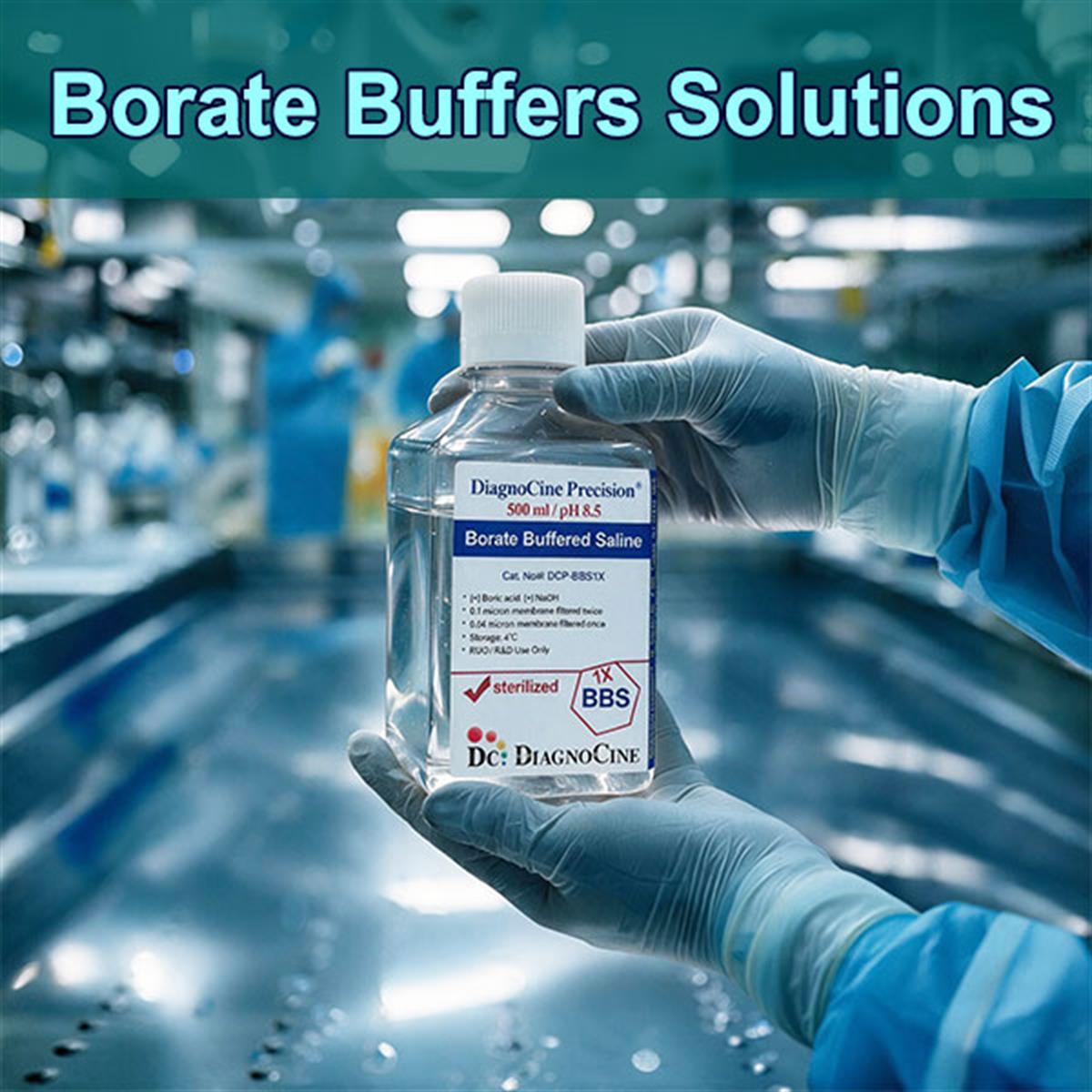
Borate Buffers - A Selection Guide for the Research Laboratory
Two formulations, one page. Pick the borate chemistry your protocol needs and go straight to its product page — the buffer-selection table, applications, and handling notes follow below.
| Borate Buffer | Core Composition · Working pH | Primary Use | Product Page |
|---|---|---|---|
| Tris Borate EDTA Running Buffer [1X] | TBE · Tris base, boric acid, EDTA · ~pH 8.3 | Nucleic acid electrophoresis, especially small DNA fragments and RNA on PAGE and agarose | Viewarrow_forward |
| Borate Buffered Saline [1X] | BBS · Boric acid/sodium borate with NaCl · pH 8.2 to 8.6 | Amine-coupling conjugation, antibody crosslinking, alkaline ELISA plate coating | Viewarrow_forward |
Running a gel? Compare TBE, TAE, and sodium/lithium borate · See applications by workflow · Read the FAQ
Why a lab reaches for borate specifically
Borate buffers are characterized by two properties that other biological buffers lack. Boric acid has a pKa near 9.24, giving stable buffering in the alkaline range of roughly pH 8 to 10 where Tris and phosphate are weak. And borate ions form reversible covalent complexes with cis-diols, the adjacent hydroxyl pairs found on sugars, glycans, catechols, and the ribose of RNA and nucleotides. Those two features, not general-purpose buffering, are the reason to reach for borate: alkaline amine-coupling chemistry, low-conductivity nucleic acid electrophoresis, and diol-selective separation and capture.
- Two formulations stocked: Tris-borate-EDTA (TBE) running buffer, 1X, and borate-buffered saline (BBS), 1X.
- Alkaline buffering holds pH stably from about 8 to 10 — the range required by NHS-ester and other amine-reactive coupling chemistries.
- No primary amines. Unlike Tris, borate carries no competing amine, so it does not quench NHS-esters or aldehyde couplings.
- cis-Diol complexation reversibly converts neutral diols into charged anionic complexes — the mechanism behind carbohydrate and glycoprotein separation and behind boronate affinity capture.[2]
- Conductivity is buffer-specific. The “runs cool at high voltage” advantage belongs to low-conductivity sodium and lithium borate buffers, not to TBE, which is a moderate-conductivity, high-capacity buffer.
- Antimicrobial character. Borate suppresses microbial growth, which lengthens the shelf life of borate-based reagents.
- Borate inhibits many enzymes — so gel-purified DNA carrying borate over can interfere with downstream ligation and cloning.
- Boric acid pKa9.24
- Stable buffering range~pH 8 to 10
- TBE running buffer, 1X — working pH~8.3
- TBE core compositionTris base, boric acid, EDTA
- BBS, 1X — working pH8.2 to 8.6
- BBS core compositionboric acid/sodium borate + NaCl
- TBE conductivity classmoderate · high capacity
- SB / LB borate conductivityvery low
- Diol bindingreversible · cis-diol selective
- Formulations in this category2
Six properties that decide whether borate is the right buffer
Borate is not a general-purpose buffer, and it is not interchangeable with Tris or phosphate. Each property below is a reason to choose it — or a reason to choose something else.
Alkaline buffering
With a pKa of 9.24, borate holds pH stably from about 8 to 10, the range required by NHS-ester and other amine-reactive coupling chemistries.
No primary amines
Unlike Tris, borate carries no competing amine, so it does not quench NHS-esters or aldehyde couplings. This is why BBS is preferred for amine conjugation and for coating at alkaline pH.
cis-Diol complexation
Borate reversibly converts neutral diols into charged anionic complexes, which is the mechanism behind carbohydrate and glycoprotein separation and behind boronate affinity capture.[2]
Conductivity is buffer-specific
The “runs cool at high voltage” advantage belongs to low-conductivity sodium and lithium borate buffers, not to TBE, which is a moderate-conductivity, high-capacity buffer.
Antimicrobial character
Borate suppresses microbial growth, which lengthens the shelf life of borate-based reagents.
Concentration affects pH
Borate self-associates into polyborates at higher concentrations, so pH and buffering behavior are concentration-dependent. Prepare and dilute at the intended working strength.
The decision that trips up most gels
Borate inhibits many enzymes. Use TBE for resolution of small fragments, but switch to TAE when the DNA will be excised and used in an enzymatic reaction, because borate carryover inhibits ligases and polymerases.[3] Matching the electrophoresis buffer to the downstream step — not just to the gel — is what separates a clean cloning result from an unexplained failure.
From weak acid to diol-selective capture, in four steps
The same chemistry drives every application on this page. Following it once explains why borate is chosen for alkaline conjugation, for electrophoresis, and for affinity capture alike.
-
1
pKa 9.24 Alkaline buffering
Boric acid has a pKa near 9.24, giving stable buffering in the alkaline range of roughly pH 8 to 10 — the range where Tris and phosphate are weak, and the range required by NHS-ester and other amine-reactive coupling chemistries.
-
2
Amine-free No competing nucleophile
Unlike Tris, borate carries no primary amine, so it does not quench NHS-esters or aldehyde couplings. That absence is why borate-buffered saline is the preferred vehicle for amine conjugation and for coating polystyrene plates at alkaline pH.
-
3
cis-Diol Reversible complexation
Borate ions form reversible covalent complexes with cis-diols — the adjacent hydroxyl pairs found on sugars, glycans, catechols, and the ribose of RNA and nucleotides — converting neutral diols into charged anionic complexes.[2]
-
4
Load / elute Diol-selective capture
That same reversible diol binding is exploited in boronate affinity chromatography to capture and release glycoproteins, nucleosides, catecholamines, and other cis-diol analytes under alkaline load and mild acid elution.
Choosing a nucleic acid electrophoresis buffer
The most common borate decision is TBE versus the alternatives. The choice is driven by fragment size and by what happens to the DNA after the gel.
| Buffer | Composition | Run behavior | Best for | Key caveat |
|---|---|---|---|---|
| TBE (Tris-borate-EDTA) | Tris, boric acid, EDTA | High buffering capacity, tolerates long and high-voltage runs | Small fragments below 1 to 2 kb, PAGE, RNA size separation, crisp resolution | Borate inhibits many enzymes, so gel-purified DNA can interfere with downstream ligation and cloning |
| TAE (Tris-acetate-EDTA) | Tris, acetic acid, EDTA | Low buffering capacity, exhausts on long runs | Large fragments above 2 kb, preparative gels, DNA recovery for cloning | Needs buffer recirculation or replacement for extended runs |
| SB or LB (sodium or lithium borate) | Borate only | Very low conductivity, runs fast and cool | Rapid routine runs at high field strength | Lower buffering capacity than TBE; borate enzyme inhibition still applies[3,4] |
Four workflows built on borate chemistry
Select a workflow to see what the borate chemistry is doing in it.
- TBE is the standard for resolving small DNA fragments
- RNA size separation
- Buffering capacity maintains pH over long runs and yields sharp bands[1]
- PAGE and agarose formats
- Borate complexation imparts a charge to otherwise neutral, weakly absorbing sugars and glycans, enabling their separation and detection
- Underlies much of carbohydrate capillary electrophoresis[2]
- Underlies much of glycoprotein capillary electrophoresis[2]
- NHS-ester crosslinking
- Antibody conjugation
- Periodate-based coupling
- Coating polystyrene plates at pH 8.2–8.6
- Capture and release of glycoproteins
- Capture and release of nucleosides
- Capture and release of catecholamines
- Capture and release of other cis-diol analytes
Five things to settle before the buffer goes on the bench
Reproduced from the source guide, unchanged in substance. Each one is a failure mode a borate buffer can cause if it is chosen for the wrong step.
| Practice | Guidance |
|---|---|
| Match the electrophoresis buffer to the downstream step | Use TBE for resolution of small fragments, but switch to TAE when the DNA will be excised and used in an enzymatic reaction, because borate carryover inhibits ligases and polymerases. |
| Avoid borate for RNA structure work | Borate is a poor counterion for native RNA because it complexes ribose diols and can perturb folding, so borate buffers are unsuitable for RNA folding and structure studies even though they are fine for denaturing size separation.[5] |
| Watch for confounded readouts | Do not use borate where diol complexation would confound the readout — for example when the target sugars, nucleotides, or glycoproteins must remain in their native uncomplexed state for a downstream assay. |
| Handle borates as reproductive hazards | Boric acid and sodium borate are classified as substances of concern for reproductive and developmental toxicity, so use appropriate protective measures and follow local waste disposal rules. |
| Watch concentration effects on pH | Borate self-associates into polyborates at higher concentrations, so pH and buffering behavior are concentration-dependent; prepare and dilute at the intended working strength. |
Frequently asked questions
The questions that come up most often when a borate buffer meets a bench protocol.
Foundational and specialized literature
The primary record behind the statements above, reproduced from the source guide. Each entry was checked against the published article before this page was written.
Foundational
- Peacock AC, Dingman CW (1968). Molecular weight estimation and separation of ribonucleic acid by electrophoresis in agarose-acrylamide composite gels. Biochemistry 7:668–674.doi:10.1021/bi00842a023
- Hoffstetter-Kuhn S, Paulus A, Gassmann E, Widmer HM (1991). Influence of borate complexation on the electrophoretic behavior of carbohydrates in capillary electrophoresis. Anal Chem 63:1541–1547.doi:10.1021/ac00015a009
- Brody JR, Kern SE (2004). History and principles of conductive media for standard DNA electrophoresis. Anal Biochem 333:1–13.doi:10.1016/j.ab.2004.05.054
- Brody JR, Kern SE (2004). Sodium boric acid: a Tris-free, cooler conductive medium for DNA electrophoresis. BioTechniques 36:214–216.doi:10.2144/04362BM02
Specialized
- Buchmueller KL, Weeks KM (2004). Tris-borate is a poor counterion for RNA: a cautionary tale for RNA folding studies. Nucleic Acids Res 32:e184.doi:10.1093/nar/gnh182