


Tris Borate EDTA Running Buffer [1X]
FluxMPS™ Tris Borate EDTA Running Buffer [1X]
An MPS-grade Tris Borate EDTA (TBE) running buffer engineered for nucleic acid gel electrophoresis and microchannel-safe molecular biology workflows. Formulated at pH 8.3 with defined 89 mM Tris base, 89 mM boric acid, and 2 mM EDTA, this ready-to-use 1X buffer is quadruple-stage filtered (0.1 µm twice and 0.04 µm twice) for ultra-low particulate purity. Every lot is DNase- and RNase-tested to protect sensitive DNA and RNA samples throughout electrophoresis.
- Quadruple-stage filtration: 0.1 µm membrane twice and 0.04 µm membrane twice
- Sterile, ultrapure formulation manufactured in a sterile environment
- pH 8.3 with 89 mM Tris base, 89 mM boric acid, and 2 mM EDTA
- DNase and RNase activity not detected after 18 hr incubation at room temperature
- Manufactured with Ultrapure Type 1 water (18.2 MΩ·cm)
- ISO 13485-certified, CE-approved manufacturing with final QA at Diagnocine's R&D and Quality Testing Center
- Microchannel-safe purity suited to lab-on-chip nucleic acid separation modules
- Custom pH, molarity, and additive formulations available on request
- pH8.3
- Tris Base89 mM
- Boric Acid89 mM
- EDTA2 mM
- AppearanceClear, colorless liquid
- Sterility0.1 µm x2 + 0.04 µm x2, sterile environment
- Water QualityUltrapure Type 1 (18.2 MΩ·cm)
- Nuclease TestingDNase/RNase not detected
- Storage4°C
- Shelf Life2 years
Engineered where standard TBE buffer falls short
Conventional single-pass 0.22 µm-filtered running buffer can carry subvisible particulates, uneven pH, and residual bioburden into sensitive electrophoresis and microfluidic workflows. FluxMPS™ TBE buffer is built to remove those failure modes at the source.[2,3]
Microchannel-safe purity
Quadruple-stage filtration down to a final 0.04 µm pass reduces particulate load relative to a single 0.22 µm filtration step.
Precise, stable pH
Formulated at pH 8.3 with defined 89 mM Tris and 89 mM boric acid for consistent electrophoretic mobility run after run.
Ultrapure-grade water
Manufactured with Ultrapure Type 1 water (18.2 MΩ·cm), consistent with USP <85> water quality expectations.
Low background for nucleic acid work
Nuclease-free verification supports clean bands in gel electrophoresis and reliable signal in Northern blotting.
Defined, traceable composition
Every lot is formulated to the same 89 mM Tris base, 89 mM boric acid, 2 mM EDTA recipe with documented QC testing.
Customization on demand
Alternate concentrations, pH, and added chemicals, compounds, proteins, or supplements available on inquiry.
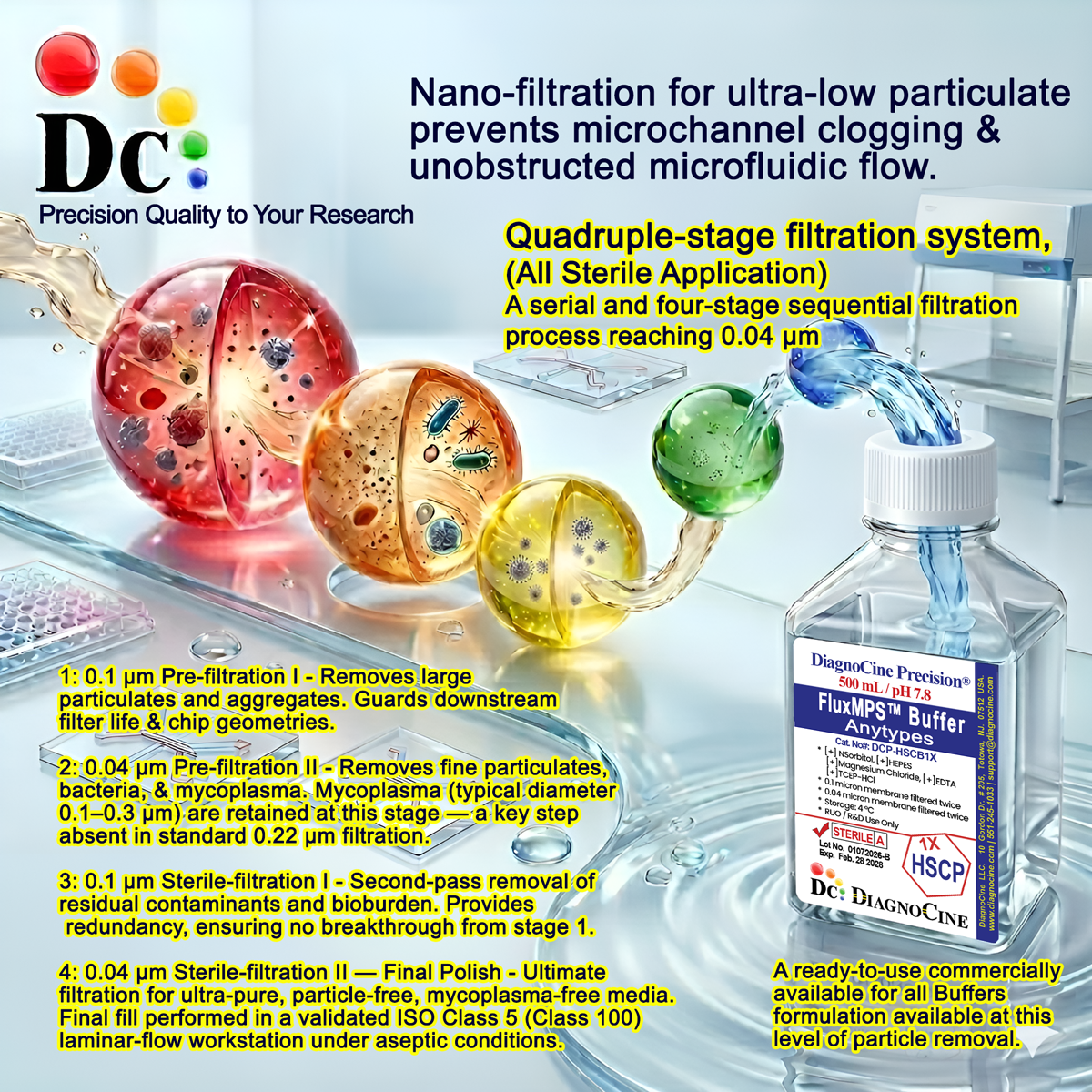
Quadruple-stage filtration system
FluxMPS™ TBE Running Buffer is sterile-filtered through a 0.1 µm membrane twice and a 0.04 µm membrane twice, in a sterile environment, before final fill.
-
1
0.1 µm Pre-filtration I
First 0.1 µm pass removes large particulates and aggregates, protecting downstream membranes.
-
2
0.04 µm Pre-filtration II
First 0.04 µm pass retains fine particulates and bioburden ahead of the sterile-filtration stages. This scale of filtration is well below the smallest mycoplasma species, which are typically about 0.2 microns.
-
3
0.1 µm Sterile-filtration I
Second 0.1 µm pass provides redundant sterile-filtration assurance.
-
4
0.04 µm Sterile-filtration II — Final Polish
Second 0.04 µm pass delivers the final polish under sterile fill conditions, helping prevent mycoplasma contamination.
Performance vs. conventional buffer
Sequential 0.1 µm and 0.04 µm filtration, applied twice each, removes finer particulates than a single 0.22 µm pass used in conventional TBE running buffer.
© Diagnocine® — DCP-TBERB1X
Where FluxMPS™ TBE Running Buffer is used
Tris Borate EDTA buffer keeps nucleic acids deprotonated, soluble, and protected from nuclease degradation, enabling reliable migration of DNA and RNA through agarose or polyacrylamide gel matrices during electrophoresis.[1,3]
Automated Bioreactors & Robotics
For automated electrophoresis platforms and robotic liquid handlers, an optional 0.01 µm (10 nm) ultra-filtered variant is available to further protect valves, sensors, and microchannels from residual particulate.
- Total Particulate Exclusion for automated fluid paths
- Valve & Sensor Protection in robotic dispensing systems
- Extended Perfusion Stability for continuous-flow chip formats
Inquiry Required: the 0.01 µm (10 nm) ultra-filtered grade is available on request — contact support@diagnocine.com.
Nucleic Acid Gel Electrophoresis
Formulated for gel electrophoresis of DNA and RNA, with high buffering capacity for stable pH across a full run.
Fragment Separation & Recovery
High buffering capacity supports resolution of short DNA and RNA fragments compared to other running buffers.
Native & Denaturing RNA Analysis
Suitable for both native (non-denaturing) and denaturing RNA analysis workflows.
Northern Blotting
Supports RNA transfer and hybridization steps downstream of gel electrophoresis.
DNA Cloning Experiments
EDTA chelates divalent cations at a concentration low enough to preserve activity of restriction enzymes and DNA polymerases used in cloning workflows.
Micro Physiological System (MPS) & Chip Workflows
Quadruple-stage filtered purity supports use in microfluidic and organ-on-a-chip nucleic acid separation modules.
Full specification sheet
All values below reflect DCP-TBERB1X as manufactured and quality-controlled by Diagnocine.
| Parameter | Specification |
|---|---|
| Formulation / Composition | 89 mM Tris base, 89 mM boric acid, 2 mM EDTA |
| Appearance | Clear, colorless liquid |
| pH USP <791> | 8.3 |
| Parameter | Specification |
|---|---|
| Sterility USP <71> | Filtered 0.1 µm x2 + 0.04 µm x2 in a sterile environment |
| DNase Activity | None detected (18 hr incubation with plasmid DNA, room temperature) |
| RNase Activity | None detected (18 hr incubation with ribosomal RNA, room temperature) |
| Water Quality | Ultrapure Type 1 (18.2 MΩ·cm) |
| Manufacturing Standard ISO 13485 | ISO 13485-certified, CE-approved facility |
| Fill Environment | Sterile environment, ISO Class 5 (Class 100) |
| Parameter | Specification |
|---|---|
| Storage Temperature | 4°C |
| Shelf Life | 2 years |
| Parameter | Specification |
|---|---|
| Manufacturing QMS | ISO 13485-certified facility |
| Regulatory Alignment | CE-approved |
| Production & Customization Site | Diagnocine Precision, Totowa, New Jersey, USA |
| Intended Use | Research Use Only (RUO) |
Full composition
Component concentrations are formulated per lot and quality-controlled prior to release.
| Component | CAS Number | Concentration |
|---|---|---|
| Tris base | 77-86-1 | 89 mM |
| Boric acid | 10043-35-3 | 89 mM |
| EDTA | 60-00-4 | 2 mM |
Manufacturing & compliance
DCP-TBERB1X is manufactured under ISO 13485-certified, CE-approved processes, with final packaging, QA, and testing performed at Diagnocine's R&D and Quality Testing Center.
ISO 13485:2016 QMS
Manufactured under an ISO 13485-certified, CE-approved quality management system.
Ultrapure Type 1 Water
Formulated with Ultrapure Type 1 water (18.2 MΩ·cm).
ISO Class 5 Fill & Finish
Filtered and filled in a sterile environment consistent with ISO Class 5 (Class 100) practices.
Micro-Batch Precision
Custom assembly and specific customization requests are completed at Diagnocine Precision, Totowa, New Jersey, USA.
Nuclease-Free Verification
No DNase or RNase activity detected after 18 hr incubation with plasmid DNA or ribosomal RNA at room temperature.
Sterility Assurance USP <71>
Sterile-filtered through 0.1 µm membrane twice and 0.04 µm membrane twice in a sterile environment.
Water Quality
Manufactured with Ultrapure Type 1 water (18.2 MΩ·cm).
Documentation
QC documentation is maintained for every lot; contact support@diagnocine.com for details.
How DCP-TBERB1X compares
A side-by-side view of FluxMPS™ TBE Running Buffer against conventional TBE preparations.
| Parameter | DCP-TBERB1X (FluxMPS™) | Conventional TBE (0.22 µm filtered) | Standard Alternative (0.22 µm filtered) |
|---|---|---|---|
| High buffering capacity for short-fragment resolution | check_circle | check_circle | check_circle |
| Final filtration pore size | 0.04 µm | 0.22 µm | 0.22 µm |
| Number of filtration stages | 4 | 1 | 1 |
| DNase / RNase tested | check_circle | cancel | cancel |
| Ultrapure Type 1 water | check_circle | cancel | cancel |
| ISO 13485 manufacturing | check_circle | cancel | cancel |
| Microfluidic channel compatibility | check_circle | cancel | cancel |
| Custom formulation available | check_circle | cancel | cancel |
Frequently asked questions
Common questions about DCP-TBERB1X, FluxMPS™ Tris Borate EDTA Running Buffer [1X].
Supporting literature
Curated literature on TBE buffer chemistry, nucleic acid electrophoresis, and microfluidic nucleic acid workflows.
- McDonell MW, Simon MN, Studier FW. Analysis of restriction fragments of T7 DNA and determination of molecular weights by electrophoresis in neutral and alkaline gels. J Mol Biol. 1977;110(1):119-146. doi:10.1016/S0022-2836(77)80102-2
- Brody JR, Kern SE. History and principles of conductive media for standard DNA electrophoresis. Anal Biochem. 2004;333(1):1-13. doi:10.1016/j.ab.2004.05.054
- Stellwagen NC. Electrophoresis of DNA in agarose gels, polyacrylamide gels, and in free solution. Electrophoresis. 2009;30(S1):S188-S195. doi:10.1002/elps.200900147
- Sambrook J, Russell DW. Molecular Cloning: A Laboratory Manual. 3rd ed. Cold Spring Harbor Laboratory Press; 2001. doi:10.1101/pdb.top133
- Aranda PS, LaJoie DM, Jorcyk CL. Bleach gel: a simple agarose gel for analyzing RNA quality. Electrophoresis. 2012;33(2):366-369. doi:10.1002/elps.201100335
- Whitesides GM. The origins and the future of microfluidics. Nature. 2006;442(7101):368-373. doi:10.1038/nature05058
- Reyes DR, Iossifidis D, Auroux PA, Manz A. Micro total analysis systems. Anal Chem. 2002;74(12):2623-2636. doi:10.1021/ac0202435
- Bustin SA, Nolan T. Talking the talk, but not walking the walk: RT-qPCR conceptual and normalization pitfalls. J Biomol Tech. 2004;15(3):155-166.
- Duffy DC, Gillis HL, Lin J, Sheppard NF, Kellogg GJ. Microfabricated centrifugal microfluidic systems for clinical biochemistry. Anal Chem. 1999;71(20):4669-4678. doi:10.1021/ac990682c