


Anti Human SF-1 mouse monoclonal antibody (N1665)
Anti Human SF-1 mouse monoclonal antibody (N1665)
SF-1: Steroidogenic factor 1
DiagnoCine offers excellent SF-1| Steroidogenic Factor-1 Antibodies to researchers studying Treatments for Metabolic and Neoplastic diseases, Steroidogenic Enzyme Gene Expression, Metabolism Adrenal, and Gonadal Development, and Sex Determination.
Human diseases include primary adrenal failure, adrenocortical tumor, disorders of sex development, primary ovarian insufficiency, and infertility.
SF-1| Steroidogenic Factor 1 Antibodies has excellent quality and this highly pure antibody can be adapted for ELISA, Immunohistochemistry, Immunoprecipitation, Western Blot, and other research methods with optimization.
General information
| Cat. No. | :FNK-PP-N1665-0C |
| Size | :100 ul |
| Antigen Species | :Human |
| Host Species | :Mouse |
| Cross Reactivity | :Human/ Mouse/ Rat |
| Purification | :Ammonium sulfate fractionation |
| Clone No | :N1665 |
| Concentration | :1 mg/mL |
| Ig Class | :G1 |
| Application | :Western Blot (3 ug/mL) :Non reducing Western Blot (3 ug/mL) :ELISA (0.1 ug/mL (A450=1.0)), :IHC (10 ug/mLL), :IP (Decide by use), |
| Specificity |
:This antibody specifically recognizes human SF-1 and cross reacts with mouse and rat SF-1.
|
| Storage | :Store at 2 - 8 ºC up to one month. For long-term storage, the solution may be frozen in working aliquots. Repeated freezing and thawing is not recommended. Storage in a frost-free freezer is not recommended. |
| Form | :Physiologic saline with 0.1 % NaN3 |
| Genbank | :U76388 |
Description
SF-1 (AD4BP, FTZF1,NR5A1) is still considered as an orphan nuclear receptor belongs to subfamily 5, It was found as a regulator of steroidogenic enzyme gene expression. Oxysterols are suggested as ligands. Its expressed in all sterodogenic tissues, including adrenal cortex, testicular Sertoli cells and Leydig cells, ovarian theca, hypothalamus and anterior pituitary. SF1 plays an important role in adrenal and gonadal development, such as hypothalamic-pituitary-gonadal axis and sex determination.
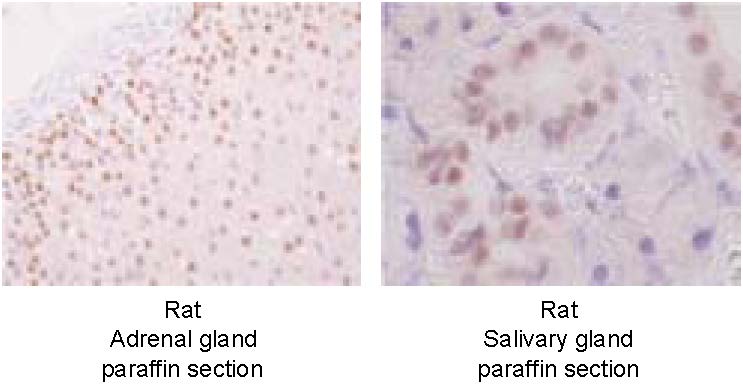
Immunohistochemistry
Origin
Produced in BALB/c mouse ascites after inoculation with hybridoma of mouse myeloma cells (NS-1) and spleen cells derived from a BALB/c mouse immunized with E.coli-expressed recombinant human SF-1(220-461aa)
Notes
Sodium azide may react with lead and copper plumbing to form explosive metal azides. Flush with large amounts of water during disposal.
References
- Jae Mi Suh, et al. Mol Endocrinol, Dec. 2006, 20(12): 3412-3420
- Jun Qin, et al. Developmemtal Dynamics, 2007, 236: 810-820
Aliases for NR5A1 Gene
- Nuclear Receptor Subfamily 5 Group A Member 1 2 3 4 5
- Steroidogenic Factor 1 2 3 4
- AD4BP 2 3 4
- HSF-1 2 3 4
- SF-1 2 3 4
- SF1 2 3 4
- Steroid Hormone Receptor Ad4BP 3 4
- Fushi Tarazu Factor Homolog 1 3 4
- FTZF1 3 4
- STF-1 3 4
- FTZ1 2 3
- ELP 2 3
- Nuclear Receptor Subfamily 5, Group A, Member 1 2
- Steroidogenic Factor 1 Nuclear Receptor 3
- Adrenal 4 Binding Protein 3
- Adrenal 4-Binding Protein 4
- Nuclear Receptor AdBP4 3
- Steroidogenic Factor-1 3
- SPGF8 3
- SRXX4 3
- SRXY3 3
- NR5A1 5
- POF7 3
