
m-Cresol Purple
m-Cresol Purple
m-Cresol Purple is supplied as a ready-to-use solution in Ultrapure Type 1, 18.2 MΩ·cm water, formulated for spectrophotometric pH determination in seawater on the total hydrogen ion scale in laboratory workflows. Dual-stage filtration system with a 0.22 µm final pore size delivers a low-particulate, reproducible medium, at a released pH of 7.9 ± 0.1. Lead time 1–2 weeks; sometimes in stock - please inquire.
- Ready-to-use solution, ready to use with no preparation required
- Supplied at pH 7.9 ± 0.1; buffering range 7.2 – 8.5
- Indicator grade, dye content ≥ 95%, 0.22 µm PES filtered
- Filtered: 0.45 µm GF prefilter + 0.22 µm PES, for optical clarity; supplied non-sterile
- Filled from ultrapure Type 1 water (18.2 MΩ·cm)
- Stored at 15–25 °C, amber glass; shelf life 12 months
- Concentration, pH, and additive customisation available on request
- pH7.9 ± 0.1
- Molarity / concentration2 mM indicator in 0.72 M NaCl (S = 35 equivalent)
- Buffering range (pKa)7.2 – 8.5 (pKa 8.0)
- Osmolality (USP <785>)~1000 mOsm/kg (seawater-matched)
- Endotoxin (USP <85>)< 0.05 EU/mL
- SterilityNon-sterile
- Filtration0.45 µm GF prefilter + 0.22 µm PES
- Water qualityUltrapure Type 1, 18.2 MΩ·cm
- Storage15–25 °C, amber glass
- Shelf life12 months
Engineered where standard buffers fail
Conventional 0.22 µm-filtered buffers and media can carry subvisible particulates, colloidal material, and bioburden that seed unwanted growth in culture vessels, shift trace-metal speciation, and raise the reagent blank in low-level analysis. m-Cresol Purple is built to remove those failure modes at the source.
Filtered for the work it is used in
Final-stage 0.22 µm membrane filtration with particulate performance confirmed by routine testing. Particulate scatters light, and in a spectrophotometric measurement scattering is indistinguishable from absorbance.
Precise, stable pH
Released at pH 7.9 ± 0.1, confirmed by routine quality testing, with buffering capacity highest near the pKa of 8.0. The useful buffering range is 7.2 – 8.5. Supplied as a ready-to-use solution, so the molarity is defined rather than made up at the bench.
Ultrapure-grade water
Formulated with ultrapure Type 1 water at 18.2 MΩ·cm to keep background conductivity, trace metals, and nuclease activity low.
Purified indicator, because impurity shifts the answer
Unpurified sulfonephthalein dyes carry impurities that shift the apparent pKa and introduce errors of up to 0.01 pH units. Purified indicator is what makes the method's precision real rather than nominal.
Defined, traceable composition
Every component, grade and amount is published on this page rather than held as a proprietary formulation, so the buffer can be reproduced or adjusted against your own protocol.
Customisation on demand
Alternate concentrations and pH values, different counter-ions, and added salts, detergents, chelators, proteins or supplements are available to order.
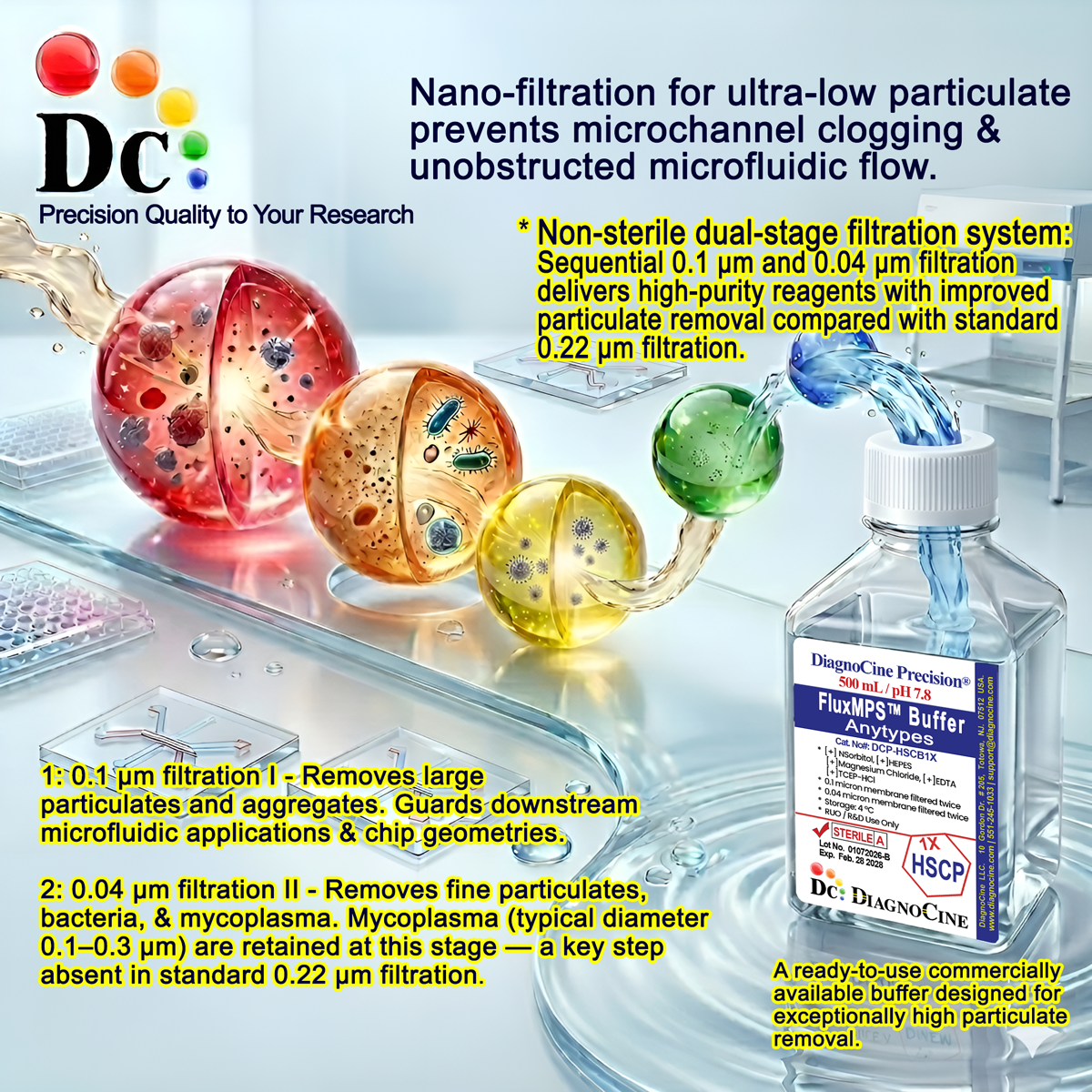
Dual-stage filtration system
m-Cresol Purple is filtered through a 0.45 µm glass fibre prefilter and a 0.22 µm PES membrane, removing the particulates that scatter light across the measurement wavelengths ahead of fill.
- 1
0.45 µm Glass fibre prefilter
A 0.45 µm glass fibre prefilter removes undissolved dye aggregates so they do not blind the final membrane.
- 2
0.22 µm PES final filtration
Single pass through a 0.22 µm polyethersulfone membrane. PES is used rather than nylon, which binds sulfonephthalein dyes and would strip product from the filtrate.
Performance vs. conventional buffer
A prefilter followed by a 0.22 µm PES membrane removes the particulates that offset the absorbance baseline at the measurement wavelengths, which a non-absorbing reference wavelength can only partly correct.
© Diagnocine® — DCP-MCP2MM
Where m-Cresol Purple is used
Sulfonephthalein indicator dye solution for spectrophotometric pH determination in seawater, estuarine, and process samples (pKa ≈ 8.0). Supplied salinity-matched and pH-adjusted so that adding dye perturbs the sample as little as possible.
Trace Analysis & Low-Background Work
Sub-0.04 µm filtration and ultrapure Type 1 water keep particulate, colloidal, and trace-metal load low in m-Cresol Purple, which is what matters where a reagent blank sets the detection floor or where a culture must stay free of contaminating growth.
- Low Reagent Blank: minimises the particulate and colloidal contribution to trace-level determinations
- Culture Integrity: reduces the bioburden and particulate load introduced into culture vessels and incubations
- Filter-Based Workflows: limits premature loading of membrane filters during sample concentration and eDNA capture
Spectrophotometric Seawater pH
The indicator for seawater pH by absorbance ratio on the total hydrogen ion scale, the method that reaches 0.001 unit precision where an electrode manages 0.01.
Long-Term Monitoring Programmes
Time-series and repeat-hydrography work where the precision needed to detect a decadal pH trend is beyond what potentiometric measurement can deliver.
Autonomous & Underway Sensors
Reagent for autonomous spectrophotometric pH sensors on moorings, floats and underway systems.
Brackish & Variable Salinity Work
Estuarine and coastal measurement, where the salinity dependence of the indicator pKa must be accounted for in the calibration used.
Electrode Cross-Validation
Checking a glass electrode against a spectrophotometric reading on the same sample, which is how a potentiometric system is shown to be reading correctly in seawater.
Calculating the Remaining Parameters
Supplying the pH input to carbonate system calculations, where pH with alkalinity or dissolved inorganic carbon yields the full set.
Specifications at a glance
Measured and declared parameters for m-Cresol Purple (DCP-MCP2MM).
| Parameter | Specification |
|---|---|
| Formulation / composition | m-Cresol purple, free acid in ultrapure, nuclease-free water; see full composition below |
| Appearance | Clear solution, free of visible particulates |
| pH (USP <791>) | 7.9 ± 0.1 USP |
| Osmolality (USP <785>) | ~1000 mOsm/kg (seawater-matched) USP |
| Molarity / concentration | 2 mM indicator in 0.72 M NaCl (S = 35 equivalent) |
| Conductivity / ionic strength | Confirmed by routine testing |
| Buffering range (pKa) | 7.2 – 8.5 (pKa 8.0) |
| Parameter | Specification |
|---|---|
| Endotoxin (USP <85> BET) | < 0.05 EU/mL USP |
| Sterility (USP <71>) | Not supplied sterile USP |
| Bioburden | Confirmed by routine testing |
| Particulate ≥ 10 µm (USP <788>) | Confirmed by routine testing USP |
| Particulate ≥ 25 µm (USP <788>) | Confirmed by routine testing USP |
| Water purity | Ultrapure Type 1, 18.2 MΩ·cm |
| Manufacturing standard | ISO 13485:2016 ISO |
| Fill environment | ISO Class 5 (Class 100) ISO |
| Parameter | Specification |
|---|---|
| Storage temperature | 15–25 °C, amber glass |
| Freeze-thaw | Do not freeze |
| Shelf life | 12 months |
| Shipping condition | Ambient |
| pH stability | Verify at the working temperature; most buffers shift measurably with temperature and ionic strength |
| Parameter | Specification |
|---|---|
| Raw material grade | Indicator grade, dye content ≥ 95%, 0.22 µm PES filtered |
| Traceability | Catalogue number DCP-MCP2MM; lot documentation available on request |
| Manufacturing QMS | ISO 13485:2016 certified ISO |
| Regulatory alignment | 21 CFR Part 820 (cGMP) aligned |
| Production method | Compounded, filtered and filled at Diagnocine Precision, Totowa, New Jersey, USA |
| Intended use | For Research Use Only (RUO) |
Full composition
Makes 100 mL of 2 mM m-cresol purple. Every component is disclosed, with CAS numbers where a single defined substance applies.
| Component | CAS Number | Concentration |
|---|---|---|
| m-Cresol purple, free acidIndicator, 2 mM, 382.43 g/mol | 2303-01-7 | 0.0765 g dye |
| Sodium chloride0.72 mol/L, matches seawater at S = 35 | 7647-14-5 | 4.22 g |
| Ultrapure waterSolvent | 7732-18-5 | q.s. to 100 mL |
Handling and storage
- 1
Supplied as the sodium salt and already in solution. The free acid does not dissolve in water on its own, so this cannot be reproduced by weighing free acid into water. The bottle is released at the stated pH.
- 2
The sodium chloride sets the ionic strength of the dye stock to match the sample. Seawater ionic strength is I = 19.924 S / (1000 - 1.005 S) mol/kg, giving 0.72 mol/kg at S = 35 and 0.62 at S = 30. Sodium chloride is a 1:1 electrolyte, so molarity equals ionic strength: 42.2 g/L at S = 35, 36 g/L at S = 30. Supplied matched to S = 35 unless specified.
- 3
Made from dye-content grade material, typically 95% or better, without further purification. The remaining impurities are other sulfonephthaleins, which absorb at the same wavelengths as the dye and can bias a measurement by up to 0.01 pH units.
- 4
That bias is immaterial for estuarine monitoring, process water, teaching, and any work where 0.01 pH units is inside the noise. It is not acceptable for pH reported on the total hydrogen ion scale, for CO₂-system calculations, or for data submitted against a certified reference. Those applications need a dye purified by preparative HPLC and characterised against Tris in artificial seawater. We can supply that grade to order.
- 5
Filtered through a 0.45 µm glass fibre prefilter and a 0.22 µm PES membrane. Particulates scatter light across the measurement wavelengths and offset the absorbance baseline; at 434 and 578 nm the particles that matter are removed at 0.22 µm. PES is used rather than nylon, which binds sulfonephthalein dyes. Filtered for clarity, not for bioburden: the product is not filled aseptically or sterility tested and is sold non-sterile.
- 6
Absorbance is read at 434 nm and 578 nm, with a non-absorbing wavelength for baseline correction. The pH follows from the absorbance ratio and the characterised dissociation constant, not from a meter, which is why absolute dye concentration does not enter the result.
- 7
The working range quoted here, 7.2 to 8.5, is the spectrophotometric range on the total hydrogen ion scale in seawater. It is narrower than the visual transition range of roughly 7.4 to 9.0 that appears on a bulk dye certificate, and the two should not be confused.
- 8
The stock is adjusted to pH 7.9, close to open-ocean seawater, so that adding it perturbs the sample as little as possible. Residual perturbation is corrected by measuring at two dye additions and extrapolating to zero added dye.
- 9
Run against Tris in synthetic seawater to check the instrument and the dye together, and establish your own offset if you are comparing results across seasons or instruments. Thymol blue is the product to use above pH 8.5.
Manufacturing & compliance
m-Cresol Purple is manufactured, filtered, and packaged under controlled, certified conditions.
ISO 13485:2016 QMS
Manufactured under ISO 13485-certified and CE-approved facilities.
Ultrapure Type 1 Water
Formulated with ultrapure, nuclease-free water (18.2 MΩ·cm) to minimise adventitious background.
ISO Class 5 (Class 100) Fill & Finish
Final packaging, quality assurance, and testing performed at the Diagnocine R&D and Quality Testing Center.
Micro-Batch Precision
Specific customisation requests and assembly performed at Diagnocine Precision, Totowa, New Jersey, USA.
Endotoxin (USP <85> BET)
Released to less than 0.05 EU/mL, confirmed by routine bacterial endotoxins testing.
Particulate (USP <788> Method 2)
Subvisible particulate at 10 µm and 25 µm, confirmed by routine testing of the filtration train.
Osmolality (USP <785>)
Determined by freezing-point depression, confirmed by routine testing.
Documentation / CoA
Specifications are confirmed by routine quality testing rather than by testing every lot. Testing and documentation for a specific lot are available as a chargeable service on request.
How DCP-MCP2MM compares
A side-by-side look at m-Cresol Purple against conventional buffer preparations.
| Parameter | DCP-MCP2MM | Conventional 0.22 µm Filtered Buffer | Standard Alternative Buffer |
|---|---|---|---|
| Defined molarity and released pH | |||
| Final filtration pore size | 0.22 µm | 0.22 µm | 0.22 µm |
| Number of filtration stages | 2 | 1 | 1 |
| Endotoxin specification | < 0.05 EU/mL | Not specified | Not specified |
| USP <788> particulate compliance | |||
| Water quality | Ultrapure Type 1 (18.2 MΩ·cm) | Standard purified water | Standard purified water |
| Manufacturing QMS | ISO 13485:2016 | Not specified | Not specified |
| Microfluidic channel compatibility | |||
| Full composition disclosed | Partial | ||
| Custom formulation available |
Frequently asked questions
Common questions about m-Cresol Purple (DCP-MCP2MM).
Supporting literature
Curated peer-reviewed literature relevant to this buffer's chemistry and to marine, freshwater and environmental laboratory workflows.
- Clayton, T.D., Byrne, R.H. Spectrophotometric seawater pH measurements: total hydrogen ion concentration scale calibration of m-cresol purple. Deep-Sea Research I, 1993, 40:2115–2129.
- Dickson, A.G. The measurement of sea water pH. Marine Chemistry, 1993, 44:131–142. doi:10.1016/0304-4203(93)90198-W
- Liu, X., Patsavas, M.C., Byrne, R.H. Purification and characterization of meta-cresol purple for spectrophotometric seawater pH measurements. Environmental Science & Technology, 2011, 45:4862–4868. doi:10.1021/es200665d
- Zhang, H., Byrne, R.H. Spectrophotometric pH measurements of surface seawater at in-situ conditions. Marine Chemistry, 1996, 52:17–25. doi:10.1016/0304-4203(95)00076-3
- Mosley, L.M., Husheer, S.L.G., Hunter, K.A. Spectrophotometric pH measurement in estuaries using thymol blue and m-cresol purple. Marine Chemistry, 2004, 91:175–186. doi:10.1016/j.marchem.2004.06.008
- Byrne, R.H. Measuring ocean acidification: new technology for a new era of ocean chemistry. Environmental Science & Technology, 2014, 48:5352–5360. doi:10.1021/es405819p
- Dickson, A.G., Sabine, C.L., Christian, J.R. (eds.) Guide to Best Practices for Ocean CO2 Measurements. PICES Special Publication 3, 2007.
- Marion, G.M., Millero, F.J., Camões, M.F., Spitzer, P., Feistel, R., Chen, C.-T.A. pH of seawater. Marine Chemistry, 2011, 126:89–96. doi:10.1016/j.marchem.2011.04.002
- Millero, F.J. The marine inorganic carbon cycle. Chemical Reviews, 2007, 107:308–341. doi:10.1021/cr0503557