
anti-Human SLFN11 monoclonal antibody (recombinant)
anti-Human SLFN11 monoclonal antibody (recombinant)
Cat. No.: FNK-R-S-001 (clone 5-14.12)
Size: 100μg
Storage: -20℃
Specifications
Category: monoclonal antibody (recombinant)
Applications: WB, IF, IHC, IP, ELISA
Reactivity: Human
Immunogen information
Immunogen: Recombinant protein of human SLFN11 (2-356), E. coli derived.
Uniprot ID: Q7Z7L1
Official Full Name: schlafen family member 11
Gene ID: 91607
Product information
Source: Recombinant mouse monoclonal antibody
Expression system: 293 cells
Clone No. 5-14.12
Epitope: Human SLFN11 (201-220)
Isotype: IgG1k (mouse)
Purification method: Protein A purification
Lot No. 002
Concentration: 1.0 mg/mL
Buffer: PBS, pH7.4, with 0.05% ProClin 300
Storage: Store at -20°C. Four or five freezes and thaws cycles are acceptable.
Recommended dilutions
WB 1:2000 – 1:5000
IF 1:200 – 1:500
IHC 1:100 – 1:200
IP 1:100 – 1:200
ELISA 1:500 – 1:1000
Western blot
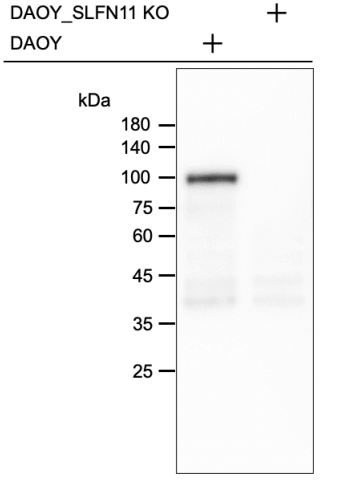
Western blot analysis of endogenous SLFN11 in DAOY human medulloblastoma cells and DAOY_SLFN11 knockout cells using anti-SLFN11 mAb (FNK-R-S-001).
Epitope mapping
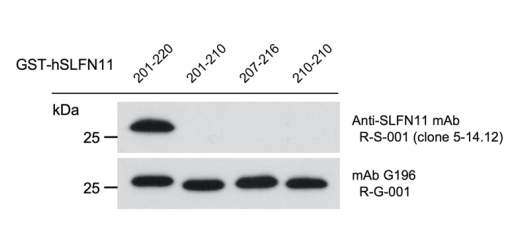
The epitope mapping of anti-SLFN11 mAb was performed by subjecting bacterially expressed GST-tagged truncated mutants of human SLFN11 to Western blot analysis, which revealed amino acid residues 201–220 as the minimal epitope. The GST fusion proteins contained the epitope DLVPR of mAb G196 (FNK-R-S-001)
Immunofluorescence
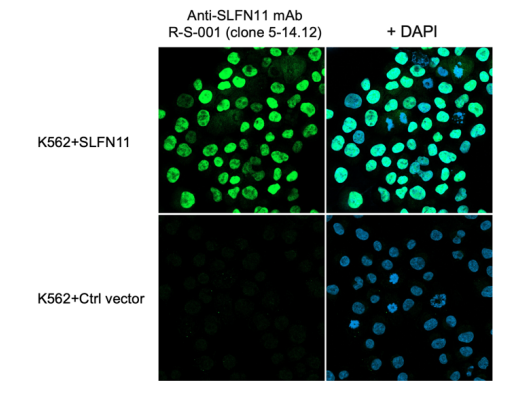
Fig 1. Immunofluorescence of K562 cells w/wo transfecting human SLFN11.
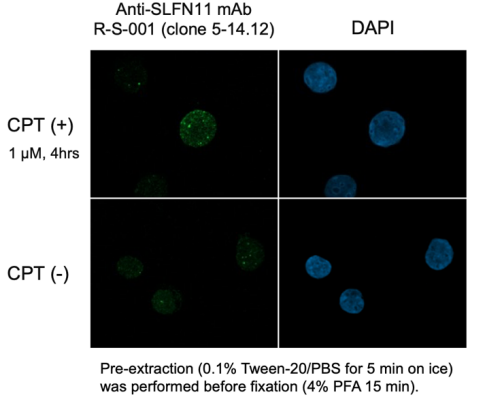
Fig 2. Immunofluorescence of SLFN11-expressing K562 cells w/wo camptothecin (CPT) treatment.
Background
Schlafen 11 (SLFN11) has attracted attention as a dominant determinant because its mRNA expression level is highly correlated with sensitivity to various DNA-damaging anticancer agents, such as topoisomerase I (TOP1) inhibitors (camptothecin, indenoisoquinolines), TOP2 inhibitors (etoposide, doxorubicin), ribonucleotides inhibitors (hydroxyurea), antimetabolites (gemcitabine, cytosine arabinoside) and platinum-derivatives (cisplatin, carboplatin).
A recent clinical study analyzing the effects of SLFN11 on PARP inhibitor olaparib sensitivity in patients with ovarian cancer showed that high SLFN11 expression is associated with improved clinical outcomes and that only patients with both BRCA mutations and high SLFN11 expression benefited significantly from olaparib treatment.
References for anti-Human SLFN11 monoclonal antibody (FNK-R-S-001)
1) PMID: 38961202, Journal: Oncogene, Application: WB IF (2023): 6.9 Q1, Title: Schlafen 11 further sensitizes BRCA-deficient cells to PARP inhibitors through single-strand DNA gap accumulation behind replication forks.
2) PMID: 38125019, Journal: iScience, Application: WB IF (2023): 4.6 Q1, Title: The crucial role of single-stranded DNA binding in enhancing sensitivity to DNA-damaging agents for Schlafen 11 and Schlafen 13.