Vinylsulfone-PEG2-COOH
Vinylsulfone-PEG2-COOH
Cat. No. LPA1411
Description
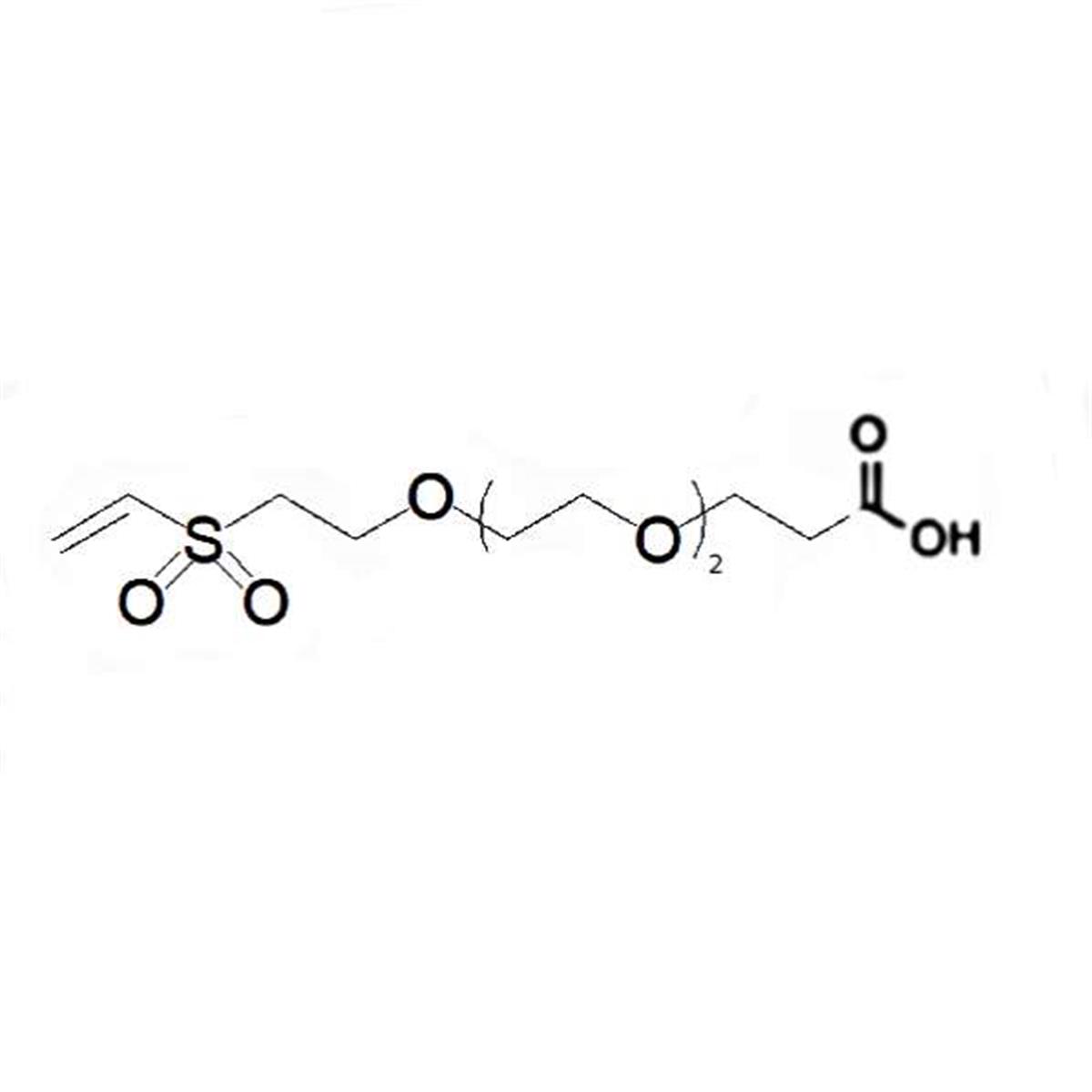
Its structure is a diethylene glycol derivative and the functional groups are vinylsulfone(one end) & carboxylic acid (other end). The vinylsulfone group undergoes Michael addition with nucleophiles such as primary amines or thiols, forming a stable thioether bond. The carboxylic acid group on the other end remains available for further modifications or reactions.
Structurally represented as: CH2?=CH-SO2-CH2-CH2-(OCH2-CH2)2-OCH2-CH2-COOH
Vinylsulfone-PEG2-COOH excels in various advanced applications such as complex protein modification and labeling, sophisticated bioconjugation techniques, development of highly sensitive assays, crosslinking of large or structurally complex biomolecules, surface functionalization with enhanced spacing, nanoparticle functionalization with superior stability, and advanced targeted drug delivery systems.
Benefits in research include improved solubility (drastically enhances the solubility of conjugated biomolecules, even those prone to aggregation), reduced immunogenicity (PEG spacer can help reduce immune responses to conjugated proteins), biocompatibility (PEG is known for its biocompatibility, making it suitable for various biological applications), cell membrane impermeability (the hydrophilic nature prevents penetration of cell membranes, making it ideal for extracellular or surface-based applications), pH and temperature stability (the vinylsulfone group's stability across a wide pH range and at high temperatures allows for versatile reaction conditions), and orthogonal chemistry (the vinylsulfone group offers an alternative to NHS ester chemistry, allowing for selective conjugation strategies).
Vinylsulfone-PEG2-COOH represents an important advancement in the field of protein modification reagents, offering researchers a flexible and efficient means to modify, conjugate, and study biomolecules in various life science research contexts. Its unique combination of a stable vinylsulfone reactive group and a short PEG spacer makes it particularly useful for applications requiring mild conjugation conditions or when working with sensitive biomolecules.
What are the advantages?
1. Hydrophilicity: The PEG component enhances water solubility and reduces cell membrane penetration.
2. Reduced Aggregation: The hydrophilic spacer minimizes aggregation and precipitation of conjugated biomolecules.
3. Versatile Reactivity: Vinylsulfone group, developed by BioActs' leading technology, reacts with:
a. Primary amines
b. Thiol groups (e.g., cysteine residues)
4. Stability: The vinylsulfone group is stable across a wide pH range and at high temperatures.
5. Flexible Spacer: The PEG2 chain provides distance between conjugated molecules, potentially preserving their individual functionalities.
Specifications
- Reactive group: Vinylsulfone
- Molecular Weight: 423.44 g/mol
- Solubility: Water, DMF, DMSO
- Storage conditions: -20 ℃
NHS ester
| Quick link (Cat.#) | Series | Quick link (Cat.#) | Series |
| LPA1411 | Vinylsulfone-PEG2-COOH | LPA1421 | Vinylsulfone-PEG2B-COOH |
| LPA1412 | Vinylsulfone-PEG3-COOH | LPA1422 | Vinylsulfone-PEG3B-COOH |
| LPA1413 | Vinylsulfone-PEG4-COOH | LPA1423 | Vinylsulfone-PEG4B-COOH |
| LPA1414 | Vinylsulfone-PEG5-COOH | LPA1424 | Vinylsulfone-PEG5B-COOH |
| LPA1415 | Vinylsulfone-PEG6-COOH | LPA1425 | Vinylsulfone-PEG6B-COOH |
| LPA1416 | Vinylsulfone-PEG7-COOH | LPA1426 | Vinylsulfone-PEG7B-COOH |
| LPA1417 | Vinylsulfone-PEG8-COOH | LPA1427 | Vinylsulfone-PEG8B-COOH |
Background
Biochemical Polymers & Labeling
The optimal labeling condition for biomolecules is to achieve an appropriate degree of conjugation ratio yet to retain the important functionality of the original biomolecules such as binding affinity, activatory or inhibitory activity, solubility and biological membrane permeability. The high-number of labeling often causes conjugated biomolecule to precipitate out of solution or to lose its functional properties, thus the degree of labeling should be determined from experimental optimization process. There are two major types of reactive dyes: amine-reactive dye and thiol-reactive dye. The primary target of amine-reactive probes at protein is lysine residue, and thiol residue is the main target for thiol-reactive probes. In mammalian proteins, the occurrence frequency of lysine residue is 7.2% and that of thiol is 3.3%.
Amino-labeling is the widely utilized method to conjugate proteins, peptides, oligonucleotides and other biomolecules with dyes. Amine-reactive dyes might be used to prepare bioconjugates for fluorescent analog cytochemistry, immunochemistry, cell tracing, receptor labeling, FITC, etc. The primary target for amine-reactive probe is lysine residue, which has the fifth highest occurrence frequency of the 20 natural amino acids in mammalian proteins. A typical IgG antibody has about 90 lysine residues, and the maximum number of labeling will be around 30 residues with excess amount of reagent and prolonged incubation. However, maintaining functional properties requires the degree of labeling less than 10 dyes per antibody. BioActs provides three major classes (NHS, Sulfo-MHS and Vinylsulfone) of amine-reactive Flamma® Fluors dyes, and they can cover the entire spectral range from visible to NIR region.
Thiol-reactive dyes are mainly used for labeling proteins for the observation of conformational change, multi-subunit complexes assembly and ligand-binding processes. In proteins and peptides, the primary targets of thiol-reactive probes are cysteine residues. Unlike amine-labeling, the low abundance of cysteine residues enable to achieve saturated labeling without risk of conjugated protein precipitation and fluorescence self-quenching interactions. Thiols play a principal role in maintaining the appropriate oxidation–reduction state of proteins, cells and organisms, and they are easily oxidized to form disulfides. Thiols can also be generated by the reduction of cysteine disulfides with reducing agents such as dithiothreitol (DTT), 2-mercaptoethanol or tris-(2-carboxyethyl)phosphine (TCEP). However, the reducing process may cause to disrupt the tertiary structure of protein. Maleimide is a well-known reactive group that can specially label thiol of cysteine residue without interacting with amino functionality. In labeling process, thiol is added to the double bond of maleimide via 1,4-addition pathway to form thioether linkage. Maleimides apparently do not react with methionine, histidine or tyrosine, but they also react with amines in the strong basic environment. BioActs offers Flamma® Fluors maleimide series as thiol-reactive fluorescence dyes.
Click chemistry is a typical type of bioorthogonal reactions, which the reaction occurs inside of living systems yet without interfering with native biochemical processes. The most widely utilized click chemistry is 1,3-dipolar cycloaddition between an azide and an alkyne to produce 1,4-disubstituted 1,2,3-triazole. The triazole ring is stable under hydrolysis, oxidation or reduction, and it survives ionization process in mass spectrometry (MS) analysis. There are two types of 1,3-dipolar cycloaddition methods: copper(I)-catalyzed azide-alkyne cycloaddition (CuAAC) and strain-promoted azide-alkyne cycloaddition (SPAAC). BioActs offers Flamma® Fluors Alkyne dyes for CuAAC, Flamma® Fluors ADIBO products for SPAAC and Flamma® Fluors Azide dyes for both CuAAC and SPAAC.
Citation & Reference
1. Marina V. Backer. Vascular endothelial growth factor selectively targets boronated dendrimers to tumor vasculature. Mol Cancer Ther 4.9 (2005): 1423-9.
2. Zhenhui Chen. Spatial and Dynamic Interactions between Phospholamban and the Canine Cardiac Ca2 Pump Revealed with Use of Heterobifunctional Cross-linking Agents. J Biol Chem 278.48 (2003): 48348-56.
3. Katharina Deiss. Raf Kinase Inhibitor Protein (RKIP) Dimer Formation Controls Its Target Switch from Raf1 to G Protein-coupled Receptor Kinase (GRK) 2. J Biol Chem 287.28 (2012): 23407-17.
4. Nicole Schmitz. Displaying Fel d1 on virus-like particles prevents reactogenicity despite greatly enhanced immunogenicity: a novel therapy for cat allergy. J Exp Med 206.9 (2009): 1941-55.
5. Ariane L. Jansma. NMR Analysis of the Structure, Dynamics, and Unique Oligomerization Properties of the Chemokine CCL27. J Biol Chem 285.19 (2010): 14424-37.