- Home
- UltraClean Krebs-Ringer Bicarbonate Buffer with Calcium Chloride, 10mM HEPES Buffer, and 0.2% Bovine Serum Albumin, without Glucose and Sodium Bicarbonate, 1X (Liquid)

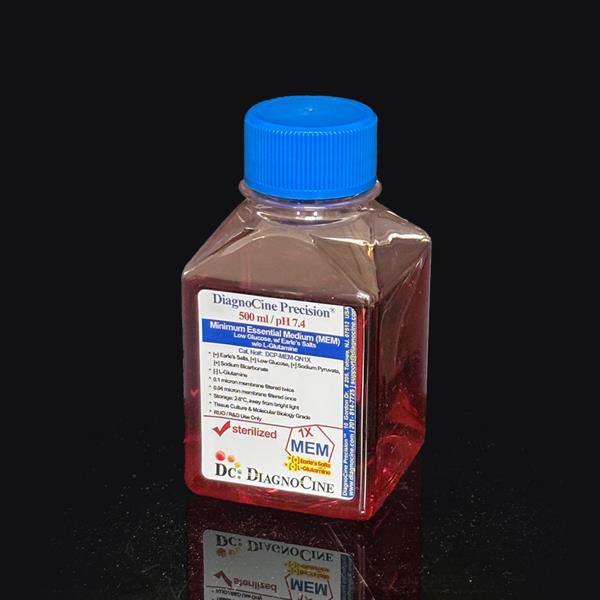
UltraClean Krebs-Ringer Bicarbonate Buffer with Calcium Chloride, 10mM HEPES Buffer, and 0.2% Bovine Serum Albumin, without Glucose and Sodium Bicarbonate, 1X (Liquid)
FluxMPS™ UltraClean Krebs-Ringer Bicarbonate Buffer with Calcium Chloride, 10mM HEPES Buffer, and 0.2% Bovine Serum Albumin, without Glucose and Sodium Bicarbonate, 1X (Liquid)
An MPS-grade, 1X Krebs-Ringer Bicarbonate buffer formulated with calcium chloride, 10 mM HEPES buffer, and 0.2% bovine serum albumin, and deliberately prepared without glucose or sodium bicarbonate. Held at pH 7.4 and quadruple-stage filtered through 0.1 µm and 0.04 µm membranes, it is built for microchannel-safe use in tissue culture, primary adipocyte and lipolysis assays, islet perifusion, and pituitary bioassays.
- Quadruple-stage filtration: 0.1-micron membrane filtered TWICE and 0.04-micron membrane filtered TWICE
- Formulated to pH 7.4 at 1X concentration
- Supplemented with 10 mM HEPES buffer (pKa 7.3 at 37°C) for extended pH stability
- Contains 0.2% bovine serum albumin and calcium chloride
- Formulated without glucose and without sodium bicarbonate
- Base prepared with Ultrapure Type 1 water (18.2 MΩ·cm)
- Sterility confirmed by 14-day incubation with no bacterial or fungal growth, per USP specification
- Custom pH, molarity, and additive formulations available on request
- Catalog No.DCP-KRBB-GB1X
- pH (1X)7.4
- HEPES Concentration10 mM
- Buffering pKa (HEPES)7.3 at 37°C
- Bovine Serum Albumin0.2%
- Formulation1X, without Glucose or Sodium Bicarbonate
- Filtration0.1 µm x2 + 0.04 µm x2
- SterilityUSP-aligned, 14-day incubation
- Storage4°C, protected from light
- Shelf Life24 months
Engineered where standard buffers fail
Conventional single-pass 0.22 µm-filtered Krebs-Ringer buffers can carry subvisible particulates and unstable pH that accumulate in narrow microfluidic channels, drift outside a CO2 incubator, and add background to sensitive metabolic assays. FluxMPS™ addresses each failure mode directly.
Microchannel-safe purity
Quadruple-stage filtration (0.1 µm membrane twice, 0.04 µm membrane twice) produces an ultra-clean buffer suited to narrow microfluidic channels and biosensor surfaces.
Precise, stable pH
Formulated to pH 7.4 and supplemented with 10 mM HEPES (pKa 7.3 at 37°C) to resist the initial pH rise that plain bicarbonate-buffered KRB experiences outside a CO2 incubator.
Ultrapure-grade water
Prepared with Ultrapure Type 1 water (18.2 MΩ·cm) as the aqueous base, consistent with USP <85> water-quality expectations.
Low background for imaging & assays
The glucose-free, sodium-bicarbonate-free formulation with 0.2% BSA is suited to lipolysis, adipocyte, and islet perifusion protocols where background interference must be minimized.
Defined, traceable composition
Every inorganic salt, HEPES, and BSA component is listed with concentration and CAS number in the full composition table below.
Customization on demand
Need a different pH, molarity, or additive package? Contact support@diagnocine.com.
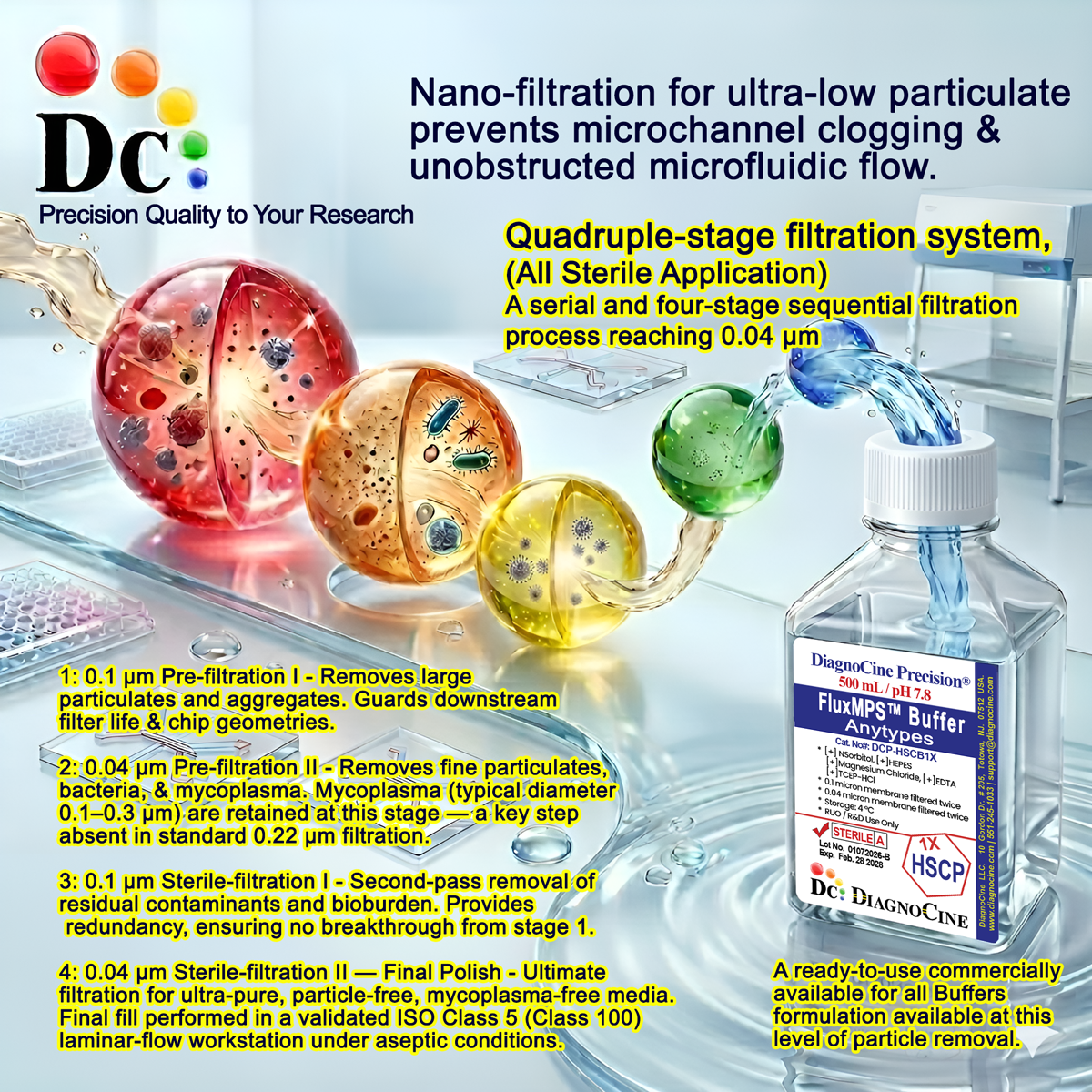
Quadruple-stage filtration system
This buffer is filtered through a 0.1-micron membrane TWICE and a 0.04-micron membrane TWICE, delivering microchannel-safe purity beyond what a single 0.22 µm pass can achieve.
-
1
0.1 µm Pre-filtration I
Removes large particulates and aggregates, extending the life of downstream filters.
-
2
0.04 µm Pre-filtration II
Retains fine particulates and bioburden, including organisms at the small end of the mycoplasma size range (approximately 0.2 µm).
-
3
0.1 µm Sterile-filtration I
A second 0.1 µm pass provides redundant sterile-filtration assurance.
-
4
0.04 µm Sterile-filtration II — Final Polish
A second 0.04 µm pass performs the final polish under ISO Class 5 (Class 100) aseptic fill conditions.
Performance vs. conventional buffer
Sequential 0.1 µm and 0.04 µm membrane passes, applied twice each, remove particulates and bioburden that a single-pass 0.22 µm filter does not retain, supporting cleaner microfluidic channels and lower contamination risk.
© Diagnocine® — DCP-KRBB-GB1X
Where this buffer is used
This Krebs-Ringer Bicarbonate buffer is used for tissue cell culture, washing, preparation of primary adipocytes and lipolysis assays, pre-perifusion for islet viability and functionality studies, and pituitary bioassays. Its salt content supplies cells with water and inorganic ions, maintaining osmotic balance and physiological pH.
Automated Bioreactors & Robotics
An optional 0.01 µm (10 nm) ultra-filtered variant of this buffer is available for automated bioreactor and robotic liquid-handling platforms where valve and sensor protection is critical.
- Total Particulate Exclusion for closed-loop perfusion systems
- Valve & Sensor Protection in automated dispensing hardware
- Extended Perfusion Stability across long-duration runs
Inquiry Required: contact support@diagnocine.com to request the 0.01 µm ultra-filtered grade.
Micro Physiological System (MPS) & Chip
Supports perfusion buffer needs in chip-based tissue models requiring defined ionic composition.
Wash, Dilution & Reconstitution
Used for washing steps and reconstitution ahead of downstream tissue culture and cell assay work.
Primary Adipocyte & Lipolysis Assays
Glucose-free, bicarbonate-free formulation supports lipolysis assay protocols using primary adipocyte preparations.
Islet Viability & Perifusion
Applied as a pre-perifusion buffer for pancreatic islet viability and functionality studies.
Pituitary Bioassays
Formulated for use in pituitary bioassay protocols requiring a defined, buffered physiological salt solution.
Microscopy & Optical Sensing
Low-particulate, low-background formulation supports imaging and biosensor readouts during live-cell work.
Specifications
Values below reflect this product's stated formulation and quality control parameters.
| Parameter | Specification |
|---|---|
| Formulation | Krebs-Ringer Bicarbonate Buffer with calcium chloride, 10 mM HEPES buffer, 0.2% bovine serum albumin, 1X, without glucose or sodium bicarbonate |
| Appearance | Clear, colorless solution |
| pH (1X concentration) USP <791> | 7.4 |
| HEPES Buffer Concentration | 10 mM |
| Buffering Range (pKa, HEPES) | 7.3 at 37°C |
| Parameter | Specification |
|---|---|
| Sterility USP | Filtered 0.1 micron membrane twice in a sterile environment; no bacterial or fungal growth after 14 days of incubation |
| Water Quality | Ultrapure Type 1 water (18.2 MΩ·cm) |
| Fill Environment | ISO Class 5 (Class 100) aseptic fill |
| Manufacturing Standard ISO 13485 | ISO 13485-certified, CE-approved facilities |
| Parameter | Specification |
|---|---|
| Storage Temperature | 4°C, protected from light |
| Shelf Life | 24 months from date of manufacture |
| Parameter | Specification |
|---|---|
| Traceability | Final packaging, quality assurance, and testing performed at the DiagnoCine R&D and Quality Testing Center; customization performed at DiagnoCine Precision, Totowa, New Jersey, USA |
| Manufacturing QMS ISO 13485 | ISO 13485-certified manufacturing |
| Regulatory Alignment | CE-approved facilities |
| Production Method | 0.1-micron membrane filtered twice, 0.04-micron membrane filtered twice |
| Intended Use | Research Use Only — tissue cell culture, washing, primary adipocyte and lipolysis assays, islet pre-perifusion, pituitary bioassays |
Full composition
Component concentrations are expressed in mg/L as released. This formulation excludes glucose and sodium bicarbonate.
| Component | CAS Number | Concentration |
|---|---|---|
| Calcium chloride dihydrate (CaCl2·2H2O) | 10035-04-8 | 367.000 mg/L |
| Disodium hydrogen phosphate, anhydrous (Na2HPO4) | 7558-79-4 | 100.000 mg/L |
| Magnesium chloride hexahydrate (MgCl2·6H2O) | 7791-18-6 | 223.000 mg/L |
| Potassium chloride (KCl) | 7447-40-7 | 372.000 mg/L |
| Sodium chloride (NaCl) | 7647-14-5 | 7012.000 mg/L |
| Sodium dihydrogen phosphate, anhydrous (NaH2PO4) | 7558-80-7 | 180.000 mg/L |
| Component | CAS Number | Concentration |
|---|---|---|
| Bovine serum albumin | 9048-46-8 | 2000.000 mg/L |
| HEPES buffer | 7365-45-9 | 2380.000 mg/L |
Manufacturing & compliance
Manufactured under an ISO 13485-certified, CE-approved quality system, with final packaging, QA, and testing completed at the DiagnoCine R&D and Quality Testing Center.
ISO 13485:2016 QMS
Manufactured under ISO 13485-certified and CE-approved facilities.
Ultrapure Type 1 Water
Prepared with Ultrapure Type 1 water (18.2 MΩ·cm) as the aqueous base.
ISO Class 5 Fill & Finish
Final fill performed under ISO Class 5 (Class 100) aseptic conditions.
Micro-Batch Precision
Customization and assembly performed at DiagnoCine Precision, Totowa, New Jersey, USA.
Endotoxin USP <85>
Bacterial Endotoxins Test (BET) methodology per USP <85> is part of the DiagnoCine quality program; lot-specific results are available on the Certificate of Analysis.
Particulate USP <788> Method 2
Particulate control is supported by the quadruple-stage 0.1 µm / 0.04 µm filtration process described above.
Osmolality USP <785>
Osmolality methodology aligned with USP <785> is available within the DiagnoCine quality program; contact support for lot-specific data.
Documentation / CoA
A Certificate of Analysis is available on request — contact support@diagnocine.com.
How DCP-KRBB-GB1X compares
A comparison of this buffer's filtration architecture and formulation practices against conventionally filtered Krebs-Ringer buffers.
| Parameter | DCP-KRBB-GB1X (FluxMPS™) | Conventional Buffer (0.22 µm filtered) | Standard Alternative (0.22 µm filtered) |
|---|---|---|---|
| HEPES Buffering Supplement | check_circle 10 mM | cancel | cancel |
| Final Filtration Pore Size | 0.04 µm | 0.22 µm | 0.22 µm |
| Number of Filtration Stages | 4 | 1 | 1 |
| Sterility Testing (14-day incubation, USP) | check_circle | cancel | cancel |
| Water Quality | Ultrapure Type 1 (18.2 MΩ·cm) | Purified water | Purified water |
| Manufacturing QMS | ISO 13485-certified, CE-approved | Not specified | Not specified |
| Microfluidic Channel Compatibility | check_circle | cancel | cancel |
| Full Composition & CAS Disclosure | check_circle | Varies | Varies |
| Custom Formulation Available | check_circle | cancel | cancel |
Frequently asked questions
Answers to common questions about this Krebs-Ringer Bicarbonate buffer.
Supporting literature
Curated literature relevant to Krebs-Ringer Bicarbonate buffers, HEPES buffering, and their laboratory applications.
- Ringer S. A further contribution regarding the influence of the different constituents of the blood on the contraction of the heart. J Physiol. 1885. doi:10.1113/jphysiol.1885.sp000184
- Krebs HA, Henseleit K. Untersuchungen uber die Harnstoffbildung im Tierkorper. Hoppe-Seylers Z Physiol Chem. 1932. doi:10.1515/bchm2.1932.210.1-2.33
- Good NE, Winget GD, Winter W, et al. Hydrogen ion buffers for biological research. Biochemistry. 1966. doi:10.1021/bi00866a011
- Rodbell M. Metabolism of isolated fat cells. I. Effects of hormones on glucose metabolism and lipolysis. J Biol Chem. 1964. doi:10.1016/S0021-9258(18)91218-1
- Lacy PE, Kostianovsky M. Method for the isolation of intact islets of Langerhans from the rat pancreas. Diabetes. 1967. doi:10.2337/diab.16.1.35
- Bhatia SN, Ingber DE. Microfluidic organs-on-chips. Nat Biotechnol. 2014. doi:10.1038/nbt.2989
- Huh D, Hamilton GA, Ingber DE. From 3D cell culture to organs-on-chips. Trends Cell Biol. 2011. doi:10.1016/j.tcb.2011.09.005
- Freshney RI. Culture of Animal Cells: A Manual of Basic Technique and Specialized Applications. Wiley-Blackwell. 2015. doi:10.1002/9781118873686
- United States Pharmacopeia. USP <85> Bacterial Endotoxins Test. USP-NF. doi:10.31003/USPNF_M99035_02_01
- United States Pharmacopeia. USP <788> Particulate Matter in Injections. USP-NF. doi:10.31003/USPNF_M99725_02_01