

Tissue-Clearing Reagent CUBIC-B (for Animals)
Product#: FNK-CSCR003
$181.50
Availability:
Ships in 1-2 Weeks
Tissue-Clearing Reagent CUBIC-B (for Animals)
Cat.No: FNK-CSCR003Size: 100ml
Storage: RT
Description
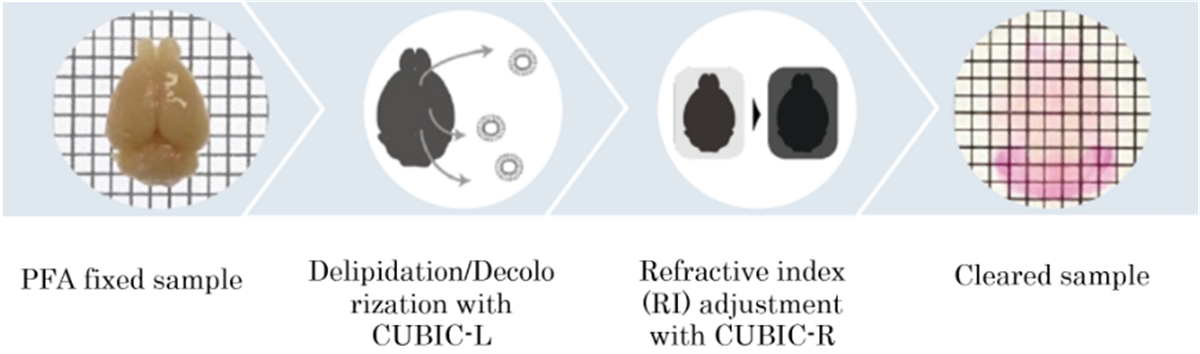
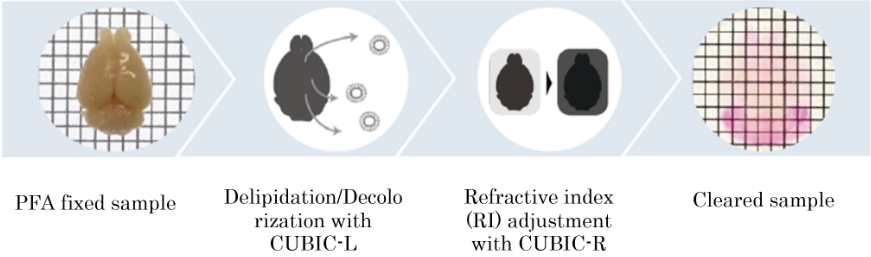
CUBIC is a water-soluble tissue clearing reagent kit designed for PFA-fixed organs and tissues. It enables 3D imaging of entire organs at cellular resolution using Light-Sheet Fluorescence Microscopy (LSFM) or Confocal Laser Scanning Microscopy (CLSM). The protocol requires only standard laboratory equipment—no specialized equipments like electrophoresis systems are required.CUBIC Technology was developed by RIKEN and the University of Tokyo over about 10 years to allow observation of all cells in organs and the body. Today, it is used by researchers around the world and gained high trust as a versatile tissue clearing and 3D tissue staining method.
Features
- Highly versatile water-soluble CUBIC tissue clearing kits that have a powerful transparency level.
- Compatible with all organs including the bone. Fluorescent protein signals can be observed after clearing the sample.
- High simplicity and reproducibility protocol solves issues pertaining to safety, waste processing, microscope compatibility, fluorescent protein signal retainability, etc.
CUBIC Bone Tissue Clearing Reagents
This reagent is optimized for bone tiusse clearing. It is designed to use in combination with CUBIC-L/R.Tissue-Clearing Reagent CUBIC-B (for Animals) is a powerful bone clearing reagent optimized for bone tissue decalcification.
100ml is sufficient for approximatley 5 to 10 mouse hindlimb samples.
Related Product : Mounting Solution
To observe cleared samples using Light-Sheet Fluorescence Microscopy (LSFM) or Confocal Laser Scanning Microscopy (CLSM), the samples must be immersed in a mounting solution. This product is optimized for samples cleared with CUBIC-R+.| Product Name | Volume | Product Code | Link |
| Mounting Solution (RI 1.522) (CUBIC-R+) | 100 ml | FNK-CSCR011 | .png) |
| 500 ml | FNK-CSCR012 | |
How to Use
Application Examples
Adult Mouse Brain
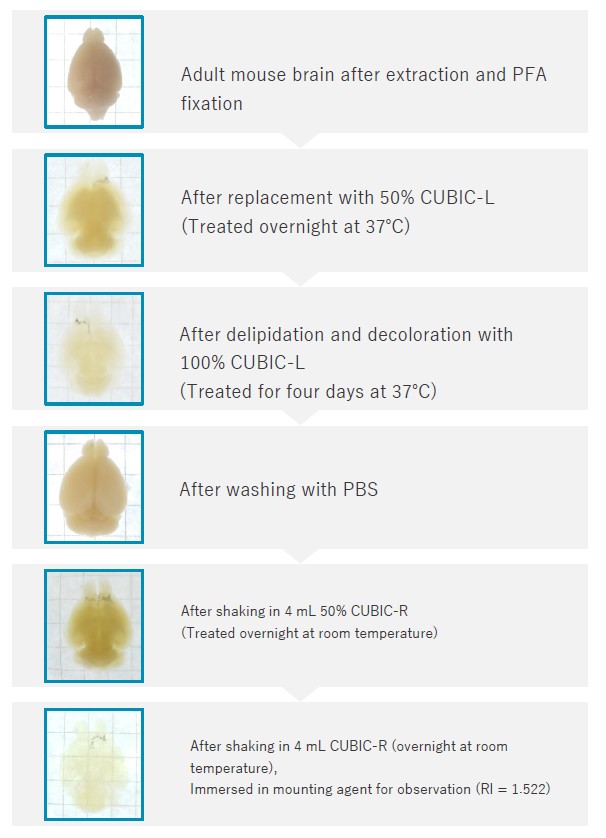
For other application examples, please refer to the technical guidebook under Manual.
- Amount of reagent and treatment time varies depending on the organ.
- Please use a slightly larger tube wider than the organ’s diameter. Most of the organ should be immersed in the reagent when the tube is laid on its side.
- Shake the organ immersed in the reagent at a speed that shakes the whole organ.
- We do not recommend rotation as it will create bubbles.