Alpha-Mannosyl-GNP
Product#: FNK-G-AMA-250
$115.10
Availability:
Ships in 24 hours
Alpha-Mannosyl-GNP
Cat. No: FNK-G-AMA-250
12 tests
Description
Alpha-Mannosyl-GNP refers to gold nanoparticles (GNP) that have been functionalized with alpha-mannosyl groups on their surface[1][3]. These nanoparticles are used in various scientific applications, particularly in the field of glycobiology and carbohydrate research.
Key features of Alpha-Mannosyl-GNP include:
1. Composition: The core consists of gold nanoparticles, which are conjugated with alpha-mannosyl groups[1].
2. Storage: They can be stored at room temperature, making them relatively stable and easy to handle[1].
3. Availability: Alpha-Mannosyl-GNP is commercially available from scientific suppliers, with product codes such as SXB-G-AMA-250-EX[1][2].
4. Applications: These functionalized nanoparticles are valuable tools in studying carbohydrate-protein interactions, particularly those involving mannose-binding proteins or lectins. They can be used in various biochemical and cellular assays to investigate glycan-mediated processes.
5. Comparison: Alpha-Mannosyl-GNP is one of several sugar-conjugated gold nanoparticles available. Others include Beta-Glucosyl-GNP and Alpha-Glucosyl-GNP, which have different sugar moieties attached to the gold nanoparticle core[3].
The alpha-mannosyl group on these nanoparticles mimics the terminal sugar residues found on many glycoproteins and glycolipids in biological systems. This makes Alpha-Mannosyl-GNP particularly useful for studying mannose-specific interactions in various biological contexts, such as cell recognition, immune responses, and pathogen binding.
Citations:
[1] https://www.2bscientific.com/products/cosmo-bio-ltd/sxb-g-ama-250-ex/alpha-mannosyl-immobilized-gold-nanoparticles-gnp
[2] https://www.amsbio.com/alphamannosyl-gnp-amssxb-g-ama-250-ex
[3] https://www.diagnocine.com/Category/Sugar-Chain/8105?sortorder=name_desc
[4] https://www.ncbi.nlm.nih.gov/gene?Cmd=DetailsSearch&Db=gene&Term=829981
[5] https://www.sciencedirect.com/topics/neuroscience/alpha-mannosidase
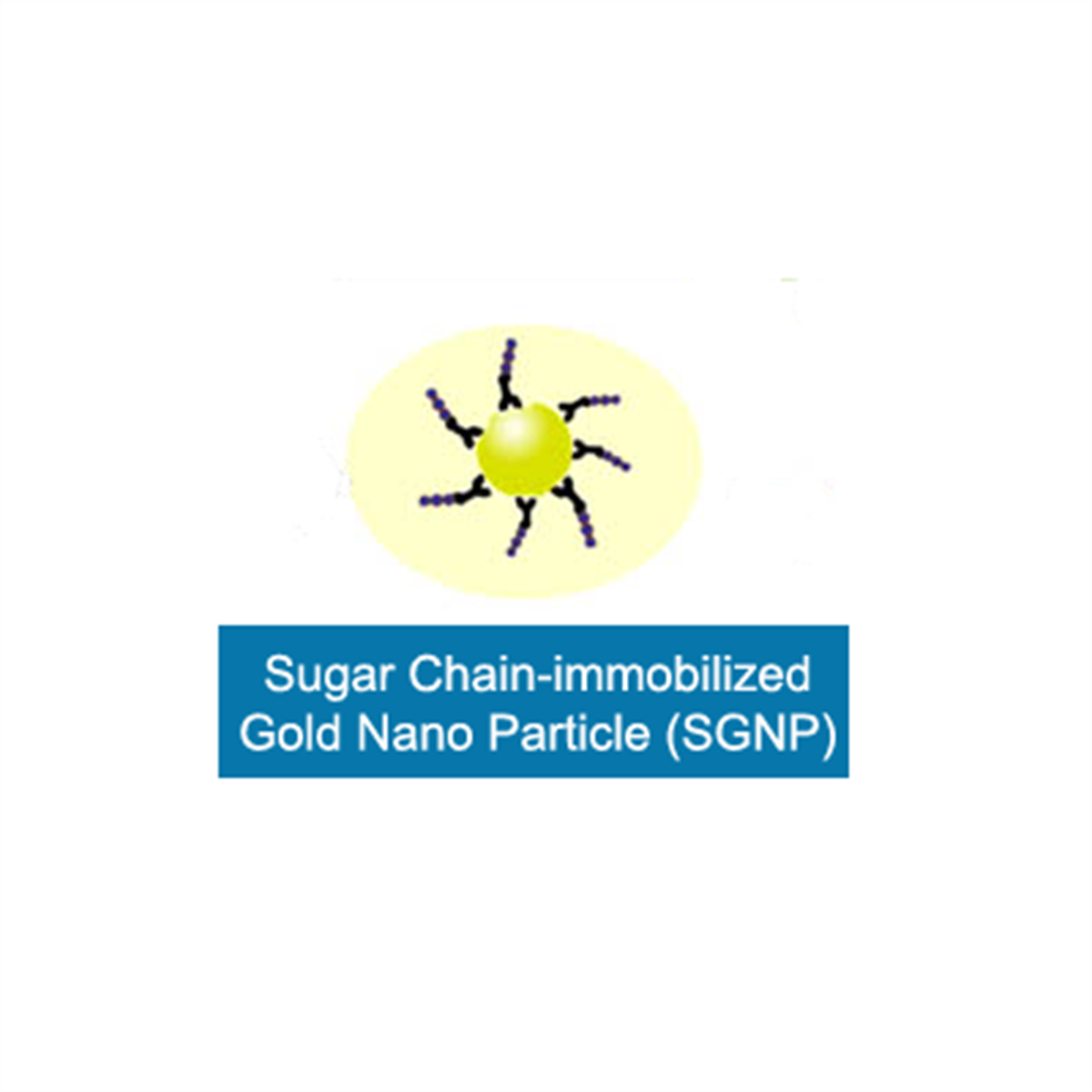
SGNP (Sugar chain immobilized Gold Nano Particle)
SGNPs

SGNP set

Delivery as
Lyophilized powder
Stability
Lyophilized powder can be stored within a year at room temperature.
Amount of SGNP in a vial
Cat. No. G-***-100
Abs530nm = 3.0[/cm] (dissolved in 1 mL of buffer)
Cat. No. G-***-250
Abs530nm = 3.0[/cm] (dissolved in 0.25 mL of buffer)
Addition of a reducing agent, such as mercaptoethanol, may affect the properties of SGNP.
Application#1: Aggregation assay of protein(s)
Regularly sugar chain binding proteins, such as lectins, possess multiple binding sites for sugar chains. By the addition of SGNP to the protein solution, the protein may form aggregates with sugar chains immobilized SGNP in a short time of period.
The change can be seen visually, or can be quantified by measuring OD at around 530 nm. Using SGNP, the binding properties (selectivity, dissociation constant (KD), specificity, etc.) are easily evaluated.
Example

Recommended protocol
- Dissolved SGNP at Abs530nm = 3.0 using your buffer.
- *see Amount of SGNP
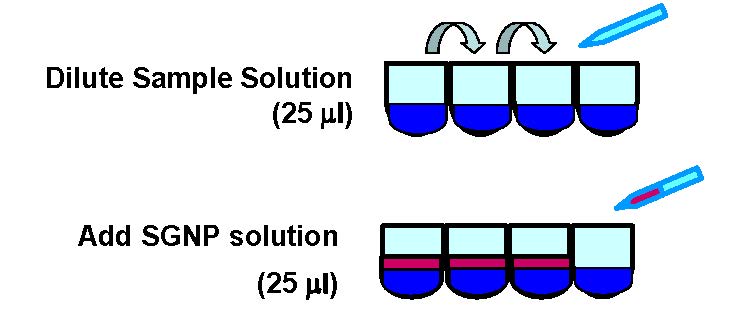
- In wells of 96-well microtiter plate (round bottom), 25μl of protein solution was added with changing the concentration.
- *Sequential 1:2 dilution from ca. 200 μg/ml (or ca. 4 μM), 6 points or more.
- Addition of 25 μl of SGNP solution prepared as above. Gentle agitation for 0.5 to 2 hr at room temperature.
- Measure OD at 530 nm of the supernatant.
This assay is useful to know the specificity of the ligands for the target protein. By the addition of inhibitor (mono-saccharide, oligo-saccharide, mimetic compounds, glycoprotein, or drug candidate), the formed protein-SGNP aggregates may be re-dissolved by the competitive binding of protein with the inhibitor.
Recommended protocol
- Dissolve SGNP at Abs530nm = 4.0 ~ 6.0 using your buffer *see Amount of SGNP
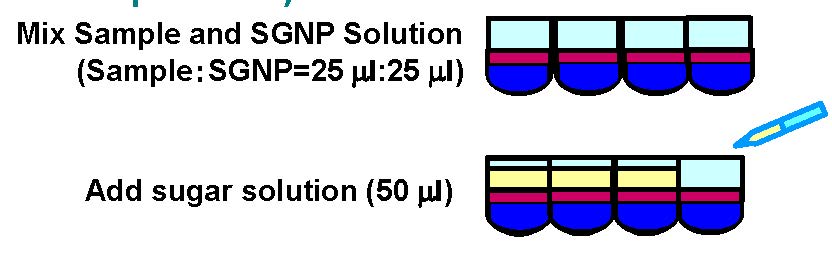
- In wells of 96-well microtiter plate (round bottom), 25μl of protein solution (Conc. > KD) and 25 μl of SGNP solution as prepared above were added. *It is important to know KD value of the protein against sugar chain on SGNP
- 50 μl of the inhibitor dissolved in the same buffer (conc. 0.1 ~ 50 mM) is added to the above mixture. Then, agitate for 1 hr or overnight.
- Measure OD at 530 nm of the supernatant.
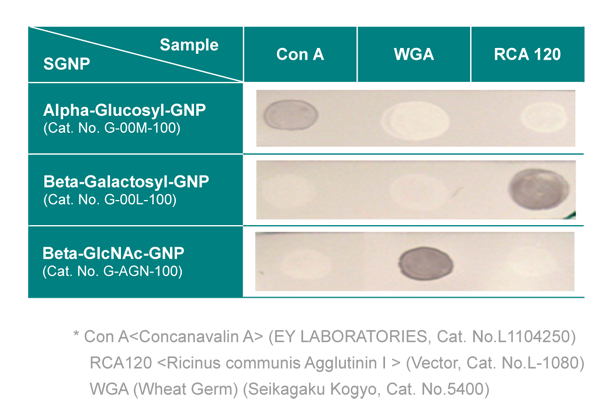
The sugar chain binding potency of the trace amount of your samples can be detected. * Independent on the valency of sugar-binding proteins

Recommended protocol
- Prepare 10~20ml SGNP solution of Abs530nm = 0.15 ~ 0.30 using your buffer. *see Amount of SGNP
- On nitrocellulose membrane* (10 x 30 mm), spot your sample (0.3 – 1 μL, 0.1- 2.0 μg) and dry up at room temperature. *Trans-BlotTM Transfer Medium, Pure Nitrocellose Membrane (0.2 μm) (Bio-Rad, Cat. No.162-0146)
- To 10 mL of SGNP solution in a glassware (φ 50 mm), the membrane is soaked with a gentle agitation for 5 – 30 min. *You may need to check the staining every 5 min. Please anchor the membrane with tweezers
- Wash the membrane with buffer and dry up. *If you see too high background, decrease the concentration of SGNP or shorten the soaking time.
Application#4: Isolation and identification of target
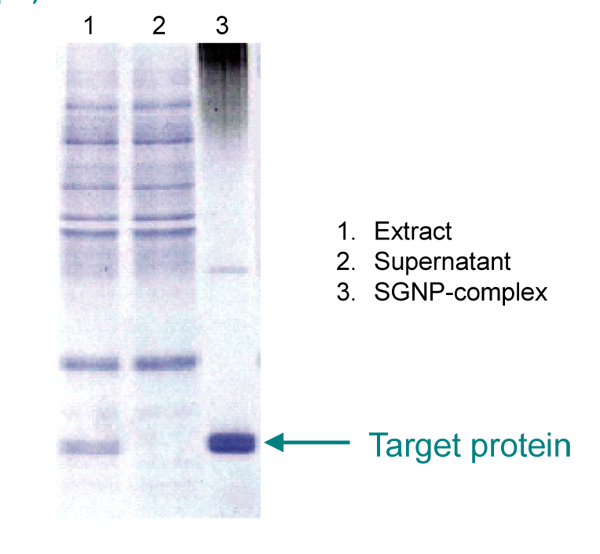
protein from a crude extract Quick isolation and identification of protein(s) having multi-binding sites (lectin) from a plant-derived crude extract of cell-lysate are available using SGNP. Once you get an aggregate by mixing appropriate SGNP with your extract or lysate, the aggregate can be
directly applied for SDS-PAGE. Then, the protein band(s) in SDS-gel is analyzed according to the proteomics procedure.

Recommended protocol
- Dissolve SGNP at Abs530nm = 3.0 using your buffer *see Amount of SGNP
- To 50 μl of SGNP solution in a 1.5 mL of eppendorf tube, add 50 μl of your extract. The mixture is incubated for 1 h to overnight at 4 degree C with a gentle agitation. * The protein concentration in the extract may be in the range between 500 and 10 mg/mL.
- Centrifugation at 6,000 ~ 10,000 x g for 10 min, and remove the supernatant.
- To the precipitate, add 500 μl of buffer, vortex for 10 sec and centrifuge at 6,000 ~ 10,000 x g for 10 min, and remove the supernatant. This may repeat 2 more times.
- To the precipitate, add 10-30 μl of sample preparation buffer*, boiled up for 10 min.. *Laemmli Sample Buffer (Bio-Rad, Cat. No.161-0737)
- SDS-PAGE *Reducing or non-reducing condition can be used.