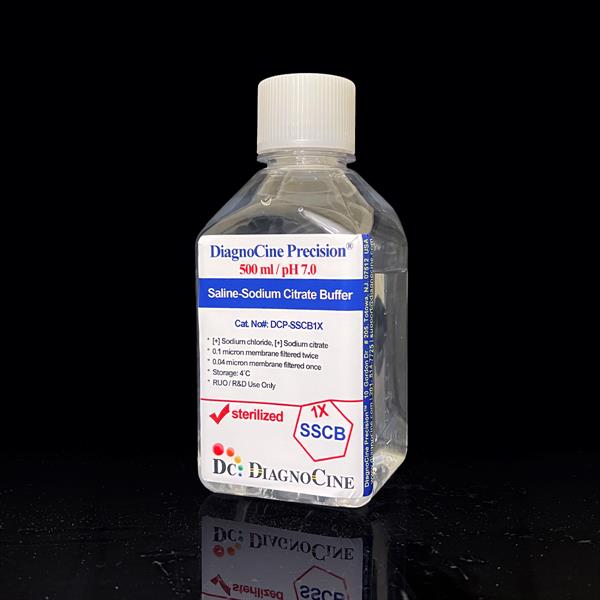
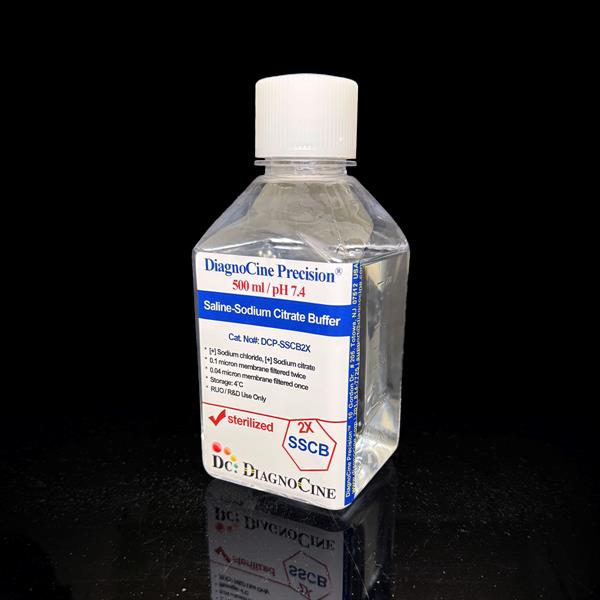
Saline-Sodium Citrate Buffer [10X]
FluxMPS™ Saline-Sodium Citrate Buffer [10X]
An MPS-grade, ultrapure 10X saline-sodium citrate (SSC) hybridization buffer formulated with defined sodium chloride and sodium citrate concentrations at a precise, stable pH. Finished through a quadruple-stage 0.1 µm / 0.04 µm filtration architecture for ultra-low particulate, mycoplasma-safe purity, it is built for Southern and Northern blotting, in situ hybridization, DNA microarray, and other nucleic-acid transfer protocols — including those run within microfluidic and chip-based molecular workflows.
- Quadruple-stage filtration — 0.1 µm membrane twice and 0.04 µm membrane twice — for ultra-low particulate, mycoplasma-safe purity
- Tested DNase- and RNase-free after 18 hr incubation at room temperature
- Precise, stable pH of 7.0 ± 0.05 (25°C) for consistent hybridization chemistry
- Defined 10X concentration — 1.5 M sodium chloride / 0.15 M sodium citrate
- Manufactured with Ultrapure Type 1 water (18.2 MΩ·cm)
- ISO 13485-certified, CE-approved manufacturing facilities
- Microchannel-safe for chip-based nucleic acid and diagnostic workflows
- Custom concentrations, pH, and chemical/compound additions available on request
- pH7.0 ± 0.05 (25°C)
- Concentration10X (1.5 M NaCl / 0.15 M Sodium Citrate)
- AppearanceClear, colorless liquid
- SterilitySterile-filtered
- Filtration0.1 µm x2 + 0.04 µm x2
- DNase ActivityNone detected (18 hr, RT)
- RNase ActivityNone detected (18 hr, RT)
- Storage4°C
- Shelf Life1 year
- Format500 mL bottle
Engineered where standard hybridization buffers fail
Conventional 0.22 µm-filtered SSC buffer can carry subvisible particulates, inconsistent pH, and residual bioburden into sensitive blotting, hybridization, and chip-based molecular workflows. FluxMPS™ Saline-Sodium Citrate Buffer is manufactured to remove those failure modes at the source, delivering the world’s cleanest buffer platform for cell and molecular biology experiments.
Microchannel-safe purity
Sequential 0.1 µm and 0.04 µm membrane filtration removes fine particulates that a single 0.22 µm pass leaves behind, supporting clean transfer and hybridization chemistry.
Precise, stable pH
Formulated to pH 7.0 ± 0.05 (25°C), within the optimal 6.0–8.0 range for most biological reactions, so stringency control during hybridization and wash steps stays reproducible.
Ultrapure-grade water
Manufactured with Ultrapure Type 1 water (18.2 MΩ·cm), consistent with USP <85> quality practices for sensitive nucleic-acid applications.
Low background for detection
Sterile, particulate-controlled formulation supports clean signal in Southern blotting, Northern blotting, and in situ hybridization detection workflows.
Defined, traceable composition
A saline-citrate formulation of sodium chloride and sodium citrate at fixed 10X molarity, tested DNase- and RNase-free before release.
Customization on demand
Alternate concentrations (e.g., 20X, 2X, 0.5X), pH, and additions of chemicals, compounds, proteins, or supplements are available — contact support@diagnocine.com.
Quadruple-stage filtration system
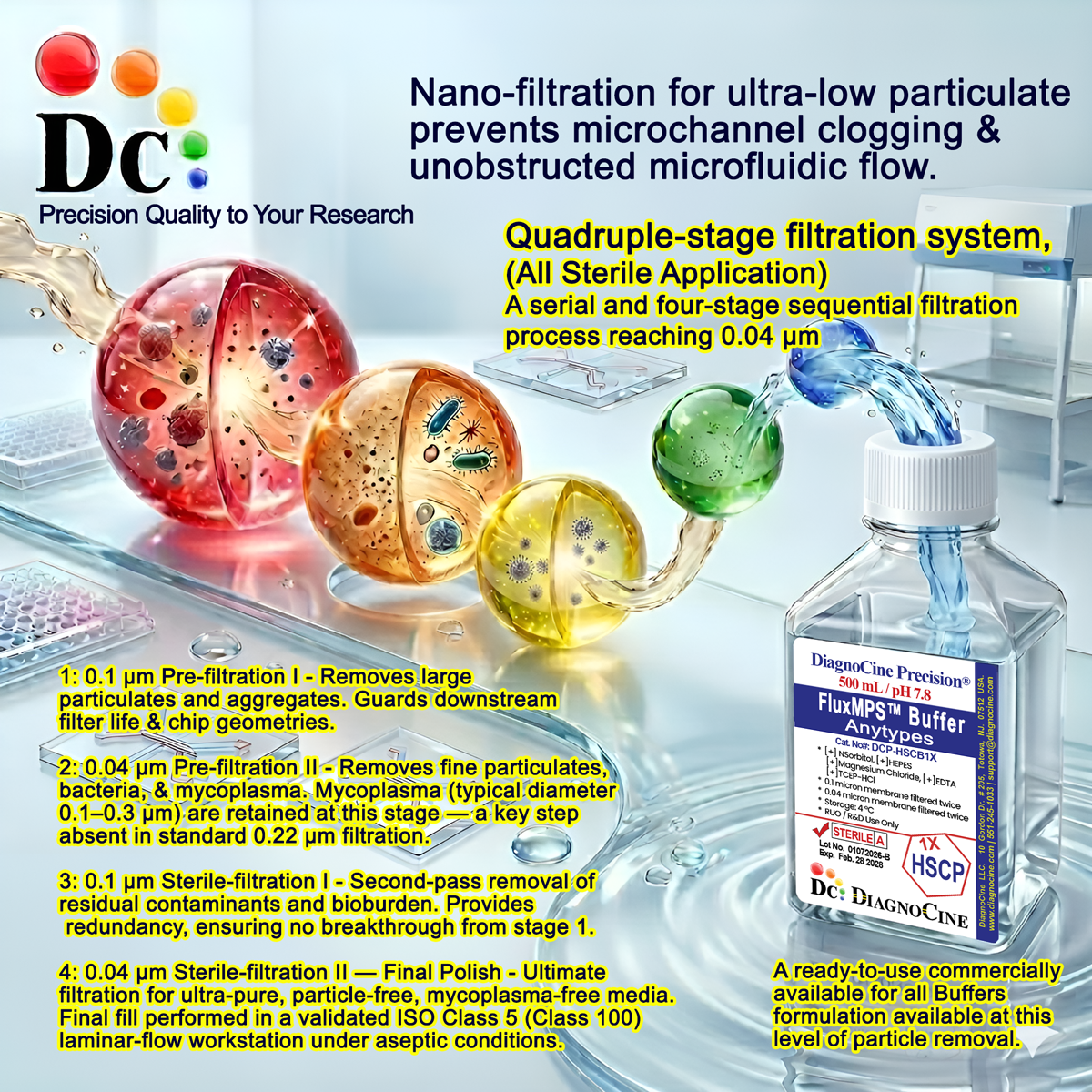
Every lot of DCP-SSCB10X is finished through four sequential filtration passes — 0.1 µm membrane filtration twice, followed by 0.04 µm membrane filtration twice — in a sterile environment, delivering ultra-low particulate, mycoplasma-safe purity for demanding hybridization and blotting protocols.
- 1
0.1 µm Pre-filtration I
First-pass 0.1 µm membrane filtration removes large particulates and aggregates, extending the service life of downstream filters.
- 2
0.04 µm Pre-filtration II
0.04 µm membrane filtration retains fine particulates and bioburden, including organisms near the smallest known mycoplasma size of approximately 0.2 micron.
- 3
0.1 µm Sterile-filtration I
A second 0.1 µm pass provides redundancy ahead of final polishing.
- 4
0.04 µm Sterile-filtration II — Final Polish
A second 0.04 µm pass delivers the final polish, performed in a sterile environment, helping prevent mycoplasma contamination.
Performance vs. conventional buffer
Sequential 0.1 µm and 0.04 µm filtration removes finer particulates than a single 0.22 µm pass, supporting cleaner hybridization backgrounds and mycoplasma-safe handling in cell and molecular biology workflows.
© Diagnocine® — DCP-SSCB10X
Where DCP-SSCB10X performs
Saline-sodium citrate buffer is a standard reagent across nucleic-acid hybridization, transfer, and preparation workflows, with stringency tunable by salt concentration.
Automated Bioreactors & Robotics
For automated liquid-handling and robotic hybridization platforms, an optional 0.01 µm (10 nm) ultra-filtered variant of this buffer is available to further protect fine-bore tubing, valves, and sensors.
- Total Particulate Exclusion — supports sub-0.1 µm polishing beyond the standard quadruple-stage process
- Valve & Sensor Protection — reduces particulate load on automated fluidic hardware
- Extended Perfusion Stability — supports consistent long-run automated protocols
Inquiry Required: the 0.01 µm (10 nm) ultra-filtered grade is available on request — contact support@diagnocine.com.
Micro Physiological System (MPS) & Chip
Compatible with chip-based molecular workflows requiring low-particulate, sterile-filtered hybridization reagents.
Wash, Dilution & Reconstitution
Stringency during wash steps is controlled by salt concentration — higher concentrations (2X) allow less stringent washing, while lower concentrations (0.5X) increase stringency and reduce non-specific binding.
iPSC-Derived Model Handling
DNase- and RNase-free formulation supports nucleic-acid QC workflows used alongside iPSC-derived model characterization.
Endothelial & Primary Cell Perfusion
Sterile-filtered, ultrapure formulation is suited to nucleic-acid preparation steps in primary and endothelial cell workflows.
ELISA, Blotting & Blocking
Used as a transfer buffer for Southern and Northern blotting and as a sodium citrate buffer for heat-induced antigen retrieval (HIER) in immunohistochemistry, helping break protein cross-links formed during fixation to improve antigen detection.
Microscopy & Optical Sensing
Developed for in situ hybridization on brain sections, helping control hybridization stringency for downstream microscopy-based detection.
Full specification summary
All parameters below reflect DCP-SSCB10X as manufactured and quality-tested by Diagnocine.
| Parameter | Specification |
|---|---|
| Formulation | Sodium Chloride 1.5 M; Sodium Citrate 0.15 M |
| Appearance | Clear, colorless liquid |
| pH USP <791> | 7.0 ± 0.05 (25°C) |
| Concentration | 10X |
| Parameter | Specification |
|---|---|
| Sterility | Filtered 0.1 µm membrane twice and 0.04 µm membrane twice in a sterile environment |
| DNase activity | None detected after 18 hr incubation with plasmid DNA at room temperature |
| RNase activity | None detected after 18 hr incubation with ribosomal RNA at room temperature |
| Manufacturing standard ISO 13485 | ISO 13485-certified, CE-approved facilities |
| Parameter | Specification |
|---|---|
| Storage temperature | 4°C |
| Shelf life | 1 year |
| Parameter | Specification |
|---|---|
| Manufacturing QMS ISO 13485 | ISO 13485-certified manufacturing facilities (Diagnocine Precision suppliers) |
| Regulatory alignment | CE-approved facilities |
| Production method | Final packaging, quality assurance, and testing at the Diagnocine R&D and Quality Testing Center; customization and assembly at Diagnocine Precision, Totowa, New Jersey, USA |
| Intended use | For Research Use Only (RUO) |
Full composition
Saline-sodium citrate buffer formulated at defined 10X molarity, released on a per-lot basis.
| Component | CAS Number | Concentration |
|---|---|---|
| Sodium Chloride | 7647-14-5 | 1.5 M |
| Sodium Citrate | 68-04-2 | 0.15 M |
Manufacturing & compliance
DCP-SSCB10X is manufactured, tested, and released under a documented quality system.
ISO 13485:2016 QMS
Manufactured under ISO 13485-certified and CE-approved facilities (Diagnocine Precision suppliers).
Ultrapure Type 1 Water
Formulated with Ultrapure Type 1 water (18.2 MΩ·cm) as the base for all buffer components.
ISO Class 5 Fill & Finish
Final sterile-filtration passes are performed in a controlled, sterile environment prior to fill.
Micro-Batch Precision
All final packaging, QA, and testing take place at the Diagnocine R&D and Quality Testing Center; customization is performed at Diagnocine Precision, Totowa, New Jersey, USA.
Endotoxin USP <85> BET
Endotoxin assessment follows USP <85> Bacterial Endotoxins Test methodology as part of the Diagnocine quality system.
Particulate USP <788> Method 2
Sub-visible particulate control is supported by the quadruple-stage 0.1 µm / 0.04 µm filtration process.
Sterility Assurance
Two passes of 0.1 µm filtration and two passes of 0.04 µm filtration are performed in a sterile environment.
Documentation / CoA
A Certificate of Analysis covering appearance, pH, sterility/filtration validation, and DNase/RNase activity is available on request.
How DCP-SSCB10X compares
A side-by-side view of DCP-SSCB10X against conventional single-stage-filtered SSC buffer.
| Parameter | DCP-SSCB10X (FluxMPS™) | Conventional 0.22 µm-filtered buffer | Standard alternative 0.22 µm-filtered buffer |
|---|---|---|---|
| Final filtration pore size | 0.04 µm | 0.22 µm | 0.22 µm |
| Number of filtration stages | 4 | 1 | 1 |
| DNase / RNase tested | check_circle | cancel | cancel |
| pH specification | 7.0 ± 0.05 (25°C) | Not specified | Not specified |
| Water quality | Ultrapure Type 1 (18.2 MΩ·cm) | Standard purified water | Standard purified water |
| Manufacturing QMS | check_circle ISO 13485 | cancel | cancel |
| Microfluidic / chip compatibility | check_circle | cancel | cancel |
| Custom formulation available | check_circle | cancel | cancel |
Frequently asked questions
Common questions about DCP-SSCB10X Saline-Sodium Citrate Buffer [10X].
Supporting literature
Curated references relevant to saline-sodium citrate buffer chemistry and its hybridization, blotting, and antigen-retrieval applications.
- Southern, E.M. Detection of specific sequences among DNA fragments separated by gel electrophoresis. J Mol Biol. 1975. doi:10.1016/S0022-2836(75)80083-0
- Alwine, J.C., Kemp, D.J., Stark, G.R. Method for detection of specific RNAs in agarose gels by transfer to diazobenzyloxymethyl-paper and hybridization with DNA probes. PNAS. 1977. doi:10.1073/pnas.74.12.5350
- Pardue, M.L., Gall, J.G. Molecular hybridization of radioactive DNA to the DNA of cytological preparations. PNAS. 1969. doi:10.1073/pnas.64.2.600
- Shi, S.R., Key, M.E., Kalra, K.L. Antigen retrieval in formalin-fixed, paraffin-embedded tissues: an enhancement method for immunohistochemical staining based on microwave oven heating of tissue sections. J Histochem Cytochem. 1991. doi:10.1177/39.6.1709656
- Schena, M., Shalon, D., Davis, R.W., Brown, P.O. Quantitative monitoring of gene expression patterns with a complementary DNA microarray. Science. 1995. doi:10.1126/science.7569999
- Bhattacharyya, A., Klapperich, C.M. Design and testing of a disposable microfluidic chemiluminescent immunoassay for disease biomarkers in human serum samples. Biomed Microdevices. 2007. doi:10.1007/s10544-006-9026-2
- Bustin, S.A. et al. The MIQE guidelines: minimum information for publication of quantitative real-time PCR experiments. Clin Chem. 2009. doi:10.1373/clinchem.2008.112797
- Huang, Y. et al. Organ-on-a-chip platforms for accelerating the evaluation of nanomedicine bioactivity. Adv Drug Deliv Rev. 2020. doi:10.1016/j.addr.2020.01.001
- Ingham, C.J. et al. The micro-Petri dish, a million-well growth chip for the culture and high-throughput screening of microorganisms. PNAS. 2007. doi:10.1073/pnas.0703287104