
SDS Stripping Buffer
FluxMPS™ SDS Stripping Buffer
FluxMPS™ SDS Stripping Buffer is a harsh-strength Western blot stripping reagent formulated with 0.5 M Tris-HCl, 10% SDS, and 50 mM TCEP to aggressively dissociate high-affinity antibodies from immunoblot membranes. Sterile-filtered through DiagnoCine's quadruple-stage 0.1 µm (twice) and 0.04 µm (twice) membrane architecture, it delivers a clean, DNase/RNase-free reagent for reliable membrane reprobing. Manufactured under ISO 13485-certified, CE-approved processes for research applications requiring dependable, reproducible antibody stripping.
- Quadruple-stage sterile filtration: 0.1-micron membrane twice and 0.04-micron membrane twice
- Harsh stripping formulation: 0.5 M Tris-HCl, 10% SDS, 50 mM TCEP
- TCEP reducing agent — more effective than DTT or beta-mercaptoethanol for disulfide bond cleavage
- pH 6.8, clear, colorless liquid; DNase- and RNase-free
- Designed for high-affinity antibody removal and reliable membrane reprobing in Western blot workflows
- Manufactured in ISO 13485-certified, CE-approved facilities
- Customizable to MILD or MEDIUM stripping formulations, pH, and additive content on request
- FormulationTris-HCl / SDS / TCEP
- pH6.8
- Tris-HCl0.5 M
- SDS Concentration10%
- TCEP Concentration50 mM
- AppearanceClear, Colorless Liquid
- Sterility0.1 µm x2 + 0.04 µm x2
- DNase / RNaseNone Detected
- Storage4°C or Room Temperature
- Shelf Life1 Year
Engineered where standard stripping buffers fall short
Conventional 0.22 µm-filtered stripping buffers can carry subvisible particulates and bioburden into sensitive membrane reprobing workflows, contributing to variable background and inconsistent antibody removal. FluxMPS™ SDS Stripping Buffer is built around a defined formulation and a multi-stage sterile filtration process to deliver consistent, reproducible stripping performance.
Microchannel-safe purity
Sequential 0.1 µm (x2) and 0.04 µm (x2) filtration removes fine particulates well beyond a single-pass 0.22 µm filter, consistent with USP <788> particulate-control principles, protecting membrane integrity in downstream immunoassay and chip-based workflows.
Precise, stable pH
Formulated at pH 6.8 with a defined 0.5 M Tris-HCl buffering system, giving consistent dissociation conditions for high-affinity antibody-antigen complexes from lot to lot.
Ultrapure-grade water
Prepared with Ultrapure Type 1 water (18.2 MΩ·cm) to minimize trace contaminant interference during BET-aligned quality workflows.
Low background for imaging & assays
Verified DNase- and RNase-free after 18-hour incubation studies, helping minimize background signal in downstream immunodetection and imaging steps.
Defined, traceable composition
Every lot is characterized for Tris-HCl, SDS, and TCEP concentration, appearance, and pH, delivering traceable, reproducible stripping performance.
Customization on demand
pH, salt content, and additive load can be adjusted, including MILD and MEDIUM stripping buffer formulations with low/high pH and high salt content — contact support@diagnocine.com.
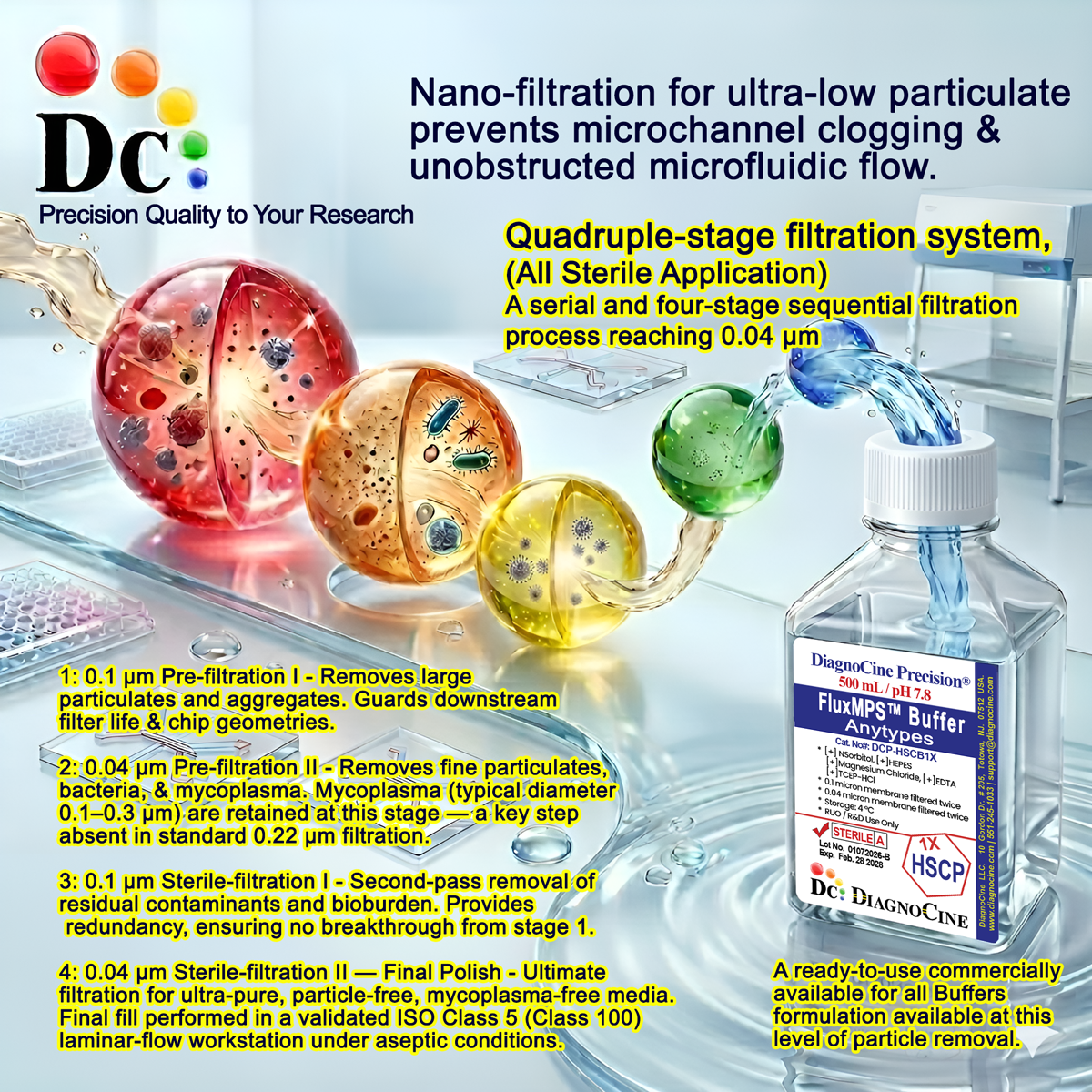
Quadruple-stage filtration system
FluxMPS™ SDS Stripping Buffer is sterile-filtered through a quadruple-stage architecture — the 0.1-micron membrane applied twice and the 0.04-micron membrane applied twice — delivering an ultra-clean, low-particulate stripping reagent for Western blot and membrane-based immunoassay workflows.
- 1
0.1 µm Pre-filtration I
Large particulate and aggregate removal, extending the service life of downstream filtration stages.
- 2
0.04 µm Pre-filtration II
Retention of fine particulates and bioburden ahead of final sterile filtration.
- 3
0.1 µm Sterile-filtration I
Second-pass 0.1 µm filtration adds redundancy to the sterile filtration process.
- 4
0.04 µm Sterile-filtration II — Final Polish
Final 0.04 µm polish into an ISO Class 5 (Class 100) aseptic fill environment. This pore size is smaller than the smallest known mycoplasma organisms, approximately 0.2 micron, helping prevent mycoplasma contamination in the finished buffer.
Performance vs. conventional buffer
Sequential 0.1-micron (x2) and 0.04-micron (x2) filtration captures particulates and bioburden that a single 0.22-micron pass allows through, supporting a cleaner, more consistent stripping reagent for sensitive membrane reprobing work.
© Diagnocine® — DCP-SDSSB1X
Where FluxMPS™ SDS Stripping Buffer fits your workflow
This harsh-strength stripping buffer is intended for removing high-affinity antibodies from Western blot membranes and immobilized immunocomplexes, enabling clean re-probing across a range of protein detection and membrane-based immunoassay workflows.
Automated Bioreactors & Robotics
For laboratories integrating membrane stripping and reprobing into automated liquid-handling or robotic Western blot workstations, an optional 0.01-micron (10 nm) ultra-filtered variant of this buffer is available on request to further reduce particulate load in automated fluidic pathways.
- Total Particulate Exclusion for automated fluidic pathways
- Valve & Sensor Protection in robotic liquid-handling systems
- Extended Perfusion Stability for continuous or repeated-cycle instrumentation
Inquiry Required: The 0.01-micron (10 nm) ultra-filtered grade is produced to order. Contact support@diagnocine.com to request this variant for your automated platform.
Micro Physiological System (MPS) & Chip
Supports membrane stripping and reprobing steps for miniaturized, chip-based Western blot and immunoassay platforms.
Wash, Dilution & Reconstitution
Used within membrane wash and stripping steps of broader sample preparation and reprobing workflows.
iPSC-Derived Model Handling
Enables stripping and reprobing of membranes probed with lysates from iPSC-derived cell models.
Endothelial & Primary Cell Perfusion
Supports reprobing of membranes from endothelial and primary cell lysates for multiplexed target detection.
ELISA, Blotting & Blocking
Primary use case: harsh stripping of high-affinity antibodies for Western blot membrane reprobing.
Microscopy & Optical Sensing
After stripping, membranes can be reprobed for targets correlated with confocal and biosensor-based detection.
Specifications at a glance
Every parameter below reflects data stated for this product; where a parameter is not characterized for this buffer, it is omitted rather than approximated.
| Parameter | Specification |
|---|---|
| Formulation / Composition | Tris-HCl, SDS, TCEP buffer system |
| Appearance | Clear, Colorless Liquid |
| pH USP <791> | 6.8 |
| Tris-HCl Concentration | 0.5 M |
| SDS Concentration | 10% |
| TCEP Concentration | 50 mM |
| Parameter | Specification |
|---|---|
| Sterility USP <71> | Filtered 0.1-micron membrane twice and 0.04-micron membrane twice in a sterile environment |
| DNase Activity | None detected after 18 hr incubation with plasmid DNA at room temperature |
| RNase Activity | None detected after 18 hr incubation with ribosomal RNA at room temperature |
| Water Quality | Ultrapure Type 1 water (18.2 MΩ·cm) |
| Manufacturing Standard ISO 13485 | ISO 13485-certified, CE-approved facility |
| Fill Environment | ISO Class 5 (Class 100) aseptic fill |
| Parameter | Specification |
|---|---|
| Storage Temperature | 4°C (long-term storage; SDS may precipitate — redissolve at room temperature) or room temperature |
| Shelf Life | 1 year |
| Parameter | Specification |
|---|---|
| Manufacturing Facility | ISO 13485-certified and CE-approved facility (DiagnoCine Precision supplier network) |
| Final QA & Packaging | Completed at the DiagnoCine R&D and Quality Testing Center |
| Customization & Assembly | Performed at DiagnoCine Precision, Totowa, New Jersey, USA |
| Intended Use | Research Use Only (RUO) |
Full composition
FluxMPS™ SDS Stripping Buffer is a defined Tris-HCl / SDS / TCEP formulation, with every component and concentration released on a per-lot basis.
| Component | CAS Number | Concentration |
|---|---|---|
| Tris-HCl | 1185-53-1 | 0.5 M |
| SDS (Sodium Dodecyl Sulfate) | 151-21-3 | 10% |
| TCEP (Tris(2-carboxyethyl)phosphine) | 51805-45-9 | 50 mM |
Manufacturing & compliance
FluxMPS™ SDS Stripping Buffer is produced under a controlled quality system, with final release testing and customization completed at DiagnoCine's own facilities.
ISO 13485:2016 QMS
Manufactured under ISO 13485-certified and CE-approved facilities.
Ultrapure Type 1 Water
Formulated with Ultrapure Type 1 water (18.2 MΩ·cm) for cleanroom-level purity.
ISO Class 5 Fill & Finish
Quadruple-stage 0.1-micron (x2) / 0.04-micron (x2) filtration culminating in a sterile, ISO Class 5 fill.
Micro-Batch Precision
Final packaging, QA, and testing performed at the DiagnoCine R&D and Quality Testing Center; customization and assembly performed at DiagnoCine Precision, Totowa, New Jersey, USA.
Endotoxin Testing USP <85> BET
Endotoxin testing follows USP <85> Bacterial Endotoxins Test methodology as part of DiagnoCine's sterile buffer release framework; contact support@diagnocine.com for lot-specific results.
Particulate Control USP <788> Method 2
Particulate matter is controlled through the product's quadruple-stage 0.1-micron / 0.04-micron filtration architecture, in line with USP <788> Method 2 principles.
Osmolality USP <785>
Osmolality testing is applied across DiagnoCine's aqueous buffer platform as applicable; this product is characterized primarily by pH and reducing/denaturing agent concentration relevant to its stripping application.
Documentation / CoA
A lot-specific Certificate of Analysis documenting appearance, pH, sterility/filtration, DNase, and RNase testing is available on request.
How DCP-SDSSB1X compares
A structural comparison against conventional, single-pass 0.22-micron-filtered stripping buffer.
| Parameter | DCP-SDSSB1X (FluxMPS™) | Conventional Buffer (0.22 µm filtered) | Standard Alternative (0.22 µm filtered) |
|---|---|---|---|
| Defined high-strength SDS/TCEP formulation | check_circle | cancel | cancel |
| Final filtration pore size | 0.04 µm | 0.22 µm | 0.22 µm |
| Number of filtration stages | 4 | 1 | 1 |
| TCEP-based reducing agent (vs. DTT/BME) | check_circle | cancel | cancel |
| Verified DNase/RNase-free | check_circle | cancel | cancel |
| Manufacturing QMS (ISO 13485) | check_circle | cancel | cancel |
| Membrane-based / chip-integrated immunoassay compatibility | check_circle | cancel | cancel |
| Custom formulation (pH, salts, additives) | check_circle | cancel | cancel |
Frequently asked questions
Answers to common questions about DCP-SDSSB1X SDS Stripping Buffer.
Supporting literature
No product-specific citations were provided for DCP-SDSSB1X; the curated literature below supports the underlying chemistry and quality principles applied to this buffer.
- Kaufmann SH, Ewing CM, Shaper JH. The erasable Western blot. Anal Biochem. 1987. doi:10.1016/0003-2697(87)90496-8
- Yeung YG, Stanley ER. A solution for stripping antibodies from polyvinylidene fluoride immunoblots for multiple reprobing. Anal Biochem. 2009. doi:10.1016/j.ab.2009.03.017
- Burnette WN. Western blotting: electrophoretic transfer of proteins from sodium dodecyl sulfate-polyacrylamide gels to unmodified nitrocellulose. Anal Biochem. 1981. doi:10.1016/0003-2697(81)90281-5
- Han JC, Han GY. A procedure for quantitative determination of tris(2-carboxyethyl)phosphine, an odorless reducing agent more stable and effective than dithiothreitol. Anal Biochem. 1994. doi:10.1006/abio.1994.1173
- Getz EB, Xiao M, Chakrabarty T, Cooke R, Selvin PR. A comparison between the sulfhydryl reductants tris(2-carboxyethyl)phosphine and dithiothreitol for use in protein biochemistry. Anal Biochem. 1999. doi:10.1006/abio.1999.4302
- Uphoff CC, Drexler HG. Detecting mycoplasma contamination in cell cultures by polymerase chain reaction. Methods Mol Biol. 2011. doi:10.1007/978-1-61779-108-6_9
- Rottem S, Barile MF. Beware of mycoplasmas. Trends Biotechnol. 1993. doi:10.1016/0167-7799(93)90121-Z
- Bass JJ, Wilkinson DJ, Rankin D, et al. An overview of technical considerations for Western blotting applications to physiological research. Scand J Med Sci Sports. 2017. doi:10.1111/sms.12702
- Junqueira-Neto S, Batista IA, Costa JL, Melo SA. Bioanalytical methods for membrane protein detection and reprobing in microfluidic immunoassay platforms. Micromachines. 2018. doi:10.3390/mi9080387