

- Home
- FluxMPS™ RPMI 1640 Medium, High Glucose & 25mM HEPES w/o L-Glutamine, Sodium Pyruvate, Sodium Bicarbonate, Phenol Red: 1X Liquid
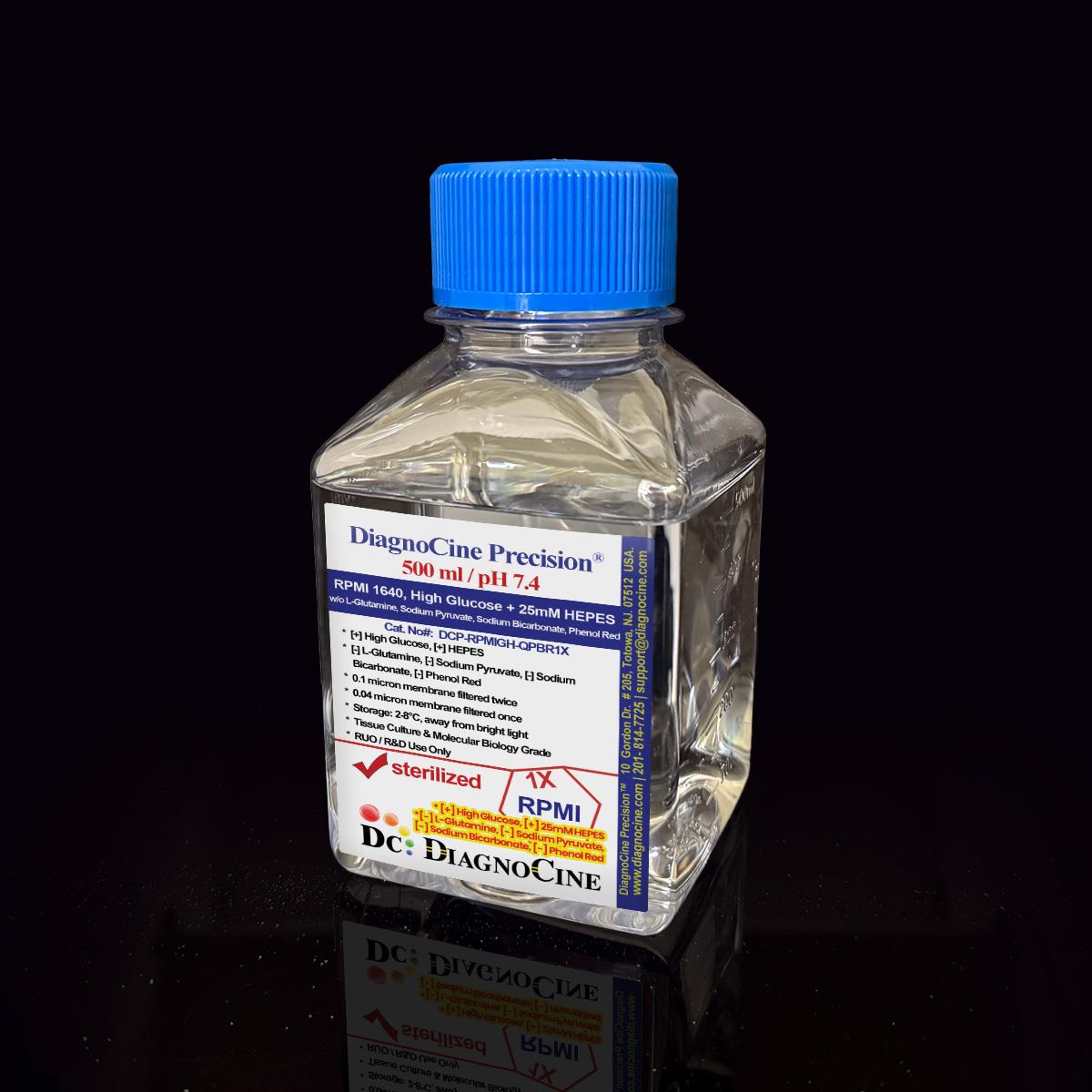
FluxMPS™ RPMI 1640 Medium, High Glucose & 25mM HEPES w/o L-Glutamine, Sodium Pyruvate, Sodium Bicarbonate, Phenol Red: 1X Liquid
FluxMPS™ RPMI 1640 Medium, High Glucose & 25mM HEPES w/o L-Glutamine, Sodium Pyruvate, Sodium Bicarbonate, Phenol Red: 1X Liquid
FluxMPS™ DCP-RPMIGH-QPBR1X is a Microfluidics Suitable, quadruple-stage ultra-filtered RPMI 1640 cell-culture medium engineered for organ-on-a-chip (OoC) and microphysiological system (MPS) platforms. This high-glucose, 25 mM HEPES-buffered, bicarbonate-free and phenol-red-free formulation is processed through a Quadruple-stage filtration system (0.1 µm ×2 + 0.04 µm ×2), finishing with a 0.04 µm final polish for microchannel-safe purity.
- RPMI 1640 base with high glucose (4500 mg/L D-Glucose) and 25 mM HEPES buffering
- Bicarbonate-free and phenol-red-free formulation; L-Glutamine and Sodium Pyruvate not added
- HEPES-buffered for reduced CO₂ dependence — validate per cell line
- Endotoxin release specification: < 0.05 EU/mL (LAL, USP <85>)
- Quadruple-stage filtration (0.1 µm ×2 + 0.04 µm ×2) with a 0.04 µm final polish
- 37 defined components verified per lot with full CAS traceability
- Manufactured under an ISO 13485:2016 quality management system; final QC at Diagnocine, Totowa NJ
- Customization available: pH, glucose, HEPES, salts, and nutrients on request
- Formulation[+] HEPES, [+] Calcium, [+] Magnesium, [+] Glucose; [-] L-Glutamine, [-] Sodium Bicarbonate, [-] Phenol Red, [-] Sodium Pyruvate
- Glucose4500.000 mg/L
- L-GlutamineNone / Not added
- pH (USP <791>)7.4
- Endotoxin (USP <85>)< 0.05 EU/mL
- Filtration0.1 µm ×2 + 0.04 µm ×2
- CO₂ requirementHEPES-buffered; reduced CO₂ dependence
- Storage2–8°C, protect from light
- Shelf Life12 months from date of manufacture, unopened
- ShippingCold pack
Engineered where standard media fails
Conventional 0.22 µm–filtered media can pass mycoplasma-sized organisms, subvisible particulates, and aggregates that foul microfluidic channels and confound on-chip assays. FluxMPS™ addresses these failure modes through a 0.04 µm final-polish architecture and a fully defined, traceable formulation.
Microchannel-safe purity
0.04 µm final filtration removes subvisible particulates and aggregates that accumulate in OoC microchannels.
Total metabolic control
Defined RPMI 1640 base with no added L-Glutamine or pyruvate gives you precise control over carbon and nitrogen sources in your experimental system.
HEPES-buffered stability
25 mM HEPES with a bicarbonate-free formulation maintains physiological pH with reduced CO₂ dependence — suited to open microfluidic and perfusion setups.
Low background for imaging
Ultra-low subvisible particulate background supports confocal microscopy, biosensors, and live-cell imaging on-chip.
Rich, traceable nutrient profile
37 defined components verified per lot with full CAS traceability; manufactured by micro-batch for lot-to-lot consistency.
Customization on demand
pH, glucose, HEPES, salts, and nutrient composition modifications available. Contact support@diagnocine.com.
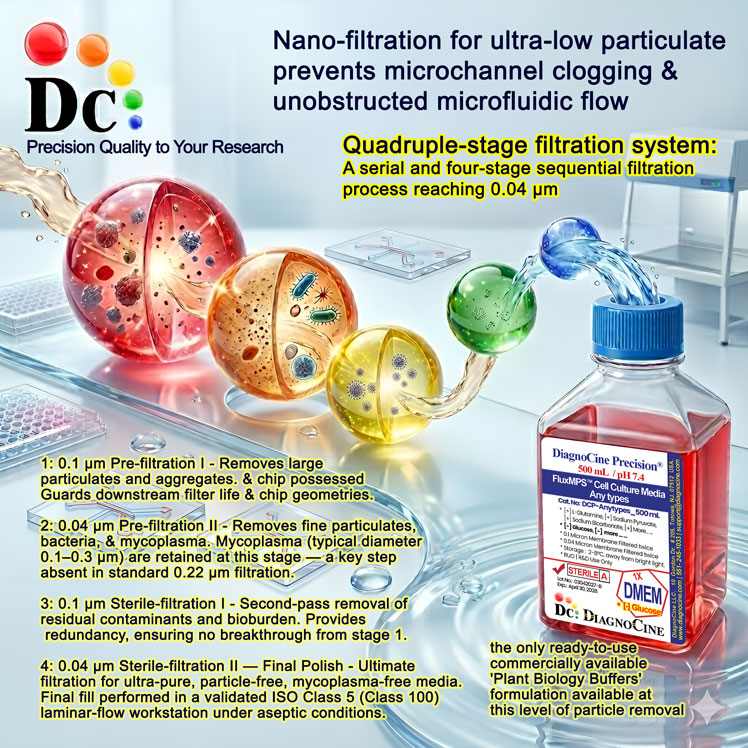
Quadruple-stage filtration system
Four serial filtration stages culminate in a 0.04 µm final polish under aseptic fill & finish, delivering media at a purity level beyond conventional 0.22 µm filtration.
-
1
0.1 µm Prefiltration I
Large particulate, cell debris and protein aggregate removal; protects the first 0.04 µm final filter cartridge.
-
2
0.04 µm Final filtration I
First 0.04 µm pass; retains sub-micron particulates and microaggregates that a 0.22 µm filter would pass.
-
3
0.1 µm Prefiltration II
Second dedicated 0.1 µm prefilter, protecting the second 0.04 µm final filter cartridge.
-
4
0.04 µm Final filtration II — Polish
Ultimate polishing filter; aseptic fill & finish. Final product QC release gate.
Performance vs. conventional media
FluxMPS™ DCP-RPMIGH-QPBR1X reaches a 0.04 µm final pore size across four sequential filtration passes — well below the 0.22 µm cut-off of conventional media, using paired 0.1 µm mycoplasma-retentive prefiltration ahead of each 0.04 µm final filter.
© Diagnocine® — DCP-RPMIGH-QPBR1X
OoC and MPS applications
FluxMPS™ DCP-RPMIGH-QPBR1X delivers ultra-filtered, HEPES-buffered RPMI 1640 for organ-on-a-chip, microfluidic, and metabolic research where particulate-free media and defined nutrient control are critical.
Automated Bioreactors & Robotics
An optional 0.01 µm (10 nm) MPS Grade variant is available on request for automated bioreactors and robotic perfusion systems that demand the lowest possible particulate load — a distinct, higher tier above this Microfluidics Suitable (0.04 µm) product.
- Total Particulate Exclusion: 10 nm filtration removes nanoparticulate aggregates that foul automated systems
- Valve & Sensor Protection: Reduces micro-fouling in automated perfusion and recirculation systems
- Extended Perfusion Stability: Consistent nutrient delivery over long-duration culture runs
Inquiry Required: Contact support@diagnocine.com to request the 0.01 µm MPS Grade variant.
Micro Physiological System (MPS) & Chip
0.04 µm filtered media for organ-on-a-chip, tissue-on-a-chip, and body-on-a-chip where particle-free media prevents channel fouling.
Warburg Effect & Metabolic Research
RPMI 1640 base supports cancer cell lines and Warburg-effect metabolic studies with precise, defined nutrient control.
iPSC-Derived Models
Ultra-clean base for iPSC differentiation protocols requiring defined, particulate-free media.
Endothelial & Primary Cells
Particle-free formulation for primary cells and endothelial monolayer studies on-chip.
Metabolic Flux Analysis
Defined, bicarbonate-free, phenol-red-free formulation for ¹³C isotope tracing, Agilent Seahorse XF metabolic assays, and NMR metabolomics.
Microscopy & Optical Sensing
Ultra-low particulate background for confocal microscopy, biosensor measurements, and TEER monitoring on-chip.
Analytical release specifications
Every lot is released against the product specification. A Certificate of Analysis is available: support@diagnocine.com.
| Parameter | Specification |
|---|---|
| Formulation | [+] HEPES, [+] Calcium, [+] Magnesium, [+] Glucose; [-] L-Glutamine, [-] Sodium Bicarbonate, [-] Phenol Red, [-] Sodium Pyruvate |
| Appearance | Pale yellow / colorless, clear solution |
| Total ingredients | 37 |
| pH USP <791> | 7.4 |
| Osmolality USP <785> | Contact for specification |
| Glucose | 4500.000 mg/L |
| L-Glutamine | None / Not added |
| Phenol Red | None / Not added |
| Parameter | Specification |
|---|---|
| Endotoxin USP <85> BET | < 0.05 EU/mL |
| Sterility USP <71> | No growth / 14 days |
| Mycoplasma | 0.1 µm mycoplasma-retentive filtration (not tested per lot) |
| Manufacturing std. ISO | ISO 13485:2016 |
| Parameter | Specification |
|---|---|
| Storage temperature | 2–8°C, away from light |
| Freeze-thaw | Do not freeze |
| Shelf life | 12 months from date of manufacture, unopened |
| Shipping condition | Cold pack |
| CO₂ requirement | HEPES-buffered; reduced CO₂ dependence (validate per cell line) |
| Available pack sizes | 500 mL, 1000 mL |
| Parameter | Specification |
|---|---|
| Raw material grade | Reagent / cell-culture grade |
| Traceability | Full lot traceability per ISO 13485 |
| Manufacturing QMS ISO | ISO 13485:2016 certified |
| UNSPSC | 41116155 — Molecular biology and cell culture growth media (UNv260801) |
| Grade | Microfluidics Suitable — 0.04 µm final filtration (not MPS Grade) |
| Regulatory alignment | Manufactured under ISO 13485-certified facilities |
| Final QC | Diagnocine, Totowa NJ |
| Intended use | Research Use Only (RUO) |
Full composition (mg/L)
RPMI 1640 Medium, High Glucose & 25mM HEPES w/o L-Glutamine, Sodium Pyruvate, Sodium Bicarbonate, Phenol Red: 1X Liquid — 37 ingredients verified per lot with CAS numbers for full raw-material traceability. All ingredients from the original formulation are preserved exactly.
| Component | CAS Number | mg/L |
|---|---|---|
| INORGANIC SALTS | ||
| Calcium nitrate tetrahydrate | 13477-34-4 | 100.000 |
| Magnesium sulfate anhydrous | 7487-88-9 | 48.840 |
| Potassium chloride | 7447-40-7 | 400.000 |
| Sodium chloride | 7647-14-5 | 6000.000 |
| Sodium phosphate dibasic anhydrous | 7558-79-4 | 800.000 |
| Component | CAS Number | mg/L |
|---|---|---|
| AMINO ACIDS | ||
| Glycine | 56-40-6 | 10.000 |
| L-Arginine hydrochloride | 1119-34-2 | 241.000 |
| L-Asparagine | 70-47-3 | 50.000 |
| L-Aspartic acid | 56-84-8 | 20.000 |
| L-Cystine dihydrochloride | 30925-07-6 | 65.200 |
| L-Glutamic acid | 56-86-0 | 20.000 |
| L-Histidine hydrochloride monohydrate | 5934-29-2 | 20.960 |
| L-Hydroxyproline | 51-35-4 | 20.000 |
| L-Isoleucine | 73-32-5 | 50.000 |
| L-Leucine | 61-90-5 | 50.000 |
| L-Lysine hydrochloride | 657-27-2 | 40.000 |
| L-Methionine | 63-68-3 | 15.000 |
| L-Phenylalanine | 63-91-2 | 15.000 |
| L-Proline | 147-85-3 | 20.000 |
| L-Serine | 56-45-1 | 30.000 |
| L-Threonine | 72-19-5 | 20.000 |
| L-Tryptophan | 73-22-3 | 5.000 |
| L-Tyrosine Disodium Salt | 69847-45-6 | 28.830 |
| L-Valine | 72-18-4 | 20.000 |
| Component | CAS Number | mg/L |
|---|---|---|
| VITAMINS | ||
| Choline chloride | 67-48-1 | 3.000 |
| D-Biotin | 58-85-5 | 0.200 |
| D-Ca-Pantothenate | 137-08-6 | 0.250 |
| Folic acid | 59-30-3 | 1.000 |
| Niacinamide | 98-92-0 | 1.00 |
| Pyridoxine hydrochloride | 58-56-0 | 1.00 |
| Riboflavin | 83-88-5 | 0.200 |
| Thiamine hydrochloride | 67-03-8 | 1.000 |
| p-Amino benzoic acid (PABA) | 150-13-0 | 1.000 |
| OTHERS | ||
| D-Glucose | 50-99-7 | 4500.000 |
| Glutathione reduced | 70-18-8 | 1.000 |
| HEPES | 7365-45-9 | 5958.000 |
| i-Inositol | 87-89-8 | 35.000 |
ISO 13485 manufacturing & compliance
Every batch of FluxMPS™ DCP-RPMIGH-QPBR1X is manufactured under a certified ISO 13485:2016 QMS, with full lot traceability and multi-parameter QC release testing; final QC is performed at Diagnocine, Totowa NJ.
ISO 13485:2016 QMS
Full quality management system with documented procedures, deviation control, and CAPA. Every lot traceable from raw material to final release.
Quadruple-stage filtration
Four sequential passes (0.1 µm ×2 + 0.04 µm ×2) ending in a 0.04 µm final polish and aseptic fill & finish.
Per-lot QC & CoA
Micro-batch manufacturing with per-lot QC release. Every batch tested independently — not pooled or blended across lots.
Finished in Totowa, NJ
Manufactured under ISO 13485-certified quality systems, with final quality control completed at Diagnocine, Totowa, New Jersey, USA.
Endotoxin USP <85> BET
LAL Bacterial Endotoxin Test per batch. Release specification: < 0.05 EU/mL.
Sterility USP <71>
No growth after 14-day incubation per lot, confirming aseptic fill & finish.
Mycoplasma control
0.1 µm mycoplasma-retentive filtration at each prefiltration stage (not tested per lot).
Documentation / CoA
Full Certificate of Analysis available per lot, including QC parameters, test dates, and raw-material lot numbers. Request: support@diagnocine.com.
- Endotoxin — LAL assay, USP <85> Bacterial Endotoxins Test; assay sensitivity 0.005 EU/mL; release specification < 0.05 EU/mL
- pH, osmolality, conductivity, appearance and clarity
- Sterility
How DCP-RPMIGH-QPBR1X compares
FluxMPS™ versus conventional 0.22 µm filtered RPMI 1640 media for OoC and MPS applications.
| Parameter | DCP-RPMIGH-QPBR1X (FluxMPS™) | Conventional 0.22 µm Filtered | Standard Alternative |
|---|---|---|---|
| Grade | Microfluidics Suitable | Not applicable | Not applicable |
| Formulation | RPMI 1640, high glucose, 25 mM HEPES, bicarbonate-free, phenol-red-free | Standard RPMI 1640 | Standard RPMI 1640 |
| Final filtration pore size | 0.04 µm | 0.22 µm | 0.22 µm |
| Number of filtration stages | 4 stages | 1 stage | 1–2 stages |
| Mycoplasma-retentive filtration (0.1 µm) | check_circle | cancel | cancel |
| Endotoxin (release specification) | < 0.05 EU/mL | Corning classical liquid media — < 0.25 EU/mL Sigma-Aldrich DMEM complete medium — ≤ 2 EU/mL Gibco classical DMEM — Not specified (recorded per lot) |
|
| Subvisible particulate control (0.04 µm polish) | check_circle | cancel | cancel |
| Buffer system | 25 mM HEPES (reduced CO₂ dependence) | Sodium bicarbonate (typically 5% CO₂) | Sodium bicarbonate (typically 5% CO₂) |
| Manufacturing QMS | ISO 13485:2016 | Varies by manufacturer | Varies by manufacturer |
| Microfluidic channel compatibility | check_circle | cancel | cancel |
| Custom formulation | check_circle | cancel | Limited |
Comparison figures from published supplier specifications, accessed 2026-09-02. Suppliers that publish no numeric endotoxin specification are shown as "Not specified".
Frequently asked questions
Common questions about FluxMPS™ DCP-RPMIGH-QPBR1X and its use in OoC and MPS applications.
Supporting literature
Curated peer-reviewed references relevant to OoC and MPS applications and to HEPES-buffered RPMI 1640 cell-culture media.
- Bhatia SN, Ingber DE. Microfluidic organs-on-chips. Nature Biotechnology. 2014;32(8):760–772.doi:10.1038/nbt.2989
- Sackmann EK, Fulton AL, Beebe DJ. The present and future role of microfluidics in biomedical research. Nature. 2014;507(7491):181–189.doi:10.1038/nature13118
- Huh D, et al. Reconstituting organ-level lung functions on a chip. Science. 2010;328(5986):1662–1668.doi:10.1126/science.1188302
- Ingber DE. Human organs-on-chips for disease modelling, drug development and personalized medicine. Nature Reviews Genetics. 2022;23:467–491.doi:10.1038/s41576-022-00466-9
- Maoz BM, et al. A linked organ-on-chip model of the human neurovascular unit. Nature Biotechnology. 2018;36:865–874.doi:10.1038/nbt.4226
- Bhise NS, et al. A liver-on-a-chip platform with bioprinted hepatic spheroids. Biofabrication. 2016;8(1):014101.doi:10.1088/1758-5090/8/1/014101
- Moore GE, Gerner RE, Franklin HA. Culture of normal human leukocytes. JAMA. 1967;199(8):519–524.doi:10.1001/jama.1967.03120080053007
- Good NE, et al. Hydrogen ion buffers for biological research. Biochemistry. 1966;5(2):467–477.doi:10.1021/bi00866a011
- van Duinen V, et al. Microfluidic 3D cell culture: from tools to tissue models. Current Opinion in Biotechnology. 2015;35:118–126.doi:10.1016/j.copbio.2015.05.002
- Warburg O. On the origin of cancer cells. Science. 1956;123(3191):309–314.doi:10.1126/science.123.3191.309