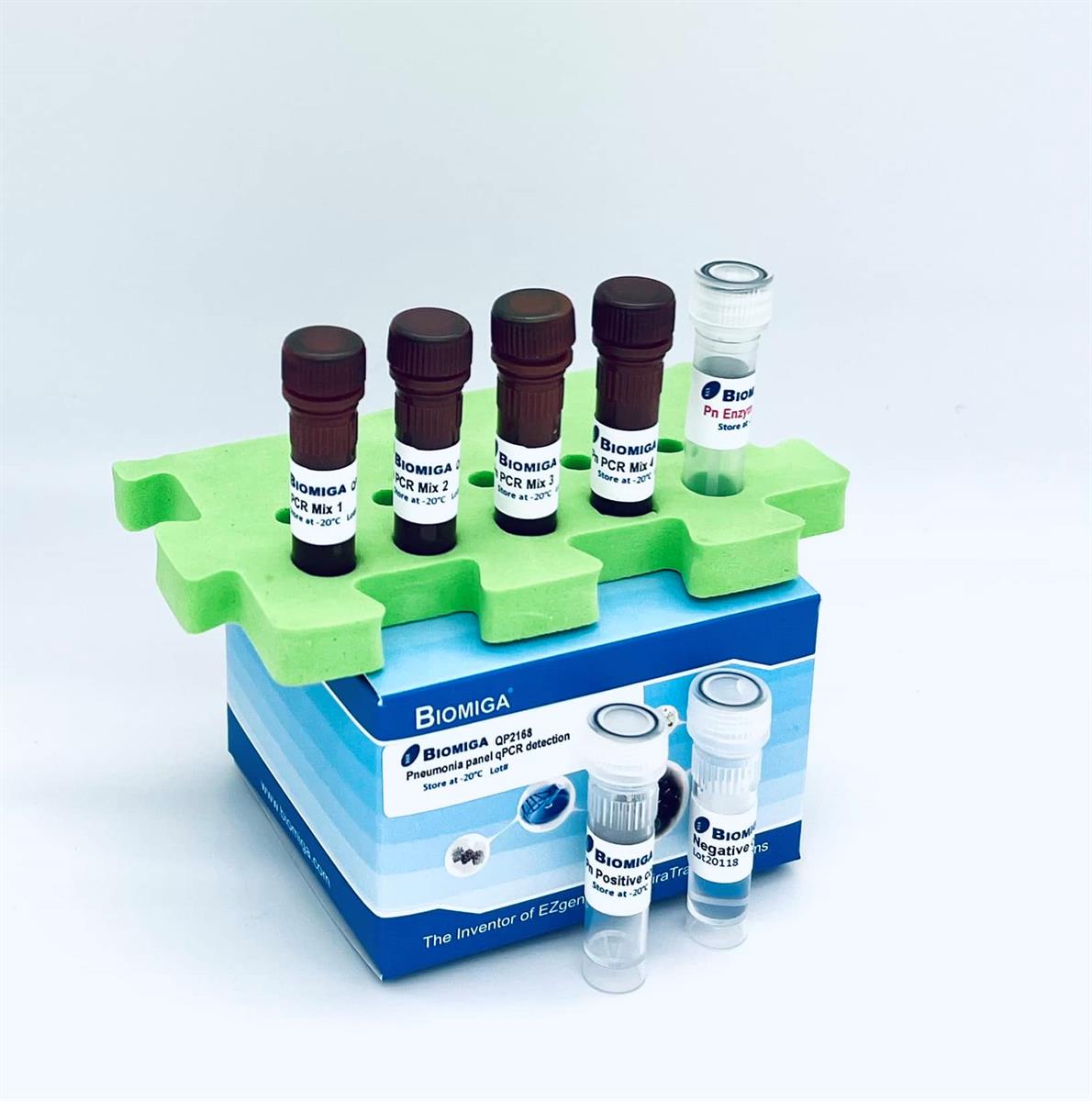
Penumonia panel real time PCR detection (100 test)
Cat. No.: BMG-QP2168-01
Size: 100 tests
Description
Respiratory pathogens cause acute local and systemic disease, such as pneumonia. Due to the similarity of diseases caused by many bacteria or fungi, diagnosis based on clinical symptoms alone is difficult. Identification of potential causative agents provides data to aid the physician in determining appropriate patient treatment and public health response for disease containment. This panel is designed for specific and qualitative detection of pneumonia-causing bacteria in specimens such as oropharyngeal swabs, nasopharyngeal swabs or sputum. The product is intended for use by qualified laboratory personnel well trained in nucleic acid amplification techniques and in vitro diagnostic procedures. Positive results do not rule out bacterial infection or co-infection with other pathogens. Negative results do not preclude microbial infection and should not be used as the sole basis for patient management decisions. Test results must be combined with clinical observations, patient history, and epidemiological information.
Summary and explanation of the test
The Pneumonia Panel Assay is a real-time PCR test intended for the qualitative detection of DNA from the bacteria in nasopharyngeal or oropharyngeal swabs, sputum.
The assay includes the following respiratory track bacteria targets:
Haemophilus influenzae
Klebsiella aerogenes
Klebsiella pneumonia group
Moraxella catarrhalis
Pseudomonas aeruginosa
Serratia marcescens
Staphylococcus aureus
Streptococcus agalactiae
Streptococcus pneumoniae
Streptococcus pyogenes
Chlamydia pneumoniae
Legionella pneumophila
Mycoplasma pneumoniae
Principle
The primers and probes are selected from the regions of targeted conserved regions of the above bacteria. The primer/probe sets are designed for specific detection of above regions are separated into 4 multiplex qPCR setups. An additional primer/probe set to detect human TERT gene (as an internal control) is also included. DNA extracted from respiratory specimens is amplified in a Real-Time PCR Thermocycler (such as Applied Biosystems 7500 Real-Time PCR Instrument). The fluorescent signal is emitted when the 5’ nuclease active domain of Taq polymerase degrades the probe anneals to target sequence between the forward and the reverse primers. During each cycle, the fluorescence intensity is increased with the additional reporter dye molecules released from their respective probes. The Pneumonia Panel Assay also contains a positive control (Plasmid DNA) and a negative control for testing process monitoring.
Reagents and materials provided
| Item |
Component |
Quantity |
Volume
/T |
100 Tests
/ Box |
500 Tests
/ Box |
| 1 |
Pn1 PCR Mix
Pn2 PCR Mix
Pn3 PCR Mix
Pn4 PCR Mix |
1.5 mL each |
15 mL each |
14 µL |
| 2 |
Enzyme Mix |
450 μL/ tube × 1 |
450 μL/ tube × 10 |
1 µL |
| 3 |
Positive
Control |
50 μL/ tube × 1 |
250 μL/ tube × 1 |
5 μL |
| 4 |
Negative
Control |
50 μL/ tube × 1 |
250 μL/ tube × 1 |
5 μL |
Storage instructions
Store the kit frozen at -20±5°C and avoid repeated freeze-thaw cycles (less than 5 frozen-thaw times allowed). The product is valid for 12 months, and the expiry date of the product is shown on the label.
Specimen type and preservation
Specimen type: oropharyngeal swabs, nasopharyngeal swabs and sputum.
Specimen preservation: process specimens for viral RNA extraction and nucleic acid detection as soon as possible. Specimens can be stored at 4°C for 24 hours, or frozen at -80°C for longer storage, if not processed immediately. Avoid repeated freeze-thaw cycles during transport and storage of the specimens
Assay PCR reaction setup (at reagent preparation area)
A. Reagent Preparation
To calculate the number (n) of PCR reaction tubes (n= number of specimens to be tested + number of positive controls + number of negative controls), add n x14 μL of SARS-CoV-2 PCR Mix and n x 1 μL of RT-PCR Enzyme Mix to a clean tube, vortex to mix well, centrifuge and aliquot 15 µL of the mix into each PCR reaction tube.
B. Addition of Viral RNA
Add 5 μL of viral RNA extracts of the specimen or positive/negative control to each PCR tube according to the reaction preparation table below for testing. Then immediately cap the tube tightly, briefly spin the mixture and move it to the amplification area for RT-PCR detection
| Component |
Volume per test |
| PCR Mix |
14 μL |
| Enzyme Mix |
1 μL |
| Negative Control / Positive Control / RNA of specimen to be tested |
5 μL |
| Total Reaction Volume |
20 μL |
C. RT-PCR amplification (at Amplification Area, use Applied Biosystems 7500 Real-Time PCR System as an example)
- 1. Place the complete PCR reaction tubes into the fluorescent quantitative PCR analyzer and label positive control, negative control and testing specimen on the Thermocycler software.
- 2. Enter the PCR reaction volume: 20 μL.
- 3. Select fluorescence detection channels: JOE, FAM and Cy5 channels. Cy5 is the E gene indicator channel, FAM is the ORF1ab indicator channel, and JOE is the RNase P gene indicator channel (internal control).
- 4. Select PCR cycle parameter setting following the instructions below, save the file and start the PCR run.
- 5. Analyze the results according to your thermocycler manufacturer’s instructions. If the positive and negative control samples do not meet their respective requirements, the PCR run must be repeated.
Note: The positive and negative control can be used directly without purification.
| Cycles |
Step |
Time |
Temperature |
| 1 |
Initial denaturation |
30 seconds |
95 ºC |
| 40 |
Denaturation |
30 seconds |
95 ºC |
| Annealing/Extension |
40 seconds |
60 ºC |
Determination of results
1.The results can only be determined when the results of both controls meet their requirements.
2. Criterion for a positive specimen: a specimen can be reported as positive when FAM, Cy5 and JOE channels are all positive.
3. Criterion for a negative specimen: a specimen can be reported as negative when the JOE channel is positive and the FAM and Cy5 channels are negative.
Multiplex qPCR setup 1
| Channel |
Bacteria |
Results Interpretation |
| FAM |
Serratia marcescens |
Serratia marcescens positive: If Fam has an exponential increase curve with Ct ≤ 37 |
| JOE |
Moraxella catarrhalis |
Moraxella catarrhalis positive: If JOE has an exponential increase curves with Ct ≤ 37 |
| ROX |
Pseudomonas aeruginosa |
Pseudomonas aeruginosa positive: If ROX has an exponential increase curves with Ct ≤ 37. |
| Cy5 |
Mycoplasma pneumoniae |
Mycoplasma pneumoniae positive: If Cy5 has an exponential increase curves with Ct ≤ 37. |
| Manufacturer |
Model |
| Applied Biosystems |
7500 Real-Time PCR System |
| 7300 plus Real-Time PCR System |
Product performance
Product analysis performance evaluation results:
- 1. The analytical sensitivity of this kit is 250 copies/mL.
- 2. Cross-reaction: no cross-reaction with other pathogens.