


Human Tyrosinase Inhibitor Screening Kit (Diphenolase activity)
Product#: FNK-SL-7031
$1,198.84
Availability:
Ships in 1-2 Weeks
Human Tyrosinase Inhibitor Screening Kit (Diphenolase activity)
Cat No: FNK-SL-7031
Size: 1 kit
Shelf Life: After use, individual prepared components stored at the following temperature and are stable for 3 months from the production date.
Introduction
Tyrosinase (EC1.14.18.1) is present in a wide range of species from bacteria to plants, insects and animals, and is a major metabolic enzyme in melanin pigment synthesis. In vertebrates, melanin pigments are mainly synthesized by pigment cells (melanocytes) in the skin and hair tissue and protect the cells from ultraviolet rays. However, excessive melanin production due to excessive UV rays and physical stress deposits on the skin and causes blemishes. On the other hand, in edible plants, tyrosinase promotes melanin synthesis due to scratches and long-term storage, causing discoloration (browning). It has been reported that substances that inhibit tyrosinase activity have whitening and browning inhibitory effects, and substances that promote them have an inhibitory effect on white hair.
In the process of melanin synthesis, tyrosinase mainly catalyzes two reactions. One is monophenolase activity, which oxidizes monophenols such as L-tyrosine to quinones such as L-dopaquinone, and the other is diphenolase activity, which oxidizes diphenols such as L-DOPA to quinones. .. Sensitivity to drugs differs greatly between the two activities, but general tyrosinase enzyme activity is often measured using L-DOPA, which is easy to prepare reagents, as a substrate, and measurement using sparingly soluble L-tyrosine as a substrate is not possible. It was stable and difficult.
This kit can stably verify the monophenolase or diphenolase activity when reacting with L-tyrosine or L-DOPA as a substrate using mushroom, mouse, and human-derived tyrosinase.
Features
- You can screen for inhibitors and promoters of tyrosinase, which is the main metabolic enzyme of the melanin pigment synthesis pathway.
- Tyrosinase-derived organisms can be selected from humans, mice, and mushrooms, and the kit using mammalian-derived enzymes is the first in the industry.
- L-tyrosine and L-DOPA can be selected as substrates, and the activity of each of the two catalytic functions of tyrosinase can be measured.

Applications
- Screening and characterizing tyrosinase inhibitors
Kit Components
| Assay buffer | 25 mL |
| Enzyme (Human tyrosinase) | 450 μL X 4 |
| Substrate buffer | 7 mL |
| Substrate(L-Tyrosine) | 300 μL |
| Enhancer | 300 μL |
| Inhibitor control (10mM Kojic acid) | 300 μL |
| 96 well microplate | 1 plate |
User Supplied Reagents and Equipment
- Microplate reader (480-510nm filter)
- Incubator (25-30℃)
- Multichannel pipette(recommendation)
Storage
| Assay buffer | Store at 4℃ |
| Enzyme | Store at -20℃ |
| Substrate buffer | Store at 4℃ |
| Substrate (L-Tyrosine) | Store at -20℃ |
| Enhancer | Store at -20℃ |
| Inhibitor control (Kojic acid) | Store at -20℃ |
| 96 well microplate | Store at room temperature |
Reagent Preparation
- Tyrosinase Assay Buffer
- Ready to use as supplied. Equilibrate to room temperature before use.
- Enzyme solution
- Thaw Enzyme on ice before use. For each well, prepare 20μL Enzyme solution. Keep on ice while in use.
- Assay Buffer 5μL
- Enzyme 15μL
- Substrate solution(The solution is prepared immediately before use)
- Thaw Substrate buffer, Substrate and Enhancer at room temperature before use. For each well, prepare 60μL Substrate solution.
- Substrate Buffer 55μL
- Substrate 2.5μL
- Enhancer 2.5μL
- Sample & Inhibitor control
- Sample can be diluted to the desired test concentration with Assay buffer before use. Inhibitor control (10mM Kojic acid) is ready to use as supplied. Thaw Inhibitor control at room temperature before use. The final concentration is 2mM.
Experimental Protocol
- Step1(Sample preparation)
- Add 20μL of Control (Assay buffer), Inhibitor control and Samples for each well on 96 well microplate.
- Step2(Enzyme preparation)
- Add 20μL of Enzyme solution for each well and gently shake. Incubate at 25-30℃ for 10min.
- Step3(Substrate preparation)
- Add 60μL of Substrate solution for each well and gently shake. Incubate at 25-30℃ for 0-5 hours.
- Step4(Measurement)
- Measure the absorbance immediately after Step3 (T0) and after 5 hours of incubation (T5) at 480-510nm (recommended wavelength is 495nm). The absorbance (AbsT0 & T5) of two time points is obtained.
Sample of Results
- Assay was performed following kit protocol.
 |
 |
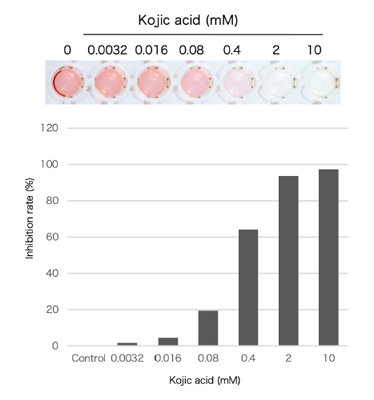
| Figure 1. Inhibitions of Tyrosinase activity (Monophenolase activity) with Kojic Acid |
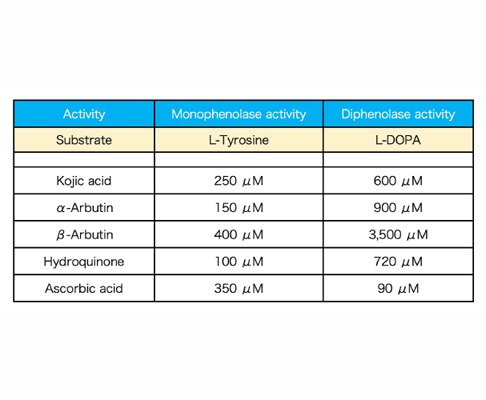
Table 1 IC50 values of the typical inhibitor components are indicated. |
