

PCNA (human), functional (100µg)
PCNA (human), functional
Cat. No. FNK-10-152
Store at -80°C
Size 100µg
Description
PCNA (Proliferating cell nuclear antigen) is a homotrimeric protein (261 aa; 29 kDa) known to act as a co-factor for DNA polymerase δ, which is responsible for leading strand DNA replication. PCNA was originally identified as an antigen that is expressed in the nuclei of cells during the DNA synthesis phase of the cell cycle.
Crystal structure data suggests that a PCNA homotrimer ring encircles and slides along the DNA double helix. Multiple proteins involved in DNA replication, DNA repair, and cell cycle control bind to PCNA rather than directly associates with DNA, thus facilitating rapid processing of DNA. PCNA is a useful marker for DNA synthesis and some cancers. It is highly conserved among most amimals.
|
|
|
|
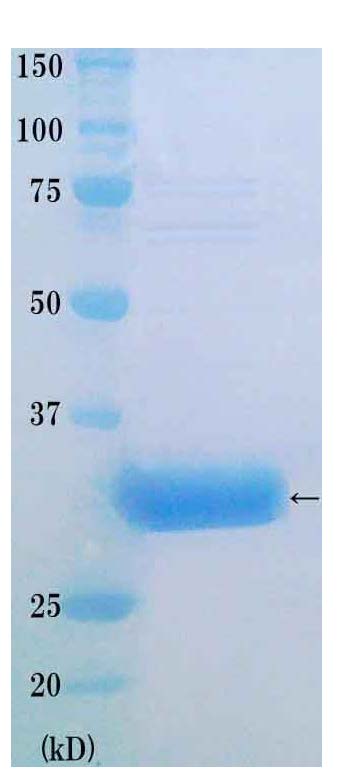
Fig. 1. SDS-PAGE analysis of purified PCNA protein. |
|
Applications confirmed
- Functional studies on DNA replication, recombination and repair. (Ref 2, 3, 5, 6, 7, 8, 9, 10).
- Identification of proteins interacting with PCNA by using PCNA –conjugated resin. (Ref 1, 5)
- Ubiquitination targets (Ref 4, 9, 10).
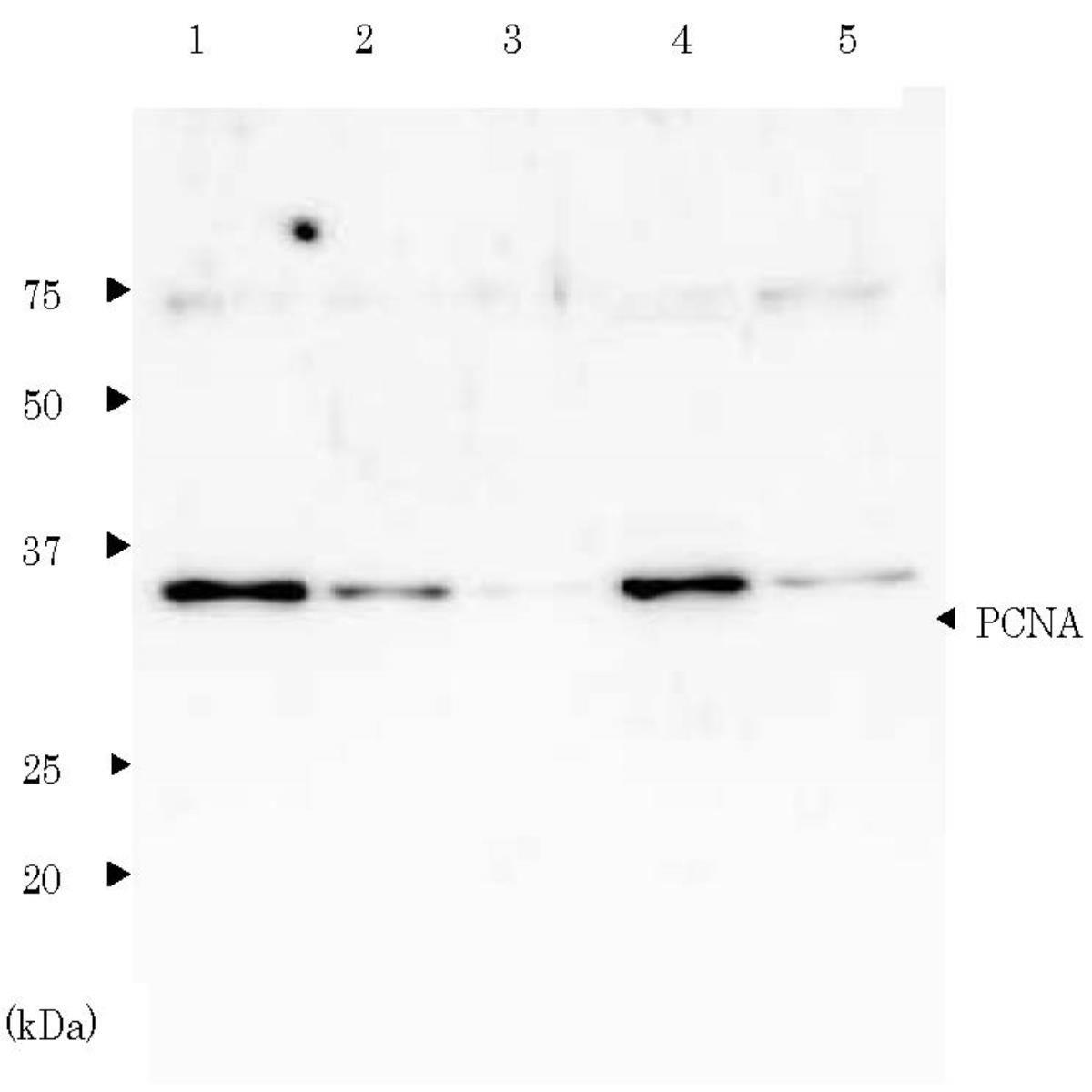
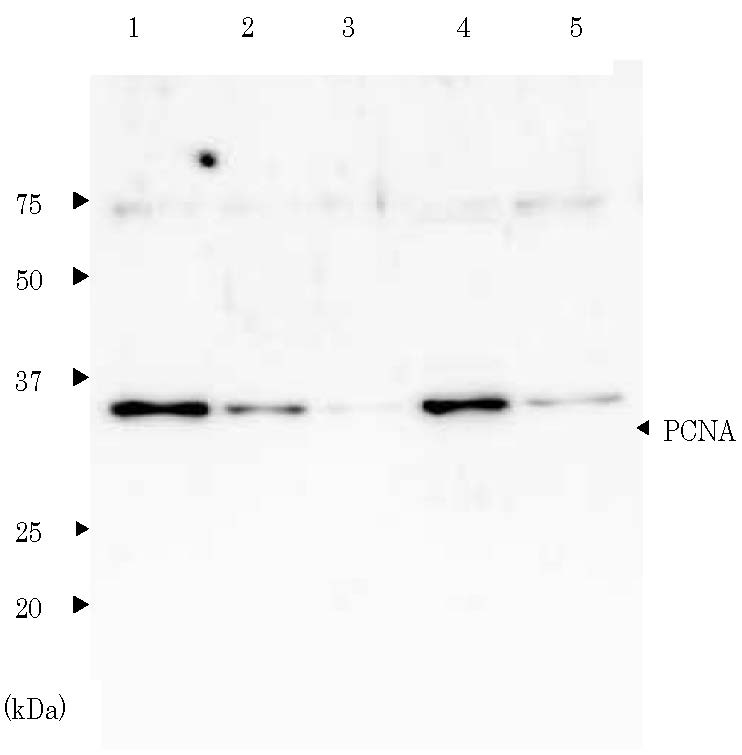
- SDS-PAGE (Fig. 1). 5. Western blot (Fig. 2) . 6. Dot blot. 7. ELISA. Not tested for other applications.
Source
Human PCNA was over-expressed in E. coli as a recombinant full-size protein without any tag and highly purified.
Form
1.0 mg/ml in 25 mM HEPES (pH 7.9), 1 mM EDTA, 0.01% NP40, 1 mM DTT, 2 ug/ml leupeptin, 0.1 mM PMSF, 75 mM NaCl, 50% glycerol.
Storage
Sent at 4℃ or -20℃. Upon arrival spin-down and store at -20℃ (or at -80℃ for longer storage)
Purity
Greater than 98% purity as determined by SDS-PAGE (Fig.1).
Data Link
Swiss-Port P12004 (human), P04961(rat), P17918(mouse), Q9PTP1(Zebrafish).
This product has been used in the following References.
- Ohta S. et al (2002) A proteomics approach to identify proliferating cell nuclear antigen(PCNA)-binding proteins in human cell lysates. Identification of the human CHL12/RFCs2-5 complex as a novel PCNA-binding protein. J Biol Chem 277: 40362-40367 PMID:12171929 .
- Iida T. et al (2002) “PCNA clamp facilitates action of DNA cytosine methyltransferase 1 on hemimethylated DNA. Genes Cells 7: 997-1007 PMID: 12354094
- Shiomi Y, et al (2004) TThe reconstituted human Chl12-RFC complex functions as a second TPCNAT loader. HTGenes Cells.TH 9:279-90. PMID: 15066120.
- Watanabe K, et al. (2004) TRad18 guides pol eta to replication stalling sites through physical interaction and TPCNAT monoubiquitination. HTEMBO J.TH 23:3886-96 PMID :15359278.
- Tsurimoto T, et al. (2005) THuman Werner helicase interacting protein 1 (WRNIP1) functions as a novel modulator for DNA polymerase delta. HTGenes Cells.TH 10:13-22. PMID 15670210.
- Nishitani H, et al. (2006) TTwo E3 ubiquitin ligases, SCF-Skp2 and DDB1-Cul4, target human Cdt1 for proteolysis. HTEMBO J.TH 25:1126-36. PMID: 16482215.
- Shiomi Y, et al. (2007) A second Tproliferating cell nuclear antigenT loader complex, Ctf18-replication factor C, stimulates DNA polymerase eta activity. HTJ Biol Chem.TH 282:20906-14.T PMID: 17545166.
- Masuda Y, et al. (2007) Dynamics of human replication factors in the elongation phase of DNA replication. HTNucleic Acids Res.TH 35:6904-16. PMID: 17932049.
- Tomida J, et al. (2008) DNA damage-induced ubiquitylation of RFC2 subunit of replication factor C complex. HTJ Biol Chem.TH 283:9071-9. PMID:18245774.
- Tsuji Y, et al. (2008) Recognition of forked and single-stranded DNA structures by human RAD18 complexed with RAD6B protein triggers its recruitment to stalled replication forks. HTGenes Cells.TH 13:343-54. PMID:18363965.

