- Home
- FluxMPS™ Minimum Essential Medium (MEM), High Glucose w/o Sodium Pyruvate, Phenol Red: 1X Liquid
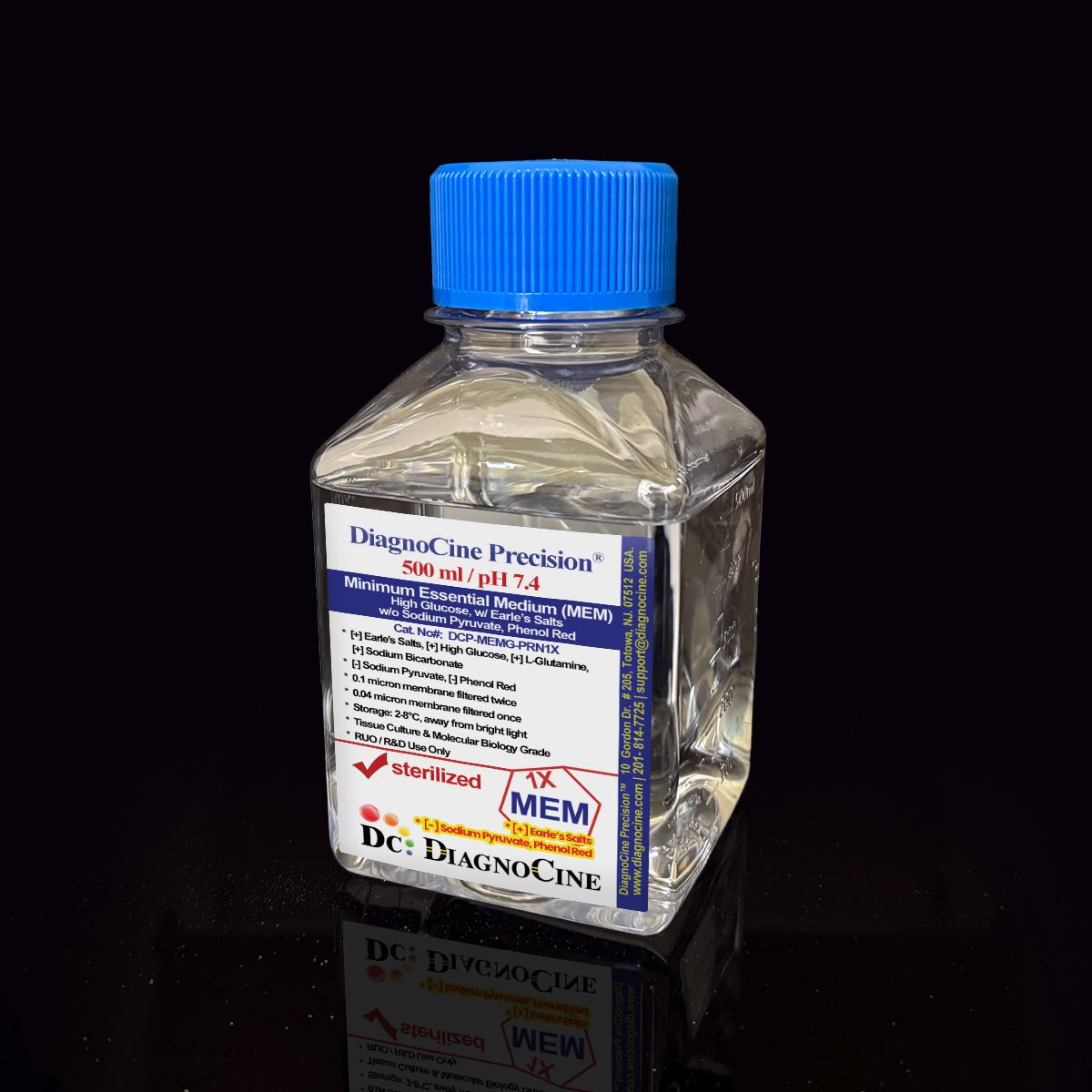
FluxMPS™ Minimum Essential Medium (MEM), High Glucose w/o Sodium Pyruvate, Phenol Red: 1X Liquid
FluxMPS™ Minimum Essential Medium (MEM), High Glucose w/o Sodium Pyruvate, Phenol Red: 1X Liquid
FluxMPS™ Minimum Essential Medium (MEM), High Glucose w/o Sodium Pyruvate, Phenol Red: 1X Liquid is a Microfluidics Suitable, quadruple-stage ultra-filtered (0.1 µm ×2 + 0.04 µm ×2) 1X liquid cell culture medium engineered for organ-on-a-chip (OoC), tissue-on-a-chip (ToC), and microphysiological system (MPS) applications. The high-glucose (4.5 g/L), phenol-red-free, sodium-pyruvate-free classical MEM formulation is processed through a validated four-pass filtration train reaching a 0.04 µm final pore size — well beyond the 0.22 µm industry standard — for microchannel-safe purity.
- High glucose (4.5 g/L) classical Eagle's MEM (Earle's salts) formulation prepared without sodium pyruvate and without phenol red — suited to high-energy-demand cell types and optical assays sensitive to phenol red interference
- Quadruple-stage filtration train: 0.1 µm (Prefiltration I & II) + 0.04 µm (Final filtration I & II — Polish), four sequential passes
- Endotoxin release specification: < 0.05 EU/mL (LAL assay, USP <85> Bacterial Endotoxins Test), controlled per manufacturing batch
- pH 7.4 (USP <791>); sodium bicarbonate buffered (2200 mg/L), consistent with an approximately 5.8% CO₂ incubator atmosphere
- Prepared with Ultrapure Type 1 water (18.2 MΩ·cm); aseptic fill performed in an ISO Class 5 environment
- Manufactured under an ISO 13485:2016 quality management system; final QC and customization at Diagnocine, Totowa, NJ
- Custom formulations available — pH, glucose, salts, HEPES, and nutrient composition on request via support@diagnocine.com
- Glucose4500 mg/L (4.5 g/L)
- L-Glutamine292 mg/L
- Sodium PyruvateNot added
- pH (USP <791>)7.4
- Osmolality (USP <785>)See Certificate of Analysis
- Endotoxin (USP <85>)< 0.05 EU/mL
- Filtration0.1 µm ×2 + 0.04 µm ×2
- Storage2–8°C, protect from light
- Shelf Life12 months from date of manufacture, unopened
- ShippingCold pack
Engineered where standard media fails
Conventional 0.22 µm-filtered media carry mycoplasma-sized particulates (0.2–0.3 µm), subvisible debris, and lot-to-lot endotoxin variability that accumulate inside microchannels — corrupting biosensor readings and shortening device lifetimes. FluxMPS™ addresses these failure modes with a validated four-pass filtration train.
Microchannel-safe purity
Four-stage filtration reaching a 0.04 µm final pore size retains particulates to sub-mycoplasma dimensions; USP <788> Method 1 (light obscuration) particulate testing is performed on every production lot.
High-glucose metabolic support
4.5 g/L glucose supports high-energy-demand cell types including HeLa, MCF-7, fibroblasts, and iPSC-derived models in perfusion devices.
Ultrapure-grade water
Prepared with Type 1 water (18.2 MΩ·cm) for trace-metal and organic-carbon control, minimizing extraneous chemical background in the finished medium.
Low background for imaging
Ultra-low particulate baseline (0.04 µm final filtration) supports confocal microscopy, live-cell biosensors, and TEER measurements. Note that riboflavin in this formulation is intrinsically autofluorescent (excitation ∼444 nm / emission ∼525 nm) and should be accounted for in fluorescence channel selection.
Rich, stable nutrient profile
A complete complement of 13 essential amino acids per classical Eagle's MEM chemistry, plus micro-batch precision manufacturing, ensures consistent nutrient delivery for demanding cell culture models.
Customization on demand
pH, glucose, salts, HEPES, and full nutrient composition available on request. Contact support@diagnocine.com.
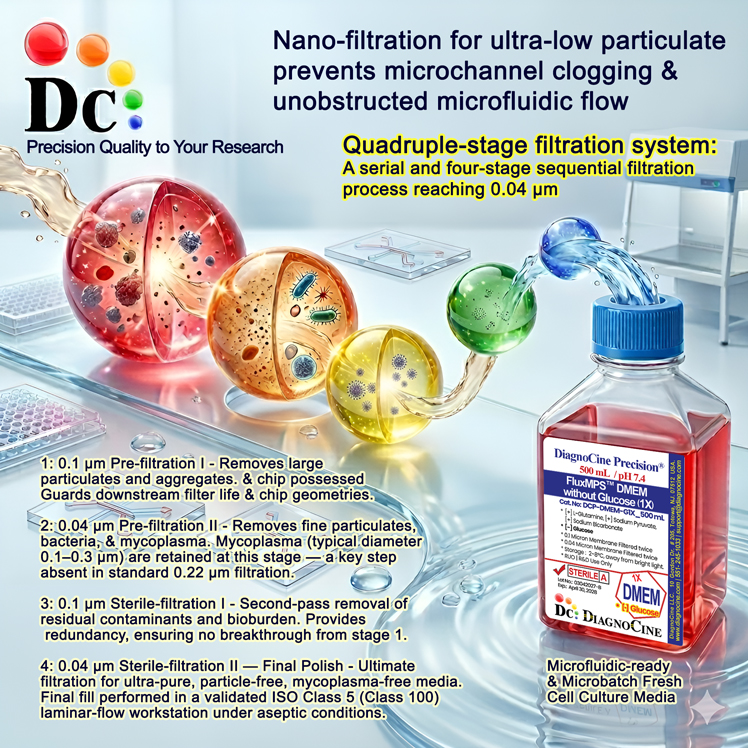
Quadruple-stage filtration system
FluxMPS™ Minimum Essential Medium (MEM), High Glucose w/o Sodium Pyruvate, Phenol Red: 1X Liquid is processed through a four-pass filtration sequence — two dedicated prefilter/final-filter pairs — reaching a 0.04 µm final pore size, addressing mycoplasma-sized organisms and subvisible particulates that a single 0.22 µm pass does not remove.
-
1
0.1 µm Prefiltration I
Removes large particulates, cell debris, and protein aggregates; protects the first 0.04 µm final filter cartridge.
-
2
0.04 µm Final filtration I
First 0.04 µm pass; retains sub-micron particulates and microaggregates that a 0.22 µm filter cannot capture, including mycoplasma-sized organisms (0.2–0.3 µm).
-
3
0.1 µm Prefiltration II
Second dedicated prefilter stage, protecting the second 0.04 µm final filter cartridge from particulate loading.
-
4
0.04 µm Final filtration II — Polish
Ultimate polishing filtration immediately prior to aseptic fill and finish.
Filtration architecture
Two prefilter/final-filter pairs run in series to a 0.04 µm final pore size, with USP <788> Method 1 particulate compliance verified on every production lot.
© Diagnocine® — DCP-MEMG-PRN1X
Designed for next-generation cell culture platforms
FluxMPS™ Minimum Essential Medium (MEM), High Glucose w/o Sodium Pyruvate, Phenol Red: 1X Liquid is suited to organ-on-a-chip, cancer biology, metabolic research, live-cell imaging, and primary cell models where particulate contamination and endotoxin variation are unacceptable.
Automated Bioreactors & Robotics
An optional 0.01 µm (10 nm) MPS Grade ultra nano-filtered variant of this formulation is available for automated bioreactor and robotic perfusion systems requiring the ultimate particulate exclusion.
- Total Particulate Exclusion: 10 nm MPS Grade filtration for nanoscale valve and sensor protection
- Valve & Sensor Protection: reduces particulate-induced blockage risk in precision fluidic systems
- Extended Perfusion Stability: supports flow rate consistency across multi-week automated runs
Inquiry Required: Contact support@diagnocine.com to request the 0.01 µm MPS Grade variant.
Micro Physiological System (MPS) & Chip
Ultra-filtered formulation helps prevent microchannel clogging and supports laminar flow integrity across complex chip geometries.
Warburg Effect & Metabolic Research
High-glucose base supports Warburg effect studies and glucose uptake assays in cancer cell lines.
iPSC-Derived Models
Ultrapure formulation supports sensitive iPSC differentiation protocols where endotoxin variability causes off-target effects.
Endothelial & Primary Cells
Microchannel-safe purity supports endothelial barrier integrity and TEER measurement in perfusion models.
Metabolic Flux Analysis
High-glucose base enables precise ¹³C isotope tracing and glycolytic flux experiments. Not compatible with Agilent Seahorse XF assays, which require bicarbonate-free, phenol red-free medium; this formulation contains sodium bicarbonate.
Microscopy & Optical Sensing
Ultra-low particulate load supports high-content confocal imaging and optical biosensor integration; account for intrinsic riboflavin autofluorescence when selecting fluorescence channels.
Lot-release quality parameters
Every production batch of FluxMPS™ Minimum Essential Medium (MEM), High Glucose w/o Sodium Pyruvate, Phenol Red: 1X Liquid undergoes the quality-release battery below before shipment.
| Parameter | Specification |
|---|---|
| Formulation | High Glucose (4.5 g/L) + L-Glutamine + Sodium Bicarbonate + Calcium + Magnesium; without Sodium Pyruvate, without Phenol Red, without HEPES |
| Appearance | Colorless to pale yellow, clear solution (phenol red-free) |
| pH USP <791> | 7.4 |
| Osmolality USP <785> | See Certificate of Analysis (lot-specific) |
| Glucose | 4500 mg/L (4.5 g/L) |
| L-Glutamine | 292 mg/L |
| Sodium Pyruvate | Not added |
| Phenol Red | Not added |
| Parameter | Specification |
|---|---|
| Endotoxin USP <85> BET | < 0.05 EU/mL (release specification; see §Manufacturing for batch-testing detail) |
| Sterility USP <71> | No growth after 14 days |
| Mycoplasma | Controlled by 0.1 µm mycoplasma-retentive filtration (not tested per lot) |
| Particulate ≥10 µm USP <788> Method 1 | Compliant |
| Particulate ≥25 µm USP <788> Method 1 | Compliant |
| Water Purity | Ultrapure Type 1, 18.2 MΩ·cm |
| Manufacturing std. ISO 13485 | ISO 13485:2016 |
| Fill environment | ISO Class 5 (Class 100) |
| Parameter | Specification |
|---|---|
| Storage temperature | 2–8°C, protect from light |
| Freeze-thaw | Not recommended |
| Shelf life | 12 months from date of manufacture, unopened |
| Shipping condition | Cold pack |
| CO₂ requirement | Approximately 5.8% CO₂ (derived from 2200 mg/L sodium bicarbonate at pH 7.4 via Henderson-Hasselbalch) |
| Parameter | Specification |
|---|---|
| Raw material grade | Cell culture / reagent grade |
| Traceability | Full lot documentation, CoA available |
| Manufacturing QMS | ISO 13485:2016 certified |
| UNSPSC | 41116155 — Molecular biology and cell culture growth media (UNv260801) |
| Regulatory alignment | 21 CFR Part 820 (QMSR) aligned |
| Production method | Micro-batch precision manufacturing |
| Available sizes | 500 mL, 1000 mL |
| Intended use | For Research Use Only (RUO) |
Full composition (mg/L)
Total: 28 components across 4 categories (INORGANIC SALTS, AMINO ACIDS, VITAMINS, OTHERS), reproduced in full from the manufacturer specification with CAS numbers. Custom compositions available on request.
| Component | CAS Number | mg/L |
|---|---|---|
| INORGANIC SALTS | ||
| Calcium chloride dihydrate | 10035-04-8 | 265.000 |
| Magnesium sulfate anhydrous | 7487-88-9 | 97.720 |
| Potassium chloride | 7447-40-7 | 400.000 |
| Sodium bicarbonate | 144-55-8 | 2200.000 |
| Sodium chloride | 7647-14-5 | 6800.00 |
| Sodium phosphate dibasic anhydrous | 7558-79-4 | 122.000 |
| Component | CAS Number | mg/L |
|---|---|---|
| AMINO ACIDS | ||
| L-Arginine hydrochloride | 1119-34-2 | 126.000 |
| L-Cystine dihydrochloride | 30189-89-0 | 31.300 |
| L-Glutamine | 56-85-9 | 292.000 |
| L-Histidine hydrochloride monohydrate | 5934-29-2 | 42.000 |
| L-Isoleucine | 73-32-5 | 52.000 |
| L-Leucine | 61-90-5 | 52.000 |
| L-Lysine hydrochloride | 657-27-2 | 72.500 |
| L-Methionine | 63-68-3 | 15.000 |
| L-Phenylalanine | 63-91-2 | 32.000 |
| L-Threonine | 72-19-5 | 48.000 |
| L-Tryptophan | 73-22-3 | 10.000 |
| L-Tyrosine disodium salt | 69847-45-6 | 51.900 |
| L-Valine | 72-18-4 | 46.000 |
| Component | CAS Number | mg/L |
|---|---|---|
| VITAMINS | ||
| Choline chloride | 67-48-1 | 1.000 |
| D-Ca-Pantothenate | 137-08-6 | 1.000 |
| Folic acid | 59-30-3 | 1.000 |
| Niacinamide | 98-92-0 | 1.000 |
| Pyridoxine hydrochloride | 58-56-0 | 1.000 |
| Riboflavin | 83-88-5 | 0.100 |
| Thiamine hydrochloride | 67-03-8 | 1.000 |
| i-Inositol | 87-89-8 | 2.000 |
| OTHERS | ||
| D-Glucose | 50-99-7 | 4500.000 |
ISO 13485:2016 manufacturing & compliance
Manufactured under an ISO 13485:2016 quality management system with final packaging, testing, and customization at Diagnocine Precision in Totowa, New Jersey, USA.
ISO 13485:2016 QMS
Full quality management system certification covering manufacturing, testing, and release for every production lot.
Ultrapure Type 1 Water
Media prepared with 18.2 MΩ·cm resistivity water for trace-metal and organic-carbon control.
ISO Class 5 Fill & Finish
Aseptic filling in a validated ISO Class 5 laminar-flow workstation; 21 CFR Part 820 (QMSR) aligned.
Micro-Batch Precision
Small-batch manufacturing supports lot-to-lot nutrient consistency for reproducible perfusion studies.
- Endotoxin — LAL assay, USP <85> Bacterial Endotoxins Test; assay sensitivity 0.005 EU/mL; release specification < 0.05 EU/mL
- pH, osmolality, conductivity, appearance and clarity
- Sterility
Endotoxin — USP <85> BET
LAL assay per manufacturing batch. Release specification: < 0.05 EU/mL.
Particulate — USP <788> Method 1
Light obscuration particle count confirms ≥10 µm and ≥25 µm compliance per lot.
Osmolality — USP <785>
Freezing-point osmometry per USP <785>. Result: see Certificate of Analysis.
Documentation — CoA & Full Lot Records
Certificate of Analysis with full QC panel, traceability, and release signatures for every lot.
How DCP-MEMG-PRN1X (FluxMPS™) compares
Side-by-side comparison against conventional 0.22 µm-filtered MEM High Glucose alternatives.
| Parameter | DCP-MEMG-PRN1X (FluxMPS™) | Conventional MEM High Glucose (0.22 µm) | Standard MEM High Glucose alternative |
|---|---|---|---|
| Grade | Microfluidics Suitable (0.04 µm final filtration) | Standard grade (0.22 µm filtration) | Standard grade (0.22 µm filtration) |
| Formulation trait | High glucose (4.5 g/L), sodium pyruvate-free, phenol red-free | Standard glucose, phenol red included | Variable formulation |
| Final filtration pore size | 0.04 µm | 0.22 µm | 0.22 µm |
| Number of filtration stages | 4 passes | 1 pass | 1–2 passes |
| Mycoplasma barrier filtration | check_circle | cancel | cancel |
| Endotoxin (release specification) | FluxMPS™ — < 0.05 EU/mL | Corning classical liquid media — < 0.25 EU/mL Sigma-Aldrich DMEM complete medium — ≤ 2 EU/mL Gibco classical DMEM — Not specified (recorded per lot) |
|
| USP particulate compliance | check_circle USP <788> Method 1 | cancel | cancel |
| Water quality | Ultrapure Type 1 (18.2 MΩ·cm) | Purified water | Purified water |
| Manufacturing QMS | ISO 13485:2016 | Variable | Variable |
| Microfluidic channel compatibility | check_circle Validated | cancel Risk of clogging | cancel Risk of clogging |
| Custom formulation | check_circle On request | cancel | Limited |
Comparison figures from published supplier specifications, accessed 2026-09-02. Suppliers that publish no numeric endotoxin specification are shown as "Not specified".
Frequently asked questions
Common questions about FluxMPS™ Minimum Essential Medium (MEM), High Glucose w/o Sodium Pyruvate, Phenol Red: 1X Liquid and Microfluidics Suitable cell culture media.
Supporting literature
Peer-reviewed publications supporting ultra-filtered media and microfluidic cell culture applications.
- Huh D et al. (2010). Reconstituting organ-level lung functions on a chip. Science, 328(5986), 1662–1668. doi:10.1126/science.1188302
- Bhatia SN & Ingber DE (2014). Microfluidic organs-on-chips. Nature Biotechnology, 32(8), 760–772. doi:10.1038/nbt.2989
- Eagle H (1959). Amino acid metabolism in mammalian cell cultures. Science, 130(3373), 432–437. doi:10.1126/science.130.3373.432
- Warburg O (1956). On the origin of cancer cells. Science, 123(3191), 309–314. doi:10.1126/science.123.3191.309
- Bhattacharya S et al. (2018). Challenges in maintaining cell viability during microfluidic experiments. Electrophoresis, 39(7), 997–1006. doi:10.1002/elps.201700375
- Zhang YS et al. (2017). Multisensor-integrated organs-on-chips for automated in situ monitoring. PNAS, 114(12), E2293–E2302. doi:10.1073/pnas.1612906114
- Vernetti L et al. (2017). Functional coupling of human microphysiology systems. Scientific Reports, 7, 42296. doi:10.1038/srep42296
- Esch EW et al. (2015). Organs-on-chips at the frontiers of drug discovery. Nature Reviews Drug Discovery, 14(4), 248–260. doi:10.1038/nrd4539
- Zheng F et al. (2021). Organ-on-a-chip systems: microengineering to biomimic living systems. Small, 17(7), 2004175. doi:10.1002/smll.202004175