

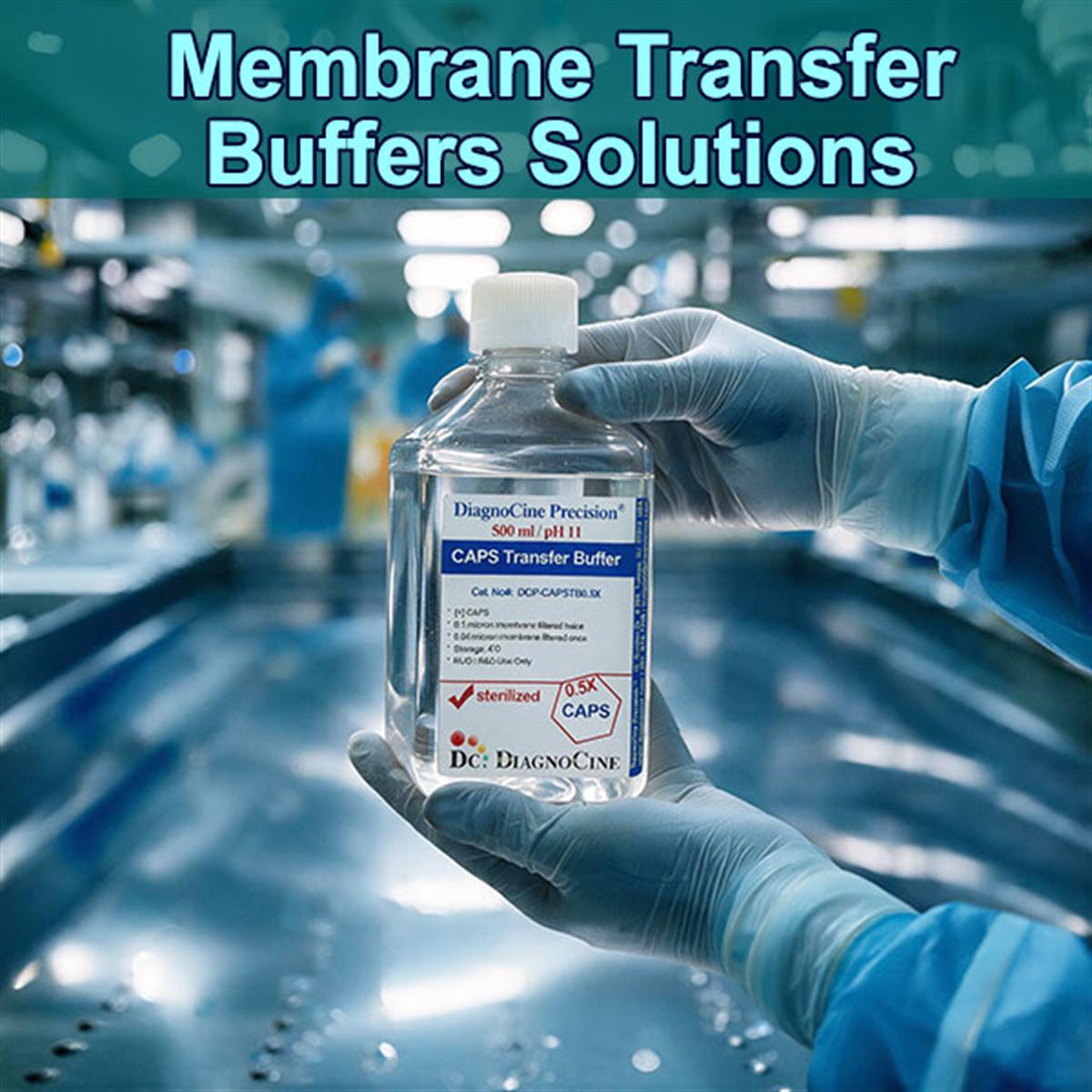
Membrane Transfer Buffers Solutions
This is a category overview, not an orderable page. Pick the transfer chemistry your blot needs and click View to reach its product page — the history, the selection logic, and the full formulation comparison follow below.
| Product | Product# | Core Formulation | Product Page |
|---|---|---|---|
| Tris Based Transfer Buffers | TrisBasedTransferBuffers | Standard Tris-Glycine core | Viewarrow_forward |
| CAPS Transfer Buffer | DCP-CAPSTB0.5X | 3-(Cyclohexylamino)-1-propanesulfonic acid, ~pH 11 | Viewarrow_forward |
| Sodium Chloride and Sodium Hydroxide Transfer Buffer | DCP-NACLNAOH1X | Alkaline saline profile | Viewarrow_forward |
Not sure which chemistry? Compare all four formulations · Match blot type to membrane · See applications · Read the FAQ
The step between the gel and the probe
Once proteins or nucleic acids are separated by size on a gel, they must be transferred to a solid support so they can be probed with antibodies or nucleic acid probes. Membrane transfer buffers are the conductive solutions that drive these macromolecules out of the gel matrix and immobilize them on a synthetic membrane (PVDF, nitrocellulose, or nylon) during Western, Southern, and Northern blotting.
- Three products in this category, covering the standard Tris-Glycine system, a high-pH CAPS system, and an alkaline saline system for nucleic acids.
- Four formulations are compared below — the fourth, Bis-Tris, is reached through the Tris Based Transfer Buffers page rather than ordered here.
- Three membrane types are named by the source: PVDF, nitrocellulose, and nylon.
- Three blot types: Western for proteins, Southern for DNA, Northern for RNA.
- The buffer is electrochemistry, not just liquid. It has to conduct high current without generating destructive heat, set the charge profile so the target migrates uniformly, and manage gel hydration so bands do not distort.
- pI is the variable most people forget. Most proteins carry net negative charge and migrate cleanly in standard alkaline Towbin buffer, but very basic proteins (pI above about 9) can approach neutral or reversed charge in that system.
- Glycine is a problem for sequencing. CAPS is glycine-free, which is why it is the standard when transferred proteins will be sequenced by Edman degradation.
- Products in this category3
- Formulations compared4
- Blot types supportedWestern, Southern, Northern
- Membrane types namedPVDF, nitrocellulose, nylon
- Southern blot introduced1975
- Towbin electroblotting introduced1979
- CAPS / PVDF sequencing introduced1987
- CAPS buffer pH~11
- High-pI thresholdpI > ~9
- Tris-Glycine typical protein range~15–100 kDa
Moving a molecule out of a dense gel is an electrochemical problem
Moving a biomolecule out of a dense gel and onto a membrane requires a controlled electrochemical environment. Each card below is one thing the buffer has to deliver — or one way the blot fails.
Efficient electromigration
A controlled ion concentration conducts high current and voltage without excessive resistance — and without the destructive heat that excessive resistance generates.
Binding-site optimization
The buffer sets or preserves the charge profile of the target so it migrates uniformly toward the opposing electrode and adheres firmly to the membrane on arrival. Methanol, for example, promotes nitrocellulose binding.
Gel dimension stabilization
The buffer manages gel hydration during transfer so the matrix does not warp or shrink and distort band alignment. A distorted gel means a blot you cannot line up against your ladder.
High-pI accommodation
Most proteins carry net negative charge and migrate cleanly in standard alkaline Towbin buffer, but very basic proteins (pI above about 9) can approach neutral or reversed charge there. High-pH buffers such as CAPS at about pH 11 keep them moving toward the membrane.
What methanol is actually doing
In the classic Tris-Glycine-methanol formulation, methanol counteracts gel swelling and strips SDS from proteins, improving adsorption to nitrocellulose. It is doing two jobs at once, which is why changing its concentration changes transfer behaviour.
Why glycine-free matters
Glycine interferes with Edman chemistry. That single fact is the reason a glycine-free CAPS system exists alongside Tris-Glycine, and why it is the buffer of choice when downstream N-terminal sequencing is the goal.
Match the buffer to the molecule, not to the protocol you inherited
The standard alkaline Towbin system is standard because it works for most proteins in the mid-range. It is not universal: a very basic protein can stall or run backwards in it, a small protein can pass straight through the membrane, and a nucleic acid needs an entirely different, alkaline saline chemistry driven by capillary flow rather than current.
Three papers that built the blot
Each step below explains a buffer still on the shelf today — why Tris-Glycine is the default, why CAPS exists at all, and why nucleic acid transfer looks nothing like protein transfer.
-
1
1975 The Southern blot
Edwin Southern demonstrated transfer of size-separated DNA fragments from a gel onto a membrane using high-salt capillary flow, enabling sequence-specific probe detection in the “Southern blot.” This established the blotting concept for nucleic acids, but passive capillary transfer was slow and inefficient for large, tightly packed protein matrices.[1]
-
2
1979 Electroblotting and the Towbin buffer
Towbin, Staehelin & Gordon introduced electroblotting, in which an electric field pulls proteins out of a polyacrylamide gel onto nitrocellulose. Their Tris-Glycine-methanol formulation became the canonical “Towbin buffer.” Methanol counteracts gel swelling and strips SDS from proteins, improving adsorption to nitrocellulose. This invented the Western blot transfer step and set the global standard transfer chemistry still used today.[2]
-
3
1987 CAPS, PVDF, and direct sequencing
Paul Matsudaira showed proteins could be electroblotted onto PVDF membranes and sequenced directly by Edman degradation, using a glycine-free CAPS transfer buffer. This made N-terminal protein sequencing from gels routine, and established CAPS as the buffer of choice when downstream sequencing is the goal, because glycine interferes with Edman chemistry.[3]
Which molecule, which membrane, which chemistry
The mapping the source states between the blot you are running, the molecule you are moving, the membrane it lands on, and the transfer chemistry associated with it.
| Blot type | Molecule transferred | Membrane | Transfer chemistry noted by the source |
|---|---|---|---|
| Western (wet-tank & semi-dry) | Proteins, from polyacrylamide gels | Nitrocellulose or PVDF | Tris-Glycine-methanol (the canonical Towbin buffer); Bis-Tris for small or sensitive proteins |
| Southern | Fragmented genomic DNA | Nylon | Alkaline saline, driving capillary transfer onto charge-modified nylon |
| Northern | Single-stranded RNA | Nylon | Alkaline saline, driving capillary transfer onto charge-modified nylon |
| N-terminal sequencing | Proteins, for direct Edman degradation | PVDF | CAPS at about pH 11, glycine-free |
What you are transferring, and why
Select a workflow to see what the source says about it, and which formulation it names for that job.
- Western blotting (wet-tank & semi-dry) — driving proteins from polyacrylamide gels onto nitrocellulose or PVDF
- Named formulation: Tris-Based Transfer Buffers, the universal Western blot standard for routine wet-tank transfer of mid-range proteins (~15–100 kDa), typically paired with user-added methanol to optimize nitrocellulose adhesion
- Southern & Northern blotting — transferring fragmented genomic DNA or single-stranded RNA onto nylon membranes
- Named formulation: NaCl / NaOH Transfer Buffer, optimized for capillary blotting of nucleic acids — the alkaline environment simultaneously denatures DNA duplexes and drives capillary transfer of target sequences onto charge-modified nylon membranes
- N-terminal protein sequencing — CAPS transfer onto PVDF for direct Edman degradation
- Named formulation: CAPS Transfer Buffer — high pH keeps basic proteins net-negative and migrating, and it is glycine-free, making it the standard when transferred proteins will be sequenced by Edman degradation
- High-molecular-weight protein transfer — customized buffer/methanol conditions to mobilize large proteins that transfer poorly
- The source names no specific product for this workflow; it identifies the buffer and methanol conditions as the variables to customize. For a custom formulation, contact support@diagnocine.com.
- Two-dimensional (2D) gel transfer — immobilizing complex protein arrays for downstream immunodetection or mass spectrometry
- The source names no specific product for this workflow.
All four transfer chemistries side by side
The source comparison table, reproduced row for row. Three of these four are ordered from the catalog at the top of this page; Bis-Tris is reached through the Tris Based Transfer Buffers page.
| Product | Core Formulation | Best Use |
|---|---|---|
| Tris-Based Transfer Buffers | Standard Tris-Glycine core | Universal Western blot standard — routine wet-tank transfer of mid-range proteins (~15–100 kDa); typically paired with user-added methanol to optimize nitrocellulose adhesion |
| Bis-Tris Transfer Buffer | Bis-Tris core, milder near-neutral pH | Optimized for small/sensitive proteins — a less alkaline environment that helps retain low-molecular-weight proteins (<~20 kDa) that can blow through the membrane in harsher systems |
| CAPS Transfer Buffer | 3-(Cyclohexylamino)-1-propanesulfonic acid, ~pH 11 | Choice for high-pI proteins & N-terminal sequencing — high pH keeps basic proteins net-negative and migrating; glycine-free, making it the standard when transferred proteins will be sequenced by Edman degradation |
| NaCl / NaOH Transfer Buffer | Alkaline saline profile | Optimized for capillary blotting of nucleic acids — the alkaline environment simultaneously denatures DNA duplexes and drives capillary transfer of target sequences onto charge-modified nylon membranes |
Frequently asked questions
The questions that come up most often when a blot does not look the way it should.
The three papers behind the category
The source's own reference list, verified against the published record.
- Southern, E. M. (1975). Detection of specific sequences among DNA fragments separated by gel electrophoresis. Journal of Molecular Biology, 98(3), 503–517. — The origin of blotting: capillary transfer of DNA to a membrane for sequence-specific detection (the “Southern blot”).doi:10.1016/S0022-2836(75)80083-0
- Towbin, H., Staehelin, T., & Gordon, J. (1979). Electrophoretic transfer of proteins from polyacrylamide gels to nitrocellulose sheets: procedure and some applications. Proceedings of the National Academy of Sciences, 76(9), 4350–4354. — The paper that invented Western blot electroblotting and defined standard Tris-Glycine transfer chemistry.doi:10.1073/pnas.76.9.4350
- Matsudaira, P. (1987). Sequence from picomole quantities of proteins electroblotted onto polyvinylidene difluoride membranes. Journal of Biological Chemistry, 262(21), 10035–10038. — Introduced PVDF electroblotting and the glycine-free CAPS transfer system for direct protein sequencing.