


Sodium Chloride and Sodium Hydroxide Transfer Buffer
FluxMPS™ Sodium Chloride and Sodium Hydroxide Transfer Buffer
FluxMPS™ Sodium Chloride and Sodium Hydroxide Transfer Buffer is a 3 M NaCl / 10 mM NaOH solution engineered for efficient, reproducible RNA transfer in Northern blotting workflows.[1,2] Quadruple-stage filtration (0.1 µm membrane twice, 0.04 µm membrane twice) delivers an ultrapure, sterile solution free of detectable DNase and RNase activity, supporting microchannel-safe handling wherever ultra-clean aqueous reagents are required.
- Quadruple-stage filtration: 0.1 µm membrane twice and 0.04 µm membrane twice for an ultra-clean, mycoplasma-safe buffer
- Formulated at 3 M sodium chloride / 10 mM sodium hydroxide for efficient RNA denaturation and transfer
- pH 12 mildly alkaline environment optimized for binding to positively charged nylon membranes
- Validated DNase- and RNase-free after 18-hour room-temperature incubation
- Ultrapure, sterile-filtered solution manufactured under ISO 13485-certified, CE-approved facilities
- Customizable concentration, pH, and additive content available on request
- pH12
- Formulation3 M NaCl / 10 mM NaOH
- AppearanceClear, Colorless Liquid
- Filtration0.1 µm x2 + 0.04 µm x2
- DNase ActivityNone Detected
- RNase ActivityNone Detected
- StorageRoom Temperature
- Shelf Life6 Months
- Water QualityUltrapure
- ManufacturingISO 13485 / CE-Approved
Engineered where standard transfer buffers fall short
Conventional single-pass, 0.22 µm-filtered transfer buffers can carry subvisible particulates, inconsistent alkalinity, and residual nuclease activity into RNA transfer workflows. FluxMPS™ DCP-NACLNAOH1X is manufactured to remove those variables before the buffer reaches your blot.
Microchannel-Safe Purity
Quadruple-stage 0.1 µm and 0.04 µm membrane filtration removes fine particulates and mycoplasma-scale contaminants[5] before packaging.
Precise, Reproducible Alkalinity
Formulated at 3 M sodium chloride and 10 mM sodium hydroxide to hold a consistent pH 12 environment for RNA denaturation during transfer.[1]
Ultrapure-Grade Water
Prepared with ultrapure water to eliminate trace contaminants that can interfere with sensitive nucleic acid transfer chemistry.
Validated Nuclease-Free Performance
No DNase or RNase activity was detected after 18-hour incubation with plasmid DNA and ribosomal RNA at room temperature, protecting RNA integrity through hybridization and downstream expression analysis.
Defined, Traceable Composition
Every lot is formulated to the same 3 M sodium chloride / 10 mM sodium hydroxide composition, with CAS-traceable raw materials.
Customization on Demand
Alternate concentrations, pH, and added chemicals, compounds, proteins, or supplements are available on inquiry.
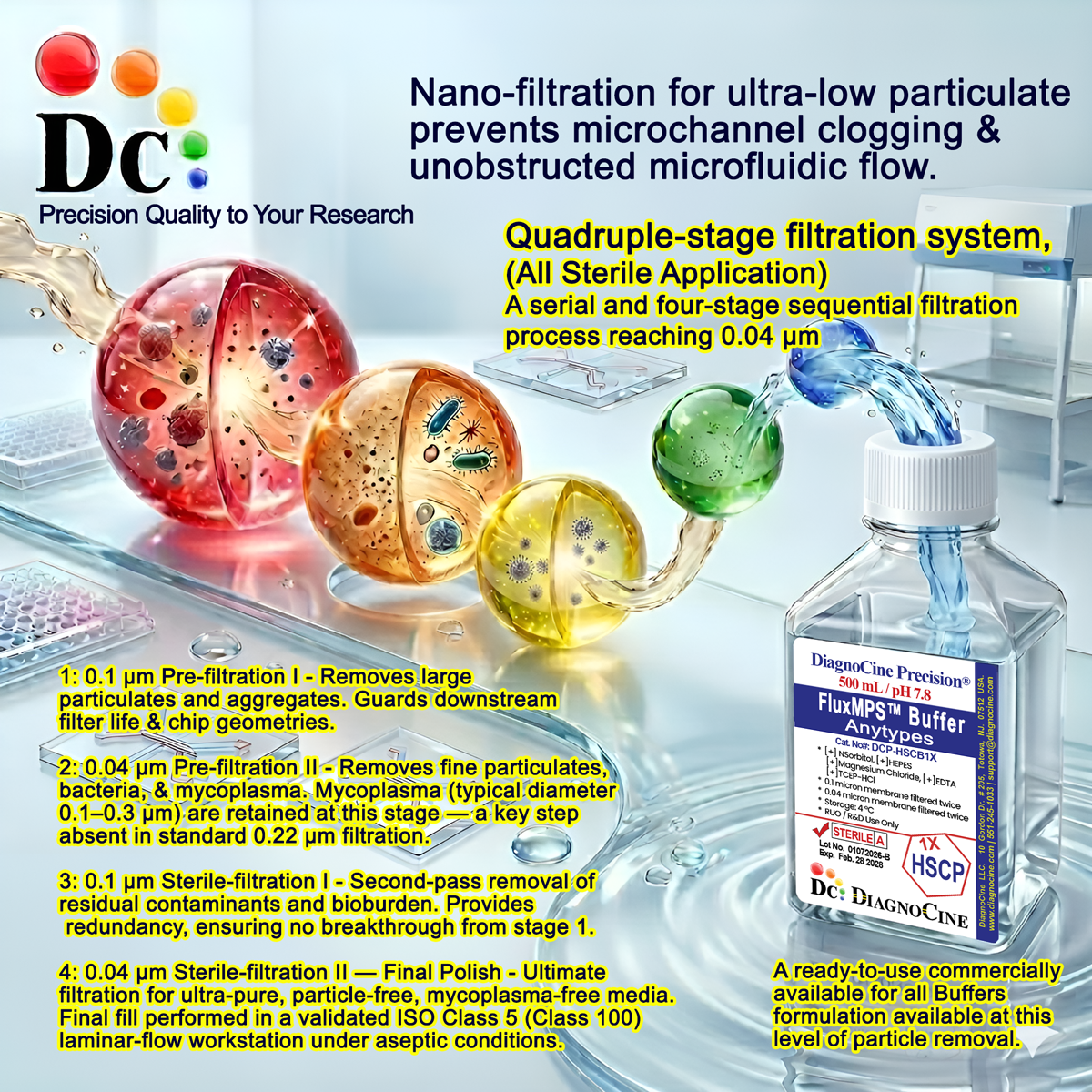
Quadruple-stage filtration system
DCP-NACLNAOH1X is sterile, ultrapure, and filtered through a 0.1 µm membrane twice and a 0.04 µm membrane twice, giving the world's cleanest buffer chemistry for RNA transfer and other molecular biology experiments.
-
1
0.1 µm Pre-filtration I
Removes large particulates and aggregates, extending the life of downstream filters.
-
2
0.04 µm Pre-filtration II
Retains fine particulates and bioburden ahead of the second filtration pass.
-
3
0.1 µm Sterile-filtration I
A second 0.1 µm pass provides redundancy against particulate breakthrough.
-
4
0.04 µm Sterile-filtration II — Final Polish
A second 0.04 µm pass is the final polish in a sterile environment, guarding against mycoplasma-scale contaminants, the smallest of which can be about 0.2 microns.[5]
Performance vs. conventional buffer
Sequential 0.1 µm and 0.04 µm membrane filtration, applied twice each, removes finer particulates than a single 0.22 µm pass used in conventional transfer buffers.
© Diagnocine® — DCP-NACLNAOH1X
Built for RNA transfer and beyond
DCP-NACLNAOH1X is primarily used for efficient RNA transfer in Northern blotting procedures, where its mildly alkaline conditions denature RNA as it deposits onto the membrane, ensuring optimal binding.[1]
Automated Bioreactors & Robotics
For automated liquid handling and closed-loop robotics, an optional 0.01 µm (10 nm) ultra-filtered variant of this buffer can be produced to further reduce particulate load in sensitive instrumentation.
- Total Particulate Exclusion — polishes beyond standard sterile filtration for automated systems
- Valve & Sensor Protection — minimizes particulate accumulation in microvalves and inline sensors
- Extended Perfusion Stability — supports longer unattended run times in closed fluidic circuits
Inquiry Required: The 0.01 µm ultra-filtered grade is produced to order. Contact support@diagnocine.com to request this configuration.
Micro Physiological System (MPS) & Chip
Ultra-filtered, low-particulate formulation suited to buffer and wash needs within microfluidic transfer and handling workflows.[7,8]
Wash, Dilution & Reconstitution
The 3 M NaCl / 10 mM NaOH formulation provides the ionic strength and alkalinity needed for downward capillary transfer setups.
iPSC-Derived Model Handling
Ultrapure, nuclease-free buffer chemistry suitable for downstream nucleic acid workflows following iPSC-derived model culture.
Endothelial & Primary Cell Perfusion
Validated DNase- and RNase-free chemistry supports downstream gene expression analysis of perfused primary cell samples.
ELISA, Blotting & Blocking
Well-suited for use with positively charged nylon membranes, promoting efficient nucleic acid binding during transfer.[2]
Microscopy & Optical Sensing
Low-particulate, ultrapure buffer chemistry supports clean sample handling ahead of imaging and biosensor workflows.
Specification summary
All values below are as measured or declared for DCP-NACLNAOH1X.
| Parameter | Specification |
|---|---|
| Formulation / Composition | 3 M Sodium Chloride / 10 mM Sodium Hydroxide |
| Appearance | Clear, Colorless Liquid |
| pH | 12 |
| Parameter | Specification |
|---|---|
| Sterility Filtered | Filtered 0.1 micron membrane twice and 0.04 micron membrane twice in a sterile environment |
| DNase Activity | None detected after 18-hour incubation with plasmid DNA at room temperature |
| RNase Activity | No RNase activity detected after 18-hour incubation with ribosomal RNA at room temperature |
| Water Quality | Ultrapure |
| Parameter | Specification |
|---|---|
| Storage Temperature | Room temperature |
| Shelf Life | 6 months |
| Parameter | Specification |
|---|---|
| Manufacturing QMS ISO 13485 | ISO 13485-certified facility |
| Regulatory Alignment | CE-approved manufacturing facility |
| Production & Customization Site | DiagnoCine Precision, Totowa, New Jersey, USA |
| Intended Use | Research Use Only (RUO) |
Full composition
DCP-NACLNAOH1X combines the ionic strength of sodium chloride with the mild alkalinity of sodium hydroxide, creating an environment optimized for RNA denaturation during transfer.[1]
| Component | CAS Number | Concentration |
|---|---|---|
| Sodium Chloride | 7647-14-5 | 3 M |
| Sodium Hydroxide | 1310-73-2 | 10 mM |
Manufactured under controlled quality systems
DCP-NACLNAOH1X is manufactured under ISO 13485-certified and CE-approved facilities, with final packaging, quality assurance, and testing completed at the DiagnoCine R&D and Quality Testing Center. All specific customization requests and assembly are accomplished at DiagnoCine Precision in Totowa, New Jersey, USA.
ISO 13485:2016 QMS
Manufactured under an ISO 13485-certified, CE-approved quality management system.
Ultrapure Water
Formulated with ultrapure water to minimize trace contamination.
Sterile Fill & Finish
Filtered and packaged in a controlled sterile environment.
Micro-Batch Precision
Final assembly and customization performed at DiagnoCine Precision, Totowa, New Jersey, USA.
DNase Activity
None detected after 18-hour incubation of plasmid DNA with this product at room temperature.
RNase Activity
No RNase activity detected after 18-hour incubation of ribosomal RNA with this product at room temperature.
Filtration
Filtered 0.1 micron membrane twice and 0.04 micron membrane twice, preventing mycoplasma contamination, the smallest of which can be about 0.2 microns.[5]
Documentation
Certificate of Analysis available on request.
How DCP-NACLNAOH1X compares
A qualitative comparison against conventional single-pass, 0.22 µm-filtered transfer buffer.
| Parameter | DCP-NACLNAOH1X (FluxMPS™) | Conventional Transfer Buffer | Standard Alternative |
|---|---|---|---|
| Defined 3 M NaCl / 10 mM NaOH formulation | check_circle | cancel | cancel |
| Final filtration pore size | 0.04 µm | 0.22 µm | 0.22 µm |
| Number of filtration stages | 4 | 1 | 1 |
| Validated DNase/RNase-free | check_circle | cancel | cancel |
| Ultrapure water base | check_circle | cancel | cancel |
| Manufacturing QMS (ISO 13485) | check_circle | cancel | cancel |
| Microchannel-safe handling | check_circle | cancel | cancel |
| Custom formulation available | check_circle | cancel | cancel |
Frequently asked questions
Answers to common questions about DCP-NACLNAOH1X.
Supporting literature
Curated literature relevant to RNA transfer, Northern blotting, mycoplasma control, and microfluidic buffer chemistry.
- Alwine JC, Kemp DJ, Stark GR. Method for detection of specific RNAs in agarose gels by transfer to diazobenzyloxymethyl-paper and hybridization with DNA probes. Proc Natl Acad Sci USA. 1977. doi:10.1073/pnas.74.12.5350
- Reed KC, Mann DA. Rapid transfer of DNA from agarose gels to nylon membranes. Nucleic Acids Res. 1985. doi:10.1093/nar/13.20.7207
- Chomczynski P. One-hour downward alkaline capillary transfer for blotting of DNA and RNA. Anal Biochem. 1992. doi:10.1016/0003-2697(92)90122-G
- Streit S, Michalski CW, Erkan M, Kleeff J, Friess H. Northern blot analysis for detection and quantification of RNA in pancreatic cancer research. Nat Protoc. 2009. doi:10.1038/nprot.2008.218
- Uphoff CC, Drexler HG. Detection of mycoplasma contaminations. Methods Mol Biol. 2002. doi:10.1385/1-59259-406-9:319
- Sambrook J, Russell DW. Molecular Cloning: A Laboratory Manual, 3rd ed. Cold Spring Harbor Laboratory Press. 2001. doi:10.1101/pdb.top1234
- Huh D, Matthews BD, Mammoto A, Montoya-Zavala M, Hsin HY, Ingber DE. Reconstituting organ-level lung functions on a chip. Science. 2010. doi:10.1126/science.1188302
- Whitesides GM. The origins and the future of microfluidics. Nature. 2006. doi:10.1038/nature05058