


CAPS Transfer Buffer
FluxMPS™ CAPS Transfer Buffer
Ready-to-use 0.5X CAPS (3-(Cyclohexylamino)-1-propanesulfonic acid) transfer buffer formulated at pH 11.0 for Western blotting of high molecular weight and basic proteins. Manufactured under quadruple-stage filtration (0.1 µm membrane twice, 0.04 µm membrane twice) for an ultra-clean, sterile buffer suitable for microfluidic sample-handling workflows and demanding molecular biology protocols.
- Quadruple-stage filtration: 0.1-micron membrane filtered twice and 0.04-micron membrane filtered twice for an ultra-clean, sterile buffer
- Ready-to-use 0.5X CAPS formulation at pH 11.0, optimized for high molecular weight and basic protein transfer
- 500 mM CAPS composition supports SDS dissociation and protein solubility during electrophoretic transfer
- No DNase or RNase activity detected after 18 hr incubation at room temperature
- Compatible with both nitrocellulose and PVDF membranes
- Manufactured under ISO 13485-certified and CE-approved facilities
- Customizable concentration, pH, and additive content available on request
- pH11.0
- Molarity / Concentration500 mM CAPS
- AppearanceClear, colorless liquid
- Sterility0.1-micron membrane twice, 0.04-micron membrane twice
- DNase ActivityNot detected (18 hr, RT)
- RNase ActivityNot detected (18 hr, RT)
- FiltrationQuadruple-stage
- Storage4°C
- Shelf Life1 year
- Format500 mL, ready-to-use
Engineered where standard transfer buffers fail
Conventional 0.22 µm-filtered transfer buffers can carry subvisible particulate and inconsistent pH that compromise reproducible protein transfer, especially for high molecular weight and basic proteins that are prone to precipitation. FluxMPS™ CAPS Transfer Buffer is manufactured to remove finer particulates and hold a precise, stable pH so transfer efficiency and blot background stay consistent lot to lot.
Microchannel-safe purity
Quadruple-stage filtration (0.1 µm membrane twice, 0.04 µm membrane twice) removes finer particulate than a single 0.22 µm pass, supporting clean downstream handling and microfluidic sample preparation.
Precise, stable pH
Formulated at pH 11.0 with 500 mM CAPS, keeping high molecular weight and basic proteins negatively charged and soluble throughout transfer.
Ultrapure-grade water
Prepared with Ultrapure Type 1 water (18.2 MΩ·cm) consistent with USP <85> quality expectations for sensitive blotting reagents.
Low background for detection
Nuclease-tested, ultra-filtered formulation helps keep chemiluminescent and fluorescent Western blot backgrounds low.
Defined, traceable composition
Single-component 500 mM CAPS formulation, lot-tested for DNase and RNase activity before release.
Customization on demand
Concentration, pH (10.5-11.0), and chemical/compound/protein/supplement additions available on inquiry.
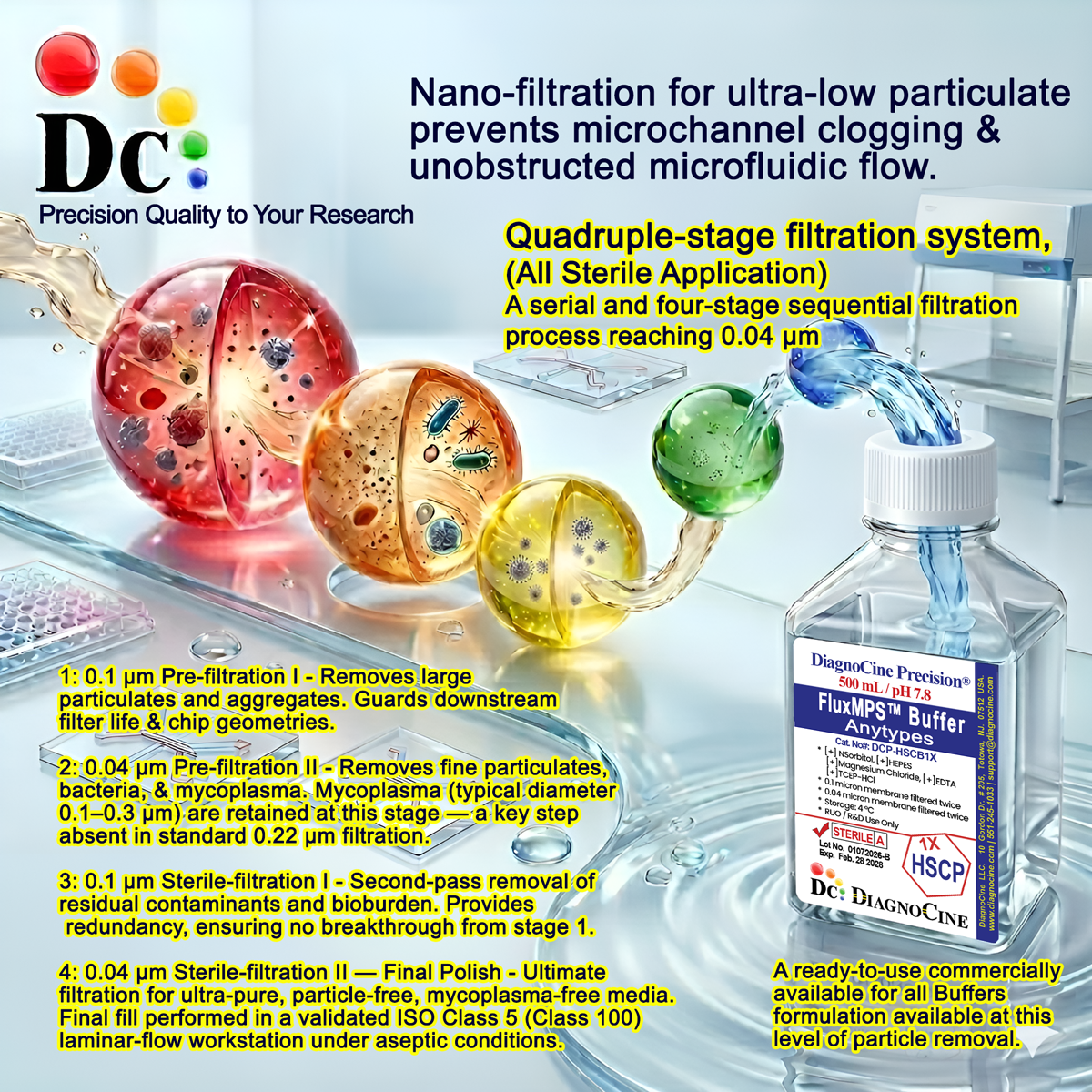
Quadruple-stage filtration system
Every FluxMPS™ CAPS Transfer Buffer lot is filtered through a 0.1-micron membrane twice and a 0.04-micron membrane twice in a sterile environment, giving the buffer world-class purity for cell and molecular biology experiments.
-
1
0.1 µm Pre-filtration I
Removes large particulate and aggregates, extending the working life of downstream filters.
-
2
0.04 µm Pre-filtration II
Retains fine particulates and bioburden ahead of the second filtration pass.
-
3
0.1 µm Sterile-filtration I
Second-pass redundancy through the 0.1 µm membrane in a sterile environment.
-
4
0.04 µm Sterile-filtration II — Final Polish
Final 0.04 µm polish. The smallest known mycoplasma type can be about 0.2 microns, so this final pore size helps prevent mycoplasma contamination.
Performance vs. conventional buffer
Sequential 0.1 µm (x2) and 0.04 µm (x2) filtration removes finer particulates than a single 0.22 µm pass, supporting a sterile, mycoplasma-safe transfer buffer for sensitive blotting applications.
© Diagnocine® — DCP-CAPSTB0.5X
Where CAPS Transfer Buffer performs
The high pH (11.0) formulation is effective for transferring high molecular weight proteins and basic proteins with high isoelectric points, maintaining protein solubility and negative charge during transfer and dissociating SDS more effectively than lower-pH buffers.
Automated Bioreactors & Robotics
For automated blot-processing platforms and robotic liquid handlers, an optional 0.01 µm (10 nm) ultra-filtered variant is available to further reduce particulate load on valves and sensors.
- Total Particulate Exclusion: minimizes fine particulate that can accumulate in automated fluidic paths
- Valve & Sensor Protection: reduces particulate exposure for precision dispensing hardware
- Extended Perfusion Stability: supports consistent performance across long automated runs
Inquiry Required: the 0.01 µm ultra-filtered grade is available on request — contact support@diagnocine.com.
Western Blot Transfer of High MW & Basic Proteins
Particularly suitable for transferring proteins greater than 20 kDa and basic proteins with high isoelectric points, where high pH keeps proteins soluble and negatively charged.
Wash, Dilution & Reconstitution
Ready-to-use 0.5X format supports direct use or further dilution in transfer buffer workflows.
Presequencing Transfers
Does not interfere with automated protein sequencers using the Edman principle; often used for transfers prior to N-terminal sequencing.
Nitrocellulose & PVDF Compatibility
Works well with both nitrocellulose and PVDF membranes; methanol content increases membrane hydrophobicity to enhance protein adsorption.
Efficient Transfer with Tris Discontinuous Buffers
When used in a discontinuous system with Tris, facilitates efficient transfer of proteins from gel to membrane.
Blotting of Basic Proteins
Recommended for blotting of basic proteins, where the adjustable pH (10.5-11.0) is optimal for many protein transfer applications.
Detailed specifications
Every measured and declared parameter for DCP-CAPSTB0.5X, as tested and released.
| Parameter | Specification |
|---|---|
| Formulation / Composition | 500 mM CAPS |
| Appearance | Clear, colorless liquid |
| pH (USP <791>) | 11.0 |
| Molarity / Concentration | 500 mM CAPS |
| Parameter | Specification |
|---|---|
| Sterility USP <71> | Filtered 0.1-micron membrane twice and 0.04-micron membrane twice in a sterile environment |
| DNase Activity | None detected after incubation of plasmid DNA and this product for 18 hr at room temperature |
| RNase Activity | No RNase activity detected after incubation of ribosomal RNA and this product for 18 hr at room temperature |
| Manufacturing Standard ISO 13485 | ISO 13485-certified and CE-approved facilities |
| Parameter | Specification |
|---|---|
| Storage Temperature | 4°C |
| Shelf Life | 1 year |
| Parameter | Specification |
|---|---|
| Manufacturing QMS | ISO 13485-certified |
| Regulatory Alignment | CE-approved facilities (Suppliers of DiagnoCine Precision) |
| Production Method | Final packaging, quality assurance, and testing at the DiagnoCine R&D and Quality Testing Center; customization and assembly at DiagnoCine Precision, Totowa, New Jersey, USA |
| Intended Use | Research Use Only (RUO) |
Full composition
Single-component 500 mM CAPS transfer buffer, released per lot.
| Component | CAS Number | Concentration |
|---|---|---|
| CAPS (3-(Cyclohexylamino)-1-propanesulfonic acid) | 1135-40-6 | 500 mM |
Manufactured to a controlled quality system
DCP-CAPSTB0.5X is produced under ISO 13485-certified and CE-approved facilities, with final packaging, quality assurance, and testing performed at the DiagnoCine R&D and Quality Testing Center.
ISO 13485:2016 QMS
Manufactured under an ISO 13485-certified quality management system.
Ultrapure Type 1 Water
Formulated with Ultrapure Type 1 water (18.2 MΩ·cm).
Sterile Filtration & Testing
Filtered 0.1-micron membrane twice and 0.04-micron membrane twice in a sterile environment; DNase and RNase tested per lot.
Micro-Batch Precision
Customization and assembly performed at DiagnoCine Precision, Totowa, New Jersey, USA.
DNase Activity Tested
None detected after incubation of plasmid DNA and this product for 18 hr at room temperature.
RNase Activity Tested
No RNase activity detected after incubation of ribosomal RNA and this product for 18 hr at room temperature.
pH Control USP <791>
Formulated and released at pH 11.0.
Documentation / CoA
Certificate of Analysis documenting appearance, pH, sterility, and nuclease testing is available on request.
How DCP-CAPSTB0.5X compares
A qualitative comparison against conventional single-pass filtered transfer buffers.
| Parameter | DCP-CAPSTB0.5X (FluxMPS™) | Conventional (0.22 µm filtered) | Standard Alternative (0.22 µm filtered) |
|---|---|---|---|
| Final filtration pore size | 0.04 µm | 0.22 µm | 0.22 µm |
| Number of filtration stages | 4 | 1 | 1 |
| pH optimized for high MW & basic proteins (11.0) | check_circle | cancel | cancel |
| Ready-to-use 0.5X formulation | check_circle | cancel | cancel |
| DNase / RNase tested | check_circle | cancel | cancel |
| Manufacturing QMS (ISO 13485 / CE) | check_circle | cancel | cancel |
| Nitrocellulose & PVDF compatible | check_circle | check_circle | check_circle |
| Custom formulation available | check_circle | cancel | cancel |
Frequently asked questions
Answers to common questions about DCP-CAPSTB0.5X CAPS Transfer Buffer.
Supporting literature
Curated references on CAPS transfer buffer chemistry, high-pH protein transfer, and Western blotting methodology.
- Towbin H, Staehelin T, Gordon J. Electrophoretic transfer of proteins from polyacrylamide gels to nitrocellulose sheets: procedure and some applications. Proc Natl Acad Sci USA. 1979. doi:10.1073/pnas.76.9.4350
- Matsudaira P. Sequence from picomole quantities of proteins electroblotted onto polyvinylidene difluoride membranes. J Biol Chem. 1987. doi:10.1016/S0021-9258(18)61070-1
- Kyhse-Andersen J. Electroblotting of multiple gels: a simple apparatus without buffer tank for rapid transfer of proteins from polyacrylamide to nitrocellulose. J Biochem Biophys Methods. 1984. doi:10.1016/0165-022X(84)90040-X
- Szewczyk B, Kozloff LM. A method for the efficient blotting of strongly basic proteins from sodium dodecyl sulfate-polyacrylamide gels to nitrocellulose. Anal Biochem. 1985. doi:10.1016/0003-2697(85)90494-X
- Bolt MW, Mahoney PA. High-efficiency blotting of proteins of diverse sizes following sodium dodecyl sulfate-polyacrylamide gel electrophoresis. Anal Biochem. 1997. doi:10.1006/abio.1996.9989
- Mahmood T, Yang PC. Western blot: technique, theory, and trouble shooting. N Am J Med Sci. 2012. doi:10.4103/1947-2714.100998
- Good NE, et al. Hydrogen ion buffers for biological research. Biochemistry. 1966. doi:10.1021/bi00866a011
- Kurien BT, Scofield RH. Western blotting. Methods. 2006. doi:10.1016/j.ymeth.2005.07.018
- Low TY, et al. A systematic study of the effect of blotting parameters on protein transfer efficiency. Electrophoresis. 2011. doi:10.1002/elps.201000692