
FluxMPS™, W5 Protoplast Buffer
FluxMPS™ W5 Protoplast Buffer
A ready-to-use, isotonic salt solution optimized for washing, stabilizing, and short-term storage of plant protoplasts. Contains NaCl, CaCl₂, KCl, glucose, and MES buffer at pH 5.7 for maximum protoplast viability.
- 4-stage filtration process (0.1 µm → 0.04 µm, followed by sterile 0.1 µm → 0.04 µm)
- NaCl and KCl provide a near-physiological salt environment that supports plasma membrane stability in plant protoplasts.
- CaCl 2 helps stabilize protoplast membranes and improves protoplast viability and responsiveness after enzymatic cell wall removal.
- MES, adjusted to pH 5.7, matches widely used conditions for plant protoplast isolation and transformation workflows.
- Glucose provides a low level of carbon source to support protoplast survival during short incubation and washing steps.
- Ultrapure Type 1 water (18.2 MΩ·cm)
- ISO Class 5 laminar-flow fill & finish
- Customizable formulation available upon request
- pH5.7
- AppearanceClear Solution
- Filtration0.1µm×2 + 0.04µm×2
- Storage2-8 °C
- Shelf Life1 year
Engineered for maximum purity & performance
Standard laboratory reagents filtered at 0.22 µm leave sub-micron particulates, mycoplasma, and aggregates that interfere with sensitive downstream applications. FluxMPS™ W5 Protoplast Buffer is manufactured under ISO 13485 quality systems with multi-stage ultra-filtration to eliminate these failure modes.
Physiological salt balance
154 mM NaCl and 5 mM KCl provide a near-physiological environment supporting plasma membrane stability.
CaCl₂ membrane stabilization
125 mM CaCl₂ improves protoplast viability and membrane responsiveness after enzymatic cell wall removal.
MES pH 5.7 buffering
2 mM MES at pH 5.7 matches the standard conditions used across plant protoplast isolation and transformation protocols.
Glucose metabolic support
5 mM glucose provides a low-level carbon source to sustain protoplast survival during washing and handling.
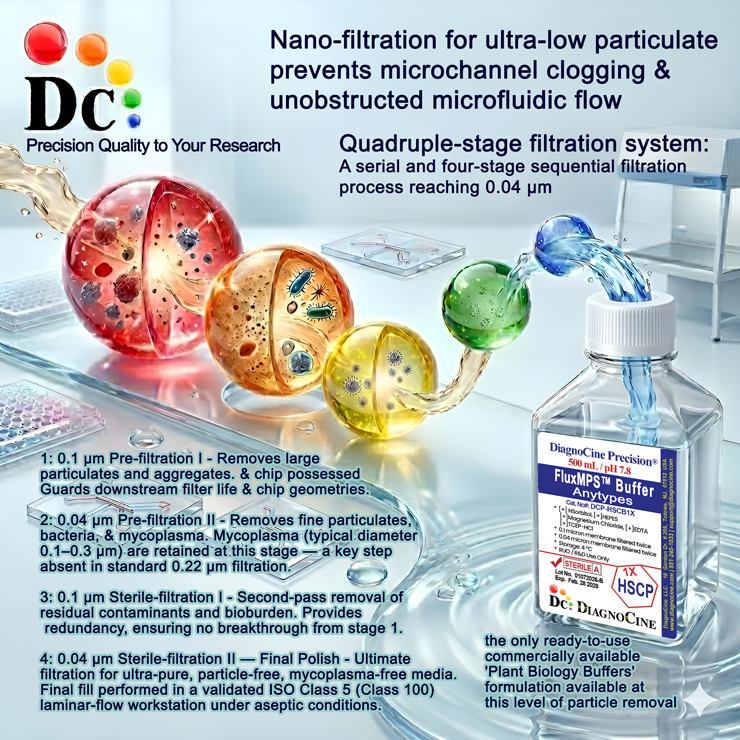
Quadruple-stage filtration system
A serial four-stage sequential filtration process reaching 0.04 µm—the only commercially available buffer at this level of particle removal.
-
1
0.1 µm Pre-filtration I
Removes large particulates and aggregates. Primary guard to extend downstream filter lifetime.
-
2
0.04 µm Pre-filtration II
Removes fine particulates, bacteria, and mycoplasma (0.1–0.3 µm)—a key step absent in standard 0.22 µm filtration.
-
3
0.1 µm Sterile-filtration I
Second-pass removal of residual contaminants and bioburden with full redundancy.
-
4
0.04 µm Sterile-filtration II — Final Polish
Ultimate filtration for particle-free, mycoplasma-free product. Final fill in validated ISO Class 5 laminar-flow workstation.
Performance vs. conventional reagents
Standard 0.22 µm single-pass filtration leaves particles in the 0.05–0.22 µm range. FluxMPS™ removes these contaminants for cleaner results and higher reproducibility.
Validated applications
- Washing and resuspension of plant protoplasts after enzymatic digestion.
- Short-term storage and handling of protoplasts before PEG-Ca2+ -mediated transformation, electroporation, or other transfection methods.
- Dilution and gentle handling during counting, viability assessment, or sorting (e.g., FACS, with appropriate optimization).
Protocol & usage instructions
- Pre-chill buffer on ice or keep at room temperature as specified by your protoplast protocol (many workflows use room temperature for washes).
- After digestion, gently pellet protoplasts, discard the enzyme solution, and resuspend in W5 buffer. Repeat washes as required by the protocol.
- Typical resuspension density: adjust protoplast concentration according to downstream needs (e.g., 1-2 × 10⁶ protoplasts/mL)
- Keep protoplasts in W5 buffer only for the recommended time (usually minutes to a few hours) before transferring to appropriate incubation or culture media.
Composition & specifications
| Component |
|---|
| Sodium Chloride |
| Calcium Chloride |
| Potassium Chloride |
| MES |
| Glucose |
Quality assurance & logistics
ISO 13485:2016 Certified
Manufactured under certified QMS with full traceability and lot documentation.
Made in USA
All manufacturing, QA testing, and final assembly at DiagnoCine Precision, Totowa, NJ.
Supporting literature
- Yoo SD, Cho YH, Sheen J. Arabidopsis mesophyll protoplasts: a versatile cell system for transient gene expression analysis. Nat Protoc. 2007;2(7):1565-1572.
- Sheen J. Signal transduction in maize and Arabidopsis mesophyll protoplasts. Plant Physiol. 2001;127(4):1466-1475.
- Wu FH, Shen SC, Lee LY, et al. Tape-Arabidopsis Sandwich: a simpler Arabidopsis protoplast isolation method. Plant Methods. 2009;5:16.