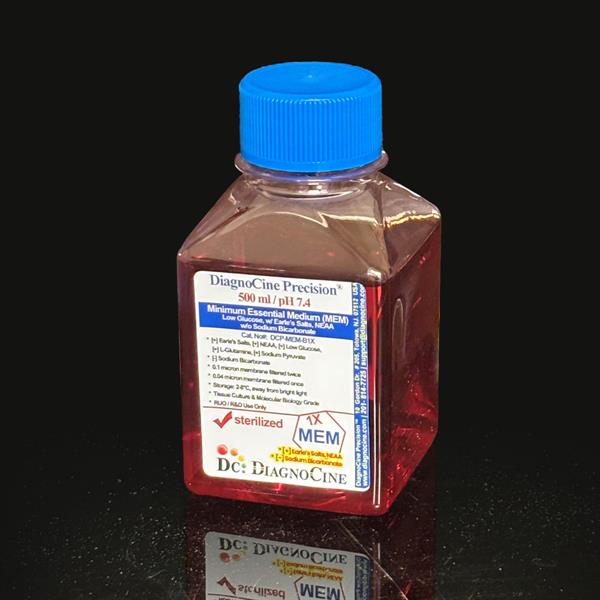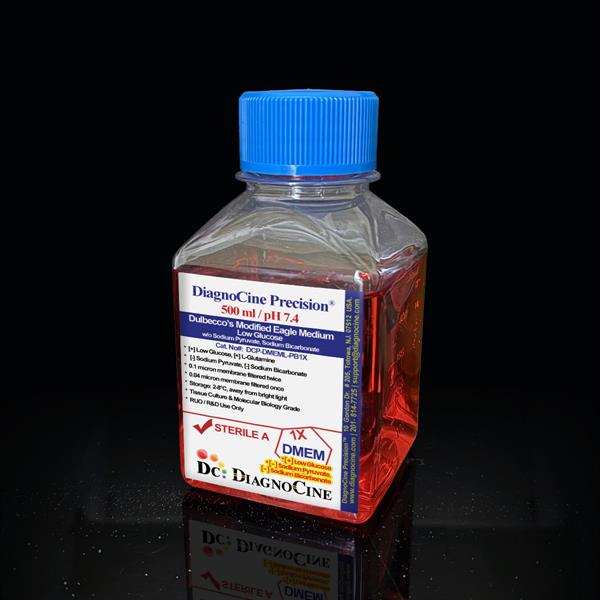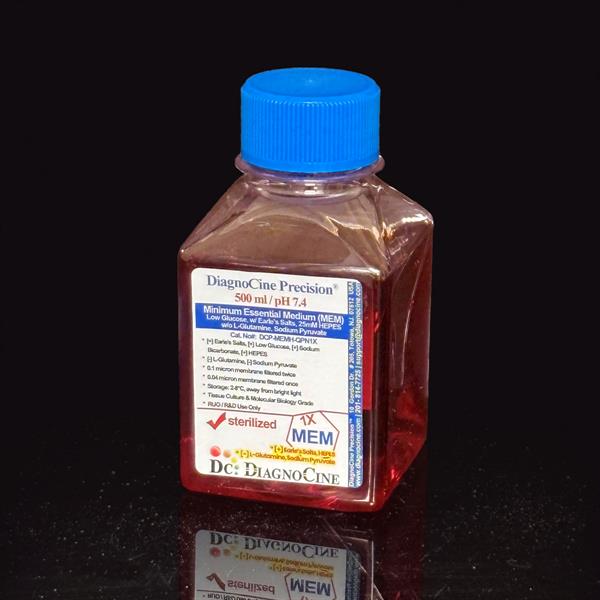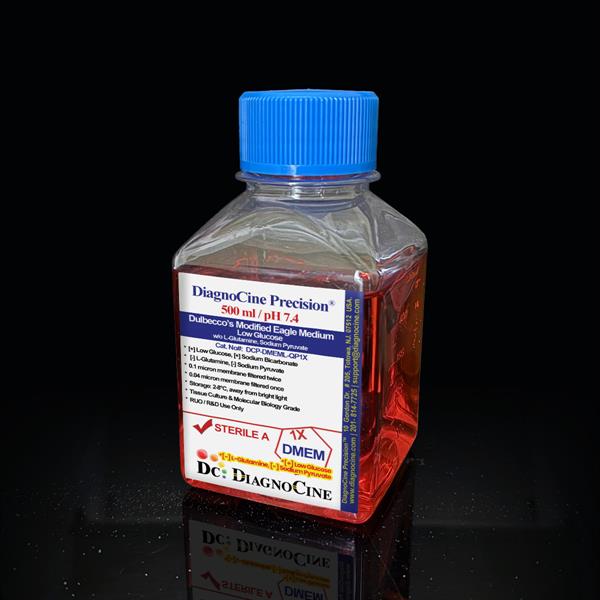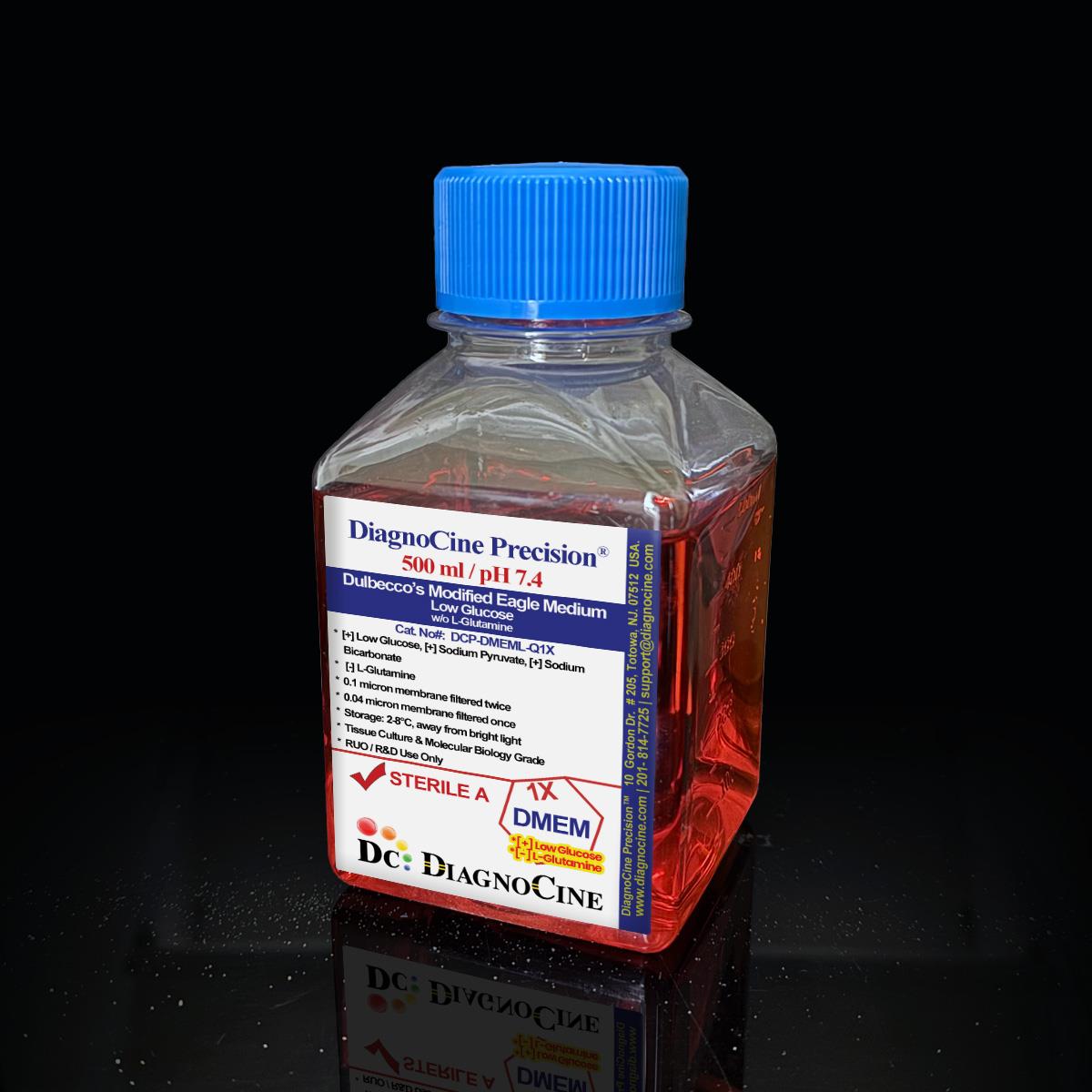
FluxMPS™ Dulbecco's Modified Eagle Medium (DMEM) Low Glucose w/o L-Glutamine: 1X Liquid
FluxMPS™ Dulbecco’s Modified Eagle Medium (DMEM), Low Glucose w/o L-Glutamine: 1X Liquid
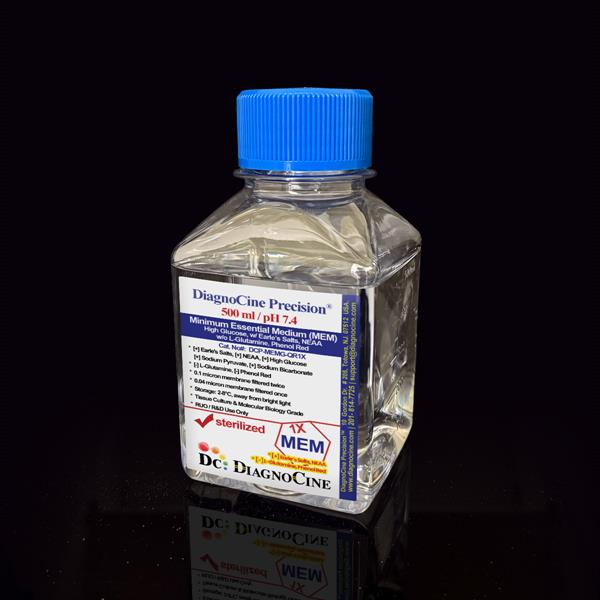
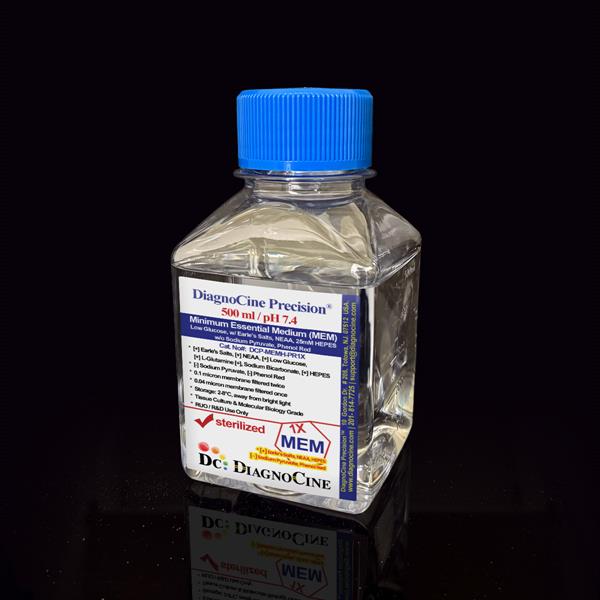
FluxMPS™ DCP-DMEML-Q1X is an MPS-grade, 4-stage ultra-filtered DMEM formulated with 1.0 g/L glucose, sodium pyruvate, and sodium bicarbonate — without L-Glutamine — giving researchers full control of nitrogen source supplementation. Processed through a Quadruple-stage filtration system (0.1 µm × 2 + 0.04 µm × 2), it is approximately 5× cleaner than conventional 0.22 µm–filtered media by particulate count and safe for the narrowest microfluidic channels.
- Quadruple-stage nano-filtration: 0.1 µm × 2 passes + 0.04 µm × 2 passes — sub-mycoplasma polishing
- Ultra-low particulate, microchannel-safe — suitable for organ-on-a-chip (OoC) and microphysiological systems (MPS)
- Endotoxin < 0.05 EU/mL (USP <85> BET); sterility confirmed per USP <71> after 14-day incubation
- Formulation: [+] Low Glucose 1.0 g/L, [+] Sodium Pyruvate, [+] Sodium Bicarbonate; [−] L-Glutamine, [−] HEPES
- Prepared with Ultrapure Type 1 water (18.2 MΩ·cm) — no ionic interference for biosensors or TEER probes
- ISO Class 5 (Class 100) aseptic fill & finish; ISO 13485:2016 QMS
- Customizable — L-Glutamine, HEPES, pH, glucose level, and other nutrients available on request
- Glucose1000 mg/L (1.0 g/L)
- L-GlutamineNot included — add exogenously
- Sodium Pyruvate110 mg/L
- pH (1× conc.)7.4 (USP <791>)
- Osmolality300–340 mOsm/kg (USP <785>)
- Endotoxin< 0.05 EU/mL (USP <85> BET)
- Filtration0.1µm×2 + 0.04µm×2
- Storage2–8°C, protect from light
- Shelf Life12 months from manufacture
- ShippingCold pack (2–8°C)
Engineered where standard media fails
Conventional 0.22 µm sterilization is inadequate for microfluidic platforms. Subvisible particulates accumulate in narrow channels, mycoplasma-sized contaminants pass through, and elevated endotoxin levels corrupt cytokine signaling and sensor readings. FluxMPS™ DCP-DMEML-Q1X was designed from the ground up for microphysiological systems, organ-on-a-chip devices, and high-precision metabolic studies.[1,2]
Microchannel-Safe Purity
0.04 µm final filter ensures USP <788> particulate compliance. Sub-5 µm particles that clog microfluidic channels are eliminated at every stage.
Total Metabolic Control
L-Glutamine-free formulation gives you full control of the nitrogen source. Supplement with stable glutamine, GlutaMAX™, or custom concentrations to precisely tune Warburg or oxidative metabolism.
Ultrapure-Grade Water
Prepared using Ultrapure Type 1 water (18.2 MΩ·cm, USP <85>), ensuring zero ionic background interference for electrochemical biosensors, TEER monitoring, and NMR metabolomics.
Low Background for Imaging
Ultra-clean formulation reduces autofluorescence artifacts in confocal and live-cell imaging, and prevents signal drift in embedded optical biosensors in MPS devices.
Rich, Stable Nutrient Profile
4× BME amino acid and vitamin concentrations, micro-batch production, and controlled fill weight ensure lot-to-lot consistency critical for longitudinal MPS and organoid studies.
Customization on Demand
pH, glucose concentration, L-Glutamine, HEPES, salts, and nutrient composition available on request — contact support@diagnocine.com.
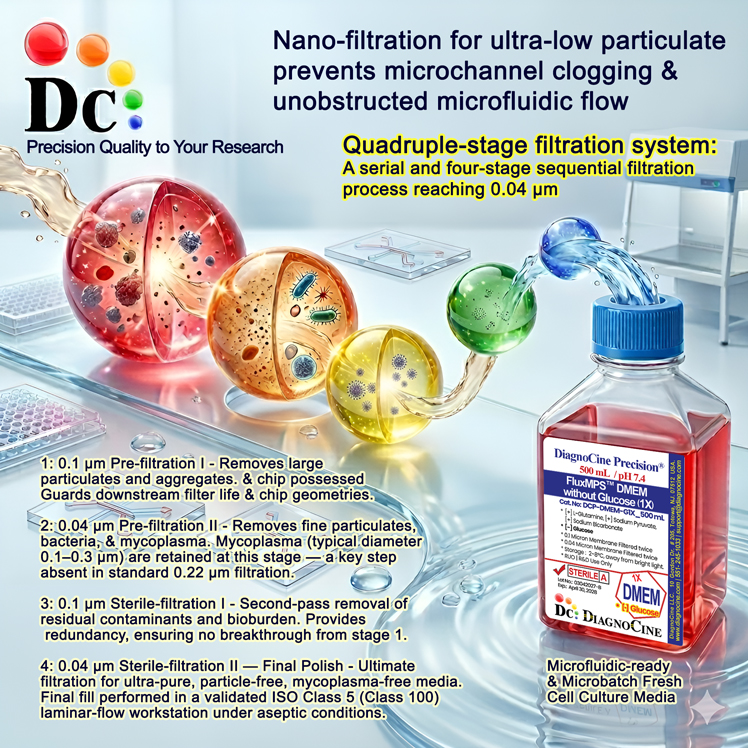
Quadruple-stage filtration system
FluxMPS™ DCP-DMEML-Q1X is the only ready-to-use 0.04 µm DMEM media at this purity level available for organ-on-a-chip and microfluidic research. Each lot passes through four distinct filtration stages — two at 0.1 µm and two at 0.04 µm — inside an ISO Class 5 cleanroom environment, guaranteeing sterility, endotoxin compliance, and mycoplasma exclusion simultaneously.
-
1
0.1 µm Pre-filtration I — Large Particulate Removal
Removes large aggregates, debris, and bulk particulates (≥100 nm). Extends the life of downstream finer filters and reduces bioburden load entering the sterile zone.
-
2
0.04 µm Pre-filtration II — Fine Particulate & Mycoplasma Barrier
Retains fine particulates, bacteria, and mycoplasma species (smallest mycoplasma ≈ 200 nm). Provides the first nano-scale polishing pass and reduces viral load by ≥4 log10 for small non-enveloped viruses.
-
3
0.1 µm Sterile-filtration I — Redundancy Pass
Second-pass sterile filtration providing redundant bioburden reduction. Any contaminant that may have shed from upstream filter housings is captured here before the final polish stage.
-
4
0.04 µm Sterile-filtration II — Final Polish & Aseptic Fill
Ultimate nano-polish under ISO Class 5 (Class 100) conditions. Product flows directly from the 0.04 µm final filter into the final container with zero open-air exposure, ensuring maximum sterility assurance level.
Performance vs. conventional media
Independent particulate analysis under USP <788> Method 2 demonstrates that FluxMPS™ media consistently delivers approximately 5× fewer subvisible particles (≥10 µm) compared to leading 0.22 µm-filtered alternatives. In microfluidic channels with hydraulic diameters of 50–200 µm, this difference is the boundary between unrestricted flow and progressive channel fouling.
by USP <788> particulate count
sub-mycoplasma polishing
© Diagnocine® — DCP-DMEML-Q1X
Research applications for FluxMPS™ DMEM Low Glucose w/o L-Glutamine
The L-Glutamine-free, low glucose formulation of DCP-DMEML-Q1X makes it uniquely suited for metabolic flux studies, glutamine restriction experiments, Warburg-effect investigations, and any system where precise nutrient control is paramount. Its MPS-grade purity enables deployment across organ-on-a-chip, microfluidic, and automated bioprocessing platforms.[3,4]
Automated Bioreactors & Robotics
For the most demanding automated perfusion systems, an optional 0.01 µm (10 nm) ultra-filtered variant of FluxMPS™ DMEM Low Glucose is available by special order. This grade provides total exclusion of nanoparticulates that could foul micro-valve actuators, optical flow sensors, and precision dosing systems in robotic cell culture platforms.
- Total Particulate Exclusion: 10 nm filtration eliminates all particulates that could trigger false-positive sensor events or coat quartz crystal microbalance sensors.
- Valve & Sensor Protection: Prevents protein aggregate deposition on micro-solenoid valve seats and PDMS channel walls during extended perfusion runs.
- Extended Perfusion Stability: Maintains consistent ionic composition and pH over multi-week automated runs without channel occlusion events.
Inquiry Required: The 0.01 µm (10 nm) ultra-filtered grade is produced on a micro-batch schedule. Contact support@diagnocine.com to request this grade and discuss lead times.
Micro Physiological System (MPS) & Chip
MPS-grade purity ensures unrestricted flow in channels as narrow as 10 µm. Suitable for gut-on-a-chip, liver-on-a-chip, kidney-on-a-chip, and multi-organ body-on-a-chip devices.
Warburg Effect & Metabolic Research
L-Glutamine-free base allows precise glutamine titration to study glutaminolysis, IDH mutations, and glutamine-driven anaplerosis. Low glucose (1 g/L) forces partial aerobic glycolysis phenotypes.
iPSC-Derived Models
Low glucose with customizable glutamine supports metabolic reprogramming studies during iPSC differentiation into neurons, cardiomyocytes, and hepatocytes where nutrient sensitivity is critical.
Endothelial & Primary Cells
MPS-grade purity and ultra-low endotoxin (<0.05 EU/mL) reduce background NF-κB activation in primary HUVECs and HAECs, enabling clean cytokine profiling and shear-stress experiments.
Metabolic Flux Analysis
Chemically defined, L-Glutamine-free base is ideal for stable-isotope tracing experiments. Add uniformly labeled 13C-glutamine at precise concentrations for accurate flux mapping.
Microscopy & Optical Sensing
Ultra-clean formulation with no phenol red option available minimizes autofluorescence. Ideal for confocal imaging, TEER monitoring, fluorescent reporter cell lines, and integrated biosensor arrays in MPS devices.
Analytical specification sheet — DCP-DMEML-Q1X
All parameters are measured on every production lot and reported in the accompanying Certificate of Analysis (CoA). USP and ISO method references are provided for each critical quality attribute.
| Parameter | Specification |
|---|---|
| Formulation | DMEM 1X; [+] Low Glucose 1.0 g/L, [+] NaPyruvate, [+] NaHCO₃; [−] L-Gln, [−] HEPESISO 13485 |
| Appearance | Red-colored, clear liquid solution |
| pH (1×) | 7.4 USP <791> |
| Osmolality | 300–340 mOsm/kg H₂O USP <785> |
| D-Glucose | 1000 mg/L (1.0 g/L) |
| L-Glutamine | Not present — add exogenously |
| Sodium Pyruvate | 110 mg/L |
| Phenol Red | 15.9 mg/L (sodium salt) |
| Parameter | Specification |
|---|---|
| Endotoxin (BET) | < 0.05 EU/mL USP <85> |
| Sterility | No growth after 14 days USP <71> |
| Mycoplasma | Not detected — 0.04 µm filtration barrier |
| Particulate ≥10 µm | Compliant USP <788> M2 |
| Particulate ≥25 µm | Compliant USP <788> M2 |
| Water purity | Ultrapure Type 1, 18.2 MΩ·cm USP <85> |
| Manufacturing std. | ISO 13485:2016 ISO 13485 |
| Fill environment | ISO Class 5 (Class 100) cleanroom |
| Parameter | Specification |
|---|---|
| Storage temperature | 2–8°C, away from bright light |
| Freeze-thaw | Do not freeze |
| Shelf life | 12 months from date of manufacture |
| Shipping condition | Cold pack (2–8°C) |
| CO₂ requirement | 5–10% CO₂ humidified atmosphere (NaHCO₃ buffer system) |
| Parameter | Specification |
|---|---|
| Raw material grade | Cell culture / reagent grade or better |
| Traceability | Full lot traceability with CoA available |
| Manufacturing QMS | ISO 13485:2016 certified; CE-approved facilities ISO 13485 |
| Regulatory alignment | 21 CFR Part 820 (cGMP) aligned |
| Production method | Micro-batch; final assembly & QC at DiagnoCine Precision, Totowa, NJ, USA |
| Intended use | Research Use Only (RUO) |
Full composition (mg/L)
FluxMPS™ DCP-DMEML-Q1X contains 4× BME amino acid and vitamin concentrations. All ingredient quantities are nominal per-lot targets; actual values are reported in the CoA. Composition is per the original Dulbecco & Freeman (1959) modification used in the source description, exactly as supplied.
| Component | CAS Number | mg/L |
|---|---|---|
| INORGANIC SALTS | ||
| Calcium chloride dihydrate | 10035-04-8 | 265.000 |
| Ferric nitrate nonahydrate | 7782-61-8 | 0.100 |
| Magnesium sulphate anhydrous | 7487-88-9 | 97.720 |
| Potassium chloride | 7447-40-7 | 400.000 |
| Sodium bicarbonate | 144-55-8 | 3700.000 |
| Sodium chloride | 7647-14-5 | 6400.000 |
| Sodium dihydrogen phosphate anhydrous | 7558-80-7 | 109.000 |
| Component | CAS Number | mg/L |
|---|---|---|
| AMINO ACIDS | ||
| Glycine | 56-40-6 | 30.000 |
| L-Arginine hydrochloride | 1119-34-2 | 84.000 |
| L-Cystine dihydrochloride | 30925-07-6 | 62.570 |
| L-Histidine hydrochloride monohydrate | 5934-29-2 | 42.00 |
| L-Isoleucine | 73-32-5 | 105.00 |
| L-Leucine | 61-90-5 | 105.000 |
| L-Lysine hydrochloride | 657-27-2 | 146.00 |
| L-Methionine | 63-68-3 | 30.00 |
| L-Phenylalanine | 63-91-2 | 66.00 |
| L-Serine | 56-45-1 | 42.000 |
| L-Threonine | 72-19-5 | 95.000 |
| L-Tryptophan | 73-22-3 | 16.000 |
| L-Tyrosine Disodium Salt dihydrate | 69847-15-0 | 103.790 |
| L-Valine | 72-18-4 | 94.000 |
| Component | CAS Number | mg/L |
|---|---|---|
| VITAMINS | ||
| Choline chloride | 67-48-1 | 4.000 |
| D-Ca-Pantothenate | 137-08-6 | 4.000 |
| Folic acid | 59-30-3 | 4.000 |
| Nicotinamide | 98-92-0 | 4.000 |
| Pyridoxal hydrochloride | 65-22-5 | 4.000 |
| Riboflavin | 83-88-5 | 0.400 |
| Thiamine hydrochloride | 67-03-8 | 4.000 |
| i-Inositol | 87-89-8 | 7.200 |
| OTHERS | ||
| D-Glucose | 50-99-7 | 1000.000 |
| Phenol red sodium salt | 34487-61-1 | 15.900 |
| Sodium pyruvate | 113-24-6 | 110.000 |
Manufacturing standards & compliance
Every batch of FluxMPS™ DCP-DMEML-Q1X is manufactured under a rigorous quality system combining ISO 13485:2016 certification, USP-grade analytical testing, and ISO Class 5 aseptic fill to deliver the reliability that MPS and organ-on-a-chip research demands.
ISO 13485:2016 QMS
Full quality management system certified to ISO 13485:2016 and CE-approved. All manufacturing, testing, and documentation procedures are audit-ready and traceable to source raw materials.
Ultrapure Type 1 Water
All media are compounded using Ultrapure Type 1 water (18.2 MΩ·cm) validated per USP <85>. Resistivity is continuously monitored during production to ensure ionic purity.
ISO Class 5 Fill & Finish
Final filtration and container filling are performed entirely within an ISO Class 5 (Class 100) unidirectional airflow enclosure, eliminating open-air contamination risk after the 0.04 µm final filter stage.
Micro-Batch Precision
Produced in small, precisely controlled micro-batches at DiagnoCine Precision, Totowa, New Jersey, USA. Micro-batch production maximizes lot-to-lot consistency and freshness for long-term experiments.
Endotoxin — USP <85> BET
Limulus Amebocyte Lysate (LAL) test per USP <85>. Release specification: < 0.05 EU/mL per lot. Result documented on CoA.
Particulate Matter — USP <788> Method 2
Light obscuration particle count per USP <788> Method 2. Both ≥10 µm and ≥25 µm particle counts are reported on every CoA.
Osmolality — USP <785>
Osmolality measured by freezing-point depression per USP <785>. Release range: 300–340 mOsm/kg H₂O for DCP-DMEML-Q1X.
Documentation — Certificate of Analysis (CoA)
Full CoA including lot number, test dates, analyst, and all QC results available. Request at support@diagnocine.com.
How DCP-DMEML-Q1X compares
FluxMPS™ DCP-DMEML-Q1X was purpose-built for microfluidic and MPS applications where conventional 0.22 µm-filtered DMEM falls short. The table below highlights key differentiation across purity, safety, and engineering compatibility parameters.
| Parameter | DCP-DMEML-Q1X (FluxMPS™) |
Conventional DMEM (0.22 µm filtered) |
Standard Competitor DMEM (0.22 µm filtered) |
|---|---|---|---|
| Formulation feature | Low glucose, no L-Gln — full metabolic control | Low glucose, no L-Gln (standard) | Low glucose, no L-Gln (standard) |
| Final filtration pore size | 0.04 µm | 0.22 µm | 0.22 µm |
| Number of filtration stages | 4 (Quadruple) | 1 | 1 |
| Mycoplasma barrier filtration | check_circle | cancel | cancel |
| Endotoxin specification | < 0.05 EU/mL | < 1 EU/mL (typical) | < 1 EU/mL (typical) |
| USP particulate compliance (<788>) | check_circle | cancel | cancel |
| Water quality | Ultrapure Type 1 (18.2 MΩ·cm) | Purified water | Purified water |
| Manufacturing QMS | ISO 13485:2016 | ISO 9001 or none | ISO 9001 or none |
| Microfluidic channel compatibility | check_circle | cancel | cancel |
| Custom formulation | check_circle | cancel | Limited |
Frequently asked questions
Answers to common questions about FluxMPS™ DCP-DMEML-Q1X from organ-on-a-chip researchers, metabolic biologists, and MPS platform engineers.
Supporting literature
The following peer-reviewed references support the science underlying FluxMPS™ MPS-grade media design, organ-on-a-chip methodology, and low-glucose metabolic research applications relevant to DCP-DMEML-Q1X.
- Bhatia, S.N. & Ingber, D.E. Microfluidic organs-on-chips. Nature Biotechnology 32, 760–772 (2014).doi:10.1038/nbt.2989
- Huh, D. et al. Reconstituting organ-level lung functions on a chip. Science 328, 1662–1668 (2010).doi:10.1126/science.1188302
- Warburg, O. On the origin of cancer cells. Science 123, 309–314 (1956).doi:10.1126/science.123.3191.309
- DeBerardinis, R.J. et al. The biology of cancer: Metabolic reprogramming fuels cell growth and proliferation. Cell Metabolism 7, 11–20 (2008).doi:10.1016/j.cmet.2007.10.002
- Bhimji, S.S. et al. Mycoplasma contamination of cell cultures: Incidence, sources, effects, detection, elimination, prevention. Cytotechnology 22, 1–27 (1996).doi:10.1007/BF00353994
- van der Meer, A.D. & van den Berg, A. Organs-on-chips: breaking the in vitro impasse. Integrative Biology 4, 461–470 (2012).doi:10.1039/c2ib00176d
- Ingber, D.E. Human organs-on-chips for disease modelling, drug development and personalized medicine. Nature Reviews Genetics 23, 467–491 (2022).doi:10.1038/s41576-022-00466-9
- Metallo, C.M. et al. Reductive glutamine metabolism by IDH1 mediates lipogenesis under hypoxia. Nature 481, 380–384 (2012).doi:10.1038/nature10602
- Huang, H. et al. Role of glutamine and interlinked asparagine metabolism in vessel formation. EMBO Journal 36, 2334–2352 (2017).doi:10.15252/embj.201695518
- Jang, K.J. et al. Human kidney proximal tubule-on-a-chip for drug transport and nephrotoxicity assessment. Integrative Biology 5, 1119–1129 (2013).doi:10.1039/c3ib40049b