

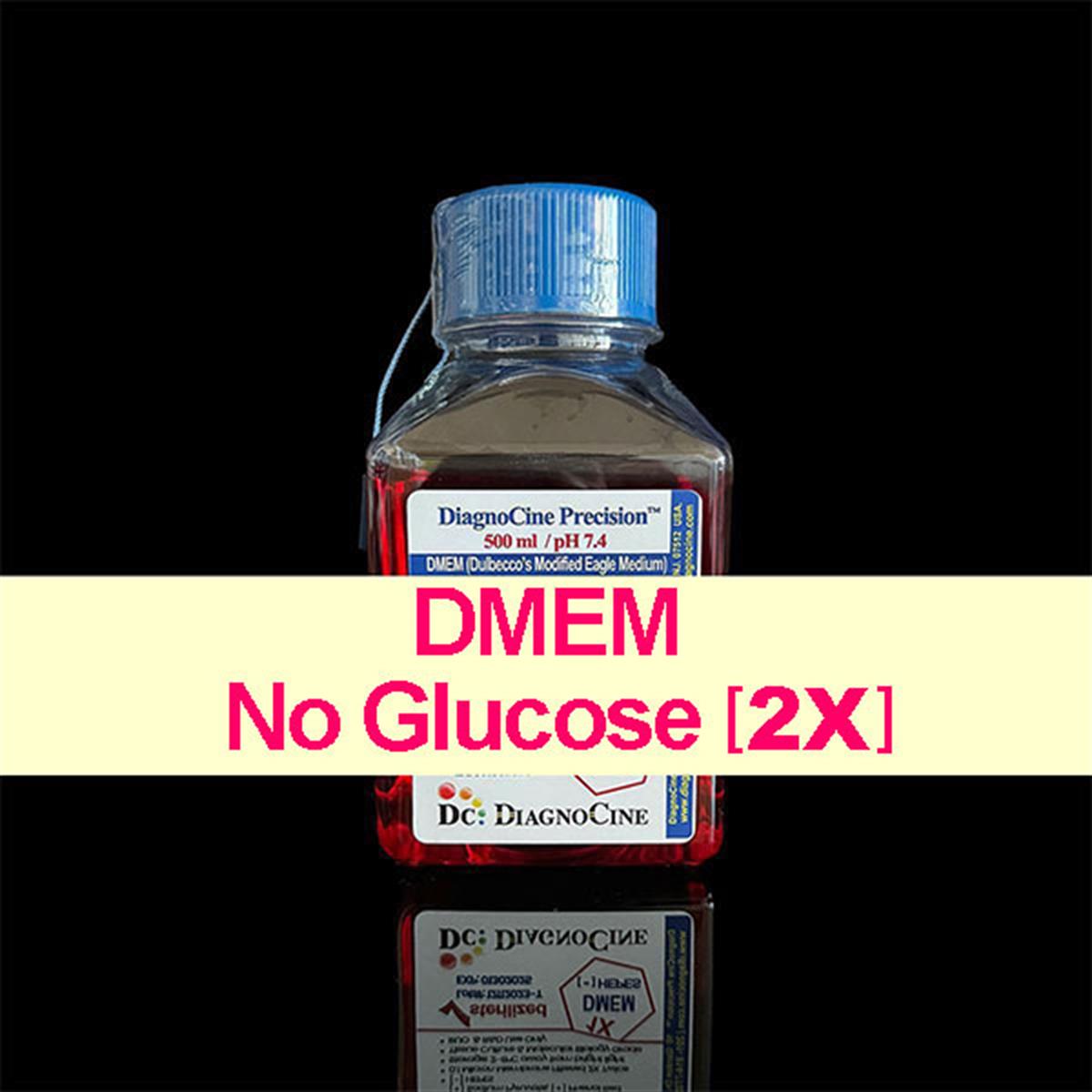
FluxMPS™ DMEM, No Glucose Family — 2X Liquid Cell Culture Media
Select 2X-Media
- see below the table
FluxMPS™ DMEM, No Glucose [2X] Family — 2X Liquid Cell Culture Media
A 32-variant DMEM with no Glucose platform, supplied as a 2X (double-strength) liquid concentrate, built on the four-fold amino acid and vitamin enrichment Renato Dulbecco and G. Freeman introduced to Eagle's medium in 1959. Removing glucose creates a defined basal medium for studying cell metabolism under low- or no-glucose conditions; glucose, galactose, or another carbon source can be added at any level. Every variant is purified through FluxMPS™ quadruple-stage 0.04 micron filtration, engineered for organ-on-chip (OoC), tissue-on-chip (ToC), and lab-on-chip (LoC) microfluidic culture systems where particulate load and channel clogging are not an option.
- 32 variants, each a 2X liquid concentrate: a full DMEM configuration portfolio including the customization of L-Glutamine, Sodium Pyruvate, Sodium Bicarbonate, HEPES (50 mM at 2X; 25 mM at 1X), and Phenol Red.
- 2X (double-strength) format: dilute 1:1 to reach 1X working strength. Add glucose, galactose, or another carbon source at any level for glucose-deprivation, dose-response, glucose-uptake, insulin-signaling, cancer-metabolism, AMPK/autophagy, and ischemia models.
- Glucose: none — a basal medium for metabolic-restriction studies relevant to cancer and stem cell biology.
- Rich nutrient profile: Includes 15 amino acids — Eagle’s essential set plus glycine and L-serine — and 8 water-soluble vitamins at approximately 4x the Basal Medium Eagle (BME) level.
- Flexible buffering options: sodium bicarbonate buffer system that helps maintain physiological pH in a 5–10% CO2 incubator, with 50 mM HEPES variants (25 mM at 1X working strength) also available.
- FluxMPS™ quadruple-stage 0.04 micron filtration — finer than any ready-to-use cell culture media currently available.
- Validated across DMEM-standard lines including HEK293/293T, NIH/3T3, COS-7, RAW 264.7, HeLa, and primary mouse embryonic cells.
- Ships in 500 mL bottles. Stored at 2–8 °C away from bright light. Custom concentration, pH, glucose concentration, salts, HEPES level, and added supplements available on request — please contact support@diagnocine.com.
- Concentration2X (double strength)
- Working strength1X after 1:1 dilution
- GlucoseNone
- L-Glutamine / Sodium PyruvateConfigurable (+/-)
- Sodium Bicarbonate / HEPES (50 mM at 2X)Configurable (+/-)
- Phenol RedConfigurable (+/-)
- Salt baseNaCl, KCl, CaCl2, MgSO4, NaH2PO4, +Fe(NO3)3
- BufferingCO2-dependent, Bicarbonate, and/or HEPES (25 mM at 1X)
- Sizes500 mL
- Storage2–8°C, away from bright light
Select Your DMEM, Glucose-Free [2X] Configuration
Check the supplement(s) you need below — every matching 2X variant is highlighted immediately, and pressing Search also scrolls to the first match. Each row links to its product page either by clicking the catalog number or the View button.
| Name | Cat No. | L-Glutamine | Sodium Pyruvate | Sodium Bicarbonate | HEPES (50mM) | Phenol Red | Product Page |
|---|---|---|---|---|---|---|---|
| DMEM, 2X w/o Glucose | DCP-DMEM-G2X | check | check | check | remove | check | Viewarrow_forward |
| DMEM, 2X w/o Glucose, L-Glutamine | DCP-DMEM-GQ2X | remove | check | check | remove | check | Viewarrow_forward |
| DMEM, 2X w/o Glucose, Sodium Pyruvate | DCP-DMEM-GP2X | check | remove | check | remove | check | Viewarrow_forward |
| DMEM, 2X w/o Glucose, Sodium Bicarbonate | DCP-DMEM-GB2X | check | check | remove | remove | check | Viewarrow_forward |
| DMEM, 2X w/o Glucose, Phenol Red | DCP-DMEM-GR2X | check | check | check | remove | remove | Viewarrow_forward |
| DMEM, 2X w/o Glucose, L-Glutamine, Sodium Pyruvate | DCP-DMEM-GQP2X | remove | remove | check | remove | check | Viewarrow_forward |
| DMEM, 2X w/o Glucose, L-Glutamine, Sodium Bicarbonate | DCP-DMEM-GQB2X | remove | check | remove | remove | check | Viewarrow_forward |
| DMEM, 2X w/o Glucose, L-Glutamine, Phenol Red | DCP-DMEM-GQR2X | remove | check | check | remove | remove | Viewarrow_forward |
| DMEM, 2X w/o Glucose, Sodium Pyruvate, Sodium Bicarbonate | DCP-DMEM-GPB2X | check | remove | remove | remove | check | Viewarrow_forward |
| DMEM, 2X w/o Glucose, Sodium Pyruvate, Phenol Red | DCP-DMEM-GPR2X | check | remove | check | remove | remove | Viewarrow_forward |
| DMEM, 2X w/o Glucose, Sodium Bicarbonate, Phenol Red | DCP-DMEM-GBR2X | check | check | remove | remove | remove | Viewarrow_forward |
| DMEM, 2X w/o Glucose, L-Glutamine, Sodium Pyruvate, Sodium Bicarbonate | DCP-DMEM-GQPB2X | remove | remove | remove | remove | check | Viewarrow_forward |
| DMEM, 2X w/o Glucose, L-Glutamine, Sodium Pyruvate, Phenol Red | DCP-DMEM-GQPR2X | remove | remove | check | remove | remove | Viewarrow_forward |
| DMEM, 2X w/o Glucose, L-Glutamine, Sodium Bicarbonate, Phenol Red | DCP-DMEM-GQBR2X | remove | check | remove | remove | remove | Viewarrow_forward |
| DMEM, 2X w/o Glucose, Sodium Pyruvate, Sodium Bicarbonate, Phenol Red | DCP-DMEM-GPBR2X | check | remove | remove | remove | remove | Viewarrow_forward |
| DMEM, 2X w/o Glucose, L-Glutamine, Sodium Pyruvate, Sodium Bicarbonate, Phenol Red | DCP-DMEM-GQPBR2X | remove | remove | remove | remove | remove | Viewarrow_forward |
| DMEM, 2X + HEPES w/o Glucose | DCP-DMEMH-G2X | check | check | check | check | check | Viewarrow_forward |
| DMEM, 2X + HEPES w/o Glucose, L-Glutamine | DCP-DMEMH-GQ2X | remove | check | check | check | check | Viewarrow_forward |
| DMEM, 2X + HEPES w/o Glucose, Sodium Pyruvate | DCP-DMEMH-GP2X | check | remove | check | check | check | Viewarrow_forward |
| DMEM, 2X + HEPES w/o Glucose, Sodium Bicarbonate | DCP-DMEMH-GB2X | check | check | remove | check | check | Viewarrow_forward |
| DMEM, 2X + HEPES w/o Glucose, Phenol Red | DCP-DMEMH-GR2X | check | check | check | check | remove | Viewarrow_forward |
| DMEM, 2X + HEPES w/o Glucose, L-Glutamine, Sodium Pyruvate | DCP-DMEMH-GQP2X | remove | remove | check | check | check | Viewarrow_forward |
| DMEM, 2X + HEPES w/o Glucose, L-Glutamine, Sodium Bicarbonate | DCP-DMEMH-GQB2X | remove | check | remove | check | check | Viewarrow_forward |
| DMEM, 2X + HEPES w/o Glucose, L-Glutamine, Phenol Red | DCP-DMEMH-GQR2X | remove | check | check | check | remove | Viewarrow_forward |
| DMEM, 2X + HEPES w/o Glucose, Sodium Pyruvate, Sodium Bicarbonate | DCP-DMEMH-GPB2X | check | remove | remove | check | check | Viewarrow_forward |
| DMEM, 2X + HEPES w/o Glucose, Sodium Pyruvate, Phenol Red | DCP-DMEMH-GPR2X | check | remove | check | check | remove | Viewarrow_forward |
| DMEM, 2X + HEPES w/o Glucose, Sodium Bicarbonate, Phenol Red | DCP-DMEMH-GBR2X | check | check | remove | check | remove | Viewarrow_forward |
| DMEM, 2X + HEPES w/o Glucose, L-Glutamine, Sodium Pyruvate, Sodium Bicarbonate | DCP-DMEMH-GQPB2X | remove | remove | remove | check | check | Viewarrow_forward |
| DMEM, 2X + HEPES w/o Glucose, L-Glutamine, Sodium Pyruvate, Phenol Red | DCP-DMEMH-GQPR2X | remove | remove | check | check | remove | Viewarrow_forward |
| DMEM, 2X + HEPES w/o Glucose, L-Glutamine, Sodium Bicarbonate, Phenol Red | DCP-DMEMH-GQBR2X | remove | check | remove | check | remove | Viewarrow_forward |
| DMEM, 2X + HEPES w/o Glucose, Sodium Pyruvate, Sodium Bicarbonate, Phenol Red | DCP-DMEMH-GPBR2X | check | remove | remove | check | remove | Viewarrow_forward |
| DMEM, 2X + HEPES w/o Glucose, L-Glutamine, Sodium Pyruvate, Sodium Bicarbonate, Phenol Red | DCP-DMEMH-GQPBR2X | remove | remove | remove | check | remove | Viewarrow_forward |
What is DMEM, and why a No-Glucose build?
Dulbecco's Modified Eagle Medium (DMEM) is one of the most widely used modifications of Eagle's medium. It is a modification of Basal Medium Eagle (BME) that contains fourfold concentrations of amino acids and vitamins, and additionally includes glycine, serine, and ferric nitrate. The original formulation contains 1 g/L of glucose and was originally used to culture embryonic mouse cells. DMEM is an enriched derivative of BME and a default choice for high-density and fast-growing adherent cultures, well suited to metabolically demanding applications.
In this family, glucose is removed to provide a basal medium for studying the metabolic activity and response of cells under low or no glucose conditions. This formulation lets researchers investigate how cells adapt and function in environments with limited glucose availability — particularly relevant for research areas such as cancer and stem cell biology.
Origins and Development
DMEM traces directly to Harry Eagle's foundational work at the National Institutes of Health, where his 1955 studies defined the minimal nutritional requirements of HeLa and L (L929) cells and led to the development of Basal Medium Eagle (BME). Eagle later noted that BME emerged from systematic nutritional studies rather than from a planned attempt to design a culture medium. In 1959, Eagle expanded BME into Minimum Essential Medium (MEM) by increasing amino acid concentrations to extend culture maintenance and broaden the range of supported cell lines.
That same year, Renato Dulbecco and G. Freeman introduced their own modification of Eagle's medium in a footnote in their Virology paper on plaque production by the polyoma virus (Virology 8: 396–397, 1959). The modification — now universally known as Dulbecco's Modified Eagle Medium (DMEM, or DME) — had substantially higher concentrations of amino acids and vitamins than BME and was used to support the culture of mouse embryonic cells in monolayers needed for quantitative virus plaque assays. As with Eagle's original work, the medium emerged as a practical tool in service of a virological objective rather than as a standalone engineering goal, and it likewise depended on serum supplementation to support proliferation.
In the decade that followed, the formulation was adapted and commercialized in several variants. Higher-glucose versions (4.5 g/L) were developed to support rapidly proliferating and transformed cell lines, and DMEM was extended to primary cultures of mouse and chicken cells, as well as a broad spectrum of normal and transformed cell types. Surveys of commercial media from this period (Morton, 1970) document how DMEM diversified into the family of glucose-, pyruvate-, glutamine-, and buffer-variant media still in use today.
Note on parent formulation: Multiple authoritative sources — including the Cantor 2019 Trends in Cell Biology review, Sigma-Aldrich, and Corning — classify DMEM as a derivative of BME. Some commercial literature describes the fourfold enrichment relative to "Eagle's Minimal Essential Medium"; the Dulbecco footnote itself refers simply to "Eagle's medium." The scientific consensus, anchored by primary review literature, identifies BME as the direct parent.
Why a 2X (Double-Strength) Format
Every member of this family is supplied at 2X: each formulated component is present at twice its working level, so that diluting the medium 1:1 brings every component to standard 1X strength. Because the base carries no glucose, the second half of the volume is where the researcher sets the carbon source — the product pages state that glucose, galactose, or another carbon source can be added at any level, for glucose-deprivation, dose-response, glucose-uptake, insulin-signaling, cancer-metabolism, AMPK/autophagy, and ischemia models. HEPES, in the HEPES variants, is 50 mM at 2X and 25 mM at 1X. Components a variant name lists as "w/o" are left out so they can be added fresh at their 1X levels.
The DMEM Family Tree
DMEM sits in the middle of a lineage that begins with Eagle and continues into several enriched descendants:
- BME (1955, Eagle) — the parent formulation; a basal amino acid and vitamin mix, including glutamine, biotin, and baseline inorganic salts.
- MEM (1959, Eagle) — a BME derivative with increased amino acid concentrations; biotin was omitted after Eagle found it dispensable.
- DMEM (1959, Dulbecco & Freeman) — a further-enriched BME modification (approximately 4x amino acids and vitamins vs. BME) with 15 amino acids (adding glycine and L-serine to the Eagle essential set) and added ferric nitrate, originally for mouse embryonic cells and viral plaque assays.
- DMEM/F-12 — a 1:1 mixture of high-glucose DMEM and Ham's F-12, combining DMEM's rich amino acid/vitamin profile with F-12's trace elements and lipids for lower-serum and serum-free work.
- IMDM (Iscove's Modified Dulbecco's Medium, 1978; Iscove & Melchers) — an enriched DMEM derivative adding selenium, additional amino acids and vitamins, sodium pyruvate, HEPES buffer, and potassium nitrate in place of ferric nitrate; designed for high-density, rapidly proliferating cultures such as lymphocytes and hematopoietic cells.
In parallel, the broader Eagle lineage also gave rise to RPMI 1640, developed by Moore, Gerner, and Franklin at Roswell Park Memorial Institute (1966; published in JAMA 199: 519–524, 1967). RPMI 1640's direct parent is McCoy's 5A Modified Medium, which was itself based in part on BME — illustrating how a single nutritional framework branched into the modern catalog of classical media.
DMEM, No Glucose — Component Summary
Categorical composition summary as documented in the source formulation record. Per-variant Certificate of Analysis (CoA) requests can be directed to support@diagnocine.com.
| Concentration | 2X liquid concentrate; dilute 1:1 to reach 1X working strength. |
| Amino acids | 15 amino acids — Eagle's essential set plus glycine and L-serine; concentrations approximately 4x BME baseline. |
| Vitamins | 8 water-soluble vitamins at ~4× BME baseline: choline chloride, folic acid, myo-inositol, niacinamide, D-calcium pantothenate, pyridoxine HCl (dominant Gibco/Thermo Fisher formulation; some suppliers substitute pyridoxal HCl), riboflavin, thiamine HCl. Biotin and vitamin B12 are absent. |
| Inorganic salts | NaCl, KCl, CaCl2, MgSO4, NaH2PO4, NaHCO3, plus ferric nitrate [Fe(NO3)3·9H2O] as a distinctive trace-iron source (0.1 mg/L) |
| Glucose | None (this family is glucose-free); add glucose, galactose, or another carbon source at any level. |
| Sodium pyruvate | Approximately 110 mg/L (1 mM) at 1X in variants that include it; configurable per the supplement matrix above. |
| Serum requirement | Not a complete medium; typically 10% FBS (5–20% depending on cell line) |
| pH buffering | Sodium bicarbonate buffer system (approximately 3.7 g/L NaHCO3) maintaining physiological pH, necessitating incubation in a 5-10% CO2 environment, or HEPES in the HEPES-supplemented variants (50 mM at 2X; 25 mM at 1X); phenol red as pH indicator where included. |
| pH / osmolality | 7.4 ± 0.04; typically 320–370 mOsm/kg depending on formulation and manufacturer |
Media Lineage Comparison — BME vs MEM vs DMEM
| Feature | BME | MEM | DMEM (FluxMPS™ 2X family, at 1X) |
|---|---|---|---|
| Amino acid level | Baseline — minimal | ~2× BME | ~4× BME |
| Vitamin level | Baseline, includes Biotin | Often lacks Biotin | 4× BME |
| Glucose | 1.0 g/L | 1.0 g/L | Glucose-Free |
| Added iron source | None | None | Ferric nitrate, 0.1 mg/L |
| Serum supplement | 5–10% recommended | 5–10% recommended | 10–20% typical |
| pH buffering | Bicarbonate, CO2-dependent | Bicarbonate, CO2-dependent | Bicarbonate, 5-10% CO2 (or HEPES) |
| Developer & year | Harry Eagle, 1955 | Harry Eagle, 1959 | Dulbecco & Freeman, 1959 |
Values in the comparison above refer to 1X working strength.
DMEM, No Glucose: 1X vs. 2X
| Feature | DMEM, No Glucose, 1X | DMEM, No Glucose, 2X |
|---|---|---|
| Supplied concentration | 1X (ready to use) | 2X (double strength) |
| Preparation before use | None | Dilute 1:1 for 1X working strength |
| Component concentrations as supplied | Standard DMEM, No Glucose | Twice the 1X level, before 1:1 dilution |
| Glucose | None | None — add glucose, galactose, or another carbon source at any level |
| HEPES (HEPES variants) | 25 mM | 50 mM at 2X; 25 mM at 1X after dilution |
| Sodium pyruvate (where included) | Approximately 110 mg/L (1 mM) | Approximately 110 mg/L (1 mM) at 1X after dilution |
| Catalog variants | 32 (all L-Glutamine / Sodium Pyruvate / Sodium Bicarbonate / HEPES / Phenol Red combinations) | 32 (the same 32 combinations) |
| Catalog number suffix | ...1X (e.g., DCP-DMEM-G1X) | ...2X (e.g., DCP-DMEM-G2X) |
| Typical uses | Metabolic studies under low or no glucose (cancer and stem cell biology); DMEM-standard lines | Glucose-deprivation, dose-response, glucose-uptake, insulin-signaling, cancer-metabolism, AMPK/autophagy, ischemia models |
| Filtration | Quadruple-stage, 0.04 micron final | Quadruple-stage, 0.04 micron final |
| Sizes | 500 mL, 1000 mL | 500 mL |
| Storage | 2-8°C, away from bright light | 2-8°C, away from bright light |
Media engineered for the architecture of the future
FluxMPS™ was designed from the ground up for microphysiological systems, where the medium itself is part of the instrument.
Purified to 0.04 microns
Finer than any ready-to-use cell culture media currently available, removing particulates and protein aggregates before they reach your chip.
Engineered for laminar flow
Every component is optimized for consistent flow performance — zero-clogging is the baseline specification, not a feature.
Optical clarity for imaging
Clean matrices support real-time imaging and integrated biosensing in Organ-on-Chip readouts.
Built for OoC / ToC / LoC
Designed specifically for Organ-on-Chip, Tissue-on-Chip, and Lab-on-Chip microfluidic platforms.
Stable over long perfusion
Consistent formulation stability across automated perfusion studies running continuously for weeks.
Regulatory foundation
Formulated to support FDA-recognized physiological modeling standards for drug discovery, toxicology, and translational research.
Quadruple-Stage Filtration System
Every FluxMPS™ DMEM, No Glucose [2X] variant passes through the same four-stage architecture before reaching your chip — two 0.1 µm pre-filtration passes and two 0.04 µm final filtration passes, each final filter preceded by its own prefilter.
-
01
Pre-Filtration Stage 1 0.1 µm
Initial coarse particulate removal.
-
02
Final Filtration Stage 1 0.04 µm
Fine filtration below standard 0.22 micron practice.
-
03
Pre-Filtration Stage 2 0.1 µm
Secondary particulate and aggregate reduction.
-
04
Final Filtration Stage 2 0.04 µm
Final polish for microfluidic-grade clarity.
Engineered for Flow, Not Just Growth
Every component is optimized for consistent, laminar flow performance across complex micro-channel geometries, capillary-bed and vascular simulations, and long-term automated perfusion studies running continuously for weeks.

Cell lines routinely cultured in DMEM
DMEM is the standard or recommended medium across a wide range of cell types. Primary mouse and chicken cultures were among the early extensions of DMEM beyond its original mouse-embryo use.
Mouse embryonic cells / MEFs
Primary mouse embryonic cells and mouse embryonic fibroblasts — the original target of Dulbecco & Freeman's formulation.
NIH/3T3 fibroblasts
A classic immortalized adherent line routinely maintained in DMEM.
HEK293 / HEK293T
The workhorse lines for transient transfection and recombinant protein and viral-vector production, typically in high-glucose DMEM.
COS-7
SV40-transformed African green monkey kidney cells used for transient expression.
RAW 264.7 macrophages
A mouse macrophage line maintained in DMEM.
HeLa & transformed epithelia
HeLa and other transformed epithelial lines are broadly supported in DMEM as well as in Eagle-family media.
Where DMEM, Glucose-Free [2X] fits
Glucose-restriction & metabolic studies
A defined basal medium for studying metabolic activity and cell responses under low or no glucose — particularly relevant to cancer and stem cell biology.
Transfection & viral-vector production
High-glucose DMEM is the default for HEK293/293T workflows — transient transfection, recombinant protein expression, and lentivirus/AAV packaging; the glucose-free base supports controlled metabolic variants of these workflows.
General adherent & high-density culture
Nutrient levels well above the minimal Eagle baseline support fast proliferation of fibroblasts and many transformed adherent lines.
Physiologic media comparison
DMEM is the canonical "traditional" medium whose nutrient levels diverge sharply from human plasma, and serves as the principal comparator (alongside RPMI 1640) in the physiologic-media literature where HPLM and Plasmax are benchmarked against it (Cantor 2019).
Frequently asked questions
Verified Bibliography
- Dulbecco, R. & Freeman, G. (1959). Plaque production by the polyoma virus. Virology, 8(3), 396–397. PMID: 13669362
- Smith, J.D., Freeman, G., Vogt, M. & Dulbecco, R. (1960). The nucleic acid of polyoma virus. Virology, 12(2), 185–196.
- Eagle, H. (1955). Nutrition Needs of Mammalian Cells in Tissue Culture. Science, 122(3168), 501–504. PMID: 13255879
- Eagle, H. (1959). Amino Acid Metabolism in Mammalian Cell Cultures. Science, 130(3373), 432–437. PMID: 13658943
- Morton, H.J. (1970). A Survey of Commercially Available Tissue Culture Media. In Vitro, 6(2), 89–108. PMID: 5523183
- Iscove, N.N. & Melchers, F. (1978). Complete replacement of serum by albumin, transferrin, and soybean lipid in cultures of lipopolysaccharide-reactive B lymphocytes. J. Exp. Med., 147(3), 923–933. PMID: 305462
- Moore, G.E., Gerner, R.E. & Franklin, H.A. (1967). Culture of normal human leukocytes. JAMA, 199(8), 519–524.
- Cantor, J.R. (2019). The Rise of Physiologic Media. Trends in Cell Biology, 29(11), 854–861. PMC7001851
- Yao, T. & Asayama, Y. (2017). Animal-cell culture media: History, characteristics, and current issues. Reproductive Medicine and Biology, 16(2), 99–117. PMC5661806
FluxMPS™ — Precision Cell Culture Media for Microphysiological Systems
Built for the architecture of the future. Not the flask of the past.
Traditional cell culture media were formulated for static well plates and flasks — environments that tolerate impurities, precipitates, and particle loads that would immediately compromise a microfluidic system. FluxMPS™ was designed from the ground up for Organ-on-Chip (OoC), Tissue-on-Chip (ToC), and Lab-on-Chip (LoC) platforms, where the medium itself is part of the instrument.
Purity That Protects Your Platform
FluxMPS™ is purified to 0.04 microns — finer than any ready-to-use cell culture media currently available. At this level, the microscopic particulates and protein aggregates that silently block micro-channels, disrupt laminar flow, and generate false biological signals are eliminated before the media ever reaches your chip.
The result: your platform stays operational, your data stays clean, and your biology drives the result — not your media.
Engineered for Flow, Not Just Growth
The name FluxMPS™ reflects its core design principle. Every component is optimized for consistent, laminar flow performance across:
- Complex micro-channel geometries
- Capillary-bed and vascular simulations
- Long-term automated perfusion studies running continuously for weeks
Zero-clogging performance is not a feature — it is the baseline specification.
Applications & Performance
| Application | What FluxMPS™ Delivers |
|---|---|
| Microfluidics | Stable shear stress; no channel blockage |
| Metabolic Tracing | Ultra-pure matrix with no contaminant interference |
| Long-term Perfusion | Consistent formulation stability over weeks of continuous flow |
| Organ-on-Chip | Optical clarity for real-time imaging and integrated biosensing |
Regulatory Foundation
FluxMPS™ is formulated to support FDA-recognized physiological modeling standards, providing a validated, reproducible media foundation for drug discovery, toxicology screening, and translational research. When your downstream data needs to stand up to regulatory scrutiny, your upstream media cannot be an afterthought.
The Bottom Line
Microfluidic platforms are precision instruments. They require precision inputs.
FluxMPS™ is the only ready-to-use cell culture medium engineered specifically to meet that standard — protecting your chip, your cells, and your science.