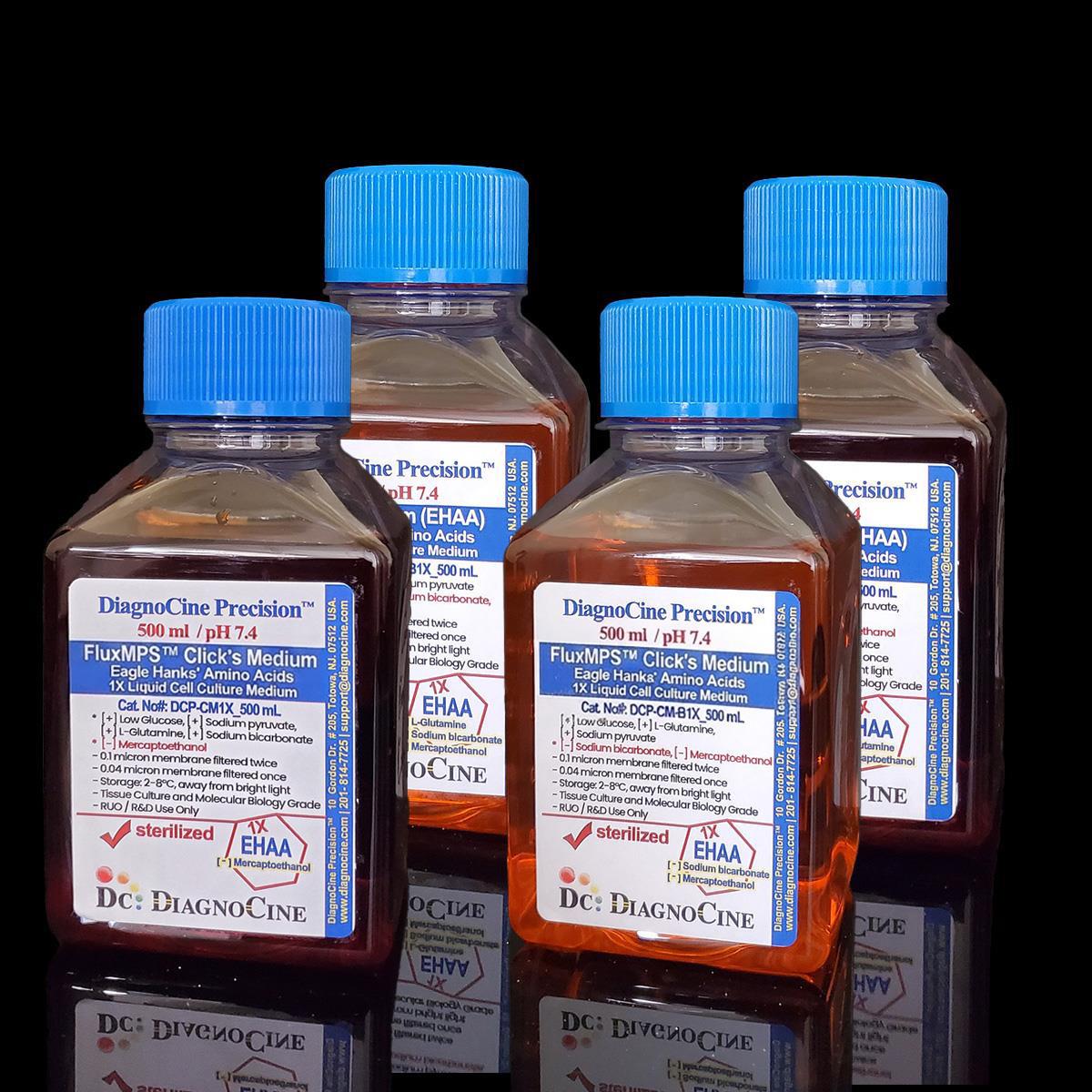
FluxMPS™ Click's Medium (EHAA) Eagle Hanks' Amino Acids
Select See the table below
- See the table below
FluxMPS™ Click's Medium (EHAA) Eagle Hanks' Amino Acids
Click's Medium (EHAA) is a specialized cell culture medium that is a modification of Eagle's Essential Medium with Hanks' Salts (HMEM). It was developed by Robert Click to study the in vitro immune response of mouse spleen cells. The key feature of Click's Medium is that it contains higher concentrations of essential amino acids, in addition to non-essential amino acids, sodium pyruvate, and nucleic acid precursors. Every FluxMPS™ variant is purified through quadruple-stage 0.04 micron filtration, engineered for organ-on-chip (OoC), tissue-on-chip (ToC), and lab-on-chip (LoC) microfluidic culture systems.
- 4 variants across L-Glutamine and Sodium Bicarbonate inclusion/exclusion (Sodium Pyruvate and Phenol Red included in every variant)
- Eagle's essential amino acid profile plus a full non-essential amino acid set, extending coverage beyond the Eagle minimum
- Hanks' Balanced Salt Solution ionic backbone, in place of Earle's salts
- Ribonucleoside precursors (adenosine, cytidine, guanosine, uridine) supporting nucleic acid biosynthesis during lymphocyte clonal expansion
- Supplied without 2-mercaptoethanol (2-ME); add 5 x 10⁻⁵ M (50 µM) at time of use due to its oxidative instability in bulk liquid stock
- Standard Low Glucose EHAA formulation: 1.0 g/L (5.5 mM) glucose
- FluxMPS™ quadruple-stage 0.04 micron filtration — finer than any ready-to-use cell culture media currently available
- Available in 500 mL and 1000 mL sizes; 2-8°C storage away from bright light; fully customizable on request (including HEPES buffering)
- Concentration1X
- Glucose1.0 g/L (5.5 mM), Low Glucose
- L-GlutamineConfigurable (+/-); add 4 mM if not in base
- Sodium PyruvateIncluded (all variants), 275 mg/L
- Sodium BicarbonateConfigurable (+/-)
- Phenol RedIncluded (all variants)
- 2-MercaptoethanolNot in base; add 50 µM at time of use
- Sizes500 mL / 1000 mL
- Storage2-8 C, away from light
Select Your Click's Medium (EHAA) Configuration
Please Click the boxes under the supplements you want, then Click the Search button. Check the supplement(s) you need below and press Search to instantly highlight every matching variant. Each row links straight through to its product page via the catalog number or the View button.
| Name | Cat No. | L-Glutamine | Pyruvate | Bicarbonate | Phenol Red | Product Page |
|---|---|---|---|---|---|---|
| Click's Medium (EHAA) | DCP-CM1X | check | check | check | check | Viewarrow_forward |
| Click's Medium (EHAA) w/o L-Glutamine | DCP-CM-Q1X | remove | check | check | check | Viewarrow_forward |
| Click's Medium (EHAA) w/o Bicarbonate | DCP-CM-B1X | check | check | remove | check | Viewarrow_forward |
| Click's Medium (EHAA) w/o L-Glutamine, Bicarbonate | DCP-CM-QB1X | remove | check | remove | check | Viewarrow_forward |
About Click's Medium (EHAA)
Click's Medium — formally designated EHAA (Eagle's Hanks' Amino Acids) — is a specialized cell culture medium formulated for in vitro immunological studies, specifically the primary antibody response of murine spleen cells. It is a modification of Eagle's Minimum Essential Medium with Hanks' Balanced Salt Solution (MEM-Hanks, or HMEM), enriched with higher concentrations of essential amino acids, a full complement of non-essential amino acids, sodium pyruvate, and nucleoside precursors — all of which distinguish it from the parent MEM-Hanks formulation. The medium's defining operational feature is its requirement for exogenous supplementation with 2-mercaptoethanol (2-ME), a critical component that enables robust in vitro antibody synthesis under stationary culture conditions without daily medium feeding.
Origins and Development
Click's Medium was developed by Robert E. Click and colleagues in the early 1970s. The foundational series of publications appeared under the collective title "Immune Responses in Vitro":
- Click, R.E., Benck, L. & Alter, B.J. (1972). "Enhancement of antibody synthesis in vitro by mercaptoethanol." Cellular Immunology, 3(1), 156-160. PMID: 5061825. An early demonstration that 2-ME enhanced in vitro antibody responses by murine lymphocytes.
- Click, R.E., Benck, L. & Alter, B.J. (1972). "Immune responses in vitro. I. Culture conditions for antibody synthesis." Cellular Immunology, 3(2), 264-276. The primary paper establishing the EHAA medium formulation and stationary culture conditions for the in vitro primary antibody response.
- Click, R.E., Benck, L., Alter, B.J. & Lovchik, J.C. (1972). "Immune responses in vitro. VI. Genetic control of the in vivo-in vitro discrepancies in 19S antibody synthesis." J. Exp. Med., 136(5), 1241-1257. PMID: 4563149. Further characterization of the in vitro immune response system using EHAA.
The immediate historical context for Click's work was the Mishell-Dutton system (Mishell, R.I. & Dutton, R.W., "Immunization of dissociated spleen cell cultures from normal mice," J. Exp. Med. 126(3): 423-442, 1967; PMID: 6034749). That system demonstrated for the first time that mouse spleen cells could be immunized in vitro to produce plaque-forming cells (PFCs) against sheep red blood cells (SRBCs), but required daily medium feeding, careful macrophage support, and a modified Eagle's-based medium. Click's contribution was to demonstrate that a modified Eagle-Hanks medium supplemented with 5 x 10⁻⁵ M 2-ME could substantially enhance the PFC response, permit stationary (non-daily-fed) culture, and reduce obligatory dependence on adherent macrophages — provided 2-ME was present from the outset of culture.
The acronym EHAA reflects the medium's three structural pillars: Eagle's essential amino acid profile (the nutritional foundation), Hanks' Balanced Salt Solution (the ionic backbone in place of Earle's salts), and an enriched Amino Acid set extending coverage beyond the Eagle minimum to include non-essential amino acids and nucleoside precursors.
The Role of 2-Mercaptoethanol
The addition of mercaptoethanol to Click's Medium permits successful immunization of mouse spleen cells with heterologous red blood cells (RBCs) under stationary culture conditions without the need for daily feeding. The mechanism of action of 2-mercaptoethanol in lymphocyte cultures was subsequently shown to involve the reduction of extracellular cystine to cysteine, thereby increasing intracellular cysteine availability for glutathione synthesis, a rate-limiting step for lymphocyte activation and proliferation.
Click's medium does not contain 2-ME as a formulated component; it is supplied without it and requires the user to add 2-ME (typically 5 x 10⁻⁵ M = 50 µM) at the time of use. This design reflects the oxidative instability of 2-ME in aqueous solution, making it unsuitable for inclusion in bulk liquid stock formulations. Click's Medium is available as both a liquid formulation and a powder formulation that requires reconstitution.
Composition
The qualitative composition below (Hanks' salt framework, dual Mg salts, enriched essential and full non-essential amino acids, the Eagle 8-vitamin set with pyridoxal, low glucose, sodium pyruvate, and ribonucleoside precursors) is consistent with published descriptions of EHAA, and the glucose/pyruvate/glutamine molar conversions check out. Several specific mg/L values noted below could not be matched to a primary or openly published EHAA formulation, and some deviate from standard Hanks' BSS (noted inline). EHAA is also sold in "with-" and "without-bicarbonate" versions. Per-lot Certificate of Analysis (CoA) requests can be directed to support@diagnocine.com.
Inorganic Salts (Hanks' BSS Framework)
| Salt | mg/L | Note |
|---|---|---|
| Calcium chloride dihydrate (CaCl2 * 2H2O) | 245.53 | standard Hanks' is approximately 140 mg/L anhydrous (approximately 185 as dihydrate) |
| Disodium hydrogen phosphate (Na2HPO4) | 47.90 | consistent with Hanks' (approximately 47.9 anhydrous) |
| Magnesium chloride anhydrous (MgCl2) | 164.90 | standard Hanks' is approximately 46.8 mg/L anhydrous (MgCl2 * 6H2O 100) |
| Magnesium sulfate anhydrous (MgSO4) | 97.72 | standard Hanks' is approximately 48.8 mg/L anhydrous (MgSO4 * 7H2O 100) |
| Potassium chloride (KCl) | 400.00 | consistent with Hanks' |
| Potassium dihydrogen phosphate (KH2PO4) | 60.00 | consistent with Hanks' |
| Sodium bicarbonate (NaHCO3) | 1350.00 | standard Hanks' is approximately 350 mg/L; see buffering note below |
| Sodium chloride (NaCl) | 8000.00 | consistent with Hanks' |
Amino Acids
The base formulation contains 19 amino acids (excluding L-glutamine, which is added separately). The profile includes elevated concentrations of Eagle's essential amino acids and a full set of non-essential amino acids.
| Amino Acid | mg/L |
|---|---|
| Glycine | 30.00 |
| L-Alanine | 35.60 |
| L-Arginine hydrochloride | 317.50 |
| L-Asparagine anhydrous | 52.80 |
| L-Aspartic acid | 53.20 |
| L-Cystine dihydrochloride | 78.20 |
| L-Glutamic acid | 58.80 |
| L-Histidine hydrochloride | 104.70 |
| L-Isoleucine | 130.00 |
| L-Leucine | 130.00 |
| L-Lysine hydrochloride | 181.20 |
| L-Methionine | 37.50 |
| L-Phenylalanine | 80.00 |
| L-Proline | 46.00 |
| L-Serine | 42.00 |
| L-Threonine | 120.00 |
| L-Tryptophan | 25.00 |
| L-Tyrosine disodium salt | 118.90 |
| L-Valine | 115.00 |
| L-Glutamine (added separately) | 584 mg/L (4 mM); add 20 mL/L of 200 mM stock |
The non-essential amino acids (alanine, asparagine, aspartic acid, glutamic acid, glycine, proline, serine) are included in full, extending coverage beyond the Eagle minimum and paralleling the amino acid breadth of MEM-Alpha (alpha-MEM). The elevated L-arginine relative to standard MEM is plausible given the high biosynthetic demands of activated lymphocytes, but the specific value of 317.50 mg/L is unverified and should be confirmed.
Vitamins
| Vitamin | mg/L |
|---|---|
| Choline chloride | 2.00 |
| D-Calcium pantothenate | 2.00 |
| Folic acid | 2.00 |
| Niacinamide | 2.00 |
| Pyridoxal hydrochloride | 2.00 |
| Riboflavin | 0.20 |
| Thiamine hydrochloride | 2.00 |
| myo-Inositol | 4.00 |
The 8-vitamin panel matches the identity of the standard Eagle MEM vitamin set (roughly 2x the classic MEM concentrations). Biotin and vitamin B12 are absent, as in DMEM. Vitamin B6 is present as pyridoxal hydrochloride — in contrast to most high-glucose DMEM formulations, which use pyridoxine hydrochloride. (Identity verified; concentrations consistent with an enriched Eagle set but not independently sourced.)
Other Components
| Component | mg/L |
|---|---|
| D-Glucose | 1000.00 |
| Sodium pyruvate | 275.00 |
| Adenosine | 25.00 |
| Cytidine | 25.00 |
| Guanosine | 25.00 |
| Uridine | 25.00 |
| Phenol red sodium salt | 11.00 |
Ribonucleoside precursors: Adenosine, cytidine, guanosine, and uridine at 25 mg/L each. These precursors are absent from both DMEM and standard MEM and support nucleic acid biosynthesis during lymphocyte clonal expansion.
Glucose: 1.0 g/L (5.5 mM) — the low-glucose baseline of the Eagle/Hanks formulation, in contrast to high-glucose DMEM (25 mM). Sodium pyruvate: 275 mg/L (2.5 mM) — substantially more than DMEM's standard 110 mg/L.
Complete Composition Summary
| Category | Details |
|---|---|
| Salt system | Hanks' BSS framework — dual Mg salts (MgCl2 + MgSO4); dual phosphate (KH2PO4 + Na2HPO4); NaCl 8000 mg/L |
| Amino acids | 19 AAs in base + L-glutamine added separately (4 mM); full non-essential set |
| Vitamins | 8 vitamins (Eagle MEM identity); pyridoxal HCl as B6; no biotin, no vitamin B12 |
| Glucose | 1000 mg/L (5.5 mM) — low glucose |
| Sodium pyruvate | 275 mg/L (2.5 mM), unverified value |
| Ribonucleoside precursors | Adenosine, cytidine, guanosine, uridine at 25 mg/L each — absent from DMEM/MEM |
| NaHCO3 | 1350 mg/L (unverified; standard Hanks' approximately 350 mg/L); with-bicarbonate version used under approximately 5% CO2 |
| pH | 7.00-7.60 |
| Osmolality | 310-350 mOsm/kg H2O |
| 2-Mercaptoethanol | Not in base; add 5 x 10⁻⁵ M (50 µM) at time of use |
| L-Glutamine | Not in base; add 20 mL/L of 200 mM stock (= 4 mM final) |
| Serum supplement | 5-10% FBS (heat-inactivated); pre-screening of FBS lots is essential |
Media Lineage Comparison
| Feature | Click's EHAA | MEM-Hanks (HMEM) | RPMI 1640 |
|---|---|---|---|
| Salt base | Hanks' BSS | Hanks' BSS | RPMI 1640's own bicarbonate-buffered salt formulation |
| Essential amino acids | Elevated vs. MEM | Standard MEM level | RPMI-specific profile |
| Non-essential amino acids | Full set included | None (supplement only) | Partial set |
| Ribonucleoside precursors | Adenosine, cytidine, guanosine, uridine (25 mg/L each) | None | None (standard formulation) |
| Sodium pyruvate | 275 mg/L | Absent | Absent (standard) |
| Glucose | 1000 mg/L (5.5 mM) | 1000 mg/L (5.5 mM) | 2000 mg/L (11.1 mM) |
| NaHCO3 | 1350 mg/L (unverified) | approximately 350 mg/L (Hanks' standard) | 2000 mg/L |
| Vitamin B6 form | Pyridoxal HCl | Pyridoxal HCl | Pyridoxine HCl |
| Primary application | In vitro immune response; murine T/B cell and hybridoma culture | General adherent cells; cytotoxicity assays | Lymphocyte culture; hematopoietic cells |
| 2-ME requirement | Characteristic — add exogenously at 50 µM | Not required | Not required |
| Primary developer | Robert E. Click, 1972 | Eagle, 1959 (MEM) with Hanks & Wallace salts (1949) | Moore, Gerner & Franklin, 1967 |
Validated Cell Types and Applications
Primary Applications
In Vitro Primary Antibody Response
Mishell-Dutton type assay. Click's medium is a standard basal medium for measuring the in vitro primary humoral immune response of murine spleen cells to T-cell-dependent antigens such as SRBCs or hapten conjugates, quantified as plaque-forming cells (PFCs) per culture. The working system is Click's EHAA + 2-ME (5x10⁻⁵ M) + pre-screened FBS + antigen, at 37°C under a humidified CO2 atmosphere.
Murine T Cell & Hybridoma Culture
Click's medium is routinely used for suspension culture of murine T lymphocytes, T cell hybridomas, and B cell hybridomas. The complete formulation ("C-EHAA," Complete EHAA) is Click's EHAA base + 10% heat-inactivated FCS + 5x10⁻⁵ M 2-ME + 4 mM L-glutamine.
Mixed Lymphocyte Reactions (MLR)
Click's medium with 2-ME supports alloantigen-driven MLR and clonal expansion of cytotoxic T lymphocytes and T-T hybridomas.
Other Cell Types Grown with Click's Media
Primary Murine Spleen Cells
Founding application; B/T cell co-culture for in vitro immunization and PFC assay.
Murine T Lymphocytes
Primary and cloned; suspension culture for Con A / LPS responses, MLR, long-term T cell lines.
Murine B Lymphocytes
Antibody synthesis assays; polyclonal activation.
Murine T Cell Hybridomas
Stationary suspension maintenance and clonal expansion.
Murine B Cell Hybridomas
Maintenance and monoclonal antibody workflows initiated by in vitro immunization.
Human Lymphoid Lines
Selected human lymphoma lines with B cell properties, maintained in C-EHAA.
Why FluxMPS™ Click's Medium (EHAA)
Quadruple-Stage 0.04 Micron Filtration
Purified to 0.04 microns — finer than any ready-to-use cell culture media currently available — removing the microscopic particulates and protein aggregates that silently block micro-channels.
Built for OoC / ToC / LoC Platforms
Engineered from the ground up for Organ-on-Chip, Tissue-on-Chip, and Lab-on-Chip platforms, where the medium itself is part of the instrument and cannot be an afterthought.
Particulate & Aggregate Removal
Eliminates particulates and protein aggregates that disrupt laminar flow and generate false biological signals before the media ever reaches the chip.
Optical Clarity
Supports real-time imaging and integrated biosensing on Organ-on-Chip platforms, where optical clarity of the medium is essential to data quality.
FDA-Recognized Physiological Modeling Standards
Formulated to support FDA-recognized physiological modeling standards, providing a validated, reproducible media foundation for regulatory-facing studies.
Drug Discovery, Toxicology & Translational Research
A validated foundation for drug discovery, toxicology screening, and translational research, where downstream data must stand up to regulatory scrutiny.
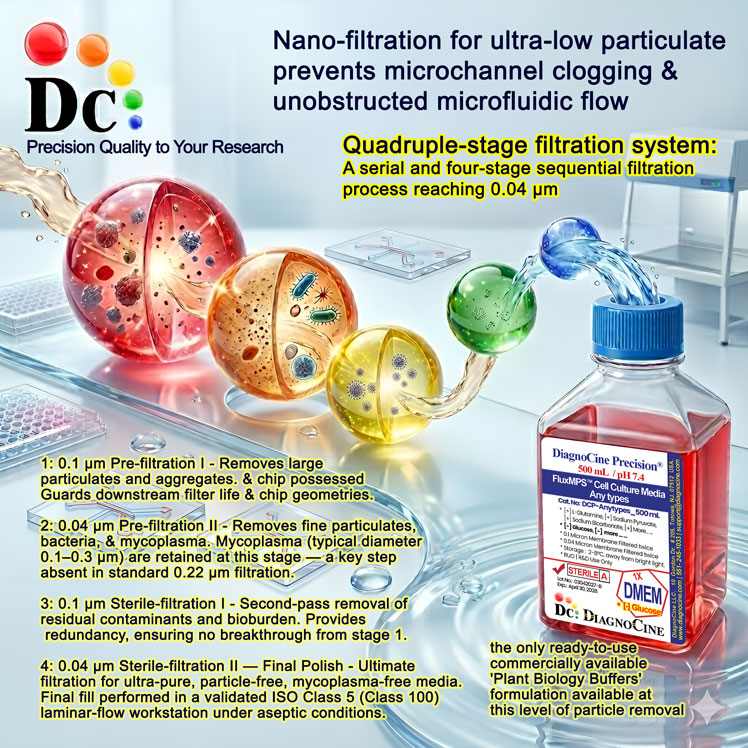
Quadruple-Stage Filtration System
Every FluxMPS™ Click's Medium (EHAA) variant passes through the same four-stage architecture before reaching your chip.
-
01
Pre-Filtration Stage 1 0.1 µm
Initial coarse particulate removal.
-
02
Pre-Filtration Stage 2 0.1 µm
Secondary particulate and aggregate reduction.
-
03
Sterile Filtration Stage 1 0.04 µm
Fine sterile filtration below standard 0.22 micron practice.
-
04
Sterile Filtration Stage 2 0.04 µm
Final polish for microfluidic-grade clarity.
Engineered for Flow, Not Just Growth
Every component is optimized for consistent, laminar flow performance across complex micro-channel geometries, capillary-bed and vascular simulations, and long-term automated perfusion studies running continuously for weeks.
Frequently Asked Questions
Verified Bibliography
- Click, R.E., Benck, L. & Alter, B.J. (1972). Enhancement of antibody synthesis in vitro by mercaptoethanol. Cellular Immunology, 3(1), 156-160. PMID: 5061825. DOI: 10.1016/0008-8749(72)90237-7
- Click, R.E., Benck, L. & Alter, B.J. (1972). Immune responses in vitro. I. Culture conditions for antibody synthesis. Cellular Immunology, 3(2), 264-276. DOI: 10.1016/0008-8749(72)90165-7
- Click, R.E., Benck, L., Alter, B.J. & Lovchik, J.C. (1972). Immune responses in vitro. VI. Genetic control of the in vivo-in vitro discrepancies in 19S antibody synthesis. J. Exp. Med., 136(5), 1241-1257. PMID: 4563149. DOI: 10.1084/jem.136.5.1241
- Mishell, R.I. & Dutton, R.W. (1967). Immunization of dissociated spleen cell cultures from normal mice. J. Exp. Med., 126(3), 423-442. PMID: 6034749. PMCID: PMC2138377. DOI: 10.1084/jem.126.3.423
- Shiigi, S.M. & Mishell, R.I. (1975). Sera and the in vitro induction of immune responses. I. Bacterial contamination and the generation of good fetal bovine sera. The Journal of Immunology, 115(3), 741-744.
- Eagle, H. (1959). Amino Acid Metabolism in Mammalian Cell Cultures. Science, 130(3373), 432-437. PMID: 13658943
FluxMPS™ — Precision Cell Culture Media for Microphysiological Systems
Built for the architecture of the future. Not the flask of the past.
Traditional cell culture media were formulated for static well plates and flasks — environments that tolerate impurities, precipitates, and particle loads that would immediately compromise a microfluidic system. FluxMPS™ was designed from the ground up for Organ-on-Chip (OoC), Tissue-on-Chip (ToC), and Lab-on-Chip (LoC) platforms, where the medium itself is part of the instrument.
Purity That Protects Your Platform
FluxMPS™ is purified to 0.04 microns — finer than any ready-to-use cell culture media currently available. At this level, the microscopic particulates and protein aggregates that silently block micro-channels, disrupt laminar flow, and generate false biological signals are eliminated before the media ever reaches your chip.
The result: your platform stays operational, your data stays clean, and your biology drives the result — not your media.
Engineered for Flow, Not Just Growth
The name FluxMPS™ reflects its core design principle. Every component is optimized for consistent, laminar flow performance across:
- Complex micro-channel geometries
- Capillary-bed and vascular simulations
- Long-term automated perfusion studies running continuously for weeks
Zero-clogging performance is not a feature — it is the baseline specification.
Applications & Performance
| Application | What FluxMPS™ Delivers |
|---|---|
| Microfluidics | Stable shear stress; no channel blockage |
| Metabolic Tracing | Ultra-pure matrix with no contaminant interference |
| Long-term Perfusion | Consistent formulation stability over weeks of continuous flow |
| Organ-on-Chip | Optical clarity for real-time imaging and integrated biosensing |
Regulatory Foundation
FluxMPS™ is formulated to support FDA-recognized physiological modeling standards, providing a validated, reproducible media foundation for drug discovery, toxicology screening, and translational research. When your downstream data needs to stand up to regulatory scrutiny, your upstream media cannot be an afterthought.
The Bottom Line
Microfluidic platforms are precision instruments. They require precision inputs.
FluxMPS™ is the only ready-to-use cell culture medium engineered specifically to meet that standard — protecting your chip, your cells, and your science.