- Home
- FluxMPS™ Click’s Medium (EHAA) Eagle Hanks’ Amino Acids w/o L-Glutamine, Sodium Bicarbonate, Mercaptoethanol, 1X Liquid Cell Culture
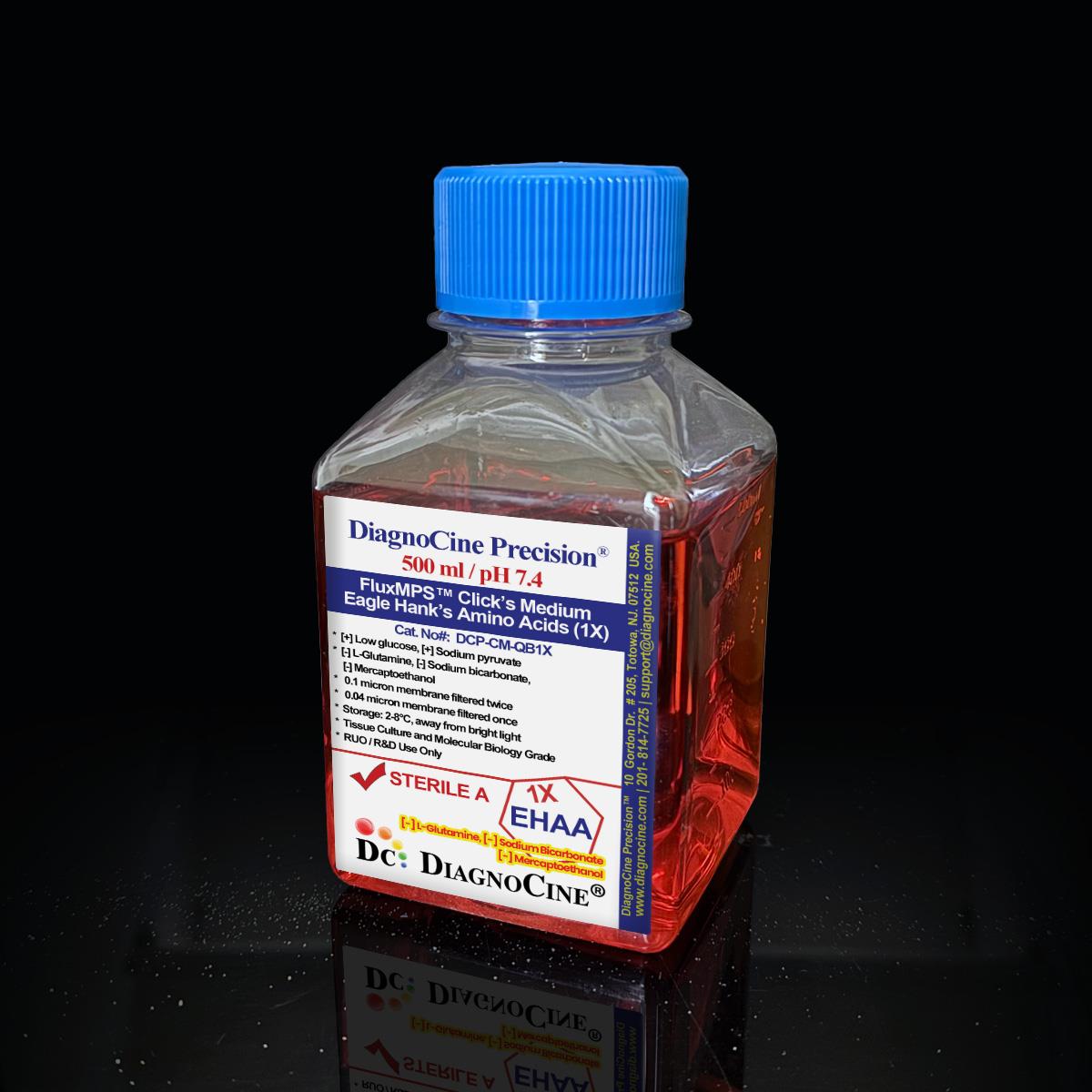
FluxMPS™ Click’s Medium (EHAA) Eagle Hanks’ Amino Acids w/o L-Glutamine, Sodium Bicarbonate, Mercaptoethanol, 1X Liquid Cell Culture
FluxMPS™ Click’s Medium (EHAA) Eagle Hanks’ Amino Acids w/o L-Glutamine, Sodium Bicarbonate, Mercaptoethanol
FluxMPS™ Click’s Medium (EHAA) is a Microfluidics Suitable, quadruple-stage ultra-filtered (0.1 µm ×2 + 0.04 µm ×2) 1X liquid Eagle Hanks’ Amino Acids formulation engineered for microphysiological systems (MPS), organ-on-a-chip (OoC), and microfluidic research. A quadruple-stage train (0.1 µm ×2 + 0.04 µm ×2) reaches a 0.04 µm final cut-off, five times finer than the 0.22 µm membranes used for conventional sterile filtration.
- Formulated as Eagle Hanks’ Amino Acids (EHAA) Click’s Medium, without L-Glutamine, Sodium Bicarbonate, or Mercaptoethanol for full researcher-controlled supplementation
- Low glucose (1.0 g/L) plus 275 mg/L Sodium Pyruvate and four nucleic acid precursors (Adenosine, Cytosine, Guanosine, Uridine) support immune-cell viability
- Hanks’ balanced salt buffering system: no CO2 incubator required; add sodium bicarbonate only if a CO2 atmosphere is used
- Quadruple-stage filtration (0.1 µm ×2 + 0.04 µm ×2) to a 0.04 µm final cut-off — Microfluidics Suitable
- Endotoxin release specification < 0.05 EU/mL (LAL, USP <85>), controlled per manufacturing batch
- Manufactured under an ISO 13485:2016 quality management system; final QC and packaging at Diagnocine, Totowa, NJ, USA
- Prepared with Ultrapure Type 1 water (18.2 MΩ·cm) for trace-metal and organic-carbon control
- Custom pH, glucose, salts, HEPES, and formulation modifications available on request
- Glucose1000.000 mg/L (Low Glucose, 1.0 g/L)
- L-GlutamineNot added — supplement per protocol
- Sodium Pyruvate275.000 mg/L
- pH (1X)7.4 USP <791>
- Osmolality320–360 mOsm/kg H2O USP <785>
- Endotoxin< 0.05 EU/mL USP <85>
- FiltrationQuadruple-stage 0.1µm×2 + 0.04µm×2
- Storage2–8°C, protected from light
- Shelf Life12 months from date of manufacture, unopened
- ShippingCold pack
Engineered where standard media fails
Conventional 0.22 µm-filtered cell culture media can harbour mycoplasma (0.2–0.3 µm), subvisible particulates, and residual endotoxin that accumulate inside microfluidic channels as narrow as 10 µm — corrupting cytokine measurements, blocking microvalves, and generating false-positive biosensor signals. For immune-cell studies in MPS and OoC platforms, where mouse spleen cells, primary lymphocytes, or iPSC-derived immune models must respond authentically to defined stimuli, medium purity matters. FluxMPS™ is engineered to address these failure modes in a single formulation.[1,2]
Microchannel-safe purity
0.04 µm final-stage filtration targets subvisible particulates below USP <788> Method 1 limits, reducing the risk of accumulation and flow disruption inside microfluidic architectures.[3]
Total metabolic control
Omission of L-Glutamine, Sodium Bicarbonate, and Mercaptoethanol allows precise user-defined supplementation for Warburg-effect studies, redox manipulation, or immune-metabolic phenotyping.
Ultrapure-grade water
Prepared using Ultrapure Type 1 water (18.2 MΩ·cm) for trace-metal and organic-carbon control, supporting reproducible chip-based immunology. Endotoxin and osmolality are independently verified per lot.[4]
Low background for imaging
Reduced particulate baseline supports confocal microscopy, TEER measurements, and biosensor readouts in chip-based immune assays with less particulate-associated background than conventional 0.22 µm media.
Rich, stable nutrient profile
Elevated essential and non-essential amino acids, four nucleic acid precursors (Adenosine, Cytosine, Guanosine, Uridine), and Sodium Pyruvate provide a robust nutrient matrix for immune-cell viability in stationary and perfusion cultures.
Customization on demand
pH, glucose concentration, Hanks’ salt balance, HEPES buffering, and additional nutrients or supplements can be modified on request. Contact support@diagnocine.com for bespoke formulations.
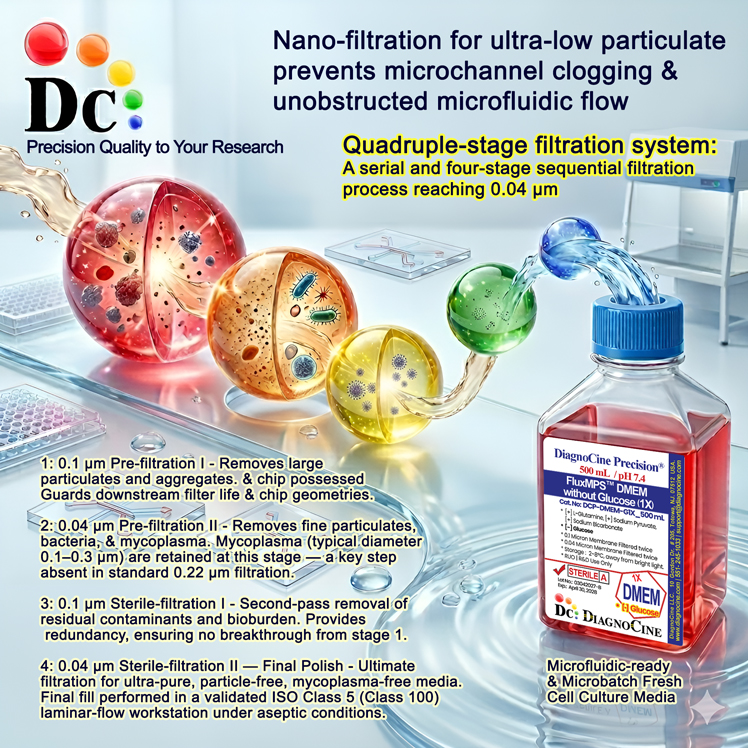
Quadruple-stage filtration system
FluxMPS™ Click’s Medium (EHAA) is processed through four sequential membrane filtration stages under ISO Class 5 (Class 100) aseptic conditions, reaching a 0.04 µm final pore size. [5]
-
1
0.1 µm Prefiltration I
Removes large particulates, aggregates, and cellular debris. Protects the first 0.04 µm final-filter cartridge from rapid fouling.
-
2
0.04 µm Final filtration I
First 0.04 µm pass; retains sub-micron particulates and provides mycoplasma-retentive filtration ahead of the second pair.
-
3
0.1 µm Prefiltration II
Second dedicated prefilter, protecting the second 0.04 µm final-filter cartridge under ISO Class 5 conditions.
-
4
0.04 µm Final filtration II — Polish
Ultimate polishing filter and aseptic fill under ISO Class 5 (Class 100) laminar-flow conditions, completing the microchannel-safe purity architecture.
Performance vs. conventional media
All lots also pass 14-day USP <71> sterility testing before release.
© Diagnocine® — DCP-CM-QB1X
Where FluxMPS™ Click’s Medium (EHAA) performs
Originally developed by Robert Click to study the in vitro immune response of mouse spleen cells using heterologous red blood cells (RBCs), Click’s Medium (EHAA) has evolved into a versatile platform for immune-cell biology, metabolic research, and microphysiological systems. The FluxMPS™ ultra-filtered formulation extends its utility to microfluidic organ-on-a-chip platforms.[1,6]
Automated Bioreactors & Robotics
For automated bioreactor platforms and robotic liquid-handling systems where media contacts precision valves, sensors, and tubing over extended perfusion runs, an optional 0.01 µm (10 nm) MPS Grade variant of FluxMPS™ Click’s Medium (EHAA) is available on inquiry.
- Total Particulate Exclusion: 0.01 µm filtration removes nanoparticulates that pass 0.04 µm membranes, protecting optical sensors and flow sensors from signal drift.
- Valve & Sensor Protection: Reduces micro-valve fouling and micro-electrode contamination risk in long-duration perfusion experiments.
- Extended Perfusion Stability: Supports media quality across multi-day automated perfusion cycles.
Inquiry Required: The 0.01 µm MPS Grade variant is produced in micro-batches on request. Contact support@diagnocine.com to discuss your automation platform requirements and lead time.
Micro Physiological System (MPS) & Chip
Ultra-filtered, microchannel-safe media for organ-on-a-chip, tissue-on-a-chip, and body-on-a-chip immune-tissue models at 0.04 µm Microfluidics Suitable purity.
In Vitro Immune Response & Spleen Cell Culture
The foundational medium for mouse spleen cell immunisation with heterologous RBCs under stationary culture conditions without daily feeding, now in Microfluidics Suitable purity for chip-based immunology.[1]
iPSC-Derived Immune Models
Supports iPSC-derived macrophages, dendritic cells, and other immune lineages in chip-based disease models requiring metabolically defined, mercaptoethanol-free base media.
Metabolic Flux & Immune Metabolism
Absence of L-Glutamine and Mercaptoethanol enables ¹³C-isotope tracing and NMR metabolomics of immune-cell energetics with full substrate-supplementation control. Not compatible with Agilent Seahorse XF assays, which require bicarbonate-free, phenol red-free medium.
Endothelial & Primary Immune Cells
Suitable as a base medium for primary lymphocytes, HUVECs co-cultured with immune cells, and multi-cell-type vasculature-on-chip models requiring minimal-interference base media.
Microscopy & Optical Sensing
Low-particulate, phenol-red-containing formulation suited to phase-contrast and confocal imaging of immune-cell morphology, TEER monitoring, and biosensor-based immune activation assays on chip.[7]
Analytical release specifications
Every batch of FluxMPS™ Click’s Medium (EHAA) is analytically characterised and released against the specifications below before shipping. Available pack sizes: 500 mL, 1000 mL. Certificate of Analysis (CoA) available on request at support@diagnocine.com.
| Parameter | Specification |
|---|---|
| Formulation | 1X liquid; [+] Phenol Red, [+] Calcium, [+] Magnesium, [+] Low Glucose (1.0 g/L), [+] Sodium Pyruvate; [−] L-Glutamine, [−] Sodium Bicarbonate, [−] Mercaptoethanol |
| Appearance | Orange-colored, clear solution |
| pH USP <791> | 7.4 |
| Osmolality USP <785> | 320–360 mOsm/kg H2O |
| Glucose | 1000.000 mg/L (1.0 g/L, low glucose) |
| L-Glutamine | Not added — supplement per protocol |
| Sodium Pyruvate | 275.000 mg/L |
| Phenol Red | 11.000 mg/L (Phenol red sodium salt) |
| Parameter | Specification |
|---|---|
| Endotoxin USP <85> BET | < 0.05 EU/mL (LAL) — batch release specification, see Manufacturing & Compliance |
| Sterility USP <71> | No growth after 14 days incubation; filtered 0.1 µm×2 + 0.04 µm×2 |
| Mycoplasma | 0.1 µm mycoplasma-retentive filtration (not tested per lot) |
| Particulate ≥10 µm USP <788> Method 1 | ≤6,000 particles/mL |
| Particulate ≥25 µm USP <788> Method 1 | ≤600 particles/mL |
| Water purity | Ultrapure Type 1, 18.2 MΩ·cm |
| Manufacturing standard ISO 13485 | ISO 13485:2016 QMS; 21 CFR Part 820 (QMSR) aligned |
| Fill environment | ISO Class 5 (Class 100) laminar-flow aseptic fill |
| Parameter | Specification |
|---|---|
| Storage temperature | 2–8°C, away from bright light; do not freeze |
| Freeze-thaw cycles | Not recommended; do not freeze |
| Shelf life | 12 months from date of manufacture, unopened |
| Shipping condition | Cold pack |
| CO2 requirement | CO2 incubator not required (Hanks’ balanced salt buffer); add sodium bicarbonate if a CO2 atmosphere is used |
| Pack sizes | 500 mL, 1000 mL |
| Parameter | Specification |
|---|---|
| Raw material grade | Cell-culture/reagent grade or higher; USP/NF where applicable |
| Traceability | Lot-specific CoA; CAS numbers on file for all components |
| Manufacturing QMS ISO 13485 | ISO 13485:2016 certified supplier facilities; Diagnocine R&D QC testing centre |
| UNSPSC | 41116155 — Molecular biology and cell culture growth media (UNv260801) |
| Regulatory alignment | 21 CFR Part 820 (QMSR) aligned |
| Production method | Precision micro-batch; all packaging, QA & testing at Diagnocine, Totowa, NJ, USA |
| Intended use | For Research Use Only (RUO). Not for clinical, diagnostic, or therapeutic use in humans. |
Full composition (mg/L)
The complete formulation is reproduced below: 41 individually verified components across four categories — Inorganic Salts, Amino Acids, Vitamins, and Others. Nucleic acid precursors (Adenosine, Cytosine, Guanosine, Uridine) distinguish Click’s Medium (EHAA) from standard Hanks’ salt media. All mg/L values are as-formulated at 1X concentration. L-Glutamine, Sodium Bicarbonate, and Mercaptoethanol are omitted by design; each is supplied as a separate supplement per researcher protocol.
| Component | CAS Number | mg/L |
|---|---|---|
| INORGANIC SALTS | ||
| Calcium chloride dihydrate | 10035-04-8 | 245.530 |
| Disodium hydrogen phosphate | 7558-79-4 | 47.900 |
| Magnesium chloride anhydrous | 7786-30-3 | 164.900 |
| Potassium chloride | 7447-40-7 | 400.000 |
| Potassium dihydrogen phosphate | 7778-77-0 | 60.000 |
| Sodium chloride | 7647-14-5 | 8000.000 |
| Component | CAS Number | mg/L |
|---|---|---|
| AMINO ACIDS | ||
| Glycine | 56-40-6 | 30.000 |
| L-Alanine | 56-41-7 | 35.600 |
| L-Arginine hydrochloride | 1119-34-2 | 317.500 |
| L-Asparagine anhydrous | 70-47-3 | 52.800 |
| L-Aspartic acid | 56-84-8 | 53.200 |
| L-Cystine dihydrochloride | 30925-07-6 | 78.200 |
| L-Glutamic acid | 56-86-0 | 58.800 |
| L-Histidine hydrochloride monohydrate | 5934-29-2 | 104.700 |
| L-Isoleucine | 73-32-5 | 130.000 |
| L-Leucine | 61-90-5 | 130.000 |
| L-Lysine hydrochloride | 657-27-2 | 181.200 |
| L-Methionine | 63-68-3 | 37.500 |
| L-Phenylalanine | 63-91-2 | 80.000 |
| L-Proline | 147-85-3 | 46.000 |
| L-Serine | 56-45-1 | 42.000 |
| L-Threonine | 72-19-5 | 120.000 |
| L-Tryptophan | 73-22-3 | 25.000 |
| L-Tyrosine disodium salt dihydrate | 69847-45-6 | 118.900 |
| L-Valine | 72-18-4 | 115.000 |
| Component | CAS Number | mg/L |
|---|---|---|
| VITAMINS | ||
| Calcium pantothenate | 137-08-6 | 2.000 |
| Choline chloride | 67-48-1 | 2.000 |
| Folic acid | 59-30-3 | 2.000 |
| Niacinamide | 98-92-0 | 2.000 |
| Pyridoxal hydrochloride | 65-22-5 | 2.000 |
| Riboflavin | 83-88-5 | 0.200 |
| Thiamine hydrochloride | 67-03-8 | 2.000 |
| OTHERS | ||
| Adenosine | 58-61-7 | 25.000 |
| Cytosine | 71-30-7 | 25.000 |
| Glucose | 50-99-7 | 1000.000 |
| Guanosine | 118-00-3 | 25.000 |
| Magnesium sulfate anhydrous | 7487-88-9 | 97.720 |
| myo-Inositol | 87-89-8 | 4.000 |
| Phenol red sodium salt | 34487-61-1 | 11.000 |
| Sodium pyruvate | 113-24-6 | 275.000 |
| Uridine | 58-96-8 | 25.000 |
Manufacturing & compliance framework
FluxMPS™ Click’s Medium (EHAA) is produced under ISO 13485:2016 certified supplier facilities. All final packaging, quality assurance, and testing are performed at the Diagnocine R&D and Quality Testing Center. All customization and assembly is accomplished at Diagnocine Precision in Totowa, New Jersey, USA.
ISO 13485:2016 QMS
Full Quality Management System certification covering design, production, and release of cell culture media. All processes are documented, audited, and 21 CFR Part 820 (QMSR) aligned.
Ultrapure Type 1 Water
All formulations prepared using 18.2 MΩ·cm resistivity Ultrapure Type 1 water for trace-metal and organic-carbon control. Endotoxin and osmolality are verified per batch.
ISO Class 5 Fill & Finish
Aseptic filling performed under ISO Class 5 (Class 100) laminar-flow conditions following the four-stage quadruple filtration sequence.
Micro-Batch Precision
Produced in tightly controlled micro-batches for lot-to-lot composition consistency. Each batch is tracked by a unique lot number with raw-material traceability.
- Endotoxin — LAL assay, USP <85> Bacterial Endotoxins Test; assay sensitivity 0.005 EU/mL; release specification < 0.05 EU/mL
- pH, osmolality, conductivity, appearance and clarity
- Sterility
Endotoxin — USP <85> BET
LAL assay confirms endotoxin below the < 0.05 EU/mL release specification per batch. Testing is performed prior to release.
Particulate — USP <788> Method 1
Light obscuration particle count confirms ≤6,000 particles/mL at ≥10 µm and ≤600 particles/mL at ≥25 µm, consistent with the 0.04 µm final filtration cut-off.
Osmolality — USP <785>
Freezing-point depression osmometry confirms 320–360 mOsm/kg H2O per lot.
Documentation / CoA
Lot-specific Certificate of Analysis covering appearance, pH, osmolality, endotoxin, sterility, and particulate results. Provided on request at support@diagnocine.com.
How DCP-CM-QB1X compares
FluxMPS™ Click’s Medium (EHAA) is processed to a 0.04 µm final filtration cut-off through a full quadruple-stage filtration architecture, verified by USP <788> particulate analysis and released under ISO 13485:2016 QMS testing.
| Parameter | DCP-CM-QB1X (FluxMPS™) | Conventional Click’s EHAA (0.22 µm) | Standard MEM / HMEM-based (0.22 µm) |
|---|---|---|---|
| Grade | Microfluidics Suitable | Not specified | Not specified |
| Formulation | [+] Phenol Red, [+] Calcium, [+] Magnesium, [+] Glucose, [+] Sodium Pyruvate; [−] L-Glutamine, [−] Sodium Bicarbonate, [−] Mercaptoethanol | Variable by supplier | Variable by supplier |
| Nucleic acid precursors (EHAA-specific) | check_circle Adenosine, Cytosine, Guanosine, Uridine (25 mg/L each) | check_circle Present at standard level | cancel Not present in standard MEM |
| Final filtration pore size | 0.04 µm (40 nm) | 0.22 µm | 0.22 µm |
| Number of filtration stages | 4 stages (Quadruple) | 1 stage | 1 stage |
| Mycoplasma barrier filtration | check_circle 0.1 µm mycoplasma-retentive, two stages | cancel 0.22 µm only (mycoplasma not reliably retained) | cancel 0.22 µm only |
| Endotoxin (release specification) | FluxMPS™ — < 0.05 EU/mL | Corning classical liquid media — < 0.25 EU/mL Sigma-Aldrich DMEM complete medium — ≤ 2 EU/mL Gibco classical DMEM — Not specified (recorded per lot) |
|
| USP particulate compliance | check_circle USP <788> Method 1 per lot | cancel Typically not tested | cancel Typically not tested |
| Water quality | Ultrapure Type 1 (18.2 MΩ·cm) | Deionised/purified water | Deionised/purified water |
| Manufacturing QMS | ISO 13485:2016 certified | Variable | Variable |
| Microfluidic channel compatibility | check_circle Microchannel-safe at <10 µm channel width | cancel Particle accumulation risk in channels <50 µm | cancel Particle accumulation risk |
| Custom formulation | check_circle On request (pH, salts, glucose, supplements) | cancel Not available | cancel Not available |
Comparison figures from published supplier specifications, accessed 2026-09-02. Suppliers that publish no numeric endotoxin specification are shown as "Not specified".
Frequently asked questions
Common questions about FluxMPS™ Click’s Medium (EHAA) (DCP-CM-QB1X), its filtration system, supplementation requirements, and quality documentation.
Supporting literature
Curated peer-reviewed publications relevant to Click’s Medium (EHAA), immune-cell biology, organ-on-a-chip research, and microphysiological system media requirements. In-text citations ([n]) throughout this page correspond to the entries below.
This product has been utilized by researchers at MD Anderson Cancer Center in scientific and laboratory applications.
- Click RE, Benck L, Alter BJ. Immune responses in vitro. I. Culture conditions for antibody synthesis in vitro by normal mouse spleen cells. Cell Immunol. 1972;3(2):264–276. doi:10.1016/0008-8749(72)90071-0
- Huh D, Matthews BD, Mammoto A, Montoya-Zavala M, Hsin HY, Ingber DE. Reconstituting organ-level lung functions on a chip. Science. 2010;328(5986):1662–1668. doi:10.1126/science.1188302
- Ingber DE. Reverse engineering human pathophysiology with organs-on-chips. Cell. 2016;164(6):1105–1109. doi:10.1016/j.cell.2016.06.005
- Bhattacharya A, Bhattacharya S. Mycoplasma contamination of cell cultures: Incidence, implications, and management. Indian J Med Microbiol. 2021;39(4):493–500. doi:10.1016/j.ijmmb.2021.07.007
- United States Pharmacopeia. USP <788> Particulate Matter in Injections. USP-NF. Rockville, MD: USP; 2023. doi:10.31003/USPNF_M74950
- Sung JH, Esch MB, Prot JM, et al. Microfabricated mammalian organ systems and their integration into models of whole animals and humans. Lab Chip. 2013;13(7):1201–1212. doi:10.1039/c3lc51138h
- Rothbauer M, Zirath H, Ertl P. Recent advances in microfluidic technologies for cell-to-cell interaction studies. Lab Chip. 2018;18(2):249–270. doi:10.1039/c7lc00815e
- Luni C, Giulitti S, Serena E, Ferrari L, Zambon A, Gagliano O, et al. High-efficiency cellular reprogramming with microfluidics. Nat Methods. 2016;13(5):446–452. doi:10.1038/nmeth.3832
- van Midwoud PM, Janse A, Merema MT, Groothuis GM, Verpoorte E. Comparison of biocompatibility and adsorption properties of different plastics for advanced microfluidic cell and tissue culture models. Anal Chem. 2012;84(9):3938–3944. doi:10.1021/ac300771z
- Pampaloni F, Reynaud EG, Stelzer EH. The third dimension bridges the gap between cell culture and live tissue. Nat Rev Mol Cell Biol. 2007;8(10):839–845. doi:10.1038/nrm2236