

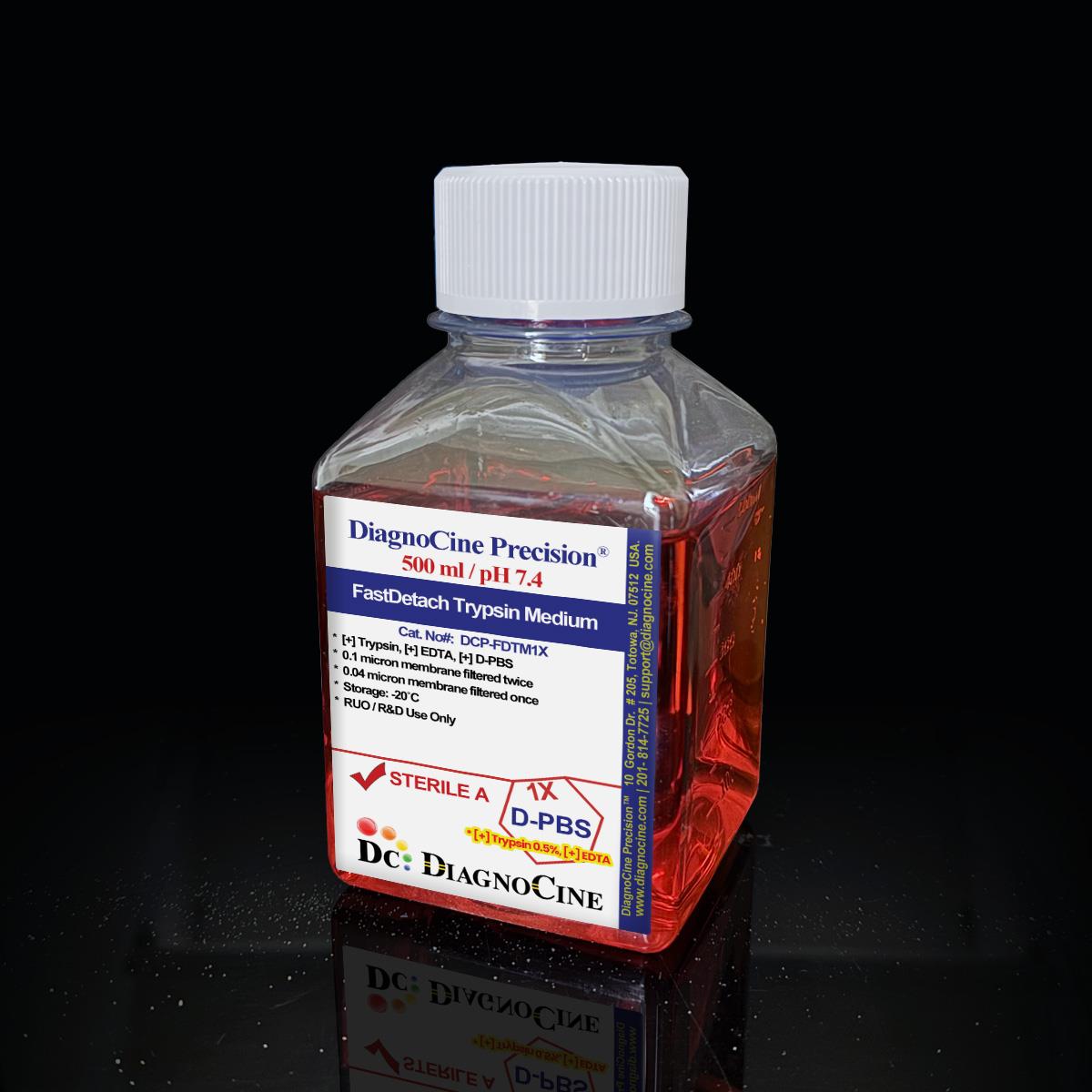
FastDetach Trypsin Medium (1X)
FluxMPS™ FastDetach Trypsin Medium (1X)
FastDetach Trypsin Medium (1X) is a Microfluidics Suitable, ready-to-use trypsin-EDTA dissociation medium formulated in Dulbecco’s Phosphate-Buffered Saline (DPBS) for rapid, controlled detachment of strongly adherent cells. Every lot is ultra-filtered through Diagnocine’s Quadruple-stage filtration system (0.1 µm ×2 + 0.04 µm ×2) to a 0.04 µm final cut-off, built to protect microfluidic channels, valves and sensors in organ-on-a-chip (OoC) and microphysiological system (MPS) passaging workflows.
- Quadruple-stage ultra-filtered (0.1 µm ×2 + 0.04 µm ×2) formulation, filtered and finished in a controlled sterile environment
- High-concentration trypsin (0.5%) combined with EDTA for rapid, reliable detachment of strongly adherent cells, transformed fibroblasts, and certain tumor cell lines
- Formulated in DPBS to provide an isotonic environment and help maintain cell viability during the detachment process
- Typical dissociation time of approximately 5 minutes at 37°C, compared to up to 60 minutes for collagenase-based dissociation methods
- QC-verified: no detectable DNase activity or RNase activity after 18-hour incubation at room temperature
- Ready-to-use liquid format at pH 7.4; supplied in 100 mL and 500 mL sizes
- Customizable formulation — D-glucose (dextrose) addition available on request
- Manufactured under an ISO 13485:2016 quality management system; final QC, packaging and customization performed at Diagnocine, Totowa, NJ, USA
- Trypsin0.5%
- EDTAPresent (chelating agent)
- VehicleDPBS (Dulbecco’s Phosphate-Buffered Saline)
- AppearanceRed-Pink liquid
- pH (USP <791>)7.4
- Filtration0.1 µm ×2 + 0.04 µm ×2 (4 stages)
- Nuclease activityDNase/RNase — None detected
- Storage-20°C, long term
- Shelf Life12 months from date of manufacture, unopened
- ShippingDry ice
Engineered where standard dissociation reagents fall short
Conventional 0.22 µm-filtered trypsin-EDTA reagents can carry sub-micron particulates and mycoplasma-sized contaminants directly into microfluidic channels, valves, and sensor surfaces — exactly where automated organ-on-a-chip (OoC) and microphysiological system (MPS) platforms are most sensitive to fouling. FastDetach Trypsin Medium (1X) is built to remove that risk at the filtration stage.[1,2]
Microchannel-safe purity
Quadruple-stage filtration to a 0.04 µm final pore size, with a dedicated 0.1 µm mycoplasma-retentive pass ahead of each polish, reduces the particulate load reaching narrow microfluidic geometries and valve seats.
Balanced, controlled dissociation chemistry
Trypsin (0.5%) and EDTA are paired so EDTA’s chelation of Ca2+ weakens cell-matrix contacts while trypsin cleaves surface proteins, enabling detachment in minutes rather than the extended incubations required by gentler enzymes such as collagenase.
Isotonic DPBS vehicle
The DPBS base is formulated to keep cells in an isotonic environment throughout the dissociation step, limiting osmotic stress while trypsin and EDTA act on the monolayer.
Microscopy-friendly monitoring
The clear liquid format supports direct visual confirmation of cell rounding and detachment under an inverted microscope, so dissociation can be stopped at the correct endpoint.
Validated nuclease-free quality
Each lot is verified free of detectable DNase and RNase activity after an 18-hour incubation at room temperature with plasmid DNA and ribosomal RNA respectively, protecting downstream nucleic acid work.
Customization on demand
Need D-glucose (dextrose) added, a different trypsin concentration, or another modification? Diagnocine can custom-formulate the trypsinization medium — contact support@diagnocine.com.
Quadruple-stage filtration system
FastDetach Trypsin Medium (1X) is filtered through two dedicated prefilter-plus-final-filter pairs — a 0.1 µm mycoplasma-retentive prefilter feeding each 0.04 µm final filter — reaching a 0.04 µm final pore size well below the 0.22 µm benchmark used for most conventional dissociation reagents.
- 1
0.1 µm Prefiltration I
Removes large particulates and protein aggregates while retaining mycoplasma-sized organisms; protects the first 0.04 µm cartridge.
- 2
0.04 µm Final filtration I
First 0.04 µm pass; retains sub-micron particulates and microaggregates that a standard 0.22 µm filter would pass.
- 3
0.1 µm Prefiltration II
Second dedicated prefilter pass, protecting the second 0.04 µm cartridge for full-train redundancy.
- 4
0.04 µm Final filtration II — Polish
Ultimate polishing filter performed in a controlled sterile environment ahead of aseptic fill and finish.
Performance vs. conventional media
Diagnocine’s Quadruple-stage train runs two full prefilter-plus-final-filter passes rather than the single 0.22 µm pass typical of standard trypsin-EDTA reagents.

© Diagnocine® — DCP-FDTM1X
Where fast, high-viability detachment matters
FastDetach Trypsin Medium (1X) is designed for cell types and culture formats that resist gentle dissociation — transformed fibroblasts, strongly adherent lines, dense multilayer cultures, and certain tumor cell lines — where speed reduces handling time without sacrificing viability.
Automated Bioreactors & Robotics
For automated cell-passaging platforms and closed bioreactor loops, Diagnocine also offers an optional 0.01 µm (10 nm) ultra nano-filtered MPS Grade variant of this formulation, intended to further protect valves, sensors and narrow-bore tubing in continuously operating systems.
- Total Particulate Exclusion — six-stage cascade down to 0.01 µm for the most particulate-sensitive automated lines
- Valve & Sensor Protection — minimizes fouling risk in long-run, unattended passaging systems
- Extended Perfusion Stability — supports continuous or semi-continuous automated dissociation workflows
Inquiry Required: The 0.01 µm MPS Grade variant of this formulation is available by request — contact support@diagnocine.com.
Microphysiological System (MPS) & Chip Reseeding
Compatible with routine cell harvesting and reseeding steps in chip-based culture workflows requiring particulate-controlled reagents.
Tumor Cell Line Dissociation
The elevated trypsin concentration is effective for certain tumor cell lines that resist gentle dissociation methods.
Transformed Fibroblasts & Robust Adherent Lines
Well-suited to cell lines with extensive extracellular matrix deposition and well-developed focal adhesions that resist standard trypsinization.
Multilayer & Highly Confluent Cultures
Effective for dissociating dense, multilayered cultures common to strongly adherent and transformed cell lines.
High-Throughput & Automated Passaging
Convenient ready-to-use formulation supports routine passaging and quick harvesting in high-throughput cell culture workflows.
Microscopy-Guided Dissociation
Clear liquid format allows direct visual confirmation under an inverted microscope so dissociation can be halted once cells round up and detach.
Recommended dissociation protocol
- Remove the spent medium from the culture vessel by aspiration.
- Wash the monolayer with a balanced salt solution without calcium and magnesium, adding it to the side of the flask opposite the cells.
- Rock the flask gently for 1–2 minutes to rinse the cell sheet, then discard the wash solution.
- Add FastDetach Trypsin Medium (1X) to the side of the flask opposite the cells, in a volume sufficient to fully cover the monolayer.
- Rock the flask to ensure the dissociation solution covers the entire cell sheet.
- Incubate at 37°C for 2–3 minutes, monitoring under an inverted microscope; gentle tapping of the flask can help detachment of resistant lines. Stop once cells round up and are in suspension.
- Add serum-containing complete medium (FBS or FCS) immediately to neutralize tryptic activity and prevent further cell damage.
- Disperse the cells into a single-cell suspension by gentle, repeated pipetting.
- Count and subculture the cells.
Full specification sheet
Every parameter below reflects Diagnocine’s manufacturing and QC records for FastDetach Trypsin Medium (1X). Pack sizes: 100 mL, 500 mL.
| Parameter | Specification |
|---|---|
| Formulation | Trypsin (0.5%) + EDTA in DPBS |
| Appearance | Red-Pink liquid |
| pH (USP <791>) USP | 7.4 |
| Trypsin concentration | 0.5% (w/v) |
| EDTA | Present (chelating agent); concentration proprietary |
| Vehicle | Dulbecco’s Phosphate-Buffered Saline (DPBS) |
| Parameter | Specification |
|---|---|
| Sterility (USP <71>) USP | Quadruple-stage filtered (0.1 µm ×2 + 0.04 µm ×2) |
| Mycoplasma | 0.1 µm mycoplasma-retentive filtration (not tested per lot) |
| DNase activity | None detected (18-hr, RT, plasmid DNA) |
| RNase activity | None detected (18-hr, RT, ribosomal RNA) |
| Manufacturing standard ISO | ISO 13485:2016 |
| Parameter | Specification |
|---|---|
| Storage temperature | -20°C, long term |
| Shelf life | 12 months from date of manufacture, unopened |
| Shipping condition | Dry ice |
| Recommended incubation | 2–5 min at 37°C during use |
| Parameter | Specification |
|---|---|
| Raw material grade | Research-grade trypsin and EDTA |
| Traceability | Final QC, packaging & customization at Diagnocine, Totowa, NJ, USA |
| Manufacturing QMS ISO | ISO 13485:2016 certified suppliers |
| UNSPSC | 41116155 — Molecular biology and cell culture growth media (UNv260801) |
| Regulatory alignment | ISO 13485:2016; Research Use Only (RUO) |
| Intended use | Research Use Only; not for clinical, diagnostic or therapeutic use |
Full composition
FastDetach Trypsin Medium (1X) is a functional dissociation reagent rather than a nutrient formulation; its documented components are listed below, grouped by function.
| Component | CAS Number | Concentration |
|---|---|---|
| Trypsin | 9002-07-7 | 0.5% (w/v) — approx. 5,000 mg/L |
| Component | CAS Number | Concentration |
|---|---|---|
| EDTA (Disodium) | 6381-92-6 | Not specified |
| Component | CAS Number | Concentration |
|---|---|---|
| Dulbecco’s Phosphate-Buffered Saline (DPBS) | Balanced salt vehicle; batch-specific composition available on request |
Manufacturing & compliance
FastDetach Trypsin Medium (1X) is manufactured, filtered, and finished under a documented quality system with per-lot verification of key safety parameters.
Sterility (USP <71>)
Achieved via Quadruple-stage filtration performed in a controlled sterile environment.
Mycoplasma control
0.1 µm mycoplasma-retentive filtration (not tested per lot); mycoplasma organisms are typically 0.2–0.3 µm.
Nuclease testing
DNase and RNase activity: None detected after 18-hour incubation at room temperature.
Documentation / CoA
A Certificate of Analysis documenting lot number, filtration record, and nuclease testing results is available on request.
- Sterility — Quadruple-stage filtration (0.1 µm ×2 + 0.04 µm ×2)
- DNase activity — None detected (18-hour incubation with plasmid DNA at room temperature)
- RNase activity — None detected (18-hour incubation with ribosomal RNA at room temperature)
- pH, appearance and clarity
How DCP-FDTM1X compares
A comparison of FastDetach Trypsin Medium (1X) against conventional and standard alternative dissociation reagents.
| Parameter | DCP-FDTM1X (FluxMPS™) | Conventional trypsin-EDTA (0.22 µm filtered) | Standard alternative (0.22 µm filtered) |
|---|---|---|---|
| Grade | Microfluidics Suitable | Not specified | Not specified |
| Trypsin concentration | 0.5% (fast detachment) | 0.25% (standard) | 0.25% (standard) |
| Final filtration pore size | 0.04 µm | 0.22 µm | 0.22 µm |
| Number of filtration stages | 4 (Quadruple-stage) | 1 | 1 |
| Mycoplasma barrier filtration | check_circle | cancel | cancel |
| Endotoxin (release specification) | FluxMPS™ — Not specified for this product | Corning classical liquid media — < 0.25 EU/mL Sigma-Aldrich DMEM complete medium — ≤ 2 EU/mL Gibco classical DMEM — Not specified (recorded per lot) |
— |
| DNase/RNase testing | check_circle Per lot | Not typically specified | Not typically specified |
| Manufacturing QMS | ISO 13485:2016 | Not specified | Not specified |
| Microfluidic / OoC compatibility | check_circle | cancel | Not specified |
| Custom formulation available | check_circle | cancel | cancel |
Comparison figures from published supplier specifications, accessed 2 September 2026. Suppliers that publish no numeric endotoxin specification are shown as "Not specified".
Frequently asked questions
Common questions about FastDetach Trypsin Medium (1X).
Supporting literature
Curated references relevant to trypsin-EDTA cell dissociation, microfluidic cell culture, and mycoplasma control in reagent manufacturing.
- Huh D, Matthews BD, Mammoto A, et al. Reconstituting organ-level lung functions on a chip. Science. 2010. doi:10.1126/science.1188302
- Bhatia SN, Ingber DE. Microfluidic organs-on-chips. Nat Biotechnol. 2014. doi:10.1038/nbt.2989
- Kirschner K, Rosen M, Neil L. Trypsinization of anchorage-dependent cells: mechanisms and viability considerations. Cytotechnology. 1990. doi:10.1007/BF00456851
- Waymouth C. To disaggregate or not to disaggregate: injury and cell disaggregation, transient or permanent. In Vitro. 1974. doi:10.1007/BF02615395
- Huang Y, Agrawal B, Sun D, et al. Microfluidics-based devices for cell dissociation and single-cell handling. Biomicrofluidics. 2011. doi:10.1063/1.3555194
- Uphoff CC, Drexler HG. Detection of mycoplasma contaminations in cell culture. Methods Mol Biol. 2011. doi:10.1007/978-1-61779-108-6_10
- Low LA, Mummery C, Berridge BR, et al. Organs-on-chips: into the next decade. Nat Rev Drug Discov. 2021. doi:10.1038/s41573-020-0079-3
- Freshney RI. Culture of Animal Cells: A Manual of Basic Technique and Specialized Applications. 7th ed. Wiley-Blackwell; 2016.
- Phelan MC. Basic techniques in mammalian cell tissue culture. Curr Protoc Cell Biol. 2007. doi:10.1002/0471143030.cb0101s36