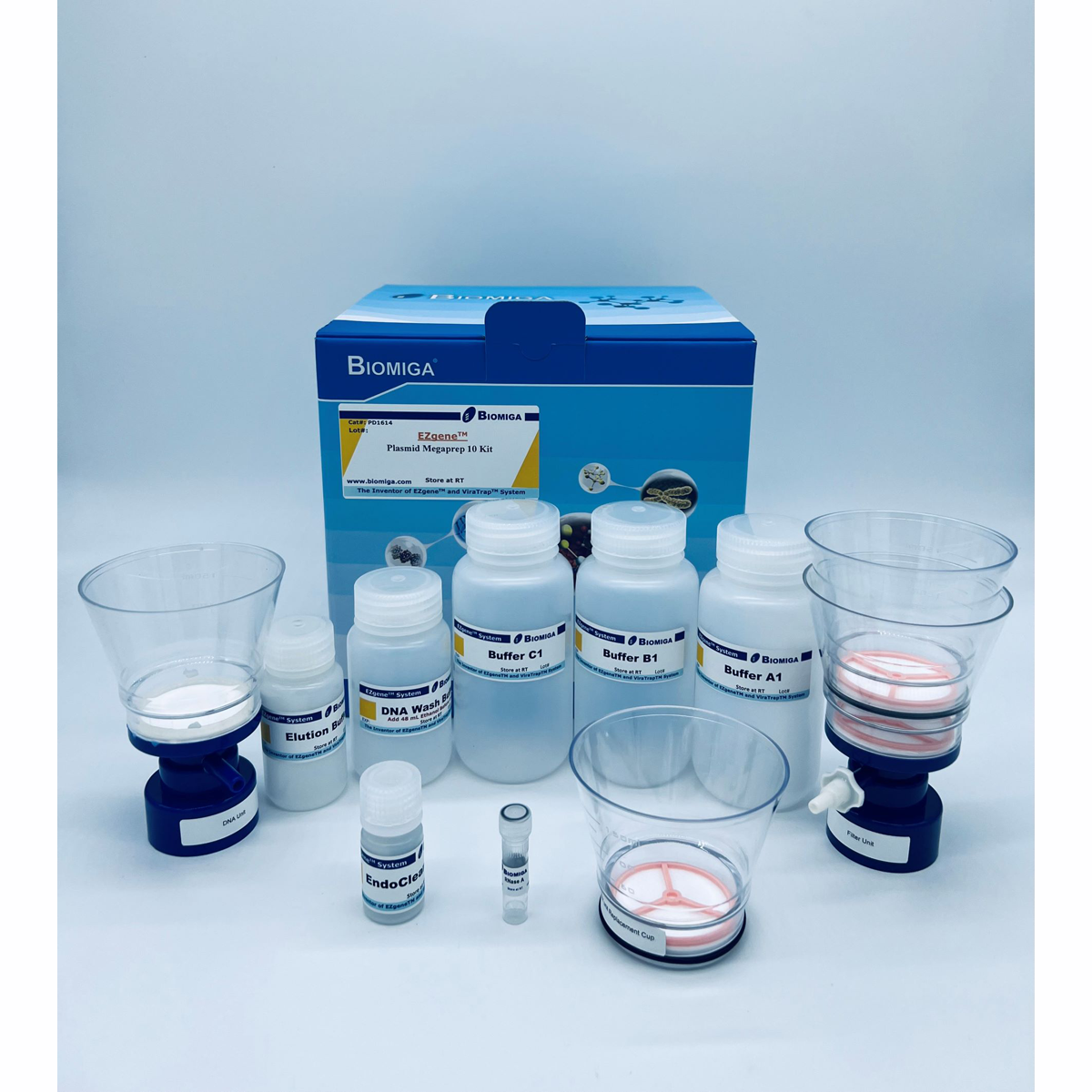
Key to the kit is our proprietary DNA binding systems that allow the high efficient binding of DNA to our ezBindTM matrix while proteins and other contaminates are removed under certain optimal conditions. Nucleic acids are easily eluted with sterile water or TE buffer. Unlike all other rivals, Biomiga’s patented plasmid purification kit has no guanidine salt in the buffer, the purified DNA is guanidine/ion exchange resin residues free which enable the high performance of downstream applications such as transfection, restriction mapping, library screening, and sequencing.
Storage and Stability
Buffer A1 should be stored at 4°C once RNase A is added. All other materials can be stored at room temperature. The Guaranteed shelf life is 18 months from the date of purchase.
Kit Contents
Catalog#
BMG-PD1614-00
BMG-PD1614-01
BMG-PD1614-02
Buffer A1
110 mL
210 mL
1100 mL
Buffer B1
115 mL
210 mL
1100 mL
Buffer C1
120 mL
230 mL
1200 mL
Elution Buffer
15 mL
30 mL
150 mL
DNA Wash Buffer
50 mL
2 x 50 mL
200 mL
DNA Unit
1
2
10
Filter Unit
1
2
10
Filter unit Replacement Cup
2
4
20
RNase A
100 µL
700 µL
3.5 mL
EndocClean Buffer
2 mL
5 mL
20 mL
Important:
RNase A: Spin down RNase A vial briefly. Add the RNase A solution to buffer A1 and mix well before use.
Buffer B1 precipitates below room temperature, it is critical to warm up the buffer at 37°C to dissolve the precipitates before use.
Add 800 mL (PD1614-02) and 200 mL (PD1614-01 and 1614-00) 100% ethanol to each bottle before use.
Keep the cap tightly closed for Buffer B1 after use.
Materials required but not supplied
100% ethanol.
Vacuum system.
250 mL or 500 mL bottle (Corning# 430282) or 1,000 mL bottle (#430518) or equivalent.
50 mL conical tubes.
Important Notes
Plasmid Copy Number: The yield of plasmid DNA depends on the origin of the replication and the size of the plasmid. The protocols are optimized for high copy number plasmid purification. For low copy number plasmids, both the culture volume and the buffer volume need to be scaled up 3 to 5 times. Please contact our customer service for further information and reference the table below for the commonly used plasmids
Plasmid
Origin
Copy Numbers
Expected Yield (µg /200 mL)
pSC101
pSC101
5
10-15
pACYC
P15A
10-12
20-25
pSuperCos
pMB1
10-20
20-40
pBR322
pMB1
15-20
30-40
pGEMR
Muted pMB1
300-400
400-500
pBluescriptR
ColE1
300-500
400-500
pUC
Muted pMB1
500-700
600-1200
Host Strains: The strains used for propagating plasmid have significant influence on yield. Host strains such as Top 10, DH5a, and C600 yield high-quality plasmid DNA. endA+ strains such as JM101, JM109, JM110, HB101, TG1 and their derivatives, normally have low plasmid yield due to either endogenous endonucleases or high carbohydrates released during lysis. We recommend transform plasmid to an endA- strain if the yield is not satisfactory.
Culture Medium: This procedure is designed for isolating plasmid grown in standard LB medium (Luria Bertani) to density of OD600 2.0 to 3.0. If rich medium such as TB or 2xYT are used, make sure the cell density doesn’t exceed 3.0 (OD600). A high ratio of cell density over lysis buffers result in low DNA yield and purity. For over amount of cell numbers, either reduce the biomass or scale up the volumes of Buffer A1, B1 and C1.