

DynaMarker, RNA Low II Easy Load
DynaMarker, RNA Low II Easy Load
Cat. No. FNK-DM157
Size 125 μl, about 25 loadings
Storage -80°C Repeated freeze/thaw cycles should be avoided.
Range 20-500 base of RNA
Loading : 5 μl is recommended for loading to a well (0.1 μg of each RNA / 5 μl )
Description
This product is research use only
DynaMarker RNA Low II consists of seven single-stranded RNAs(20-500bases). It's supplied in a ready-to-use mixture of loading dye (containing formamide EDTA sodium salt, bromphenol blue).
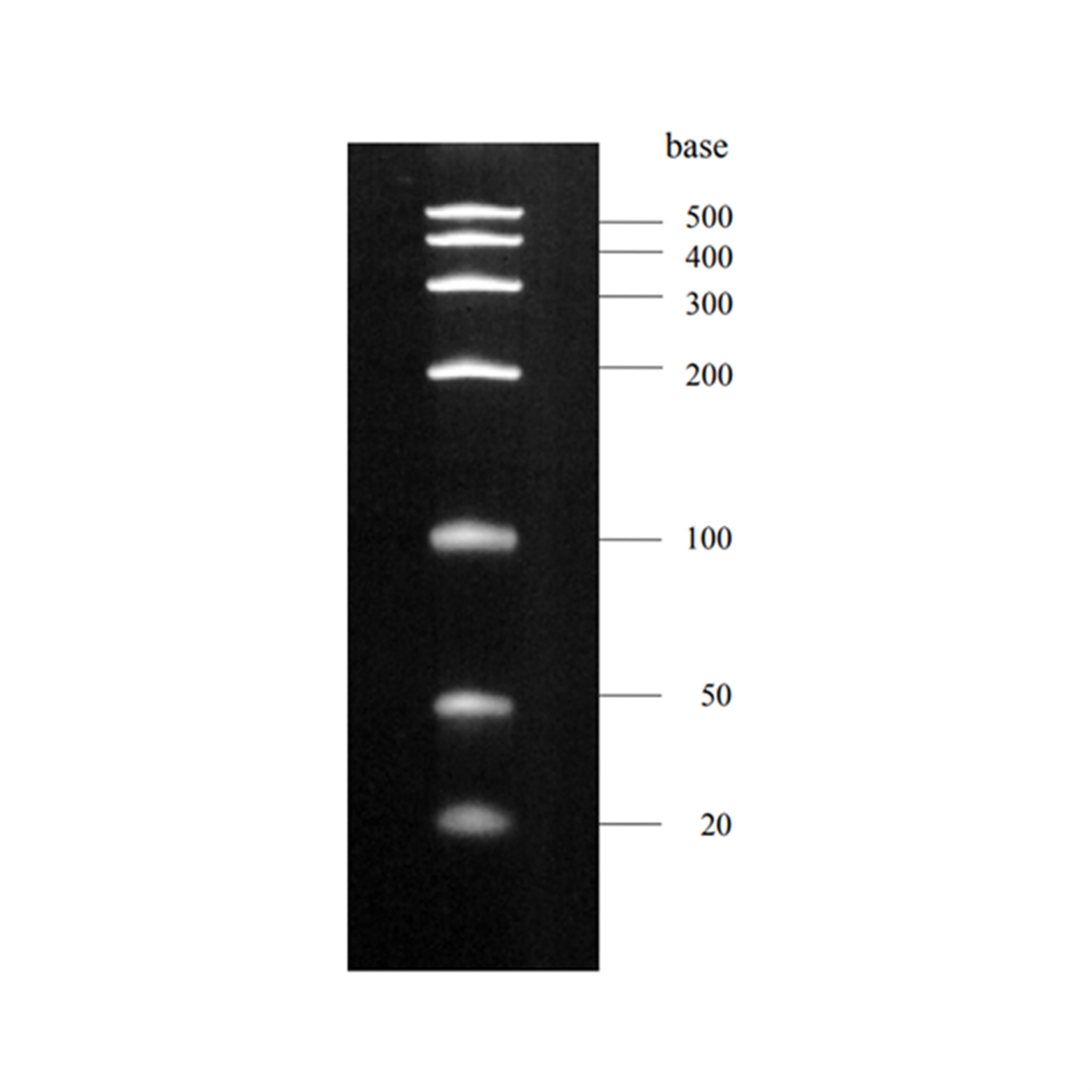
The DynaMarker RNA Low II Easy Load is supplied in a ready-to-use mixture of loading dye (containing formamide, EDTA sodium salt, bromphenol blue) and RNAs. It is prepared for denaturing polyacrylamide gel electrophoresis but not agarose gel elctrophoresis. The DynaMarker RNA Low II Easy Load has seven single-stranded RNAs, 20, 50, 100, 200, 300, 400 and 500 bases. The 20-base and 50-base RNA are synthesized by chemically (not phosphorylated), others are synthesized by in vitro transcription. In 5 μl of the DynaMarker RNA Low II, each RNA amount is approximately 100 ng. It is useful for estimating RNA amount approximately. The DynaMarker RNA Low II Easy Load can be visualized by UV light after ethidium bromide staining.

Electrophoresis profile of DynaMarker RNA Low II Easy Load (5 μl) on 5 % of acrylamide, 8 M urea gel with 1 × TBE buffer as running buffer
Ready-to-load DynaMarker® RNA Low II for denaturing polyacrylamide gel electrophoresis.
Ready-to-load RNA marker consisted of seven discrete fragments for easy recognition of RNA sizes: 20, 50, 100, 200, 300, 400, 500 base.
The concentration of each RNA in the marker is approximately 0.1μg/ 5μl (2.5-5 μl is recommended for loading to a well).
RNA Loading Buffer PA is provided for easy sample preparation to run RNA samples on a denaturing polyacrylamide gel electrophoresis.
Quality Control
After 18 hr incubation of the DynaMarker RNA Low II Easy Load at 37 oC, no visible degradation of the marker is observed in 5 % polyacrylamide / 8M urea gel electrophoresis.
Supplied product
RNA Loading buffer PA
RNA Loading buffer PA is manufactured for denaturing polyacrylamide gel electrophoresis but not agarose gel elctrophoresis. The loading buffer has a composition of 80 % formamide, 10 mM EDTA sodium salt (pH8.0), 0.025 % bromphenol blue. Store RNA Loading buffer PA at -80 °C. Repeated freeze/thaw cycles should be avoided. It is 1 × to 2 × solution. Use more than one volume of RNA solution
Recommended usage
Procedure
1. Preparation of 40 % Acrylamide : bis solution
Acrylamide 190 g
N, N-methylenebisacrylamide 10 g
H2O to 500 ml
After mixing, filter the solution through a nitrocellulose filter (0.45 μm pore size).
2. Preparation of 5 % polyacrylamide / 8M urea gel (20 ml gel)
40 % acrylamide : bis solution 2.5 ml
Urea 9.6 g
10 × TBE 2.0 ml
H2O to 20 ml
After urea is dissolved completely, add 20 μl of TEMED and 160 μl of 10 % ammonium persulfate. Mix quickly
and then pour the gel into the mold of a vertical gel apparatus (7 cm × 8 cm, thickness 1.0 mm). The gel
apparatus should be assembled according to the manufacture’s protocol and ready to run with 1 × TBE buffer.
3. Loading and electrophoresis
Mix RNA to be analyzed (for example, RNA transcript) and RNA Loading buffer PA as below.
RNA sample dried precipitate or 2 μl (0.5 – 2 μg)
RNA Loading buffer PA 5 μl - - - over one volume of RNA sample
Mix in a small tube, total 5-7 μl
Transfer aliquot (5-10 μl) of DynaMarker RNA Low II Easy Load to a small tube. Heat RNA mixed with RNA
Loading buffer PA and DynaMarker RNA Low II Easy Load at 80 oC for 3 min, and transfer the tube on ice
immediately, then load onto a well of 5 % polyacrylamide / 8M urea gel and start electrophoresis. After the
tracking dye has migrated an appropriate distance through gel, stop the electrophoresis. To stain with ethidium
bromide, disassemble the apparatus and transfer the polyacrylamide gel to a gel tray filled with 1 × TBE buffer
containing 10 μg/ml ethidium bromide. Stained RNA can be visualized using UV transilluminator.
- Sambrook, J. and Russell, D.W. (2001) Molecular Cloning: A Laboratory Manual, 3rd ed., Cold Spring Harbor Laboratory Press, Cold Spring Harbor, NY.
