

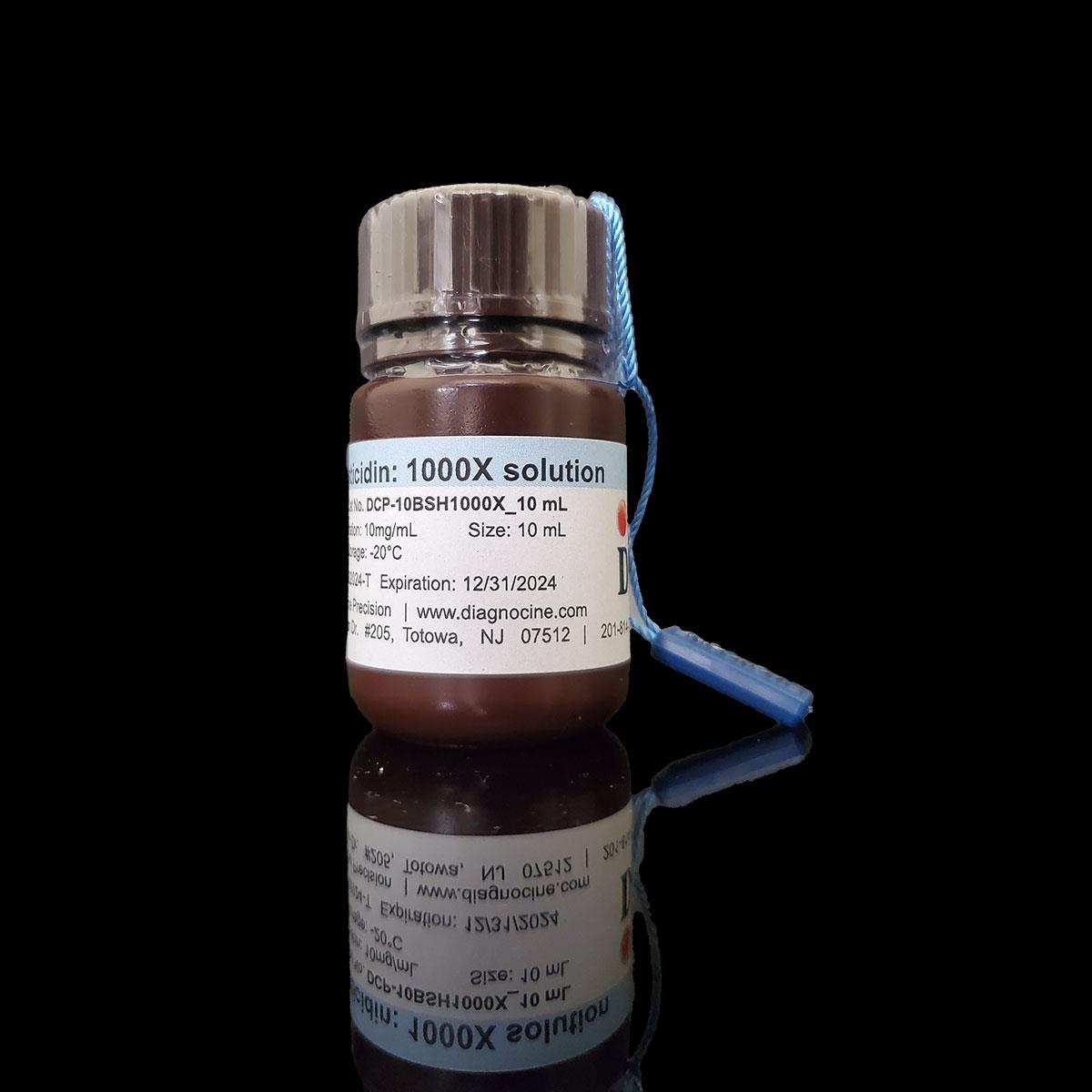
FluxMPS™ Blasticidin: 1000X solution
FluxMPS™ Blasticidin: 1000X solution is a single-stage, 0.1 µm membrane-filtered antibiotic selection reagent supplied at 10 mg/mL for reliable selection of cells expressing blasticidin-resistance genes. Isolated from Streptomyces griseochromogenes, it inhibits protein synthesis in both prokaryotic and eukaryotic cells, making it a dependable tool for stable cell line generation, CRISPR-Cas9 marker selection, and standard, microfluidic, or organ-on-a-chip (OoC) culture workflows.
- 10 mg/mL Blasticidin S HCl supplied as a 1000X concentrated stock solution for direct dilution into culture medium
- Filtered using a single 0.1 µm membrane pass for particulate and mycoplasma-scale contamination control
- Nucleoside antibiotic isolated from Streptomyces griseochromogenes; blocks peptide bond formation and peptidyl-tRNA hydrolysis at the ribosomal P-site
- Effective selection agent for cells expressing bsr, bsd, or BSD resistance genes, including CRISPR-Cas9 edited cell isolation
- Manufactured under an ISO 13485:2016 quality management system; final packaging, QA, and customization completed at Diagnocine, Totowa, NJ
- Supplied in 10 mL format; store at -20°C protected from light; avoid repeated freeze/thaw cycles and frost-free freezers
- Custom concentrations, formats, and packaging available on request
- Concentration10 mg/mL (1000X)
- Molecular FormulaC17H26N8O5 · HCl
- Molecular Weight458.9 g/mol
- Filtration0.1 µm membrane, single-stage
- PubChem CID356629
- UN Number2811
- Storage-20°C, protect from light
- Shelf Life9 months from date of manufacture, unopened
- ShippingContact for specification
- Pack Size10 mL
A selection antibiotic built for traceable, reproducible research
Reagent-grade selection antibiotics must combine consistent potency with manufacturing traceability. Conventional blasticidin preparations vary lot to lot and rarely disclose filtration or QC detail, increasing the risk of inconsistent selection pressure or contamination in sensitive microfluidic and organ-on-a-chip cultures.
Membrane-Filtered Purity
Filtered using a 0.1 µm membrane to reduce particulate and mycoplasma-scale contaminants in the 1000X stock prior to fill.
Consistent Selection Pressure
Manufactured to a fixed 10 mg/mL (1000X) concentration for reproducible antibiotic selection across experiments and lots.
Well-Characterized Mechanism[1]
A nucleoside antibiotic that binds the ribosomal P-site, strengthening tRNA binding and blocking peptide bond formation and peptidyl-tRNA hydrolysis in prokaryotic and eukaryotic cells.
CRISPR & Stable Line Selection[6]
Functions as a selectable marker for isolating cells expressing bsr, bsd, or BSD resistance genes after gene editing or stable transfection.
Broad-Spectrum Antimicrobial Activity[4]
Potent in vitro activity against Staphylococcus aureus, Pseudomonas aeruginosa, and Candida albicans, with comparatively low activity against Enterobacteriaceae such as E. coli.
Customization on Demand
Custom concentrations, formats, and packaging available on request — contact support@diagnocine.com.
Filtration
Blasticidin: 1000X solution is manufactured with a single-pass 0.1 µm membrane filtration step, reducing particulate and mycoplasma-scale (0.2–0.3 µm) risk in the concentrated stock prior to fill.
-
1
0.1 µm Filtration
Single-pass 0.1 µm membrane filtration of the concentrated 10 mg/mL stock prior to aseptic fill into 10 mL units.
Filtration summary
Blasticidin: 1000X solution is filtered once through a 0.1 µm membrane. This is a single-stage filtration process, not a multi-pass or paired filtration train.
Selection, gene editing, and translation research
Blasticidin: 1000X solution is used across standard, microfluidic, and organ-on-a-chip (OoC) research to select and maintain cells carrying blasticidin-resistance genes, to isolate successfully gene-edited clones, and to study ribosomal mechanisms of protein synthesis inhibition.
Micro Physiological System (MPS) & Chip
Used as a stable selection agent in engineered cell lines cultured within microfluidic and organ-on-a-chip (OoC) systems.
Stable & Transient Selection
Applies selective pressure to identify and maintain cells expressing blasticidin-resistance genes.
CRISPR-Cas9 & Genome Engineering[6]
Serves as a selectable marker to isolate cells that have successfully undergone gene editing.
Translation & Ribosome Studies[1]
Used to study inhibition of peptide bond formation and ribosomal mechanisms in prokaryotic and eukaryotic systems.
Antimicrobial Susceptibility Testing[4]
Applied in antimicrobial susceptibility testing (AST) against gram-positive and gram-negative organisms.
Cell Culture Maintenance
Helps prevent overgrowth of non-resistant or contaminating cells by inhibiting the growth of susceptible cells in culture.
Specifications
Key physical, chemical, safety, storage, and traceability parameters for Blasticidin: 1000X solution.
| Parameter | Specification |
|---|---|
| Active Compound | Blasticidin S Hydrochloride, 10 mg/mL (1000X) |
| Molecular Formula | C17H26N8O5 · HCl |
| Molecular Weight | 458.9 g/mol |
| Concentration | 10 mg/mL (1000X) |
| Parameter | Specification |
|---|---|
| Filtration Single-stage | 0.1 µm membrane (single pass) |
| PubChem CID | 356629 |
| UN Number | 2811 |
| Hazard / Handling | Harmful compound; use fume hood and PPE; do not ingest or inhale |
| Parameter | Specification |
|---|---|
| Storage Temperature | -20°C, protect from light |
| Freeze/Thaw Handling | Avoid multiple freeze/thaw cycles; do not store in a frost-free freezer |
| Shelf Life | 9 months from date of manufacture, unopened |
| Shipping Condition | Contact for specification |
| Parameter | Specification |
|---|---|
| Raw Material Grade | Research Use Only (RUO) |
| Traceability | Lot-specific Certificate of Analysis available |
| Manufacturing QMS ISO | ISO 13485:2016 aligned |
| UNSPSC | 41116155 — Molecular biology and cell culture growth media (UNv260801) |
| Regulatory Alignment | ISO 13485:2016 aligned |
| Production Method | Custom assembly & packaging at Diagnocine, Totowa, NJ |
| Intended Use | Research Use Only (RUO) |
Full composition
Blasticidin: 1000X solution is a single active-compound antibiotic solution. Composition, chemical identifiers, and stability handling details are provided below.
| Component | CAS Number | Concentration |
|---|---|---|
| Blasticidin S Hydrochloride | 3513-03-9 | 10 mg/mL (1000X) |
| Property | Value |
|---|---|
| Molecular Formula | C17H26N8O5 · HCl |
| Molecular Weight | 458.9 g/mol |
| PubChem CID | 356629 |
| UN Number | 2811 |
| Parameter | Detail |
|---|---|
| Freeze/Thaw | Avoid multiple freeze/thaw cycles |
| Storage Equipment | Do not store in a frost-free freezer |
| Hazard Precaution | Harmful; use fume hood and PPE; do not ingest or inhale the powder |
| Storage Temperature | -20°C, protect from light |
Manufacturing & Compliance
Blasticidin: 1000X solution is manufactured, filtered, packaged, and quality-tested under a controlled quality management system.
ISO 13485:2016 Quality System
Manufactured under ISO 13485-certified facilities (Suppliers of Diagnocine Precision).
Single-Stage 0.1 µm Filtration
Filtered using a 0.1-micron membrane to reduce particulate and mycoplasma-scale contamination prior to fill.
Custom Assembly & Packaging
All specific customization requests and assembly are accomplished at Diagnocine Precision in Totowa, New Jersey, USA.
Final QA & Testing
All final packaging, quality assurance, and testing are completed at the Diagnocine R&D and Quality Testing Center.
Filtration Validation
Single 0.1 µm membrane filtration pass, documented per production batch.
Handling & Safety
Classified as a harmful compound (UN 2811); requires fume hood and PPE during handling.
Storage Stability
9-month shelf life from date of manufacture when stored at -20°C, protected from light, without repeated freeze/thaw cycles.
Documentation / CoA
Certificate of Analysis available on request.
How DCP-10BSH1000X_10mL compares
Where a published, attributed comparison figure is available, it is shown; where none exists, the field is marked "Not specified" rather than estimated.
| Parameter | DCP-10BSH1000X_10mL (FluxMPS™) | Other Suppliers |
|---|---|---|
| Concentration & Format | 10 mg/mL (1000X), 10 mL | Not specified |
| Filtration | 0.1 µm membrane (single-pass) | Not specified |
| Endotoxin (release specification) | Not specified | Corning classical liquid media — < 0.25 EU/mL Sigma-Aldrich DMEM complete medium — ≤ 2 EU/mL Gibco classical DMEM — Not specified (recorded per lot) |
| Manufacturing QMS | ISO 13485:2016 | Not specified |
| Custom Formulation | check_circle Available on request | Not specified |
| Certificate of Analysis | check_circle Available on request | Not specified |
Comparison figures from published supplier specifications, accessed 2 September 2026. Suppliers that publish no numeric endotoxin specification are shown as "Not specified".
Frequently asked questions
Common questions about Blasticidin: 1000X solution.
Supporting literature
Curated literature on Blasticidin S mechanism, resistance gene selection, gene editing applications, and related methodology.
- Yamaguchi H, Yamamoto C, Tanaka N. Inhibition of protein synthesis by blasticidin S: studies with cell-free and reconstituted systems. J Biochem. 1965. doi:10.1093/oxfordjournals.jbchem.a128378
- Izumi M, Miyazawa H, Kamakura T, et al. Blasticidin S-resistance gene (bsr): a novel selectable marker for mammalian cells. Exp Cell Res. 1991. doi:10.1016/0014-4827(91)90467-9
- Kimura M, Kamakura T, Tao QZ, Kaneko I, Yamaguchi I. Cloning of the blasticidin S deaminase gene (BSD) from Aspergillus terreus and its use as a selectable marker. Mol Gen Genet. 1994. doi:10.1007/BF00279458
- Jorgensen JH, Ferraro MJ. Antimicrobial susceptibility testing: a review of general principles and contemporary practices. Clin Infect Dis. 2009. doi:10.1086/600885
- Low LA, Tagle DA. Organs-on-chips: progress, challenges, and future directions. Exp Biol Med. 2017. doi:10.1177/1535370217700523
- Ran FA, Hsu PD, Wright J, Agarwala V, Scott DA, Zhang F. Genome engineering using the CRISPR-Cas9 system. Nat Protoc. 2013. doi:10.1038/nprot.2013.143
- Uphoff CC, Drexler HG. Detection of mycoplasma contamination in cell cultures. Methods Mol Biol. 2011. doi:10.1007/978-1-61779-108-6_1
- Karreman C. Fusion PCR generates BSD-selectable expression constructs for mammalian cell lines. Gene. 1998. doi:10.1016/S0378-1119(98)00363-0