Anti-XPA, Human, MouseーMono(5F12) (100 ug)
Product#: FNK-70-031
$346.79
Availability:
Ships in 1-2 Weeks
Anti-XPA antibody, monoclonal (5F12)
General information
| Cat. No. | : FNK-70-031 |
| Size | :100 µg |
| Antigen Species | :Human |
| Host Species | :Mouse |
| Immunogen | :Recombinant full-length human XPA protein |
| Clone No. | :5F12 |
| Cross Reactivity | :Human (expected to react also with mouse XPA from the sequence homology) |
| Epitope | :Amino acids 30-47 |
| Subtype | :IgG2b |
| Form | :Purified IgG, 1 mg/ml in PBS pH 7.2, 50% glycerol, filter-sterilized |
| Application | :1. Western blotting (1/1,000~1/10,000) :2. Immunofluorescence staining (1/100~1/1,000) :3. ELISA :4. Inhibition of in vitro excision repair reaction :5. Inhibition of XPA interaction with ERCC1 and TFIIH :Other applications have not been tested. |
| Shipping and Storage | :Ship at 4℃ or -20℃, and store at -20℃. Do not freeze. |
| Data Link | :UniProtKB/Swiss-Prot P23025 (XPA_HUMAN) |
| Cat. No. | Size | Link |
| FNK-70-031 | 100 µg |  |
| FNK-70-032 | 250 µg | |
Type DNA repair protein
Application DNA damage and repair studies, UV sensitivity assays
Species Human
Recombinant Yes
Species Human
Recombinant Yes
XPA in the Cells
XPA plays crucial rokes in the NER pathway
- DNA damage verification
- Recruitment of other NER proteins
- Acts as a molecular scaffold to assemble NER factors around damage sites
- Stabilization of NER intermediates
It also interacts with multiple proteins both within and outside the NER pathway which include:
- ERCC1 (part of the DNA-incising complex)
- Replication protein A1 (RPA1)
- XAB2 (XPA-binding protein 2)
XPA in the Human Body
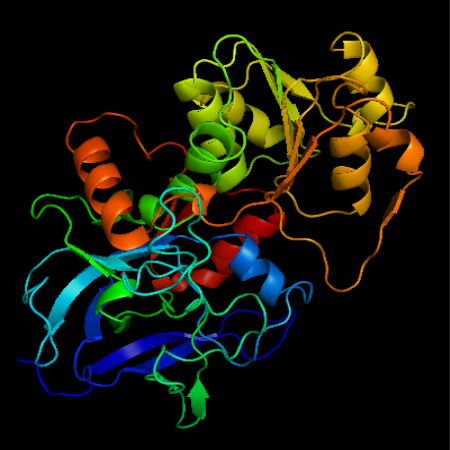
XP (Xeroderma pigmentosum) is an autosomal recessive human disease characterized by hypersensitivity to sunlight and a high incidence of skin cancer on sun-exposed skin (1). Cells from XP patients are hypersensitive to killing by UV irradiation because of a defect in nucleotide excision repair (NER). XP is classified into seven complementation groups (A~G) and a variant form (1). XPA shows the most severe symptoms. Products encoded by the XP genes function in repairing UV-induced cyclobutane pyrimidine dimmer and (6-4) photoproducts as well as chemically induced variety of DNA lesions (1). XPA protein consists of 273 amino acids and forms a complex with many proteins such as RPA, ERCC1, TFIIH、XAB1, and XAB2, which plays a role in early step of NER. The hybridoma 5F12 was constructed by Prof. K. Tanaka’s group who first cloned the XPA gene (2, 3).
 |
 |
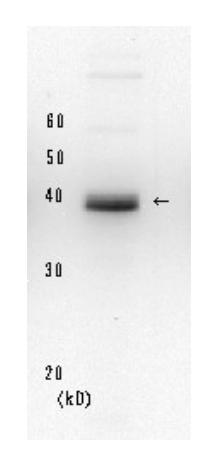
| Fig. 1 Western blot of endogenous XpA protein. Hela cell whole extrac (20 μg)t. Antibody was used at 1/2,000 dilution. As secondary antibody, HRP conjugated goat anti-mouse IgG was used at 1/20,000 dilution. |
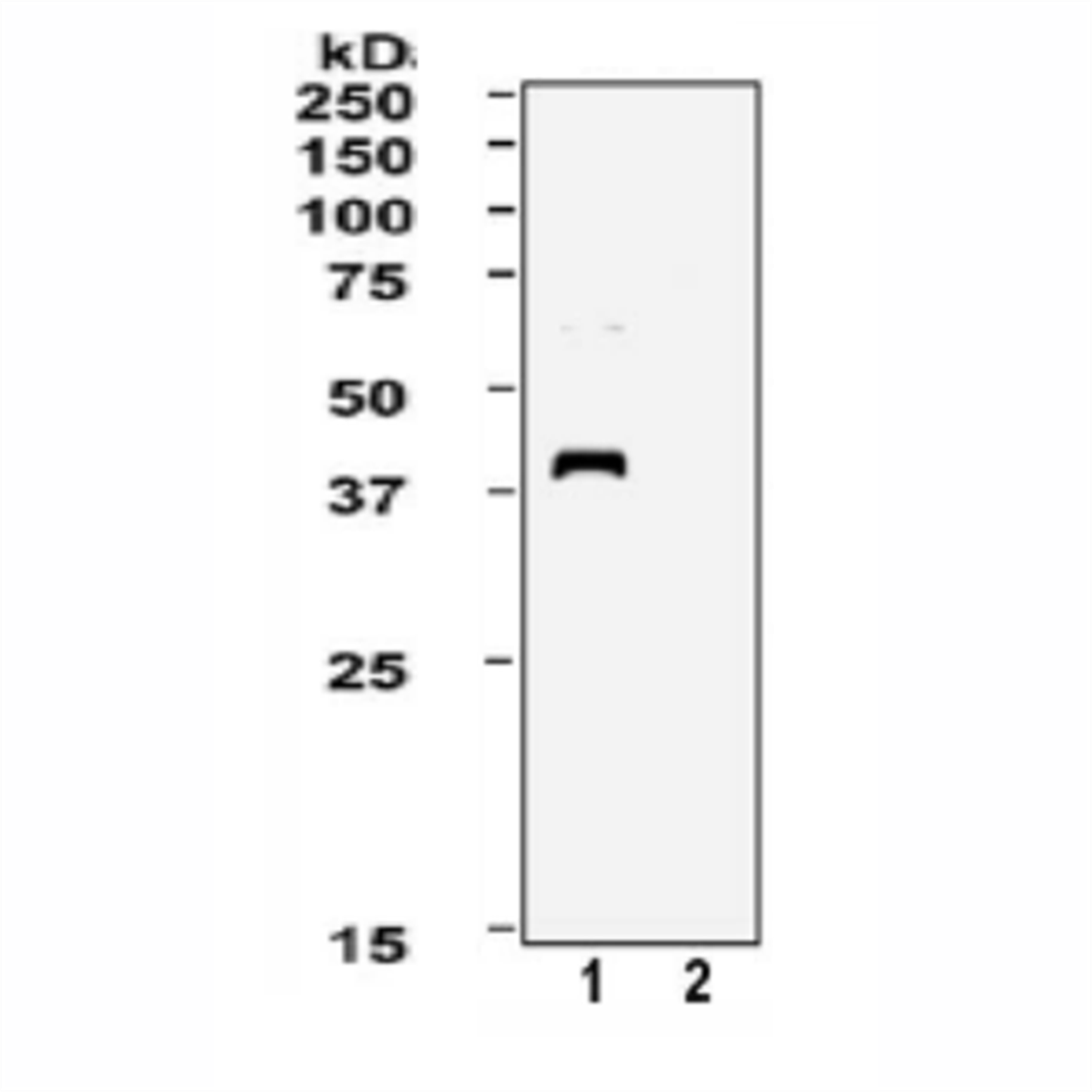
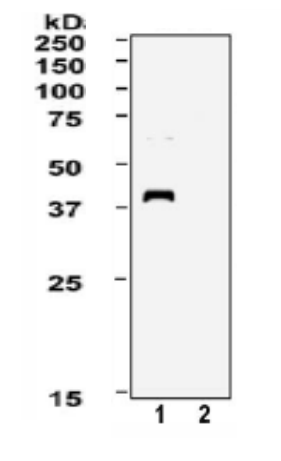
Fig 2 Weastern blot of XpA: Validation. Lane 1. Extract of Hela cells (XpA wild type) Lane 2. Extract of XP12ROSV cells (XpA deficient ) The primary and the secondary antibodies were used at 1/2,000 and 1/20,000 dilutions. |
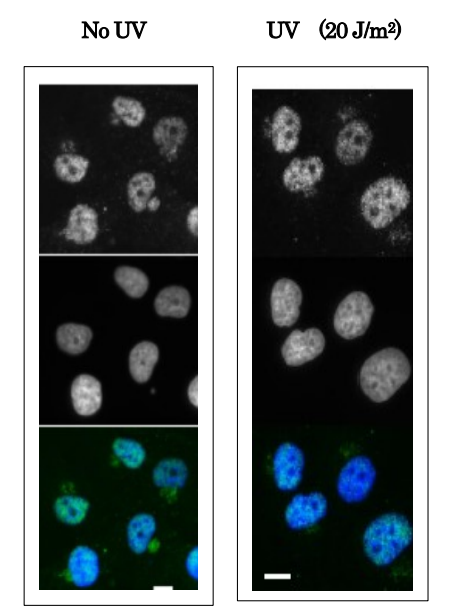 |
Fig.3 Immunofluorescence staining of human fibroblast cells (GM0637) using anti-XpA antibody (5F12) The cells were non-irradiated (left) or irradiated with UV at 20 J/m2 and fixed after 30 min with paraform aldehyde. The antibody was used at 1/100 dilution and as the second antibody, Alexa 488 conjugated goat anti-mouse IgG was used at 1/5,000 dilution. |
References
This antibody is described and used in Ref. 2
1. Friedberg EC et al DNA Repair and Mutagenesis 2nd ed., ASM Press (2006)
2. Saijo M et al “Inhibition of nucleotide excision repair by anti-XPA monoclonal antibodies which interefere with binding to RPA, ERCC1, and TFIIH” Biochem Biophys Res Comm 321:815-822 (2004) PMID: 15358100
3. Tanaka K et al “Analysis of a human DNA excision repair gene involved in group A xeroderma pigmentosum and containing a zinc-finger domain” Nature 348:73 -76 (1990) PMID: 2234061
2. Saijo M et al “Inhibition of nucleotide excision repair by anti-XPA monoclonal antibodies which interefere with binding to RPA, ERCC1, and TFIIH” Biochem Biophys Res Comm 321:815-822 (2004) PMID: 15358100
3. Tanaka K et al “Analysis of a human DNA excision repair gene involved in group A xeroderma pigmentosum and containing a zinc-finger domain” Nature 348:73 -76 (1990) PMID: 2234061
Aliases for XPA Gene