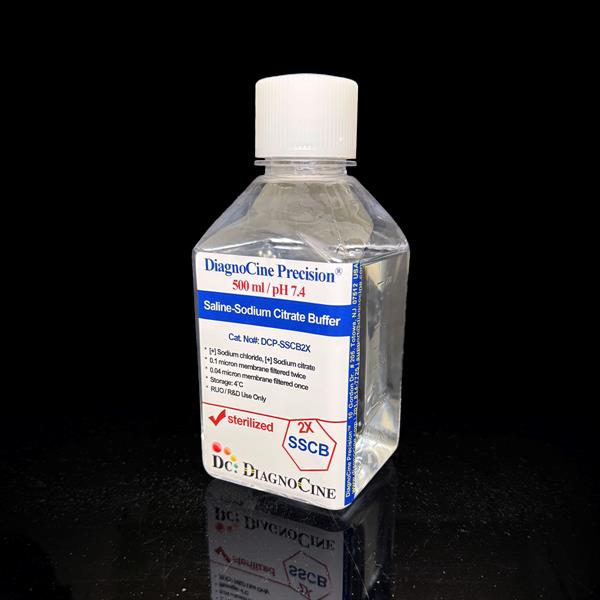
Saline-Sodium Citrate Buffer [1X]
FluxMPS™ Saline-Sodium Citrate Buffer [1X]
An MPS-grade, quadruple-stage ultra-filtered 1X Saline-Sodium Citrate (SSC) hybridization buffer engineered for Southern blotting, Northern blotting, in situ hybridization, and DNA microarray protocols. Formulated with defined 0.15 M sodium chloride and 0.015 M sodium citrate at a stable pH of 7.0, and produced under ISO 13485:2016-certified, CE-approved manufacturing for microchannel-safe, low-background nucleic acid workflows.
- Quadruple-stage filtration: 0.1 µm membrane (twice) and 0.04 µm membrane (twice)
- Stable pH of 7.0 ± 0.05 at 25°C, within the optimal range for hybridization biology
- DNase- and RNase-activity tested on every lot — none detected
- Ultrapure Type 1 water (18.2 MΩ·cm) base for low-background nucleic acid work
- Defined 1X ionic composition: 0.15 M sodium chloride / 0.015 M sodium citrate
- Microchannel-safe for automated hybridization, blotting, and microarray workflows
- Customizable to alternate SSC concentrations and additive formulations on request
- pH7.0 ± 0.05 (25°C)
- Formulation0.15 M NaCl / 0.015 M Sodium Citrate
- AppearanceClear, Colorless Liquid
- Filtration0.1 µm x2 + 0.04 µm x2
- DNase ActivityNone Detected
- RNase ActivityNone Detected
- Water QualityUltrapure Type 1 (18.2 MΩ·cm)
- Storage4°C
- Shelf Life2 Years
- ManufacturingISO 13485:2016 / CE-Approved
Engineered where standard SSC buffer falls short
Conventional 0.22 µm-filtered SSC buffer can carry subvisible particulates and bioburden into hybridization chambers, microarray flow cells, and microfluidic channels, driving background signal and non-specific binding. FluxMPS™ SSC Buffer [1X] is built around a quadruple-stage filtration architecture, defined ionic composition, and DNase/RNase-tested purity to keep hybridization and blotting workflows clean and reproducible.
Microchannel-safe purity
Final 0.04 µm membrane pass, applied twice, reduces particulate carryover into microarray flow cells and microfluidic hybridization chambers.
Precise, stable pH
Formulated to pH 7.0 ± 0.05 at 25°C, within the optimal 6.0–8.0 range for most nucleic acid hybridization reactions.
Ultrapure-grade water
Manufactured from Ultrapure Type 1 water (18.2 MΩ·cm) to minimize trace contaminants in sensitive hybridization chemistries.
Low background for blotting & hybridization
Supports Southern blotting, Northern blotting, in situ hybridization, and DNA microarrays with minimal non-specific binding at controlled stringency.
Defined, traceable composition
0.15 M sodium chloride and 0.015 M sodium citrate, lot-tested for DNase and RNase activity with none detected.
Customization on demand
Alternate SSC concentrations, pH, and additive chemistries available — contact support@diagnocine.com.
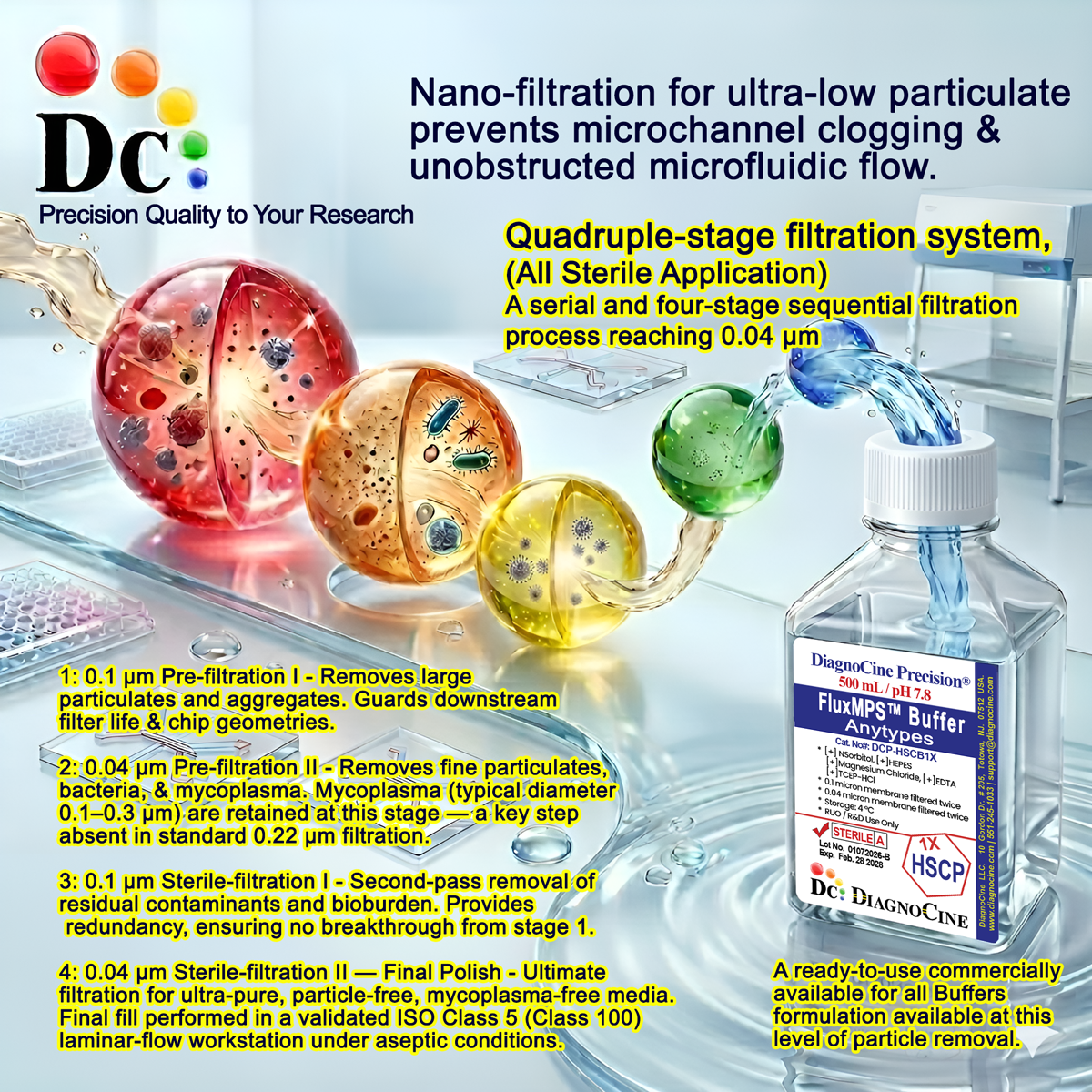
Quadruple-stage filtration system
Every lot of FluxMPS™ SSC Buffer [1X] is filtered 0.1-micron membrane twice and 0.04-micron membrane twice in a sterile environment, sequentially reducing particulate load and bioburden beyond what a single-pass 0.22 µm filtration can achieve.
-
1
0.1 µm Pre-filtration I
Removes large particulates and aggregates from the sodium chloride / sodium citrate solution, extending the life of downstream filters.
-
2
0.04 µm Pre-filtration II
Retains fine particulates and bioburden, helping guard against mycoplasma contamination — the smallest mycoplasma species measure about 0.2 micron.
-
3
0.1 µm Sterile-filtration I
Second-pass redundancy through a 0.1 µm membrane in a sterile filling environment.
-
4
0.04 µm Sterile-filtration II — Final Polish
Final 0.04 µm polish completes the quadruple-stage architecture, supporting mycoplasma-preventive, low-particulate hybridization buffer.
Performance vs. conventional buffer
Sequential 0.1 µm and 0.04 µm filtration, each applied twice, removes finer particulates and bioburden than a single 0.22 µm filtration pass typical of conventional SSC buffer preparations.
© Diagnocine® — DCP-SSCB1X
Built for hybridization, blotting & microfluidic workflows
Saline-Sodium Citrate Buffer [1X] controls hybridization stringency, facilitates DNA/RNA transfer, and supports denaturation for DNA library screening across a range of molecular biology platforms.
Automated Bioreactors & Robotics
An optional 0.01 µm (10 nm) ultra-filtered variant is available on request for fully automated liquid-handling and robotic hybridization platforms where valve and sensor protection is critical.
- Total Particulate Exclusion for automated dispensing systems
- Valve & Sensor Protection in closed-loop microfluidic hardware
- Extended Perfusion Stability for continuous hybridization or wash cycles
Inquiry Required: contact support@diagnocine.com to request the 0.01 µm ultra-filtered grade.
Micro Physiological System (MPS) & Chip
Compatible with automated hybridization and wash steps on organ-on-a-chip and lab-on-a-chip platforms.
Hybridization, Wash & Blotting Buffer
Controls stringency during hybridization wash steps and serves as a transfer buffer for DNA/RNA blotting onto nitrocellulose or nylon membranes.
iPSC-Derived Model Handling
Suitable as a low-background wash/hybridization buffer alongside nucleic acid workflows in iPSC-derived cell models.
Endothelial & Primary Cell Perfusion
Applicable to nucleic acid extraction and hybridization workflows performed alongside perfused endothelial and primary cell cultures.
Denaturation & Library Screening
Used for denaturation steps to facilitate screening of DNA libraries and downstream blotting procedures.
Microscopy & Optical Sensing
Low-particulate formulation supports clean optical backgrounds in fluorescence-based hybridization detection.
Complete parameter overview
Every FluxMPS™ SSC Buffer [1X] lot is manufactured and tested to the parameters below.
| Parameter | Specification |
|---|---|
| Formulation / Composition | Saline-Sodium Citrate (SSC) Buffer, 1X: 0.15 M Sodium Chloride, 0.015 M Sodium Citrate |
| Appearance | Clear, Colorless Liquid |
| pH | 7.0 ± 0.05 (25°C) |
| Sodium Chloride Concentration | 0.15 M |
| Sodium Citrate Concentration | 0.015 M |
| Parameter | Specification |
|---|---|
| Sterility / Filtration USP <71> | Filtered 0.1-micron membrane twice and 0.04-micron membrane twice in a sterile environment |
| DNase Activity | None detected (18 hr incubation with plasmid DNA at room temperature) |
| RNase Activity | None detected (18 hr incubation with ribosomal RNA at room temperature) |
| Water Quality | Ultrapure Type 1 water (18.2 MΩ·cm) |
| Parameter | Specification |
|---|---|
| Storage Temperature | 4°C |
| Shelf Life | 2 Years |
| Parameter | Specification |
|---|---|
| Manufacturing QMS ISO 13485 | Manufactured under ISO 13485-certified facilities |
| Regulatory Alignment | CE-approved facilities (Suppliers of DiagnoCine Precision) |
| Production & Customization Site | Final packaging, QA, and testing at the DiagnoCine R&D and Quality Testing Center; customization and assembly at DiagnoCine Precision, Totowa, New Jersey, USA |
| Intended Use | For Research Use Only (RUO) |
Full composition
Saline-Sodium Citrate Buffer [1X] is a two-component saline/citrate buffering system released per lot.
| Component | CAS Number | Concentration |
|---|---|---|
| Sodium Chloride | 7647-14-5 | 0.15 M |
| Sodium Citrate | 68-04-2 | 0.015 M |
Manufacturing & compliance
FluxMPS™ SSC Buffer [1X] is manufactured, tested, and released under a documented quality system.
ISO 13485:2016 QMS
Manufactured under ISO 13485-certified and CE-approved facilities.
Ultrapure Type 1 Water
Formulated with Ultrapure Type 1 water (18.2 MΩ·cm) as the base solvent.
ISO Class 5 Fill & Finish
Aseptic fill practices consistent with ISO Class 5 (Class 100) environments.
Micro-Batch Precision
Final packaging, QA, and testing performed at the DiagnoCine R&D and Quality Testing Center.
Endotoxin Testing Framework
Endotoxin testing protocols follow USP <85> Bacterial Endotoxins Test methodology; lot-specific results available on request.
Particulate Testing Framework
Particulate testing protocols follow USP <788> Method 2 guidance across the DiagnoCine Precision buffer line.
Osmolality Testing Framework
Osmolality testing protocols follow USP <785> guidance; lot-specific results available on request.
Documentation / CoA
Lot-specific Certificates of Analysis document pH, appearance, filtration, and DNase/RNase activity results.
How DCP-SSCB1X compares
See how FluxMPS™ SSC Buffer [1X] compares to conventional 0.22 µm-filtered saline-sodium citrate buffer.
| Parameter | DCP-SSCB1X (FluxMPS™) | Conventional SSC Buffer | Standard Alternative |
|---|---|---|---|
| Final Filtration Pore Size | 0.04 µm (quadruple-stage) | 0.22 µm (single-stage) | 0.22 µm (single-stage) |
| Number of Filtration Stages | 4 | 1 | 1 |
| Defined SSC Molarity | check_circle | cancel | cancel |
| DNase / RNase Testing | check_circle | cancel | cancel |
| ISO 13485-Aligned QMS | check_circle | cancel | cancel |
| Water Quality | Ultrapure Type 1 (18.2 MΩ·cm) | Not specified | Not specified |
| Microfluidic Channel Compatibility | check_circle | cancel | cancel |
| pH Reproducibility | 7.0 ± 0.05 | Not specified | Not specified |
| Custom Formulation Available | check_circle | cancel | cancel |
Frequently asked questions
Common questions about FluxMPS™ SSC Buffer [1X].
Supporting literature
Curated literature relevant to SSC buffer chemistry, hybridization stringency, and nucleic acid transfer techniques.
- Southern, E.M. Detection of specific sequences among DNA fragments separated by gel electrophoresis. J Mol Biol. doi:10.1016/S0022-2836(75)80083-0
- Alwine, J.C. et al. Method for detection of specific RNAs in agarose gels by transfer to diazobenzyloxymethyl-paper and hybridization with DNA probes. Proc Natl Acad Sci USA. doi:10.1073/pnas.74.12.5350
- Schena, M. et al. Quantitative monitoring of gene expression patterns with a complementary DNA microarray. Science. doi:10.1126/science.270.5235.467
- Wilkinson, D.G. In Situ Hybridization: A Practical Approach. Oxford University Press. doi:10.1093/oso/9780199637928.001.0001
- Meinkoth, J. & Wahl, G. Hybridization of nucleic acids immobilized on solid supports. Anal Biochem. doi:10.1016/0003-2697(84)90489-7
- Huang, Y. et al. Microfluidic hybridization platforms for nucleic acid detection. Lab Chip. doi:10.1039/C7LC00389G
- Ingham, V.A. et al. Buffer ionic strength and stringency control in nucleic acid hybridization assays. Methods Mol Biol. doi:10.1007/978-1-4939-6472-7_10
- Ingber, D.E. Reverse engineering human pathophysiology with organs-on-chips. Cell. doi:10.1016/j.cell.2016.05.048
- Bhatia, S.N. & Ingber, D.E. Microfluidic organs-on-chips. Nat Biotechnol. doi:10.1038/nbt.2989