
Anti-Rpn3(S.cerevisiae)antibody, rabbit serum
Product#: FNK-62-201
$350.40
Availability:
Ships in 1-2 Weeks
Anti-Rpn3(S.cerevisiae)antibody, rabbit serum
Cat.No: FNK-62-201Size: 100 μl
Storage: Store at 4℃ for short term. For long term storage store at -20℃. Aliquot to avoid repeated freezing and thawing.
Buffer: 0.05% Sodium azide
Purity: Rabbit antiserum
Immunogen: Recombinant yeast Rpn3p expresed in E. coli
Isotype: Rabbit IgG
Reactivity: S. cerevisiae Rpn3 protein. Not tested with other species.
Application
1. Western blotting (1/1,000 dilution)2. Immunoprecipitation
Not tested with other species.
Background
The 26 S proteasome is a protein complex with a molecular mass of 2000 kDa. It is essential not only for eliminating damaged or misfolded proteins but also for degrading short lived regulatory proteins involved in cell cycle regulation, DNA repair, signal transduction, apoptosis, and metabolic regulation(1). Rpn3p is essential, non-ATPase regulatory subunit of the 26S proteasome lid, similar to the p58 subunit of the human 26S proteasome (2, 3, 4).Data Link
SGD S000000823 (RPN3/YER021W)Please note: All products are FOR RESEARCH USE ONLY. NOT FOR USE IN DIAGNOSTIC PROCEDURES. NOT FOR MILITARY USE.
Data Images
62-201 Anti-Rpn3 (S. cerevisiae) antibody, rabbit serum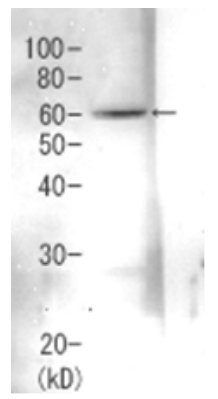
Fig.1 Detection of Rpn3 (60kDa) in the crude extract of S. cerevisiae by Western blotting using this antibody.
References
This product was used in ref. 3 and 4.1. Hershko A and Ciechanover A “THE UBIQUITIN SYSTEM” Annu. Rev. Biochem. 67: 425-479 (1998) PMID: 9759494
2. Finley D et al “Unified nomenclature for subunits of the Saccharomyces cerevisiae proteasome regulatory particle” Trends Biochem Sci 23: 244-245 (1988) PMID 9697412
3. Glickman MH et al “A subcomplex of the proteasome regulatory particle required for ubiquitinconjugate degradation and related to the COP9 signalosome and eIF3” Cell 94: 615-623 (1998) PMID: 9741626
4. Isono E et al “Rpn7 is required for the structural integrity of the 26S proteasome of Saccharomyces cerevisiae” J Biol Chem 279: 27168-27176(2004) PMID: 15102831