


Anti-HBs Pre-S1, Poly-3 high affinity
Product#: FNK-BCL-ABP1-03
$780.24
Availability:
Ships in 1-2 Weeks
Anti-HBs Pre-S1, Poly-3 high affinity
Cat. No.: FNK-BCL-ABP1-03
Size: 100μg
Storage: 4℃ (for long term storage, -20℃. Avoid freeze and thaw cycles)
Introduction:
HBsAg is the surface antigen of Hepatitis B virus (HBV). HBsAg is known to be present in blood if HBV infected patients, and used as a important diagnostic maker of HBV infection. HBsAg forms a small lipid particle(diameter 50 to 60nm)in which many antigen protein are present. Each antigen protein has three domains, called S, Pre-S1 and Pre-S2. L-type antigen contains all the three domains, M-type antigen contains S- and Pre-S2, and S-type antigen consisted of only S-domains. During the process of HBV infection, Pre-S1 domain plays a key role for host (hepatic) cell recognition, and Pre-S2 domain is essential for cell penetration. In infected patients, hepatic cells produces a lot of non-infectious S-type HBsAg (HBV mimetics without genome). The detection of serum Pre-S2 and Pre-S1 antigen is, therefore, very important to reveal the mechanism of HBV infection.
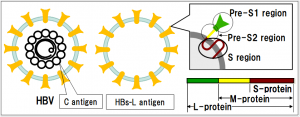
Hepatitis B virus (HBV) expresses three types of surface antigens, i.e. S-, M-, and L-protein. L-protein is composed of S-, Pre-S2, and Pre-S1 region. The deletion of Pre-S1 region forms M-protein and further deletion of Pre-S2 region results in S-protein. So called HBsAg is composed of either S-protein alone or a mixture of S- and M-proteins. The Pre-S1 region is known to be the hepatic cell recognition site and to be important in the HBV infection and Pre-S2 is reportedly known to related HBV entry or carcinogenesis. Pre-S2 region is known to have variation of amino acid sequence depending on genotypes.
Specifications:
Source : white rabbit
Appearance : liquid form(PBS containing biochemically inactive preservative)
Concentration: 1 mg/mL
Antigen: Pre-S1 peptide with thioredoxin tag (genotype C or D)
Purification: affinity by Protein A
Usage : ELISA (0.1 to 10μg/mL), Western blot (0.1 to 10μg/mL)
Antigen specificity: These antibodies bind only to Pre-S1 domain and not to S or Pre-S2 domains
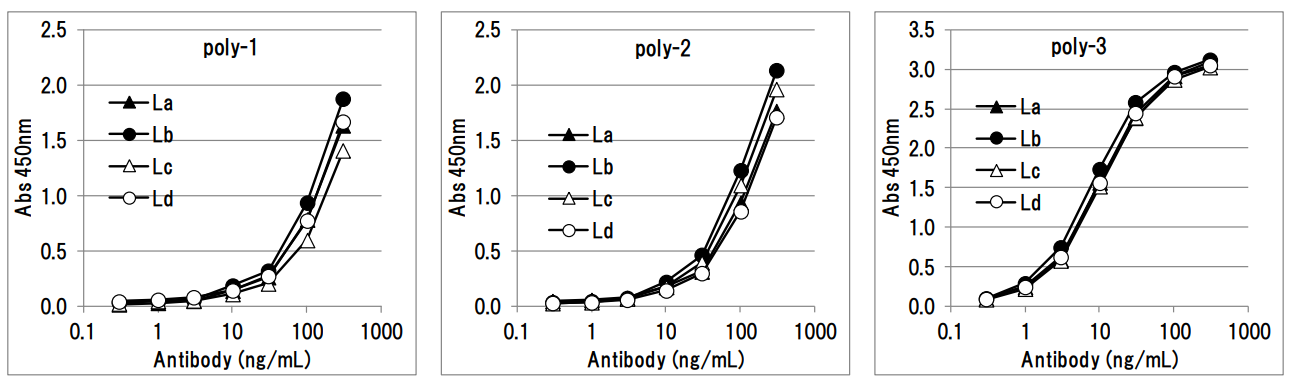
Genotype specificity:
Examples:
1. Western Blot
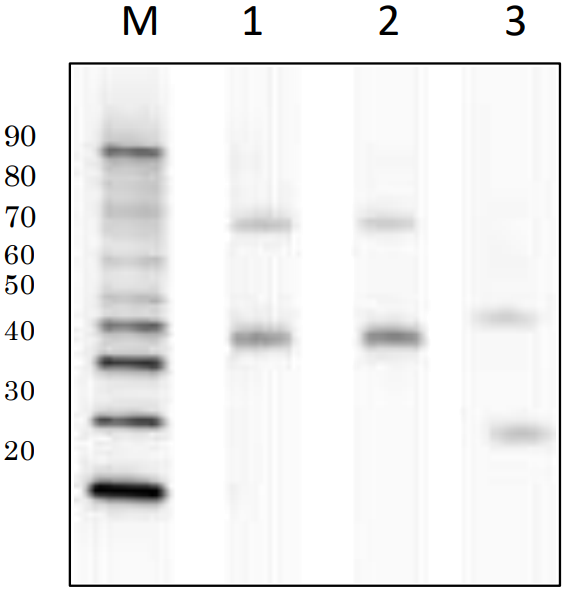 |
M;Marker 1. Antibody: anti-Pre-S1(Code#: FNKJ-BCL-ABP1-01) Antigen: HBsAg-L 2. Antibody: anti-Pre-S2(Code#: FNK-BCL-ABP2-01) Antigen: HBsAg -L 3. Antibody: anti-S antigen(Code#: FNK-BCL-ABPS-01) Antigen: HBsAg -XT Two bands seen in figure correspond to monomer and dimer of sample antigen. |
2. ELISA
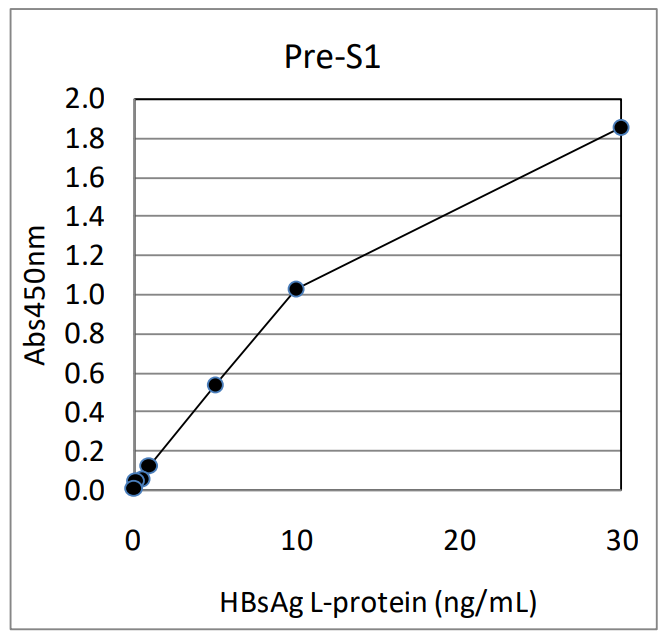 |
ELISA condition Immobilized IgG: anti-Pre-S1antibody (polyclonal, code#: FNK-BCL-ABP1-01) at 10μg/mL Blocking: k-Block-e (Code#: FNK-BCL-BKHE-01) Detection IgG: anti-Pre-S1antibody (monoclonal, HRP-labeled): 25ng/mL Antigen: HBsAg L-protein |