


Anti-DXd/Exatecan human monoclonal antibody(AB12703), HRP conjugated, 0.5mg/mL
Anti-DXd/Exatecan human monoclonal antibody(AB12703), HRP conjugated, 0.5mg/mL
Cat. No.: FNK-PP-AB12703-0R
Size: 50μl
Storage: -20℃
Label: HRP
Host Species: Human
Application: ELISA
Description:
Deruxtecan (DXd) and Exatecan are potent cytotoxic agents used as payloads in antibody-drug conjugates (ADCs) for targeted cancer therapy. Conjugated to monoclonal antibodies, they enable selective delivery to cancer cells, where they inhibit topoisomerase I, disrupting DNA replication and inducing cell death. The high potency and controlled release of DXd and Exatecan make them effective components in ADC-based cancer treatments.
Specifications:
DXd: Deruxtecan, Exatecan
Clone No. AB12703
Lot. B-1
Concentration: 0.5mg/mL
Ig Class: G1
Origin: CHO recombinant antibody stable expression strain
Conjugate: HRP
Specificity: This antibody reacts specifically with DXd and Exatecan.
Purification: Affinity chromatography with Protein A
Formulation: Storage buffer with 50% glycerol and 0.1% ProClin 950 as a preservative
Application / Recommended Concentration:
In order to obtain the best results, optimal working dilutions should be determined by each individual user.
| Western Blot | Not yet tested |
| Non reducing Western Blot | Not yet tested |
| ELISA | The recommended concentration for the HRP Anti-Dxd/Exatecan Antibody is 0.1–0.2 Pg/mL. (see the first Data section below for details.) |
| Immunoprecipitation | Not yet tested |
| Supershift Assay | Not yet tested |
| Flow Cytometry | 5-10 mg/mL |
| Chromatin immunoprecipitation | Not yet tested |
| Immunohistochemistry | Decide by use |
Data (HRP conjugated Anti-DXd/Exatecan Antibody ELISA):
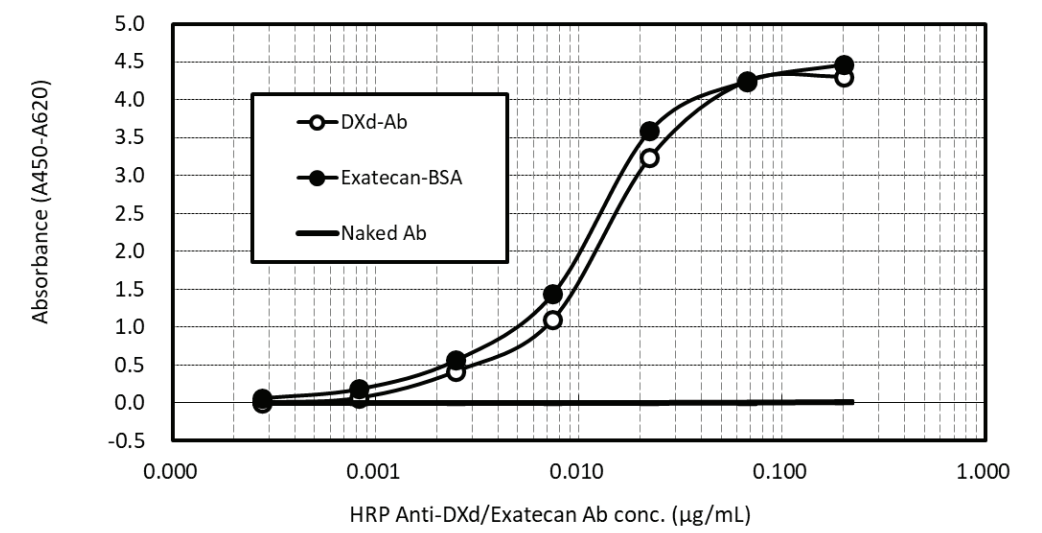 Immobilize DXd-Ab, Exatecan-BSA or Naked Ab at 2.5 Pg/mL. Add HRP-conjugated Anti-DXd/Exatecan Antibody (PP-AB12703-0R) diluted with 50% mouse plasma. Detection was performed using an HRP-based immunoassay. |
Data (Recombinant DXd-Ab Binding Protein Capture Anti-DXd/Exatecan Antibody Bridging ELISA):
1. Recombinant DXd-Ab Binding Protein Coating conc. Difference
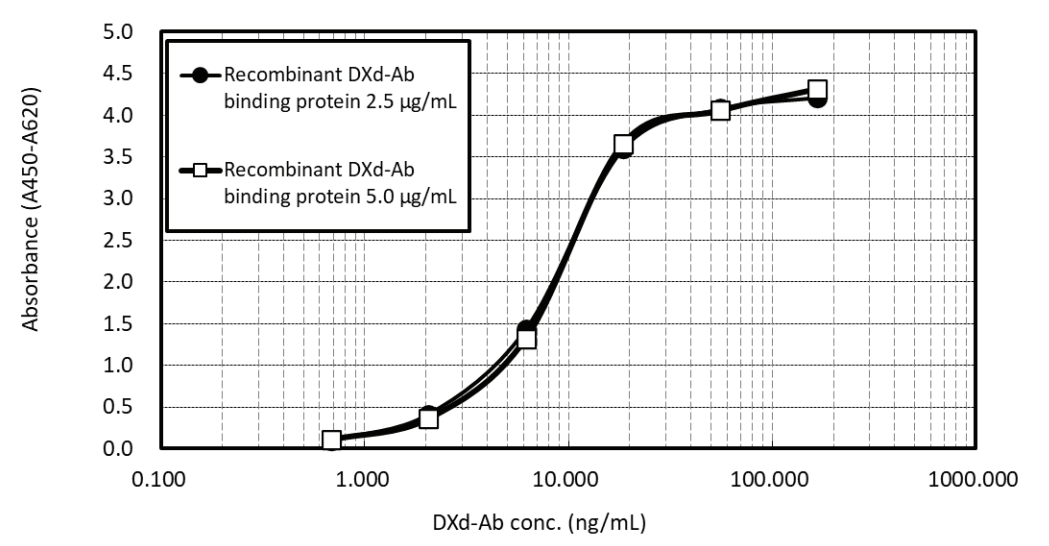 Immobilize recombinant DXd-Ab binding protein at 2.5 Pg/mL and 5.0 Pg/mL. After blocking, add serially diluted DXd-Ab, then apply HRP-conjugated anti-DXd IgG (PP-AB12703-0R) diluted 1:2500 (final concentration ≈ 0.2 Pg/mL). Detection was performed using an HRP-based immunoassay. |
2. Comparison between DXd-Ab and Naked Ab
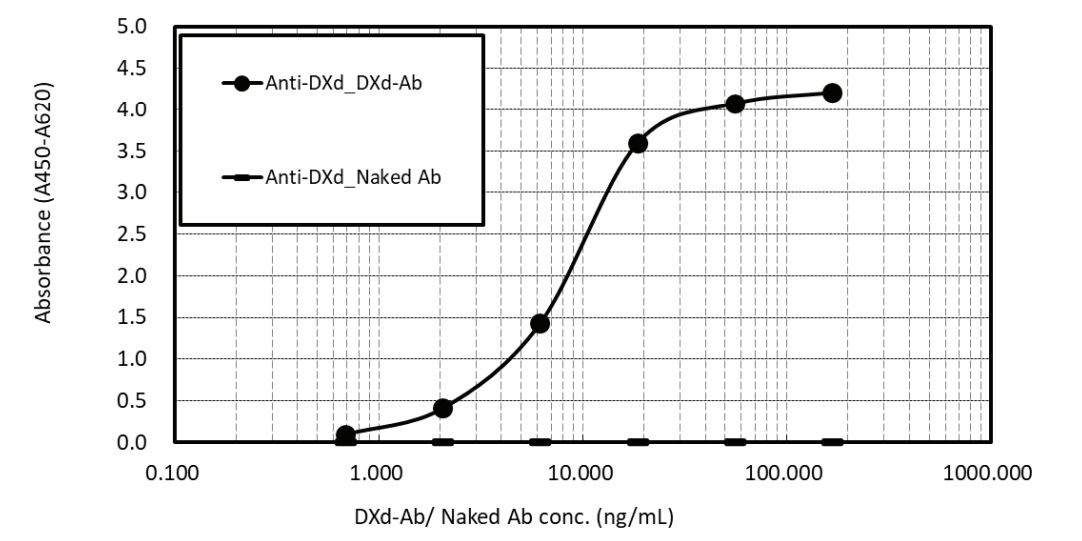 Immobilize recombinant DXd-Ab binding protein at 2.5 Pg/mL. After blocking, add serially diluted DXd-Ab or Naked Ab in 50 % mouse plasma, followed by HRP-conjugated anti-DXd IgG (PPAB12703-0R) diluted 1:2500 (final concentration 0.2 Pg/mL). Detection was performed using an HRP-based immunoassay. Limit of Detection*1: 0.68 ng/mL Range of Quantification*2: 2.06-55.6 ng/mL |
Data (Enzymatic immunoassay for pharmacokinetic evaluation):
1. Standard curve for DXd-Ab by Recombinant DXd-Ab Binding Protein -capture ELISA
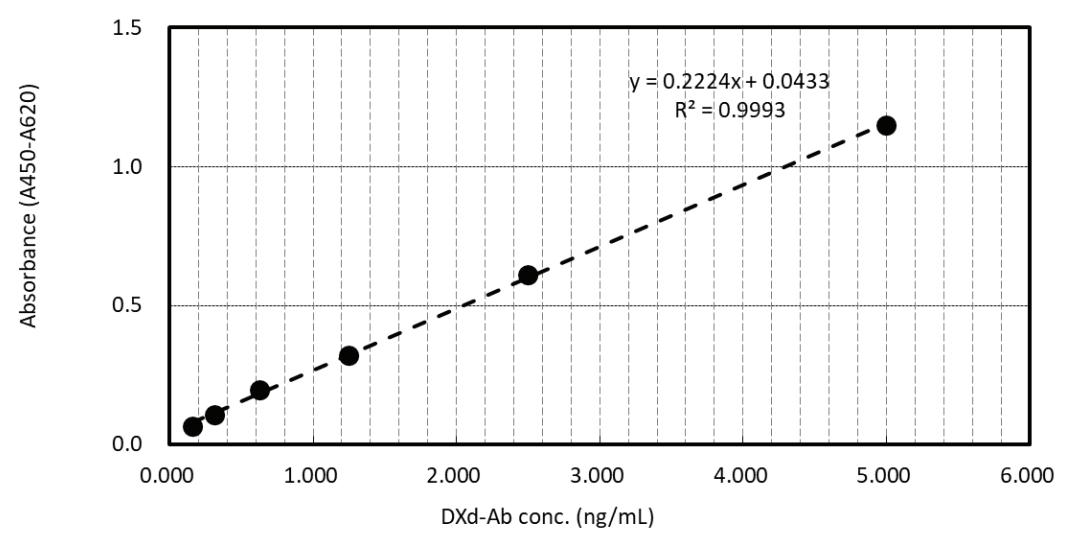 Immobilize recombinant DXd-Ab binding protein at 2.5 Pg/mL. After blocking, add serially diluted DXd-Ab, followed by HRPconjugated anti-DXd IgG (PP-AB12703-0R) diluted 1:2500 (final concentration ≈ 0.2 Pg/mL). Detection was performed using an HRP-based immunoassay. Limit of Detection*1: 0.16 ng/mL Range of Quantification*2: 0.32-5.0 ng/mL |
2. Plasma pharmacokinetics of DXd-Ab in mice after a single dose
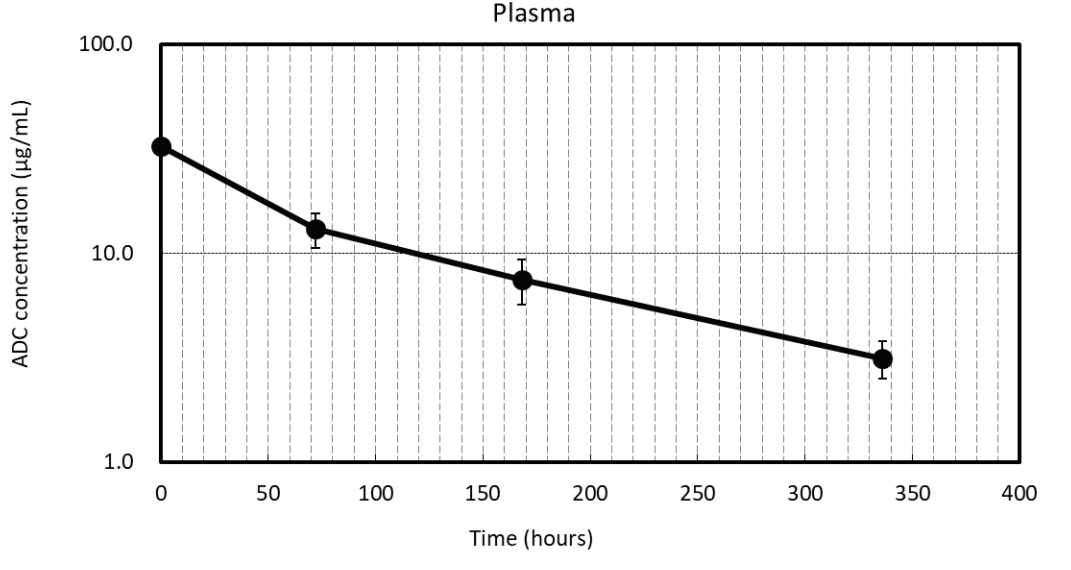 Plasma pharmacokinetics of DXd-Ab in mice after a single 3 mg/kg dose, determined using recombinant DXd-Ab binding protein capture ELISA (mean ? SD, n = 3 per time point). Blood was collected at 5 min and at 3, 7, and 14 days post-dose. Plasma samples were diluted 1:16 000–1:128 000 for the 5-min time point and 1:4 000–1:32 000 for the 3- to 14-day time points, and each dilution was analyzed in triplicate. Concentrations falling within the validated range were back-calculated, and the mean of qualifying dilutions was reported for each animal. |
*1 Limit of Detection: Mean of the blank + 2 *standard deviation.
*2 Range of Quantification is applied using ULOQ (Upper Limit of Quantification) and LLOQ (Lower Limit of Quantification). The ULOQ is the highest concentration with a back-calculated value of 80%-120% and a coefficient of variation (CV) of less than 30%. The LLOQ is the lowest concentration with a back-calculated value of 75%-125% and a CV of less than 30%
Notes:
Store at 2 - 8 ºC up to one month. For long-term storage, the solution may be frozen in working aliquots. Repeated freezing and thawing is not recommended. Storage in a frost-free freezer is not recommended.
Sodium azide may react with lead and copper plumbing to form explosive metal azides. Flush with large amounts of water during disposal.
| FOR RESEARCH ONLY. NOT FOR USE IN HUMANS. |