


Western Blot Boxes, Mixed Sizes
Western Blot Boxes, Mixed Sizes
Cat. No. FNK-MWB-AS
Size 1 set
Description
A container that can be used for antibody reaction / wash to stripping. Since there is almost no distortion or unevenness in the container, the antibody reaction can be performed evenly even with a small amount of liquid.
Feature
- Ideal for Western blotting cut into strips.
- Ideal for antibody screening and analysis using various antibodies.
- Operation efficiency is improved because multiple membranes can be processed in one container.
[Common to all well products]
- It has a well number that is easy to see from above and from the side and is convenient for sample management. The back is mirror-written (see Photo A).
- The notch in the partition wall allows the container to be tilted to easily equalize the amount of liquid in each well (see Photo B).
- Since the lid / bottom has ribs, it is possible to stack antibody reactions and sample management.
- The container is made of polycarbonate with excellent heat resistance / chemical resistance and can be used repeatedly.
- Autoclave sterilization (121°C) and storage at -80°C are also possible.
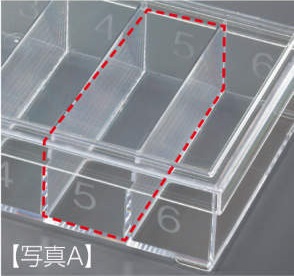
Well numbers are easy-to-read mirror writing
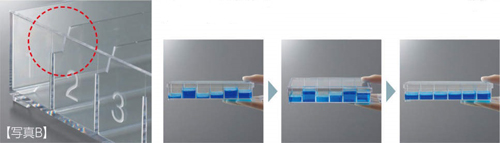
Convenient for the wash process!
The notch in the partition wall allows the container to be tilted to easily equalize the amount of liquid in each well.
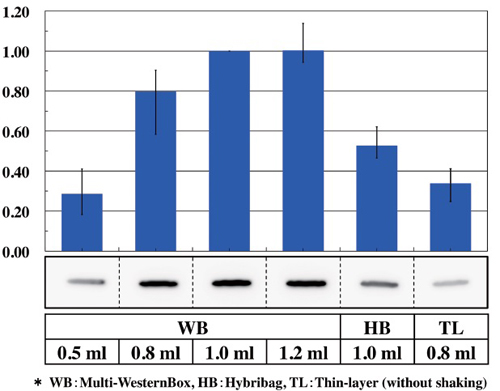
Examination of antibody reaction solution amount and comparison of reaction efficiency (when using 6-well product)
Western blotting was performed under each of the following conditions, and the signal intensities were compared.
The upper graph shows the relative comparison of signal intensities, the representative image data is shown in the middle, and the reaction vessel and the amount of the primary antibody reaction solution are shown in the lower.
Results
When using the multi-western box, good results were obtained by using an antibody reaction solution volume of 1.0 ml or more per well.
In addition, the signal intensity of "1.0 ml" using the multi-western box was about twice that when the hybrid bag was used, and about three times that when the reaction was carried out by standing still.
[Experimental conditions]
Electrophoresis and transcription were performed using a protein extract (16 μg / lane) of rat cerebral cortex, and the membrane was cut into strips for each lane to perform a primary antibody reaction.
Primary antibody reaction (anti-β-actin antibody)
WB: Add 0.5, 0.8, 1.0, 1.2 ml of the primary antibody reaction solution to each well of the multi-western box, and stir with a seesaw shaker at 4 ° C overnight to react. went.
HB: 1.0 ml of the primary antibody reaction solution was added to the hybrid bag, and the reaction was carried out overnight at 4 ° C. with stirring with a seesaw shaker.
TL: 0.8 ml of the primary antibody reaction solution was added on the membrane, and the reaction was carried out at 4 ° C. overnight in a stationary state.
Secondary antibody reaction (HRP-labeled anti-mouse IgG antibody)
All membranes were reacted with HRP-labeled anti-mouse IgG antibody in the same container, and the signal was detected by chemiluminescence.
Analysis
The same experiment was performed three times, the obtained data was quantified using image analysis software, and a relative comparison was performed with "1" when the reaction was carried out with WB-1.0 ml.
<Data provided by Kentaro Nakajima, Assistant, Institute of Neuroscience, Tokushima Bunri University (when the data was provided)>
Product Specifications
| Number of wells | 6 wells | 4 wells | 3 wells | 2 wells |
| Product size (outer dimensions) (length x width x height) |
89 x 169.5 x 34.9 mm | 104 x 169.5 x 34.9 mm | ||
| Well size (inner size) (length x width x height * 1 ) |
80 x 25 x 20 mm | 95 x 38 x 20 mm | 95 x 51.5 x 20 mm | 95 x 78.5 x 20 mm |
| Estimated membrane size that fits in one well | Up to 1/4 mini gel | Up to 1/3 mini gel | Up to 1/2 mini gel | Up to 1 mini gel |
| Minimum amount of liquid required for antibody reaction * 2 | 1.0 ml | 3.0 ml | 4.0 ml | 5.0 ml |
* 1 The height is the size up to the bottom of the notch.
* 2 Consider the amount of antibody reaction solution based on the above.

