

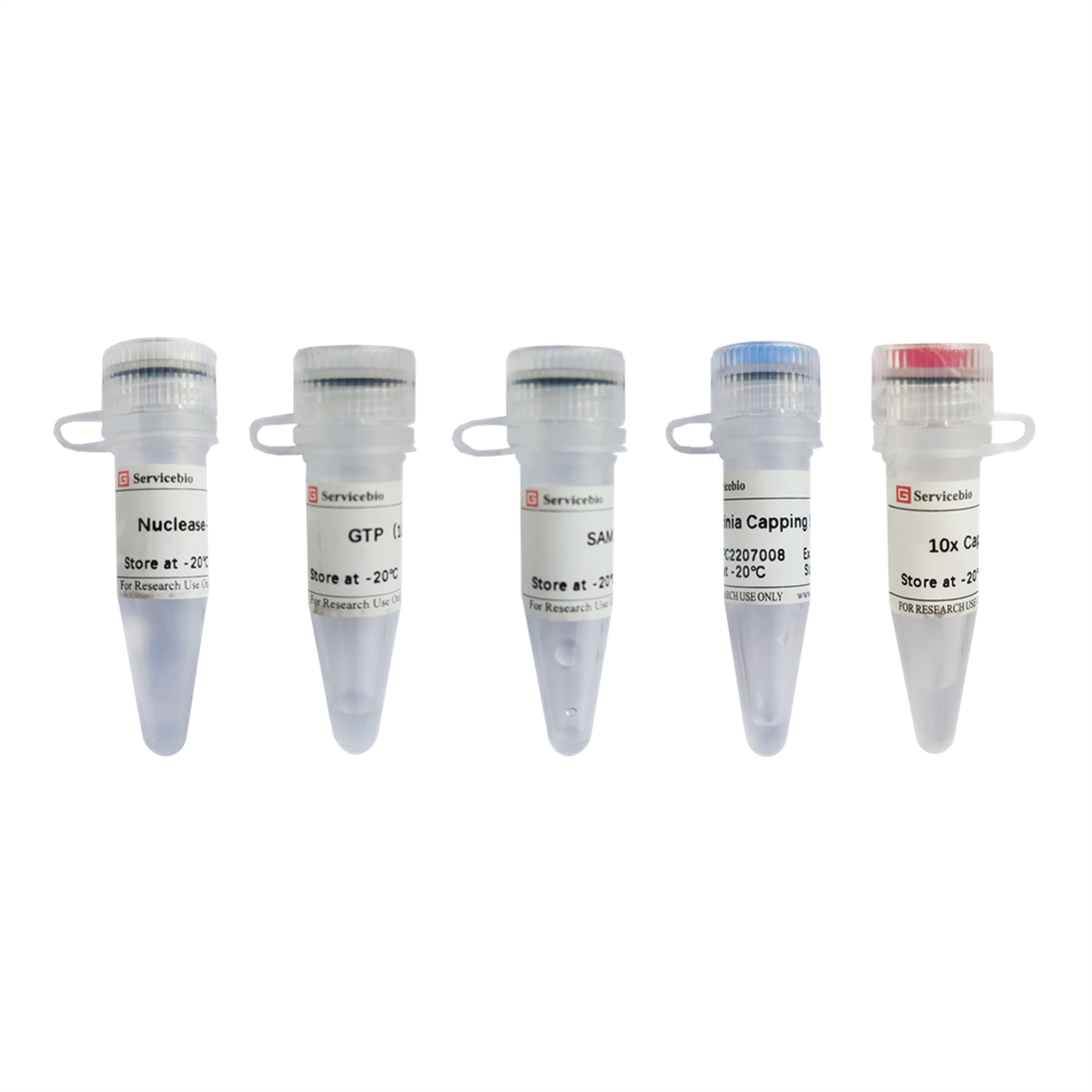
Vaccinia Capping Enzyme
Cat. No.: SB-G3454-500U
Size: 500U
Description
Vaccinia Capping Enzyme is a capping enzyme derived from vaccinia virus, recombinantly expressed in Escherichia coli, which can add 7-methylguanosine cap structure (m7Gppp, Cap 0) to the 5' end of RNA. In eukaryotes, this structure is closely related to the stability, transport and translation of mRNA. The capping enzyme consists of two subunits (D1 and D12), the D12 subunit is the regulatory subunit, and the D1 subunit has three enzymatic activities (RNA triphosphatase, guanylate transferase, and guanine methyltransferase), all of which are required to add a completed Cap 0 structure m7Gppp5'N to 5' triphosphate RNA. In vitro RNA capping by capping enzymes is highly efficient, almost 100% effective, unlike the co-transcriptional addition of some cap analogs. Mainly used for in vitro mRNA synthesis.
- Source: derived from vaccinia virus, recombinantly expressed by Escherichia coli.
- Definition of enzyme activity: at 37°C, the amount of enzyme required to incorporate 10 pmol GTP (α-32P ) into an 80 nt nucleotide transcript within 1 hour is defined as one enzyme activity unit..
- Purity and concentration: SDS-PAGE detection purity > 95%; endogenous nucleic acid residue < 1 pg/μL (qPCR detection); 10 U/μL.
- Enzyme storage buffer: 20 mM Tris-HCl, 100 mM NaCl, 1 mM DTT, 0.1 mM EDTA, 50% Glycerol, 0.1% (w/v) Triton X-100, pH 8.0.
- 10х Capping buffer: 500 mM Tris-HCl, 50 mM KCl, 10 mM MgCl2, 10 mM DTT, pH 8.0.
Storage and Handling Conditions
Composition
| Component Number | Component | G3453-500U |
| G3454-1 | Vaccinia Capping Enzyme | 50 μL |
| G3454-2 | 10х Capping Buffer | 200 μL |
| G3454-3 | GTP (10 mM) | 50 μL |
| G3454-4 | SAM (32 mM) | 20 μL |
| G3454-5 | Nuclease-Free water | 1 mL |
| Product Manual | 1 copy | |
Capping reaction:
1. Take 10 μg RNA into a 1.5 mL centrifuge tube, dilute to 15 μL with Nuclease-Free water, and heat at 65°C for 5 min;
2. Place the heated centrifuge tube on ice for 5 minutes;
3. Add the components according to the table below:
| Component | Volume |
| Denatured RNA after the above treatment | 15 μL |
| 10х Capping Buffer | 2 μL |
| GTP (10 mM) | 1 μL |
| SAM (2mM) | 1 μL |
| Vaccinia Capping Enzyme | 1 μL |
5. If the capped Cap 0 RNA needs 2'-O methylation, 2'-O-Methyltransferase can be used; if the capped RNA needs to be poly(A) tailed, Poly(A) RNA Polymerase can be used.
5' end labeling reaction
1. Take an appropriate amount of RNA into a 1.5 mL centrifuge tube, dilute to 14 μL with Nuclease-Free water, and heat at 65°C for 5 min;
2. Place the heated centrifuge tube on ice for 5 minutes;
3. Add the components according to the table below:
| Component | Volume |
| Denatured RNA after the above treatment | 14 μL |
| 10х Capping Buffer | 2 μL |
| GTP Mix (10 mM) | 2 μL |
| SAM (2mM) | 1 μL |
| Vaccinia Capping Enzyme | 1 μL |
4. Incubate the system at 37°C for 30 minutes to complete the labeling of the RNA 5' end; (reaction time can be adjusted)
5. If the capped Cap 0 RNA needs 2'-O methylation, 2'-O-Methyltransferase can be used; if the capped RNA needs to be poly(A) tailed, Poly(A) RNA Polymerase can be used.
Precautions
- Involving RNA operation, it is necessary to strictly follow the specifications of RNA operation to avoid RNase contamination. Relevant reagents and consumables need to be treated with DEPC to remove RNase or ensure that they are RNase free.
- Reaction heat treatment of RNA is used to remove the secondary structure at the 5' end. If the structure of the 5' end is complex, the time can be extended to 10 min.
- If the capping effect is not good, the reaction time can be extended to 1 h to improve the capping efficiency.
- SAM is unstable at pH 7-8 and 37°C, and needs to be freshly prepared before the reaction. Dilute 32mM SAM to 4 mM working solution before starting the reaction. To avoid SAM degradation, the whole process needs to be placed on ice.
- It is recommended to apply RNase inhibitors to prevent RNA degradation during the reaction. An RNase inhibitor ( G3414 ) can be added at a final concentration of 1 U/μL .
- For your safety and health, please wear a lab coat and disposable gloves for operation.