


UltraRIPA kit for Lipid Raft (Trial) (Only 1 Per Customer)
UltraRIPA kit for Lipid Raft (*Only 1 Per Customer*)
Cat. No. FNK-F015-Trial
Size 1 kit
NIH NSN# 664000N172813
Kit components
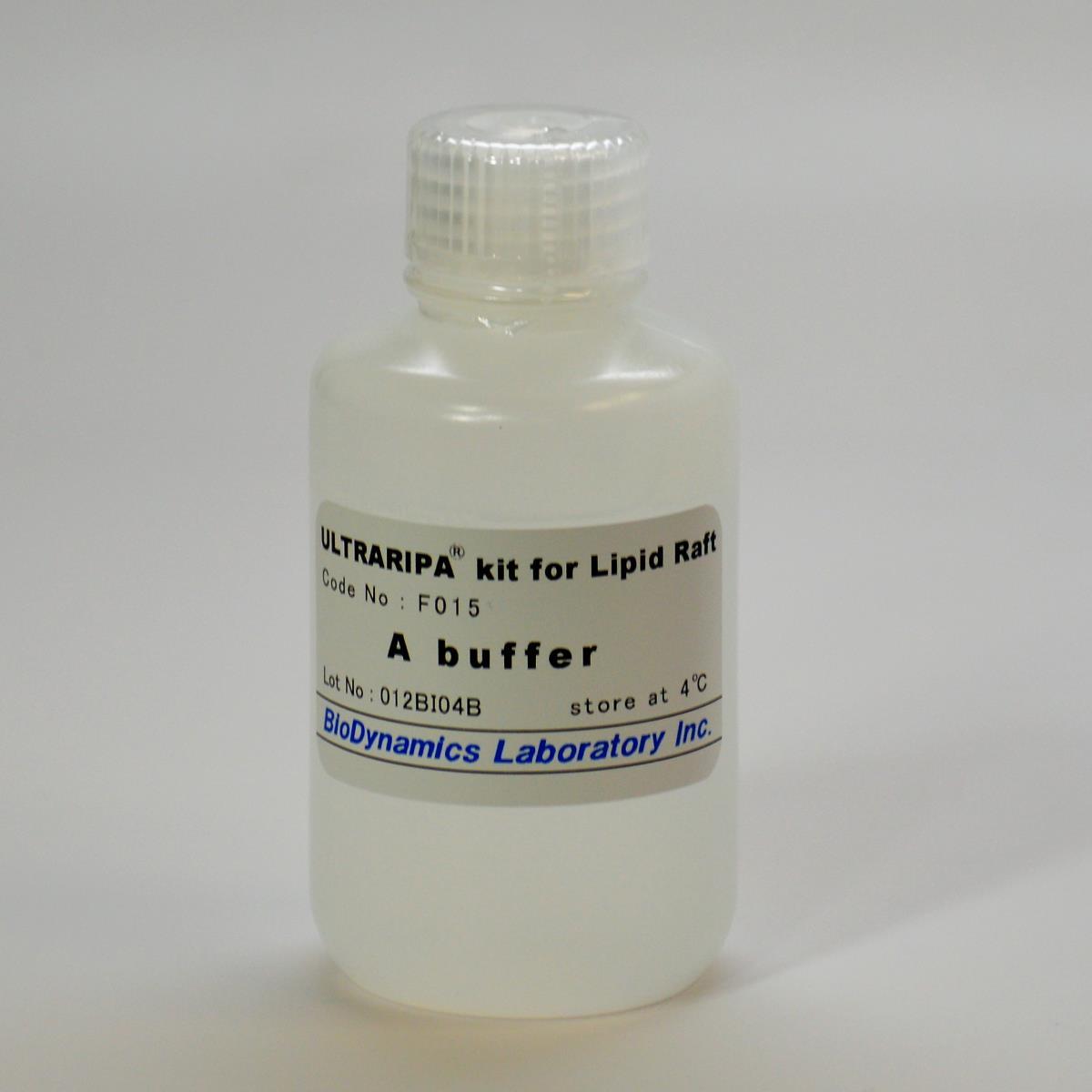
A buffer (RIPA buffer) 100 mL
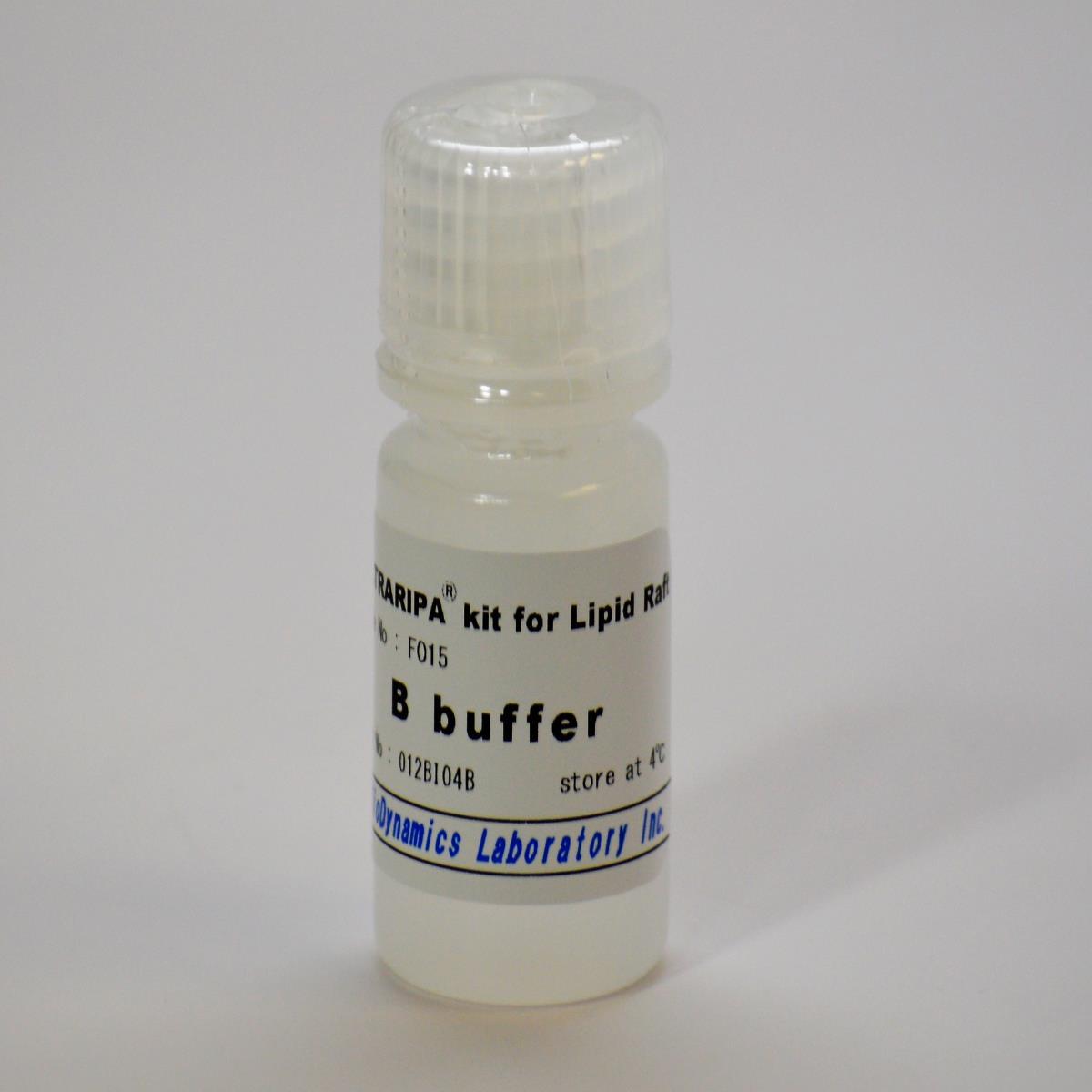
B buffer 10 mL
Store at 4oC, Product shelf life 1 year
Product ID and Size
| Cat No. | Size | Link |
| FNK-F015 | 1 Kit |  |
| FNK-F015-Trial | 1 Kit | |
Description
Next-Generation RIPA Buffer for High Efficient Membrane Protein Extraction
RIPA buffer is one of the most useful buffers for protein extraction. RIPA buffer maintains most native structures of proteins and the extracted proteins can be applied to various applications. However, RIPA buffer is not sufficient to extract membrane proteins and membrane-associated proteins concentrated in lipid raft.
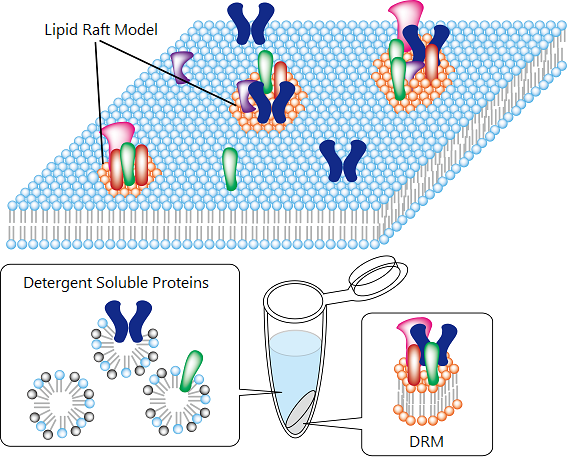
Lipid raft is a highly specialized microdomain on the lipid bilayer which contains specialized lipids, cholesterol and functional proteins. These lipid rafts are also called “Detergent Resistant Membrane (DRM)”, as lipid raft-enriched proteins are usually insoluble by mild detergent buffers such as 1% Triton X-100 and RIPA buffer. Consequently, it was difficult to analyze functions of lipid raft-enriched proteins extracted with RIPA buffer.
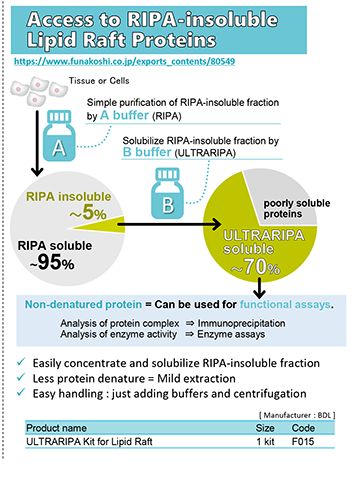
BioDynamics Laboratory's newly developed product : the UltraRIPA kit, can efficiently and rapidly extract membrane proteins or membrane-associated proteins enriched in lipid rafts with native structure and function.
UltraRIPA kit includes a totally new buffer not containing protein denaturing detergents, but can extract the DRM which was difficult to extract by conventional RIPA buffer. UltraRIPA kit helps to analyze various biological assays of the proteins in lipid raft.
Features of UltraRIPA kit
- Extract membrane / membrane associated proteins enriched in lipid rafts, with native structure and fully retained function.
- Easy and Simple Procedure : Only a centrifuge is required
- Only two components: A buffer and B buffer
Overview of Procedure
Kit components
A buffer (RIPA Buffer) : 100 mL
B buffer : 10 mL

Overview of advantages of ULTRARIPA kit
|
Protein Extraction Buffer |
Protein Extraction |
Protein Structure |
Protein Function |
Application |
||
|
Cytosolic |
Membrane |
|||||
|
Non-lipid raft |
Lipid raft |
|||||
|
> 1% SDS buffer |
|
|
|
|
|
SDS-PAGE |
|
RIPA buffer |
|
|
|
|
|
Enzymatic assay, |
|
ULTRARIPA kit |
|
|
|
|
|
|


Protein extraction efficiency of ULTRARIPA kit
 |
 |
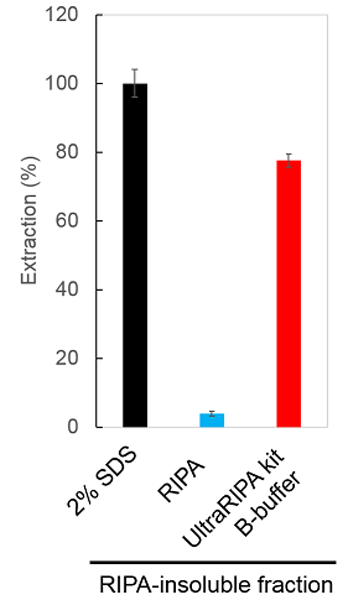
Extraction of RIPA-insoluble proteins by ULTRARIPA kit
Left : Quantification of extracted total proteins by BCA protein assay. ULTRARIPA kit could constantly extract over 70% of RIPA-insoluble proteins from the mouse brain tissue.
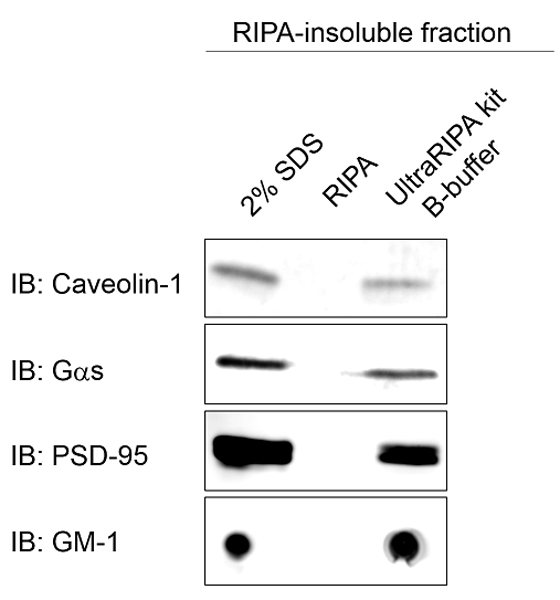
Right : Western blotting of lipid raft markers. Some lipid raft markers among proteins or a ganglioside extracted were dramatically increased in RIPA-insoluble fraction by ULTRARIPA kit.

Enzyme activity assay of proteins extracted by ULTRARIPA kit
Left : Lactate Dehydrogenase activity of proteins extracted by using 1% Triton X-100, A and B buffer. Equivalent enzyme activity are obtained when using A and B buffer.
Right: Total protein phosphatase activity. Protein extracts from RIPA-insoluble fraction of the mouse whole brain by ULTRARIPA® kit B-buffer, RIPA, and 2% SDS buffer were applied to total protein phosphatase assay. Although 2% SDS buffer completely extracted proteins, but it disrupted phosphatases. In contrast, ULTRARIPA® kit showed greatly higher activity of protein phosphatases than 2% SDS and RIPA buffer
Note
- Both A and B-buffer could not be applied to Bradford protein assay.
- Please use BCA protein assay if you would like to quantitate protein concentration.
|
Problem |
Possible Cause |
Solution |
|
Low RIPA-insoluble fraction yield |
Less of total protein Use more |
starting cells or tissues |
|
Low concentration of |
Excess buffer used |
proteins Use less buffer |
|
Degradation of proteins |
No protease inhibitors added |
Add any protease inhibitors to the both buffers before use |
Application


Reference
- Taruno A. et al., Post-translational palmitoylation controls the voltage gating and lipid raft association of CALHM1 channel. J Physiol. (2017) 595(18):6121-6145.
- Tan L. et al., Enriched expression of neutral sphingomyelinase 2 in the striatum is essential for regulation of lipid raft content and motor coordination. Mol Neurobiol. (2018) 55(7):5741-5756.
- Toyoda Y. et al., Extracellular glucose level regulates dependence on GRP 78 for cell surface localization of multipass transmembrane proteins in HeLa cells.FEBS Lett. (2018) 592(19):3295-3304.
- Araki K. et al., Mitochondrial protein E2F3d, a distinctive E2F3 product, mediates hypoxia-induced mitophagy in cancer cells. Commun Biol. (2019) 2: 3.
- Hayakawa K. et al., MicroRNA-766-3p Contributes to Anti-Inflammatory Responses through the Indirect Inhibition of NF-κB Signaling. Int J Mol Sci. (2019) 20(4): 809.
- Ding X. et al., Docosahexaenoic Acid Serving As Sensitizing Agents And Gefitinib Resistance Revertants In EGFR Targeting Treatment. Onco Targets Ther. (2019) 12: 10547–10558.
- Linden JR. et al., Clostridium perfringens epsilon toxin induces blood brain barrier permeability via caveolae-dependent transcytosis and requires expression of MAL. PLoS Pathog (2019)15(11):e1008014.
- Tsuruoka K. et al., Skin characteristics associated with foot callus in people with diabetes: A cross-sectional study focused on Desmocollin1 in corneocytes. J Tissue Viability (2020) S0965-206X(20)30077-2.
Related Products
Please, click below each image if you need more info.
 |
|
 |
 |
 |
 |
 |
|
 |
 |
