UltraClean DEPC Treated TAE Buffer, 1X
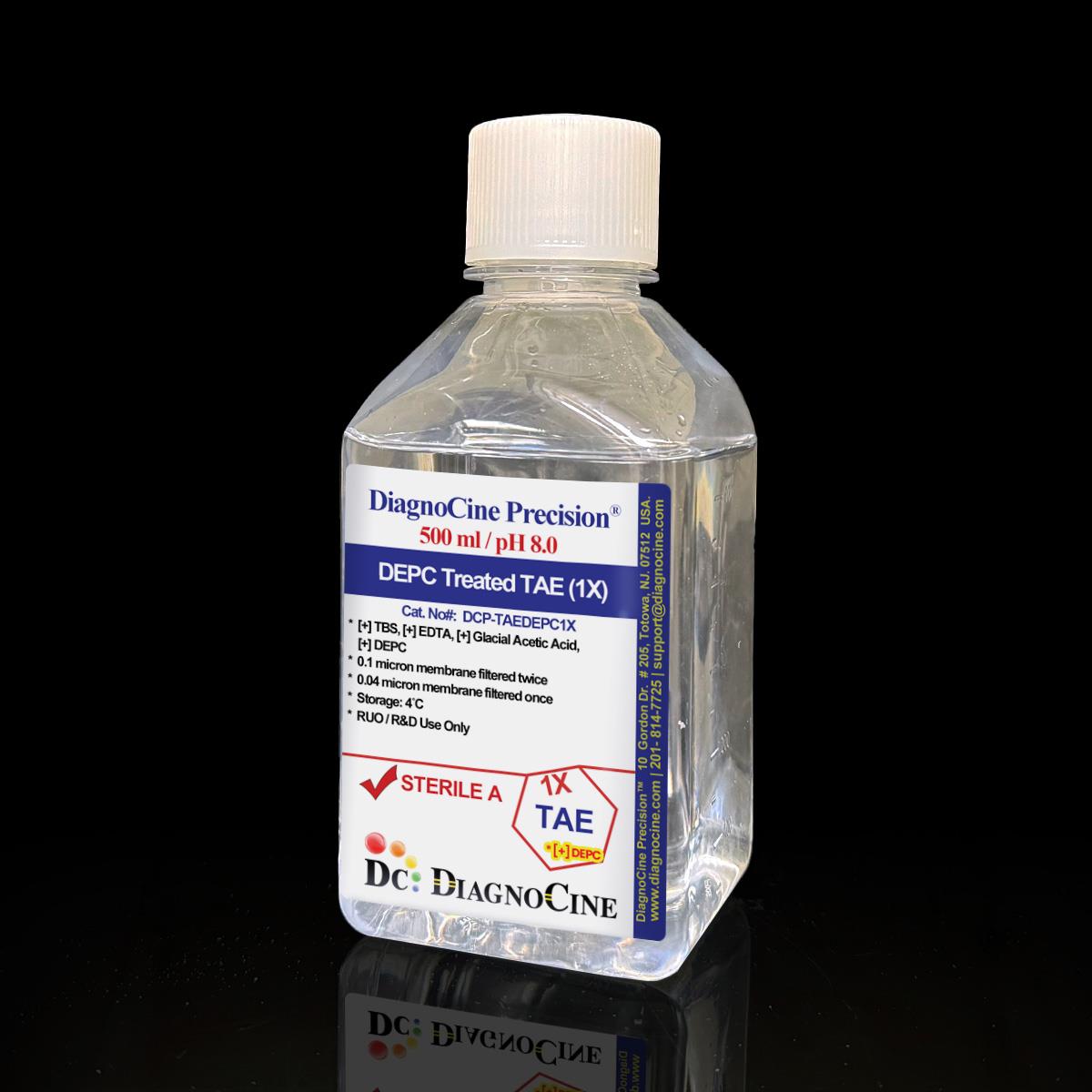
FluxMPS™ UltraClean DEPC Treated TAE Buffer, 1X
An MPS-grade, nuclease-free Tris-Acetate-EDTA (TAE) electrophoresis buffer formulated with a defined 40 mM Tris, 1 mM EDTA, and 20 mM glacial acetic acid system at pH 8.0. DEPC treatment inactivates RNase and DNase, and a quadruple-stage 0.1 µm / 0.04 µm filtration process delivers ultra-clean, microchannel-safe purity for the most sensitive nucleic acid work.
- Quadruple-stage filtration: 0.1 µm membrane (twice) and 0.04 µm membrane (twice) for ultra-clean, microchannel-safe buffer
- DEPC-treated, nuclease-free formulation inactivates RNase and DNase for sensitive RNA and DNA applications
- Precise, stable pH of 8.0 with a defined 40 mM Tris, 1 mM EDTA, 20 mM acetic acid formulation
- Prepared with DEPC-treated, nuclease-free water
- Sterile-filtered to help exclude mycoplasma-scale and microbial contaminants
- Available in 500 mL and 1000 mL sizes
- Manufactured under ISO 13485-certified, CE-approved facilities
- Custom concentrations, pH, and additive formulations available on request
- pH8.0
- FormulationTris-Acetate-EDTA (TAE), 1X
- Tris base40 mM
- EDTA1 mM
- Glacial acetic acid20 mM
- AppearanceColorless, clear solution
- SterilitySterile
- Filtration0.1 µm x2 + 0.04 µm x2
- Storage4°C
- Shelf Life24 months
Engineered where standard buffers fail
Conventional single-pass 0.22 µm-filtered buffers can carry residual particulates, uncontrolled nuclease activity, and undocumented formulation drift into sensitive electrophoresis and on-chip nucleic acid workflows. FluxMPS™ UltraClean DEPC Treated TAE Buffer is built to remove those failure modes at the source.
Microchannel-safe purity
Quadruple-stage filtration — 0.1 µm membrane twice and 0.04 µm membrane twice — reduces particulate load for clean electrophoresis runs and microfluidic-compatible nucleic acid workflows.
Precise, stable pH
Formulated to pH 8.0 with a defined 40 mM Tris, 1 mM EDTA, and 20 mM glacial acetic acid system for consistent, reproducible buffering across runs.
Nuclease-free assurance
DEPC treatment inactivates RNase and DNase, and the buffer is prepared with DEPC-treated, nuclease-free water throughout.
Low background for downstream work
A colorless, clear solution that minimizes background interference for imaging, blotting, and downstream enzymatic reactions.
Defined, traceable composition
Every component and concentration is documented and held consistent lot to lot, supporting reproducible molecular biology experiments.
Customization on demand
Alternate concentrations, additional chemicals, compounds, proteins, supplements, or a different pH can be formulated on inquiry.
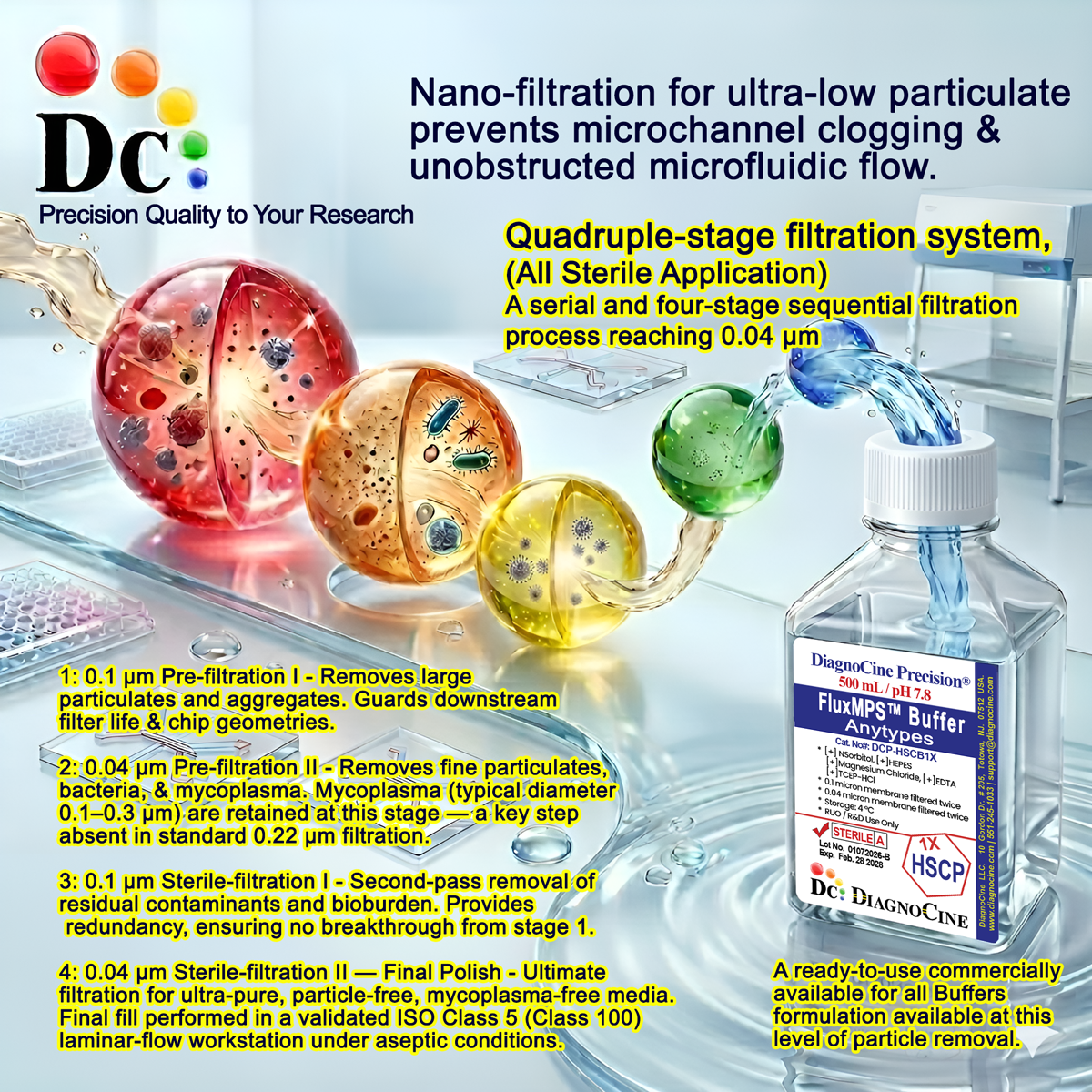
Quadruple-stage filtration system
This buffer is sterile, ultrapure, and processed through 0.1 µm membrane filtration twice and 0.04 µm membrane filtration twice, delivering the cleanest buffer platform available for cell and molecular biology experiments.
-
1
0.1 µm Pre-filtration I
Large particulate and aggregate removal, extending the life of downstream filters.
-
2
0.04 µm Pre-filtration II
Fine particulate and bioburden retention ahead of the final sterile-filtration passes.
-
3
0.1 µm Sterile-filtration I
Second-pass redundancy through a 0.1 µm membrane.
-
4
0.04 µm Sterile-filtration II — Final Polish
Ultimate polish through a second 0.04 µm membrane pass ahead of aseptic fill.
Performance vs. conventional buffer
Sequential 0.1 µm and 0.04 µm filtration — each applied twice — removes finer particulates than a single 0.22 µm pass used in conventional buffer preparations, supporting cleaner electrophoresis and nucleic acid workflows.
© Diagnocine® — DCP-TAEDEPC1X
Where UltraClean DEPC Treated TAE Buffer is used
A nuclease-free, high-purity TAE buffer built for sensitive DNA and RNA electrophoresis, blotting, and gel-based purification workflows.
Automated Bioreactors & Robotics
For automated liquid-handling platforms, robotic dispensing systems, and closed-loop molecular biology workflows, an optional 0.01 µm (10 nm) ultra-filtered variant of this DEPC-treated TAE buffer is available to further reduce particulate load in fine-bore tubing, valves, and sensors.
- Total Particulate Exclusion: 10 nm ultra-filtration limits carryover of subvisible particulates into automated dispensing lines
- Valve & Sensor Protection: reduced particulate load helps protect microvalves and inline sensors from fouling
- Extended Perfusion Stability: a cleaner buffer supports longer unattended run times in automated systems
Inquiry Required: the 0.01 µm (10 nm) ultra-filtered grade is available upon request — contact support@diagnocine.com to discuss availability for your platform.
Agarose & Polyacrylamide Gel Electrophoresis
Suitable for separation and analysis of DNA and RNA fragments, including large genomic DNA (greater than 1500 bp) and complex mixtures, on both agarose and polyacrylamide gels.
Native & Denaturing RNA Analysis
A nuclease-free environment for sensitive native and denaturing RNA work, protected from RNase and DNase degradation by DEPC treatment.
Southern Blotting
Preferred buffer for gels used in Southern blot protocols, as acetate is less inhibitory than borate for downstream applications.
Gel Preparation & Running Buffer
Used as both a running buffer and a gel preparation buffer for standard electrophoresis workflows.
Gel Purification
Favored for gel purification procedures due to minimal interference with downstream enzymatic reactions.
Micro Physiological System (MPS) & Chip Workflows
A low-background, nuclease-free buffer suited to on-chip nucleic acid handling in microfluidic and lab-on-a-chip formats.
Detailed product specifications
Physical, chemical, purity, and handling parameters for UltraClean DEPC Treated TAE Buffer, 1X.
| Parameter | Specification |
|---|---|
| Formulation | Tris-Acetate-EDTA (TAE) Buffer, 1X |
| Tris base concentration | 40 mM |
| EDTA concentration | 1 mM |
| Glacial acetic acid concentration | 20 mM |
| Appearance | Colorless, clear solution |
| pH | 8.0 |
| Parameter | Specification |
|---|---|
| Sterility | Sterile USP <71> |
| Filtration System | 0.1 µm membrane (twice) and 0.04 µm membrane (twice) |
| Nuclease Activity | DEPC-treated; RNase and DNase inactivated |
| Water Quality | DEPC-treated, nuclease-free Ultrapure Type 1 water (18.2 MΩ·cm) |
| Manufacturing Standard | ISO 13485-certified, CE-approved facility ISO 13485:2016 |
| Parameter | Specification |
|---|---|
| Storage temperature | 4°C |
| Shelf life | 24 months |
| Use guidance | Use before the expiry date given on the product label |
| Parameter | Specification |
|---|---|
| Manufacturing facility | ISO 13485-certified and CE-approved facilities (DiagnoCine Precision) |
| Final QA & testing | DiagnoCine R&D and Quality Testing Center |
| Customization & assembly location | DiagnoCine Precision, Totowa, New Jersey, USA |
| Intended use | Research Use Only (RUO) |
Full composition
Every buffer component and concentration is documented below and held consistent from lot to lot.
| Component | CAS Number | Concentration |
|---|---|---|
| Tris base | 77-86-1 | 40 mM |
| EDTA | 60-00-4 | 1 mM |
| Glacial acetic acid | 64-19-4 | 20 mM |
| Water (DEPC-treated, nuclease-free) | 7732-18-5 | To volume |
Manufacturing & compliance
UltraClean DEPC Treated TAE Buffer is manufactured, filtered, and finished under a controlled quality system.
ISO 13485:2016 QMS
Manufactured under ISO 13485-certified and CE-approved facilities (Suppliers of DiagnoCine Precision).
DEPC-Treated Nuclease-Free Water
Prepared with DEPC-treated, nuclease-free water to protect RNA and DNA samples during electrophoresis.
Sterile Filtration & Quality Testing
Quadruple-stage 0.1 µm / 0.04 µm filtration with final packaging, quality assurance, and testing performed at the DiagnoCine R&D and Quality Testing Center.
Custom Formulation Precision
Specific customization requests and assembly are accomplished at DiagnoCine Precision in Totowa, New Jersey, USA.
Sterility Verification
Sterile, colorless, clear solution confirmed at pH 8.0 by quality control.
Nuclease Activity Testing
DEPC treatment inactivates RNase and DNase, confirming a nuclease-free buffer.
Mycoplasma Contamination Prevention
Quadruple-stage 0.1 µm and 0.04 µm filtration (each applied twice) is designed to help prevent mycoplasma contamination.
Documentation & CoA
A Certificate of Analysis can be requested for this lot.
How DCP-TAEDEPC1X compares
A side-by-side look at the filtration architecture and formulation transparency of UltraClean DEPC Treated TAE Buffer against conventional buffer preparations.
| Parameter | DCP-TAEDEPC1X (FluxMPS™) | Conventional Buffer (0.22 µm filtered) | Standard Alternative (0.22 µm filtered) |
|---|---|---|---|
| Filtration architecture | 0.1 µm x2 + 0.04 µm x2 | Single 0.22 µm pass | Single 0.22 µm pass |
| Total filtration stages | 4 | 1 | 1 |
| DEPC treatment / nuclease-free | check_circle | cancel | cancel |
| Documented mM formulation | check_circle | cancel | cancel |
| Water quality | DEPC-treated Ultrapure Type 1 (18.2 MΩ·cm) | Standard purified water | Standard purified water |
| Manufacturing QMS | ISO 13485-certified | cancel | cancel |
| Custom formulation available | check_circle | cancel | cancel |
Frequently asked questions
Answers to common questions about UltraClean DEPC Treated TAE Buffer, 1X.
Supporting literature
Background literature on TAE buffer chemistry, RNase/DNase inactivation, gel electrophoresis, and microfluidic nucleic acid workflows.
- Sambrook J, Russell DW. Molecular Cloning: A Laboratory Manual. Gel electrophoresis of DNA and TAE/TBE buffer systems. doi:10.1101/pdb.top096982
- Voytas D. Agarose gel electrophoresis. Curr Protoc Mol Biol. doi:10.1002/0471142727.mb0205as51
- Blumberg DD. Creating a ribonuclease-free environment. Methods Enzymol. doi:10.1016/0076-6879(87)52014-1
- Ehresmann C, et al. Probing the structure of RNAs in solution. Nucleic Acids Res. doi:10.1093/nar/15.22.9109
- Brody JR, Kern SE. History and principles of conductive media for standard DNA electrophoresis. Anal Biochem. doi:10.1016/j.ab.2004.02.021
- Southern EM. Detection of specific sequences among DNA fragments separated by gel electrophoresis. J Mol Biol. doi:10.1016/S0022-2836(75)80083-0
- Bhatia SN, Ingber DE. Microfluidic organs-on-chips. Nat Biotechnol. doi:10.1038/nbt.2989
- Huang Y, et al. Buffer effects on nucleic acid mobility and resolution in gel electrophoresis. Electrophoresis. doi:10.1002/elps.201800345
- Ho CT, et al. Microfluidic devices for nucleic acid analysis from purification to detection. Micromachines. doi:10.3390/mi11070646