

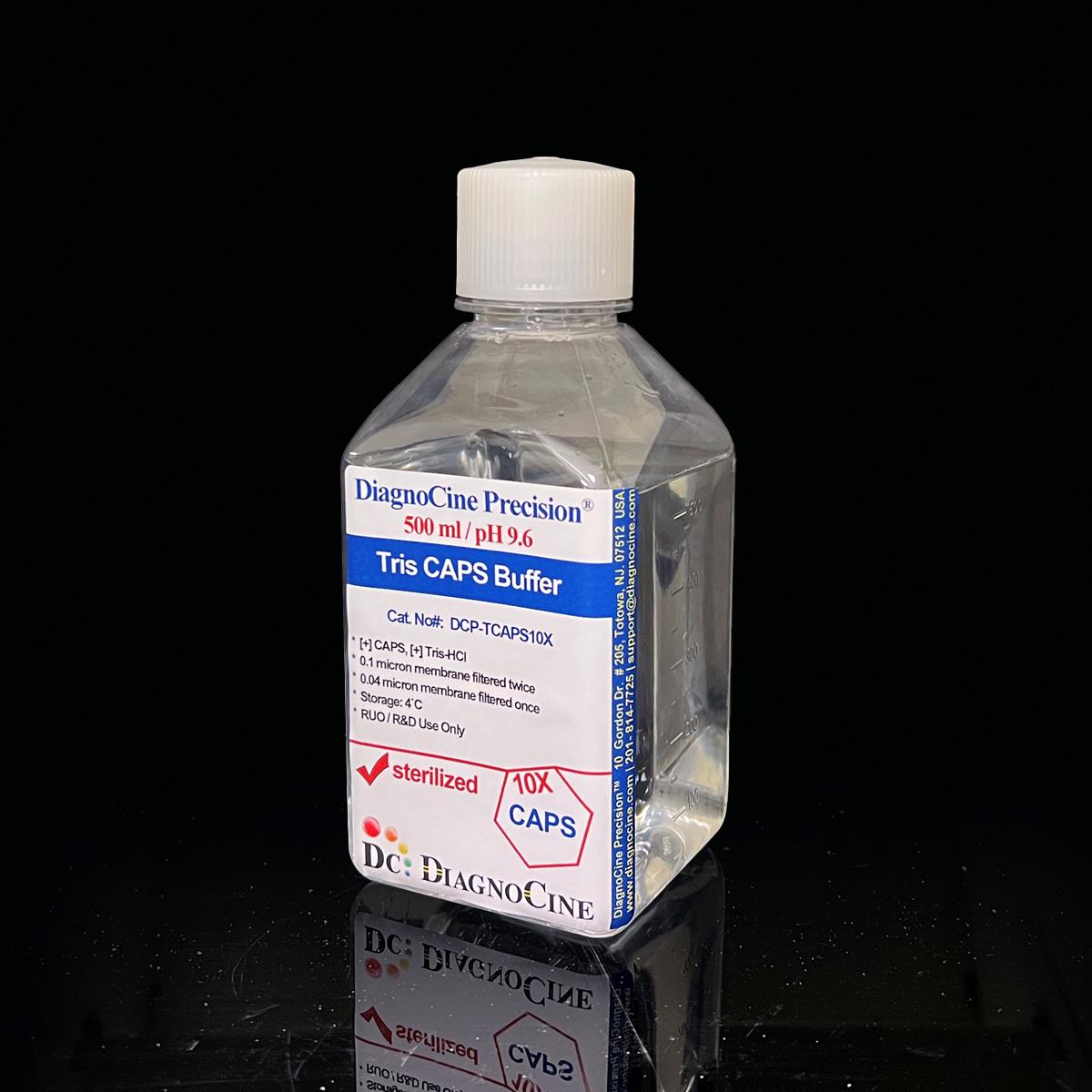
Tris CAPS buffer 10X
FluxMPS™ Tris CAPS Buffer 10X
An MPS-grade, quadruple-stage filtered Tris-CAPS transfer buffer formulated to pH 9.6 with a defined 60 mM Tris base / 40 mM CAPS system. Sterile-filtered to a 0.04 µm final pore size and verified DNase- and RNase-free, it is built for semi-dry blotting and other molecular biology workflows that demand low-particulate, microchannel-safe reagents.
- Quadruple-stage filtration: 0.1 µm membrane twice and 0.04 µm membrane twice for an ultra-clean, sterile buffer
- Defined Tris-CAPS chemistry: 60 mM Tris base and 40 mM CAPS at pH 9.6, optimized for semi-dry blotting transfer
- DNase- and RNase-free, verified after 18-hour incubation at room temperature
- Sterile-filtered in a controlled, sterile environment for molecular and cell biology use
- ISO 13485-certified, CE-approved manufacturing with final QA at the Diagnocine R&D and Quality Testing Center
- Available in 500 mL and 1000 mL sizes
- Custom pH, concentration, and additive formulations available on request
- pH9.6
- Molarity / ConcentrationTris base 60 mM; CAPS 40 mM
- Buffer SystemTris-CAPS (discontinuous transfer buffer)
- Filtration0.1 µm x2 + 0.04 µm x2
- SterilityFiltered in a sterile environment
- DNase ActivityNone detected
- RNase ActivityNone detected
- AppearanceClear, colorless liquid
- Storage4°C
- Shelf Life1 year
Engineered where standard buffers fail
Conventional 0.22 µm-filtered transfer buffers can leave behind subvisible particulates, carry variable pH and bioburden, and introduce background into sensitive downstream detection. DCP-TCAPS10X is built to remove those variables from your semi-dry blotting protocol.
Microchannel-safe purity
Quadruple-stage filtration down to a 0.04 µm final pore size removes particulates that a single-pass 0.22 µm filter cannot.
Precise, stable pH
Formulated to pH 9.6 with a defined 60 mM Tris base / 40 mM CAPS system, giving semi-dry blotting protocols a consistent, reproducible transfer environment.
Ultrapure-grade water
Manufactured with Ultrapure Type 1 water (18.2 MΩ·cm), reducing background contamination in sensitive assays.
Low background for imaging & assays
A clear, colorless composition and verified DNase-/RNase-free status keep background interference out of downstream blotting, imaging, and detection steps.
Defined, traceable composition
Tris base and CAPS are each listed with an exact concentration, so transfer performance is reproducible from lot to lot.
Customization on demand
Alternate pH, molarity, or additive content — including methanol or SDS supplementation — can be formulated on request.
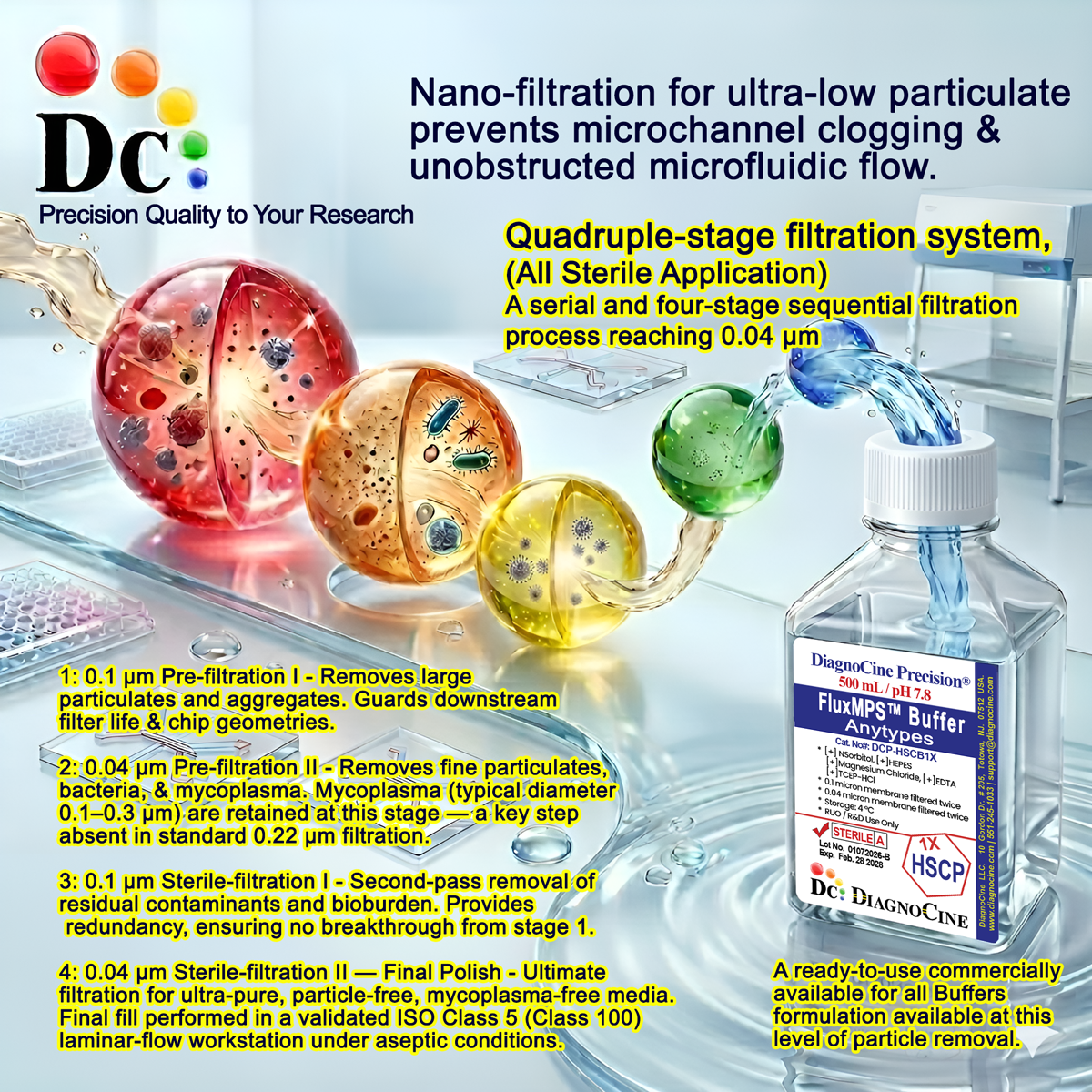
Quadruple-stage filtration system
DCP-TCAPS10X is sterile-filtered through a four-step, quadruple-stage architecture — two passes through a 0.1 µm membrane and two passes through a 0.04 µm membrane — before it reaches your gel or membrane.
-
1
0.1 µm Pre-filtration I
First 0.1 µm membrane pass removes large particulates and aggregates, protecting downstream filters.
-
2
0.04 µm Pre-filtration II
First 0.04 µm membrane pass retains fine particulates and bioburden, including organisms in the mycoplasma size range (approximately 0.2 micron).
-
3
0.1 µm Sterile-filtration I
Second 0.1 µm membrane pass adds redundancy to the sterilizing filtration train.
-
4
0.04 µm Sterile-filtration II — Final Polish
Second 0.04 µm membrane pass is the final polish, completed in a sterile environment prior to fill.
Performance vs. conventional buffer
Sequential 0.1 µm and 0.04 µm filtration, repeated twice each, removes finer particulates than a single 0.22 µm pass used in conventional transfer buffer.
© Diagnocine® — DCP-TCAPS10X
Built for semi-dry protein transfer — and beyond
Tris-CAPS Transfer Buffer is a specialized discontinuous buffer system used primarily in semi-dry blotting for Western blot applications, transferring proteins efficiently from polyacrylamide gels to membranes. In this discontinuous system, methanol (typically 15% v/v) is added on the anode side to strip SDS and promote protein binding to the membrane, while SDS (0.1%) is added on the cathode side to facilitate protein migration out of the gel. The higher pH of this buffer (9.6) makes it well suited to transferring basic proteins that may transfer less effectively with other buffer systems. As with any transfer buffer, optimization may be required depending on the specific proteins, membranes, and semi-dry blotting apparatus used.
Automated Bioreactors & Robotics
For automated dispensing systems and robotic liquid handlers, an optional 0.01 µm (10 nm) ultra-filtered variant can be formulated to further protect valves, sensors, and microfluidic channels from residual particulates.
- Total Particulate Exclusion — finer filtration for automated fluid paths
- Valve & Sensor Protection — reduces particulate load on precision hardware
- Extended Perfusion Stability — supports longer unattended run times
Inquiry Required: the 0.01 µm (10 nm) grade is available as a custom order — contact support@diagnocine.com.
Micro Physiological System (MPS) & Chip
Ultra-filtered, low-particulate formulation compatible with microfluidic protein-analysis workflows.
Dilution & Reconstitution
As a 10X concentrate, DCP-TCAPS10X is diluted to working strength for semi-dry transfer setup.
iPSC-Derived Model Handling
Supports Western blot analysis of proteins isolated from iPSC-derived cell models.
Endothelial & Primary Cell Analysis
Used for transfer of proteins from endothelial and primary cell lysates during blotting workflows.
Semi-Dry Blotting & Protein Transfer
Purpose-built discontinuous Tris-CAPS system for semi-dry Western blot transfer of proteins across a broad molecular weight range, including basic proteins.
Downstream Detection Compatibility
Clear, colorless, low-background formulation supports clean downstream chemiluminescent and fluorescent detection of transferred proteins.
Specification summary
Values reflect the release specification for DCP-TCAPS10X as documented by Diagnocine.
| Parameter | Specification |
|---|---|
| Formulation / Composition | Tris base 60 mM; CAPS 40 mM |
| Appearance | Clear, colorless liquid |
| pH (USP <791>) | 9.6 |
| Parameter | Specification |
|---|---|
| Sterility | Filtered 0.1 µm membrane twice and 0.04 µm membrane twice in a sterile environment USP <71> |
| DNase Activity | None detected (18 hr, room temperature, plasmid DNA) |
| RNase Activity | None detected (18 hr, room temperature, ribosomal RNA) |
| Water Purity | Ultrapure Type 1 water (18.2 MΩ·cm) USP <85> |
| Manufacturing Standard | ISO 13485:2016; CE-approved ISO 13485 |
| Fill Environment | ISO Class 5 (Class 100) |
| Parameter | Specification |
|---|---|
| Storage Temperature | 4°C |
| Shelf Life | 1 year |
| Parameter | Specification |
|---|---|
| Manufacturing Facility | ISO 13485-certified, CE-approved supplier facilities (Diagnocine Precision) |
| Final QA & Packaging | Diagnocine R&D and Quality Testing Center |
| Custom Assembly Location | Diagnocine Precision, Totowa, New Jersey, USA |
| Intended Use | For Research Use Only (RUO) |
Full composition
DCP-TCAPS10X is built on a Tris base / CAPS buffering system, release-tested to the concentrations below.
| Component | CAS Number | Concentration |
|---|---|---|
| Tris base | 77-86-1 | 60 mM |
| CAPS | 1135-40-6 | 40 mM |
Manufacturing & compliance
DCP-TCAPS10X is manufactured, filtered, and packaged under a documented quality system.
ISO 13485:2016 QMS
Manufactured under an ISO 13485-certified, CE-approved quality system.
Ultrapure Type 1 Water
Formulated with Ultrapure Type 1 water (18.2 MΩ·cm) to minimize background contamination.
ISO Class 5 Fill & Finish
Final sterile filtration and fill are completed in a controlled, sterile environment.
Micro-Batch Precision
Final packaging, quality assurance, and custom assembly are completed at the Diagnocine R&D and Quality Testing Center in Totowa, New Jersey, USA.
Endotoxin (USP <85> BET)
Testing methodology available; contact support@diagnocine.com for current lot-specific results.
Particulate (USP <788> Method 2)
Sub-visible particulate control achieved via quadruple-stage 0.1 µm / 0.04 µm filtration; contact support for lot-specific data.
Osmolality (USP <785>)
Testing methodology available; contact support@diagnocine.com for lot-specific data.
Documentation / CoA
Certificate of Analysis available upon request.
How DCP-TCAPS10X compares
A side-by-side look at filtration architecture and quality controls versus conventional transfer buffers.
| Parameter | DCP-TCAPS10X (FluxMPS™) | Conventional Transfer Buffer | Standard Alternative |
|---|---|---|---|
| Final filtration pore size | 0.04 µm | 0.22 µm | 0.22 µm |
| Number of filtration stages | 4 | 1 | 1 |
| DNase / RNase tested | check_circle | cancel | cancel |
| Sterile-filtered environment | check_circle | cancel | check_circle |
| Manufacturing QMS | ISO 13485:2016 | Unspecified | Unspecified |
| Custom formulation | check_circle | cancel | cancel |
Frequently asked questions
Common questions about DCP-TCAPS10X.
Supporting literature
Curated references relevant to Tris-CAPS transfer buffer chemistry and semi-dry blotting technique.
- Towbin H, Staehelin T, Gordon J. Electrophoretic transfer of proteins from polyacrylamide gels to nitrocellulose sheets. doi:10.1073/pnas.76.9.4350
- Kyhse-Andersen J. Electroblotting of multiple gels: a simple apparatus without buffer tank for rapid transfer of proteins from polyacrylamide to nitrocellulose. doi:10.1016/0165-022X(84)90063-4
- Matsudaira P. Sequence from picomole quantities of proteins electroblotted onto polyvinylidene difluoride membranes. doi:10.1016/S0021-9258(18)61070-1
- Bolt MW, Mahoney PA. High-efficiency blotting of proteins of diverse sizes following sodium dodecyl sulfate-polyacrylamide gel electrophoresis. doi:10.1006/abio.1997.2299
- Mahmood T, Yang PC. Western blot: technique, theory, and trouble shooting. doi:10.4103/1947-2714.100998
- Bass JJ, et al. An overview of technical considerations for Western blotting applications to physiological research. doi:10.1111/sms.12702
- Whitesides GM. The origins and the future of microfluidics. doi:10.1038/nature05058
- Uphoff CC, Drexler HG. Detection of Mycoplasma contamination in cell cultures. doi:10.1002/0471142727.mb2804s106