Tris Borate EDTA Running Buffer [10X]
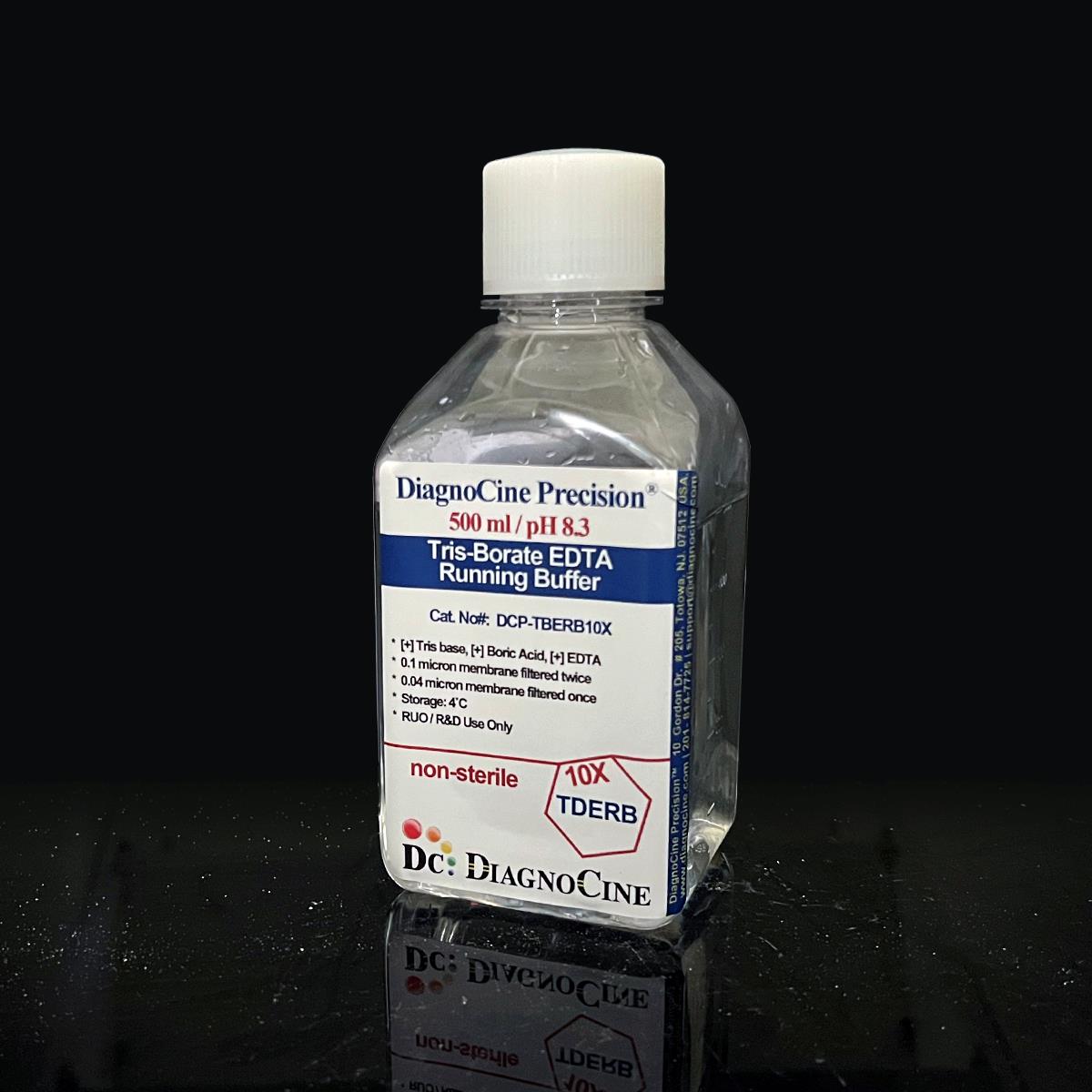
FluxMPS™ Tris Borate EDTA Running Buffer [10X]
FluxMPS™ Tris Borate EDTA Running Buffer [10X] is a precise, pH 8.3, high-buffering-capacity 10X TBE concentrate built for gel electrophoresis of DNA and RNA. Quadruple-stage 0.1 µm and 0.04 µm membrane filtration reduces particulate load, while defined Tris base, boric acid, and EDTA molarity deliver run-to-run reproducibility across agarose and polyacrylamide gels, Northern blotting, and DNA cloning workflows.
- Quadruple-stage filtration — 0.1 µm membrane twice and 0.04 µm membrane twice — for ultra-low particulate TBE buffer
- Defined 10X buffering system: 0.89 M Tris base, 0.89 M boric acid, 0.02 M EDTA at pH 8.3
- EDTA chelation protects nucleic acids from nuclease-mediated degradation during electrophoresis
- Manufactured with Ultrapure Type 1 water (18.2 MΩ·cm)
- Non-sterile formulation, filtered in a controlled but non-sterile environment for standard molecular biology use
- No detectable DNase or RNase activity after 18 hr incubation at room temperature
- Available in 500 mL and 1000 mL sizes
- Custom concentrations, pH, and additive formulations available on request
- pH8.3
- Molarity (Tris base)0.89 M
- Molarity (Boric acid)0.89 M
- Molarity (EDTA)0.02 M
- Concentration10X
- AppearanceClear, Colorless Liquid
- SterilityNon-sterile
- Filtration0.1 µm x2 + 0.04 µm x2
- Storage4°C
- Shelf Life2 years
Engineered where standard TBE buffer falls short
Conventional 0.22 µm-filtered running buffer can carry subvisible particulates, inconsistent pH, and undisclosed molarity that drift electrophoretic mobility and background signal across runs. FluxMPS™ buffer is manufactured to a defined molarity and filtration architecture so results stay reproducible from lot to lot.
Microchannel-safe purity
Final 0.04 µm membrane pass reduces particulate load beyond a single 0.22 µm filtration step.
Precise, stable pH
Defined pH 8.3 buffering system with high buffering capacity for stable conditions throughout electrophoresis runs.
Ultrapure-grade water
Formulated with Ultrapure Type 1 water (18.2 MΩ·cm) for a clean aqueous background.
Low background for imaging & assays
Clear, colorless liquid with no detectable DNase or RNase activity keeps nucleic acid bands and blots clean.
Defined, traceable composition
0.89 M Tris base, 0.89 M boric acid, and 0.02 M EDTA at 10X concentration, disclosed in full.
Customization on demand
Alternate concentrations, pH, or added chemicals/compounds/proteins/supplements available on request.
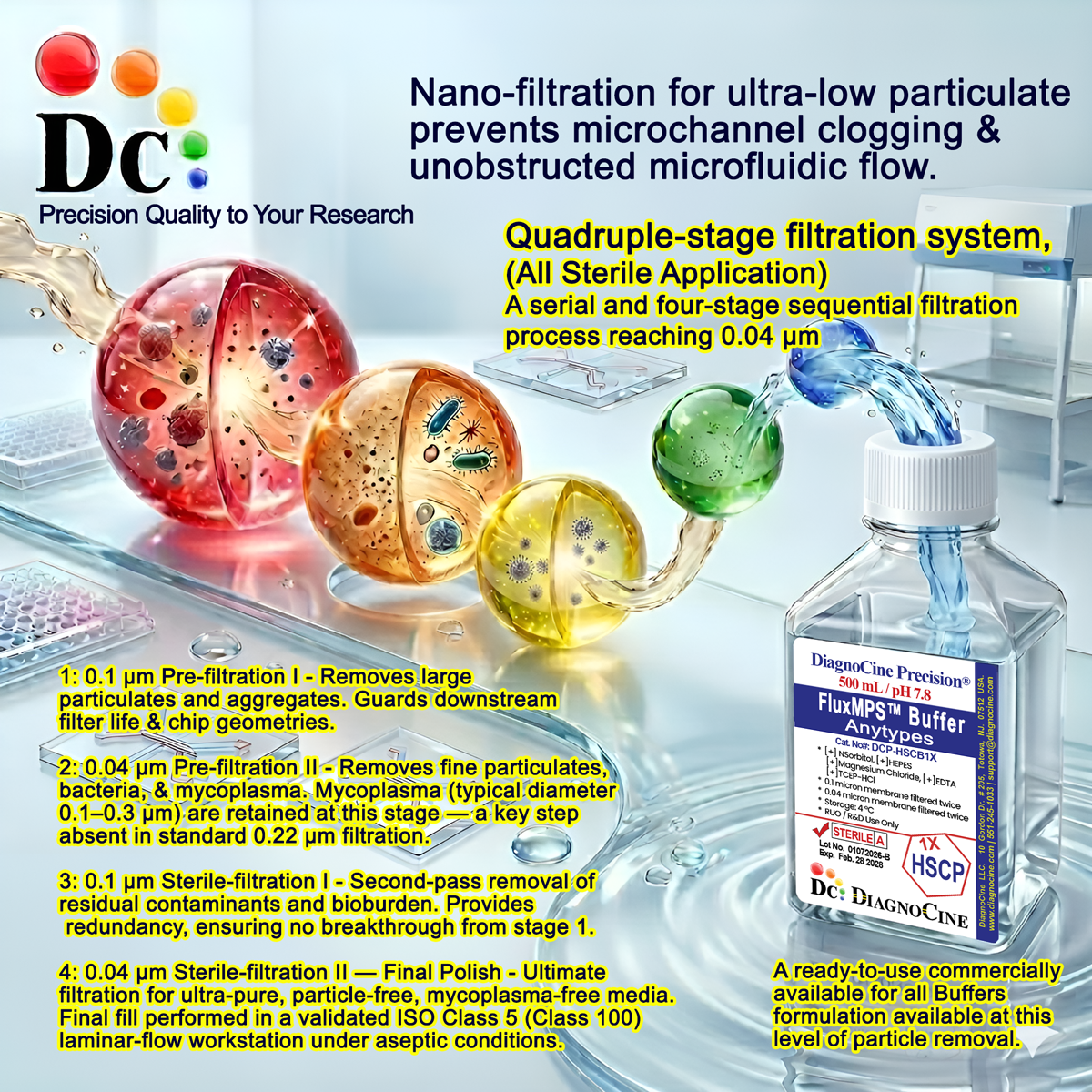
Quadruple-stage filtration system
DCP-TBERB10X is filtered 0.1 µm membrane twice and 0.04 µm membrane twice, removing fine particulates before final fill in a non-sterile environment suited to standard gel electrophoresis workflows.
-
1
0.1 µm Pre-filtration I
Large particulate and aggregate removal, extending the life of downstream filters.
-
2
0.04 µm Pre-filtration II
Fine particulate and bioburden retention ahead of the second filtration pass.
-
3
0.1 µm Sterile-filtration I
Second-pass redundancy through a 0.1 µm membrane.
-
4
0.04 µm Sterile-filtration II — Final Polish
Second 0.04 µm membrane pass for the finest particulate polish this architecture provides.
Performance vs. conventional buffer
Sequential 0.1 µm (x2) and 0.04 µm (x2) filtration removes finer particulates than a single 0.22 µm pass, supporting a cleaner background for downstream nucleic acid electrophoresis and blotting.
© Diagnocine® — DCP-TBERB10X
Where DCP-TBERB10X is used
A defined, quadruple-filtered 10X TBE running buffer built for nucleic acid electrophoresis and related molecular biology workflows, including automated liquid-handling and lab-on-a-chip formats.
Automated Bioreactors & Robotics
For automated liquid-handling and high-throughput electrophoresis platforms, an optional 0.01 µm (10 nm) ultra-filtered variant is available on request.
- Total Particulate Exclusion — minimizes fine particulate carry-over in automated fluid paths
- Valve & Sensor Protection — reduces particulate accumulation on automated dispensing hardware
- Extended Perfusion Stability — supports consistent buffer delivery in continuous-run systems
Inquiry Required: the 0.01 µm ultra-filtered grade is available by request — contact support@diagnocine.com.
Gel Electrophoresis of Nucleic Acids
Running buffer for separating DNA or RNA fragments in agarose or polyacrylamide gels.
Native & Denaturing RNA Analysis
Compatible with both native (non-denaturing) and denaturing RNA electrophoretic analysis.
DNA Cloning Workflows
Supports gel-based verification steps within DNA cloning experiments.
Lab-on-a-Chip Nucleic Acid Separation
High-buffering-capacity chemistry suited to microchannel and chip-based electrophoresis formats.
Northern Blotting Support
Formulated to support RNA transfer and detection workflows following gel separation.
Nuclease-Protected Sample Handling
EDTA chelation of divalent cations helps protect nucleic acid samples from nuclease activity during runs.
Full specification sheet
Every value below is measured or declared for DCP-TBERB10X as manufactured.
| Parameter | Specification |
|---|---|
| Formulation | 10X Tris Borate EDTA (TBE) Running Buffer |
| Appearance | Clear, Colorless Liquid |
| pH USP <791> | 8.3 |
| Molarity (Tris base) | 0.89 M |
| Molarity (Boric acid) | 0.89 M |
| Molarity (EDTA) | 0.02 M |
| Concentration | 10X |
| Parameter | Specification |
|---|---|
| Sterility | Non-sterile (filtered in a non-sterile environment) |
| Filtration | 0.1 µm membrane (x2) and 0.04 µm membrane (x2) |
| DNase Activity | None detected after 18 hr incubation with plasmid DNA at room temperature |
| RNase Activity | None detected after 18 hr incubation with ribosomal RNA at room temperature |
| Water Purity | Ultrapure Type 1 water (18.2 MΩ·cm) |
| Manufacturing Standard ISO 13485 | ISO 13485-certified, CE-approved facility |
| Parameter | Specification |
|---|---|
| Storage Temperature | 4°C |
| Shelf Life | 2 years |
| Parameter | Specification |
|---|---|
| Raw Material Grade | Molecular-biology-grade Tris base, boric acid, and EDTA |
| Manufacturing QMS ISO 13485 | ISO 13485-certified facility |
| Regulatory Alignment | CE-approved manufacturing facility |
| Production Method | Final packaging, QA, and testing at the DiagnoCine R&D and Quality Testing Center; customization and assembly at DiagnoCine Precision, Totowa, New Jersey, USA |
| Intended Use | Research Use Only (RUO) |
Full composition
10X Tris Borate EDTA (TBE) buffer formulation, disclosed component by component.
| Component | CAS Number | Concentration |
|---|---|---|
| Tris base | 77-86-1 | 0.89 M |
| Boric acid | 10043-35-3 | 0.89 M |
| EDTA | 60-00-4 | 0.02 M |
Manufacturing & compliance
Manufactured under ISO 13485-certified and CE-approved facilities, with final packaging, QA, and testing performed at the DiagnoCine R&D and Quality Testing Center.
ISO 13485:2016 QMS
Manufactured under an ISO 13485-certified quality management system.
Ultrapure Type 1 Water
Formulated with Ultrapure Type 1 water (18.2 MΩ·cm).
CE-Approved Manufacturing
Produced at supplier facilities that are CE-approved (Suppliers of DiagnoCine Precision).
Micro-Batch Precision
Customization requests and assembly are accomplished at DiagnoCine Precision in Totowa, New Jersey, USA.
DNase Activity Testing
None detected after incubation of plasmid DNA with this product for 18 hr at room temperature.
RNase Activity Testing
No RNase activity detected after incubation of ribosomal RNA with this product for 18 hr at room temperature.
pH Verification USP <791>
Confirmed at pH 8.3.
Documentation / CoA
A Certificate of Analysis is available on request.
How DCP-TBERB10X compares
A side-by-side look at filtration architecture and disclosed composition versus conventional TBE buffer options.
| Parameter | DCP-TBERB10X (FluxMPS™) | Conventional TBE Buffer (0.22 µm filtered) | Standard Alternative (unfiltered / lab-prepared) |
|---|---|---|---|
| Final filtration pore size | 0.04 µm | 0.22 µm | Not filtered |
| Number of filtration stages | 4 | 1 | 0 |
| Defined component molarity | Tris 0.89 M / Boric acid 0.89 M / EDTA 0.02 M | Variable, not always disclosed | Variable, not always disclosed |
| DNase & RNase tested | check_circle | cancel | cancel |
| Water quality | Ultrapure Type 1 (18.2 MΩ·cm) | Type 2 water | Tap/DI water |
| Manufacturing QMS | ISO 13485:2016 | cancel | cancel |
| Microchannel / microfluidic compatibility | check_circle | cancel | cancel |
| Custom formulation available | check_circle | cancel | cancel |
Frequently asked questions
Common questions about DCP-TBERB10X Tris Borate EDTA Running Buffer [10X].
Supporting literature
Curated literature on TBE buffer chemistry, EDTA chelation, and nucleic acid gel electrophoresis.
- Sambrook J, Russell DW. Molecular Cloning: A Laboratory Manual, 3rd ed. Cold Spring Harbor Laboratory Press; 2001. doi:10.1101/pdb.top089110
- McDonell MW, Simon MN, Studier FW. Analysis of restriction fragments of T7 DNA and determination of molecular weights by electrophoresis in neutral and alkaline gels. J Mol Biol. 1977. doi:10.1016/0022-2836(77)90052-3
- Voytas D. Agarose Gel Electrophoresis. Curr Protoc Mol Biol. 2000. doi:10.1002/0471142727.mb0205as51
- Brody JR, Kern SE. History and principles of conductive media for standard DNA electrophoresis. Anal Biochem. 2004. doi:10.1016/j.ab.2004.04.031
- Stellwagen NC. Electrophoresis of DNA in agarose gels, polyacrylamide gels and in free solution. Electrophoresis. 2009. doi:10.1002/elps.200900068
- Lee PY, Costumbrado J, Hsu CY, Kim YH. Agarose gel electrophoresis for the separation of DNA fragments. J Vis Exp. 2012. doi:10.3791/3923
- Nchinda AT, Uludag H. EDTA and chelation chemistry in nucleic acid stabilization. Curr Protoc Nucleic Acid Chem. 2005. doi:10.1002/0471142700.nc0902s21
- Sant KE, et al. Comparative evaluation of TAE and TBE buffer systems for DNA electrophoresis. Electrophoresis. 2011. doi:10.1002/elps.201100109
- Kim D, et al. Microfluidic gel electrophoresis for nucleic acid analysis on lab-on-a-chip platforms. Lab Chip. 2016. doi:10.1039/C6LC00243A